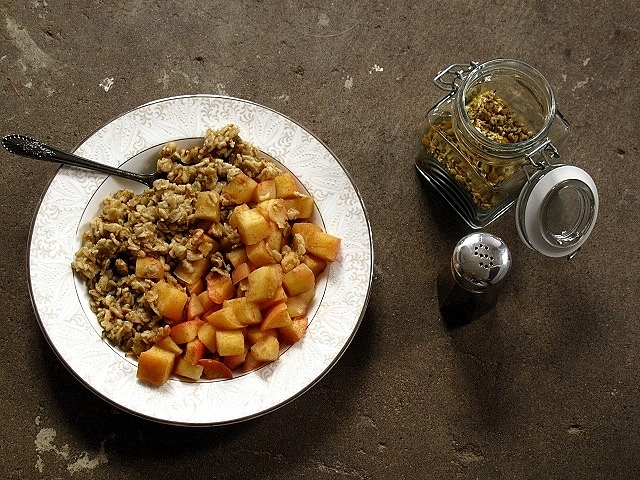
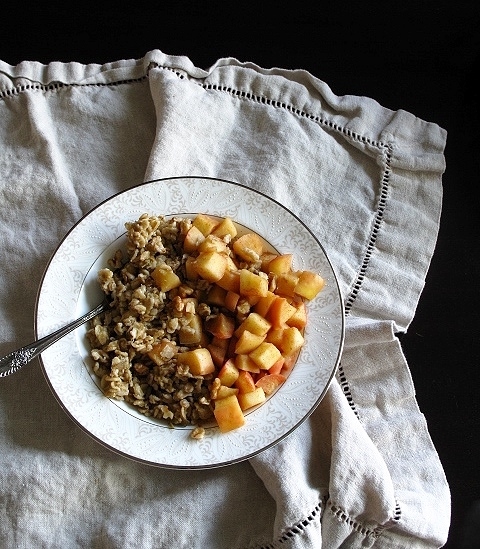
toasted oat porridge with chamomile, walnuts + spiced apples

toasted oat porridge with chamomile, walnuts + spiced apples

img_1092

Everything is connected here…the soil feeds the plants that feed us. We are merely the walking, talking result of that connection.
– Lora Lea Misterly


I tend to share the same old stories here, I’m sure, but one of the big turning points in my relationship with food was marked by my visit to Quillasascut Farm School back in 2009. The week of cooking, harvesting, and gathering with like-minded young folk was put on as part of a Slow Food Youth workshop. I was the only “experienced” farm girl among the participants, and I was chosen in part because I come from a conventional agriculture background while the teachings and discussions were in line with Slow Food’s philosophy of food that is good, clean, and fair. At the time, I had just wrapped up spending 18 days straight working wheat harvest which entailed driving a combine for 12 hours a day across soil that was essentially devoid of life–save that wheat. The experience was a good one and I worked for a great family but I was beginning to put the pieces of our food and health systems together.


img_1105


I don’t think the week at Quillasascut changed any of my viewpoints on food necessarily, but through it I was able to move away from hyper-focusing on what any one food was doing to me individually and instead look at it from a broader lens, taking into consideration the communal and ecological connections to what I was eating. I was able to move away from thinking of myself as just an eater and realized I play a vital part in this connection within our vast food system. When I began to take into consideration and participate in more of the story behind my food, where did it grow, in what conditions, by who, were the people that grew it compensated fairly?, what role do I play?, I stopped worrying so much about the things that do not matter, i.e. exactly how many calories are in my meals, how I can control my body, etc., and just eat with joy, mindfully. To be sure, I’ve had a volatile last few years in terms of my relationship to food and body image, but each time I begin to overthink and hyper analyze, I’m usually brought back into better relationship by refocusing on the communal and broader connection aspects of eating.
 

img_1054


This month, The Recipe Redux challenged us to pull out one of our cookbooks and share a reduxed recipe. In similar, past challenges, I have shared recipes from my favorite blogger family. This year, I instead pulled down Quillasascut’s cookbook, Chefs on the Farm. 

The book is beautiful, and though many of the recipes bring back warm memories since they are ones myself and the workshop participants made there with chef Karen Jurgensen, the book contains much more than recipes. Each season is marked with a reflection by farmer Lora Lea or her husband Rick about life on the farm as well as knowledge of sustainability practices that can be incorporated, no matter the location, or lack of farm.


img_1049


Today’s recipe is adapted from a chamomile porridge in the Winter section of Chefs on the Farm. Both chamomile and oats have relaxing properties that soothe the nerves and set us up for a more grounded day. Chamomile is also useful for soothing an anxious, hyped-up, or perhaps overworked stomach and digestive system, which may be needed this time of year. Along with omega-3 rich toasted walnuts, the oats and chamomile combine to make a truly delightful and nourishing breakfast option during this holiday season. Enjoy the combination on its own, or if you’ve the mind, make a quick spiced apple compote to serve alongside. If unable to track down bulk chamomile, break open a packet of tea. Enjoy!


Toasted Oat Porridge with Chamomile, Walnuts + Spiced Apples, serves 1
1/2 cup old-fashioned or thick rolled oats, gluten free if necessary
1 cup water
1 Tbs. dried chamomile flowers
dash of sea salt
1 small apple, diced
dash of cinnamon and ginger
1-2 Tbs. walnuts, toasted and roughly chopped

  • Toast the oats in a skillet over medium-high heat, just until they become fragrant. This step is optional but it will lead to a richer, toasty oat flavor.
  • Then, in a small saucepan, bring 1 cup water to a boil and add in the toasted oats, chamomile, and a dash of sea salt. Cook for 5-10 minutes, depending on the cut of your oats and desired consistency.
  • While the oats are cooking, combine the diced apple, spices, and a splash of water in a small saucepan. Bring them to a good simmer and cook just long enough for the apple to soften and the liquid to form a slight syrup.
  • Remove the oats to a bowl, pour over the spiced apples, and top with toasted and chopped walnuts.

recipe-redux-linky-logo

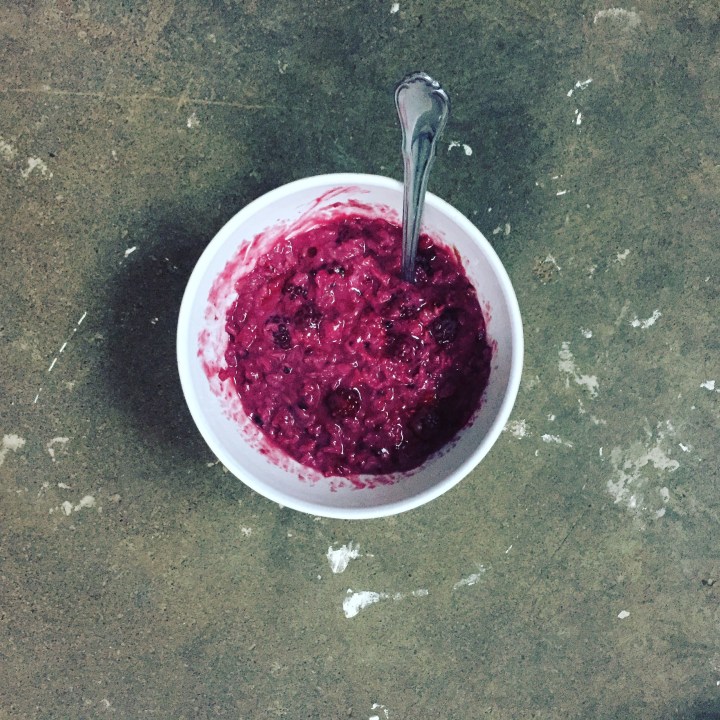
Blackberry Hazelnut Butter Oatmeal

Blackberry Hazelnut Butter Oatmeal

IMG_4594


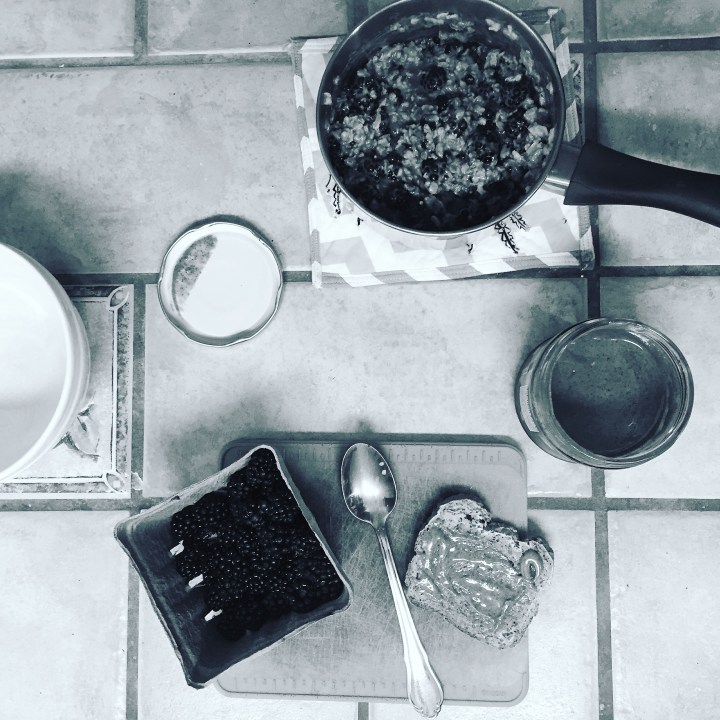
I had a realization yesterday over my morning bowl of oats about how I have spent so much of my life worrying and anxious about the future and so little of it enjoying the day, the experience, and the moment. I have nothing positive to show for all the time spent on those worries. For the past few weeks, when anxiety and racing, circling thoughts start to grip me, as they often do, I’ve tried to take more of a noticing approach, and on some days, can consciously catch myself before my mind jumps in to the chaos, take a couple slow deep breaths, and remind myself the only thing I need to do is direct all of my attention into focusing on the task at hand.

In a similar way, I’ve also been working on eating with mindfulness more often, especially in the morning over porridge. I tend to be a floor person and spend the majority of my “down” time at home on the floor instead of in a chair or the couch. I really enjoy eating my porridge on the floor, sitting cross-legged in front of the big window in our main room, as I watch the morning grow brighter or with the sun warming my face. When I sit and eat slowly without distractions, looking out at the trees and watching the neighbor cats, I begin to experience the connection again, to taste the subtle sweetness and richness of the berries, the texture of the oats, and the hint of hazelnuts. I miss the subtle flavors when I eat it mindlessly while multi-tasking or when in an anxious “what’s next/what if” state of mind.

We enjoyed a wine tasting/sampling at a friend’s party over the weekend and we savored and made notes on six different rosé wines, trying to guess the country, price range, and style. I rarely drink and when I do it’s often in small amounts at social occasions like these, but I really appreciate the act of tasting wine or cider in this way, slowly, with a focus on the whole process:  tasting the beginning, middle, and ending notes and picking out the subtle hints of flowers, of cherries, of chocolate, etc.

Good food has complexity and deep flavors much like good wine or cider does–especially this time of year. Why don’t we appreciate it in the same way more often?

With my intention (again) this week being to focus on the task at hand, I’m going to put more emphasis on extending mindfulness to eating the meals I get to enjoy–and try to return to just eating each time my mind darts off in another in the future direction again.


IMG_4596


Blackberry Hazelnut Butter Oatmeal, makes 1 bowl

1 cup water

1/2 cup old-fashioned oats, gluten free if necessary

1 cup blackberries or boysenberries

1/2-1 Tbs. hazelnut butter, to taste

dash of salt

dash of cinnamon, if desired

sweetener of choice, if needed

  • In a small saucepan over high heat, bring the water to a boil. Pour in the oats, give the pan a gentle shake to distribute them in the water, and then turn to medium low.
  • Cook until almost done, about five minutes, and then stir in the berries.
  • Allow the berries to either meld completely in and cook down a bit, which will take a few minutes longer and have more of a jammy texture, or simply let them heat just a bit without breaking down.
  • Stir in the hazelnut butter, salt and cinnamon and heat just a minute or so longer.
  • Remove from the heat, allow to sit a moment to develop more flavor and pour into a serving bowl. Depending on the berries, top with your sweetener of choice as needed.


Blueberry Swirl Buckwheat, Amaranth + Walnut Porridge

Blueberry Swirl Buckwheat, Amaranth + Walnut Porridge

IMG_9958

I received free samples of California walnuts mentioned in this post. By posting this recipe I am entering a recipe contest sponsored by the California Walnut Commission and am eligible to win prizes associated with the contest. I was not compensated for my time.


As part of my nutrition program, I took a class last term which covered the basics of cooking whole foods including how to cook grains, beans and other legumes, and greens. One thing I hadn’t previously given much thought to was the reason for soaking grains, beans, nuts, and seeds prior to eating.

Whole grains, nuts, seeds, and legumes contain antioxidants called phytic acids (or phytates) which are the plants’ primary form of stored phosphorus. Phytates tends to bind minerals like zinc, magnesium, calcium, potassium and iron, making them more difficult for us to absorb. Soaking these foods overnight prior to cooking or eating initiates the sprouting process, which makes many of the minerals more digestible.

There is some debate as to whether we should worry about phytates or bother taking the time to soak our whole grains and nuts, as many experts suggest we simply eat a balanced diet and we’ll get enough of these minerals anyway. From my own personal experience however, I have been eating a diet of whole foods, comprised mostly of these phytate-rich plants, for going on 10 years or so, and I’ve continued to struggle with absorbing the vitamins and minerals my diet should contain–even after removing the two big culprits which were causing me the most damage, gluten and dairy. Gut health is an area I’m super interested in learning more about, but in the meantime, I’ve been trying to remember to soak more of my grains and now nuts, in addition to beans, more of the time.


IMG_9960


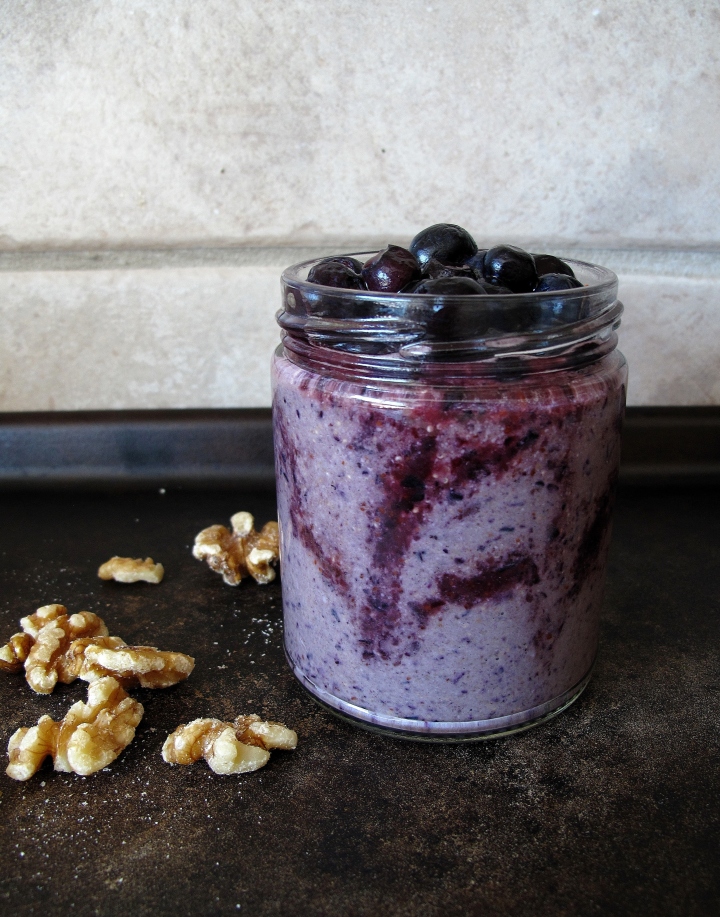
This porridge combination contains three ingredients to get the day off to a good start thanks to those soaked seeds and nuts including walnuts, amaranth, and buckwheat. The California Walnut Commission generously sent me a 2-lb. bag of walnuts to play with and I’ve been having lots of fun using them in unconventional ways. Walnuts are a delicious and versatile ingredient and they perfectly complement other whole foods for nutritious, tasty meals. I’ve found that walnuts can be used a lot like cashews to make “creams,” although with a stronger walnut presence due to their nice wholesome flavor. They pair especially well with amaranth and buckwheat, as all those earthy flavors complement each other.

Walnuts are a nice addition to meals and snacks as an ounce of walnuts — the amount in one serving of this porridge — has 2.5 grams of the essential plant-based omega-3 alpha-linolenic acid (ALA), in addition to 4 grams of protein and 2 grams of fiber.


IMG_9966


Since the beginning of the year, I’ve been streamlining my morning process and often make my breakfast the night before, or batch cook a few days of meals at once. I tend to opt for some form of porridge most days and this means I have the perfect opportunity to soak and prep my morning fixings. Since it’s been getting hot outside, I have considered returning to a more summery breakfast like raw buckwheat porridge, but find that I  still tend to wake up ready for something warm to start my day. I tend to run cool most of the time so I decided to make a porridge that is soaked overnight or for a few hours prior to blending, and then it can be quickly finished and heated on the stove top to eat. I usually do the whole process the night before, as long as I remember to soak those main components a few hours before that evening prep. Then I reheat individual portions in the morning.


IMG_9959


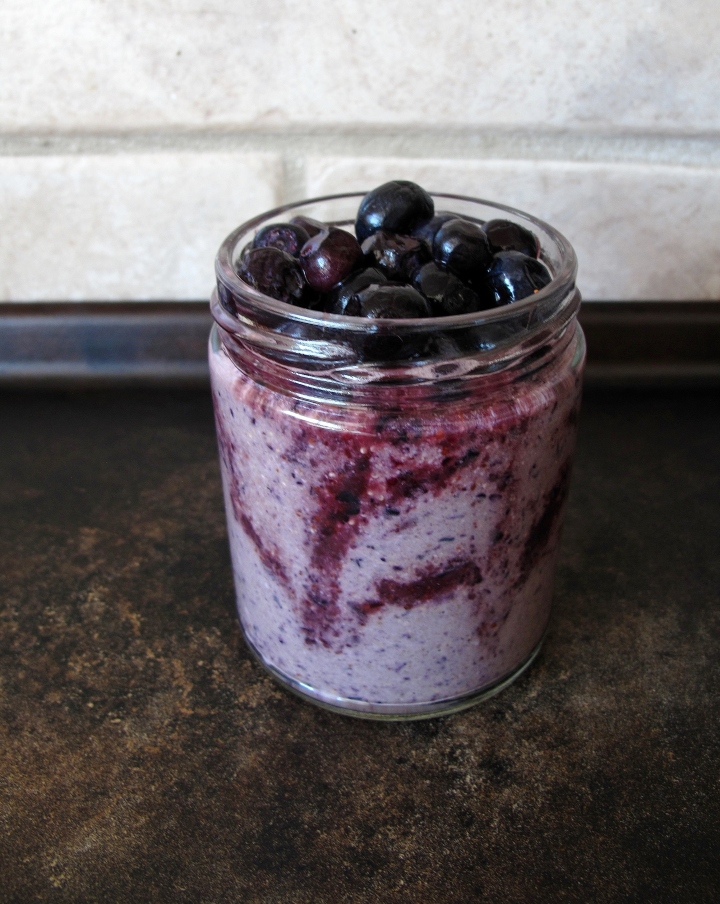
Blueberry Swirl Buckwheat, Amaranth + Walnut Porridge, serves 4

1/3 cup buckwheat groats

1/3 cup amaranth

1 cup raw walnuts

1 Tbs. apple cider vinegar or lemon juice

4 cups blueberries, fresh or frozen

1 Tbs. raw honey or maple syrup

1/2 tsp. ground cardamom

1/4 tsp. cinnamon

dash of sea salt

1/2 tsp. pure vanilla extract

1/2- 1 1/2 cups water, divided

Directions:
  1. Cover walnuts, amaranth, and buckwheat with warm water and one tablespoon of lemon juice or apple cider vinegar. Let soak overnight. The next morning, drain and rinse well.
  2. In a food processor or blender, puree the blueberries and honey until they become smooth. Spoon out about half the puree and set aside.
  3. Without removing the remaining puree, add in the drained and rinsed nuts and seeds along with the spices and about 1/2 cup water. Puree the mixture until smooth.
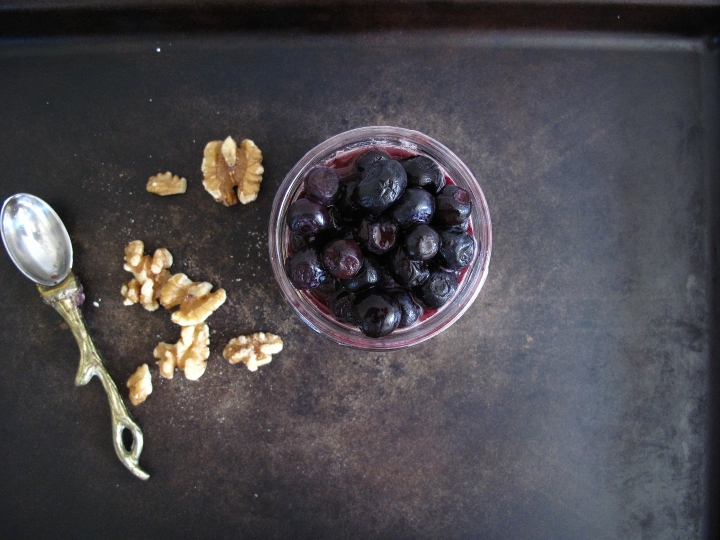
  4. To assemble and eat, spoon the pureed porridge into a small saucepan along with enough water to make it a thinnish consistency, if necessary. This will depend on your berries. Heat through until it forms a thick porridge. Then, swirl a few spoonfuls of the blueberry puree into each portion. Top with more blueberries and walnuts, if desired.


References:

Frølich, W. (n.d.) Phytate–a natural component in plant food. Whole Grains Council. Retrieved from:  http://wholegrainscouncil.org/files/backup_migrate/PhytateProsCons_0910_DK-WGC.pdf.

Sparvoli, F. and Cominelli, E. (2015). Seed biofortication and phytic acid reduction: A conflict of interest for the plant? Plants. 4 (4): 728-755. doi:  10.3390/plants4040728.

Weil, A. (2010). Are phytates bad or good? Retrieved from: http://www.drweil.com/drw/u/QAA400758/Are-Phytates-Bad-or-Good.html.