Training the Gut for and during Long Runs and Endurance Sports

Now that it’s full on summer, let’s check in about a topic that is pertinent for all the endurance athletes, and particularly runners, with wonky guts and/or rigid beliefs about fueling during longer efforts. 

I’ve heard so many variations on the following over my years as a runner:
“I can’t eat anything before a run, ever.”
“I can’t eat anything during a run.”
“ I can’t drink anything more than a little water during a run.”
“I have no appetite for hours (or days) after a run and my GI is messed up for several days.”
“I’m not recovering from long runs or races as well as I used to.”

If you currently relate to any of those statements, I want you to know that the digestive system is highly adaptable. Gastric emptying as well as stomach comfort can be ‘trained’ during endurance activities.

Stored glycogen, or the amount of carbohydrates in our system already, are depleted after about 80 minutes at marathon pace, so for most athletes training for longer efforts, fueling with some sort of carbohydrate during exercise is essential. This training of the gut can improve the delivery of nutrients during exercise so during these long efforts, your system gets the fuel you need and are ingesting, and alleviates some (and perhaps all) of your negative GI symptoms.

How Can I Train my Gut? 

What we currently know is that the stomach can adapt to ingesting large volumes of  both solids, fluids, or combinations of the two. 

Just think about those competitive eaters who can down dozens of hot dogs in a matter of minutes. Disgusting thought, I know, but they have to train their systems to do it!  For endurance athletes needing fuel for the long run, we need to do our own version of gut training. 

This happens both during and outside of exercise because eating a higher carbohydrate diet leads to our intestinal cells, called enterocytes, being able to absorb and utilize carbohydrates as fuel more efficiently. 

To get sugar (carbohydrates) from our small intestine where absorption occurs into our blood, the sugar molecules mostly have to be transported across the membrane by glucose or fructose transporters. Think of a taxi transporting you from the airport to your destination. When we eat a diet high in carbohydrates, our body naturally increases the number of sugar taxis (glucose and fructose transporters). 
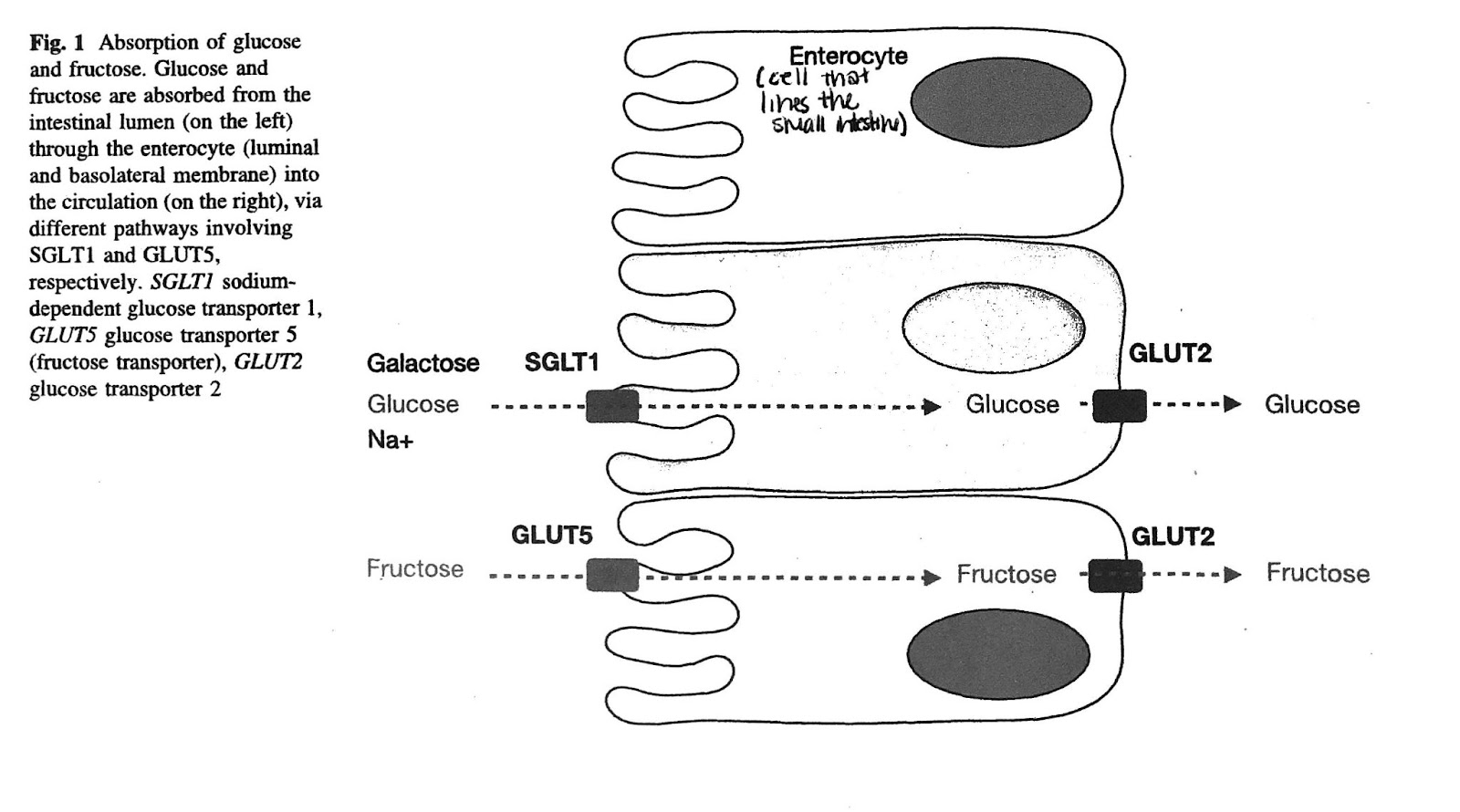
You’ll notice some of these taxis are sodium-dependent, which is a super essential nutrient for endurance exercise, particularly in the summer, but a topic for another day. 

We also know that increasing dietary intake of carbohydrates increases the rate of gastric emptying. This occurs rapidly with a change in diet, within just a few days. So what this means is that you can fuel with more carbohydrate before exercise, fuel with more carbohydrate during exercise, not feel like you’re running around with a giant, full, sloshy gut, and perform the training run or race better, because you were using the fuel you needed to perform adequately. 

And, we also now have evidence that when you fuel with the appropriate amount of carbohydrates before, during and after an exercise bout, recovery from hard efforts is substantially improved. 

When your body has all the sugar taxis it needs to get carbohydrates out of the digestive system and into the blood stream for circulation and use as fuel as quickly and efficiently as possible, and our body gets used to using carbohydrates added on the go as fuel, the chances of developing GI complaints during exercise are much smaller.

Win, win, and win, in my opinion. 

How Much Carbohydrate Can and Should I Be able to Tolerate ?

How much carbohydrates you need or should consume during exercise depends on a few factors. One, how long you’re going to be out there. Two, the intensity of the effort. And three, your gender. 

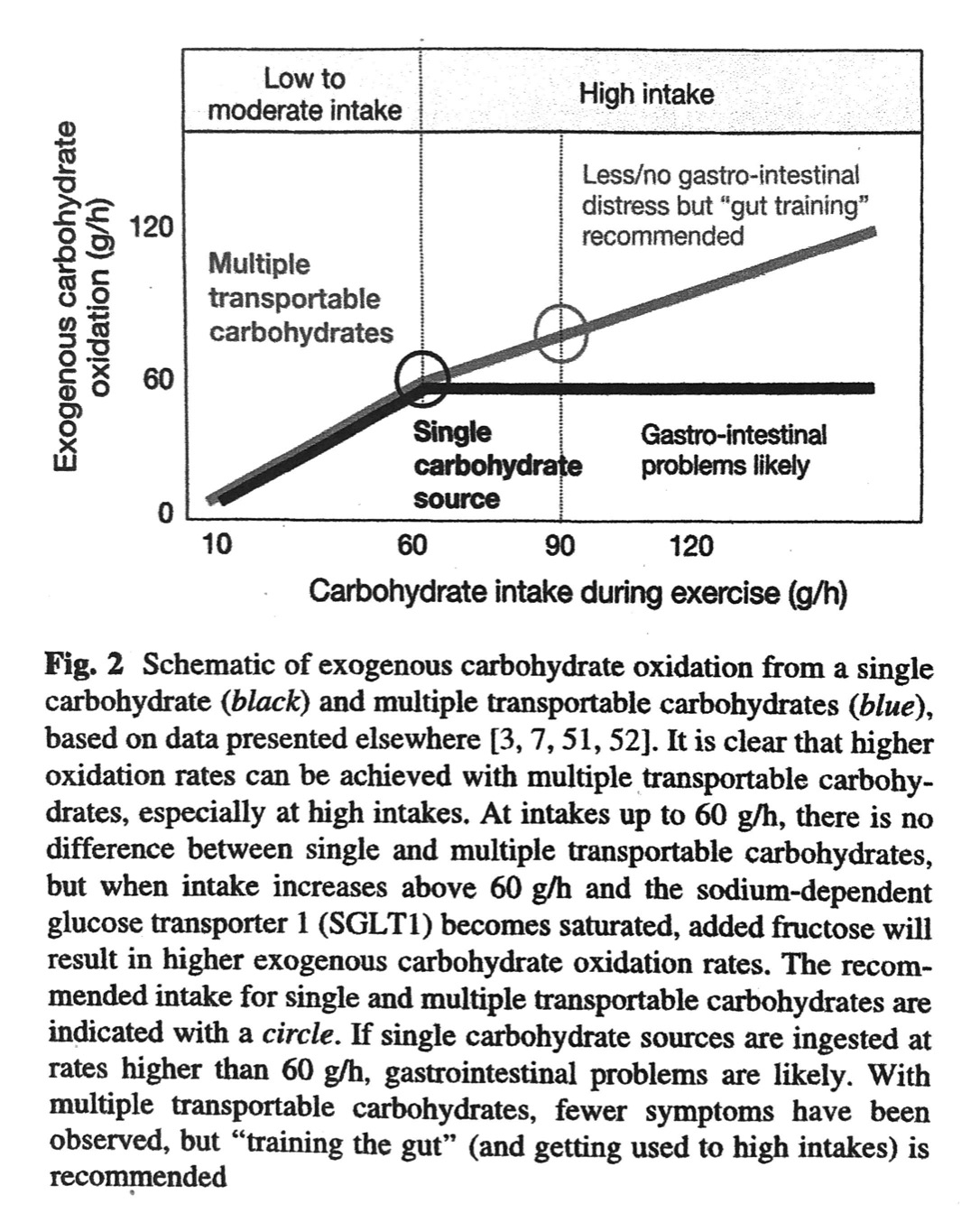
Exogenous carbohydrate oxidation, or the amount of carbohydrates we can use during exercise, peaks around 60 grams per hour when it comes from glucose only.  When fructose is ingested in addition to glucose, carbohydrate oxidation rates are elevated above 60 grams per hour, to 90 to 120 grams per hour (when the gut has been trained). In women, however, we have evidence that carbohydrate oxidation rates appear to be maximized at about 60 grams of carbohydrates per hour (2). If you’re a female and looking to maximize your fueling and racing/recovering capacity, you can experiment with ingesting more than 60 grams per hour. This upper limit will likely be individual.

The current guidelines for fueling are to take in up to about 60 grams per hour of carbohydrates for exercise lasting up to two hours. 

And when the effort lasts longer than 2 hours, men should experiment with increasing their intake to slightly greater amounts of carbohydrate (90g/hr), but women may feel best at sticking with 60 grams per hour. These carbohydrates should be a mix of glucose and fructose or maltodextrin and fructose. Virtually every sports nutrition product for use during exercise includes a mixture of carbohydrates these days so most people will not need to worry about getting the different sources. And most do-it-yourself whole food fuel sources will also include both fructose and glucose. 

Note that sucrose, which is contained within many whole foods and is also what makes up simple table sugar, is a disaccharide, meaning it has two different sugar compounds, fructose and glucose.
Here’s another way to look at the timeline of fueling needs:

Exercise Duration0-59 minutes1 hour2 hours2.5 hours3 hours
Grams of Carbohydrate Per Hournone3030-60g : women
Up to 70 g/hr: men
(higher intensity = higher need)
30-60g : women
Up to 70 g/hr: men
60 g: women (can experiment with more)
Up to 90 g: men
(can experiment with up to 120 g)

How Long Does Training the Gut Take? 


If you’re training for a race and practicing fueling during long efforts, it doesn’t take more than a few days to a couple weeks to increase those sugar taxis in your gut. Based on animal data, an increase in dietary carbohydrate from 40 to 70% could result in a doubling of SGLT1 transporters over a period of two weeks (1).

But it’s important to practice your race nutritional strategy in training, get used to higher volumes of solid or liquid intakes, and higher carbohydrate intakes both during and outside of training. 


As always with fueling for sports, it will take a little individual experimenting and tweaking to find what works for you so you’re less likely to end up looking like this during your next long run or race:

Will Training My Gut Fix all my Exercise-Related Digestive Woes? 

Perhaps following the above recommendations will be a simple answer to fixing all your exercise-caused angry/sad midsection woes. 

But many people with digestive systems that are more prone to upset also need to pay special attention to what you are and aren’t consuming, and how much you’re eating in all the hours outside of training. This can be very individual. 

Want to Know More?

Within my nutrition practice, I specialize in digestive imbalances. Often when we’re experiencing chronic GI distress, fatigue, and/or malabsorption of foods and nutrients, there will be imbalances in several systems of the body simultaneously. I shared more about this topic in the nervous system’s role in part 1, the immune response and subsequent inflammation in part two, gut microbes and dysbiosis in part three and the importance of chewing our food in part four. Check those out or reach out to me for more personalized support for gut healing, or to go from not being able to tolerate fueling, to training your gut for the amount you need.

References:

1). Jeukendrup, A.E. (2017). Training the Gut for Athletes. Sports Medicine, 47(Suppl 1): S101-S110. https://doi.org/10.1007/s40279-017-0690-6  
2). Wallis, G.A, et al. (2007). Dose-response effects of ingested carbohydrate on exercise metabolism in women. Medicine and Science in Sports and Exercise, 39(1): 131-8. https://doi.org/10.1249/01.mss.0000241645.28467.d3. 

Breakfast Tacos with Black Beans + Egg Scramble

A couple weeks ago, I made puff pastry, a cooking project I’ve long considered, but never before attempted. Puff pastry is so rich in butter, containing nearly more butter than anything else, that’s its the ultimate antithesis of a food you might think a nutritionist would make and eat.

It was a project well worth my time and effort. Gluten free, dairy-free (using Miyoko’s cultured ‘butter’), and more rich in refined starches than would be my norm. And it was an eight-hour kitchen project just to turn and fold and chill the dough.

The process and end result was so satisfying. I used the pastry the following day to make a spring asparagus, radish, and egg-topped tart which was super easy to finish and bake, but tasted like, well, I’d spent more than eight hours meticulously turning and folding it.

That puff pastry crunch as our teeth sank into each bite.

In the days that followed, the topic of puff pastry has come up again and again on repeat. In The Great British Baking Show, a past season I’ve been watching for the first time ever. And, multiple nights in a row, I woke up somewhere around 3am from a dream about getting my pastry baked in time, having enough room in the oven, measuring and folding my puff pastry correctly. A direct result of watching the show with apt attention for too many nights in a row.

Puff pastry again in a book I’m listening to on becoming a French chef.

And then another in a new recipe sent to my email from a baking blog I follow, but have never actually baked from.

I consider that when topics or ideas keep repeating themselves in rapid succession in my life, there’s meaning there. But what’s the meaning of puff pastry on repeat?

And what does that have to do with these breakfast tacos?

One thing I realized was just how much joy I found in the process. How little nutrition brain was involved in the making. Is the puff pastry good for me? Yes, unequivocally yes. For any creative process that brings that much joy, present moment awareness, and time just being lost in the process is certainly good for me / us.

Is it nutritionally sound? Certainly not everyday.

It’s taken me nearly 15 years and a whole lot of practice, therapeutic reprogramming, health crises, and grad school to realize that health is about a lot more than just the nutritional components of what we put into our mouth.

Does what we eat matter? Absolutely.

But what our body does with the food, what mindset or stress-state we eat it in, are we enjoying it with full attention or just half-heartedly chewing while doing something else? I’m coming to believe those matter even more. It took me something like these past 15 years to achieve puff pastry freedom from the food police in my brain, and just have joy in the process.

And that’s something to be proud of.

In an earlier article I wrote this year on Intuitive Eating and Cravings, which has quickly become a popular one, I spoke to the idea that we often need to balance our body first before we can decipher between what our body actually wants (intuition) and what our mind desires (cravings).

Was puff pastry an intuition or a craving?

For me, it was neither. It was a cooking project that I’ve long considered quite challenging, especially with gluten-free flour. That I just happened to eat. I love that there’s room for that in my current life.

One thing I’ve realized after I spent more time learning about the purpose of balancing flavors and optimizing a food’s digestibility is that when those two are done, the flavor and yum-factor is usually there by default. And in contrast, some of the recipes I see published that I might have reached for previously stand out to me as overly spiced, one-sided, leaning too heavily on one taste aspect or effect, and containing too many components that stimulate me/us on various levels. Or are just plain too difficult to digest. The more I notice it, the more I notice the effect it has on my mind and body.

As I focus on the balancing flavors in the everyday meal-after-meal routine, the intuitive of what my body needs / wants becomes infinitely more clear. And what it doesn’t want when I temporarily stray from that does too.

So that’s what these breakfast tacos are.

A colorful, flavorful, texture-rich, balanced taste, and for all that, actually-easy taco plate. They may have breakfast in their title, but I enjoy them much more as a weekend after-run brunch or weeknight meal.

Hope you enjoy! If you try them out, leave a comment and let me know how you enjoy them.

Breakfast Tacos with Black Beans and Egg Scramble

Switch up radishes for another seasonal vegetable as desired, add more of your tortillas as needed, or switch them out for rice to make more of a plate-style meal instead of tacos.
The black beans should make enough for a double batch (about 4 servings) to be used for another meal. 

Prep:  overnight   | Cook: 3-4 hours (for beans); 15-20  minutes  to finish  | Serves: about 2

1 small avocado
1 lime, zest and juice
olive oil for cooking eggs
pinch of mineral salt
2 eggs
1 tsp. olive oil
⅛ tsp. salt
½ tsp. smoked paprika
1 bunch of radishes, quartered
cooked black beans, see below
6 small  tortillas (6”)
small handful of cilantro, minced

Black Beans
1 cup dry black beans, soaked overnight
¾ tsp. mineral salt
1 ½ tsp. ground cumin
1 tsp. ground coriander
¼ tsp. ground black pepper
1 bay leaf
water to cover by 3-4 inches

  1. A few hours before or in the morning, cook black beans in a medium pot in the spices and water until very soft and flavorful. This is best done for at least 3-4 hours, adding water as needed. 
  2. To prepare breakfast tacos, peel and pit the avocado and mash in a small bowl. Zest the lime and stir in lime zest, salt, and then juice from at least half of the lime. Add more juice as needed. Set aside. 
  3. Scramble the uncooked eggs in a small bowl, add a dash of salt and pepper, and set aside. 
  4. Add the olive oil, ⅛ tsp. salt, and paprika to a sauté pan. Heat until the aroma comes up and then add in the radishes and a splash of water to cover the radishes by about a ¼. Simmer, covered, until the radishes are just soft. Transfer to a bowl, and then use the sauté pan to scramble the eggs in a little oil. 
  5. Heat the tortillas in a clean pan. 
  6. Enjoy the various elements including the seasoned black beans, eggs, sautéed radishes, mashed avocado, tortillas and cilantro, either as traditional taco toppings, or as a plate with tortillas on the side. 

What exactly is intuitive eating? Cravings vs. intuition

This is the time of year when it’s common to think about ways to improve our health. And if you are one of the majority that has a long and unsavory history with your relationship to food and/or your body, you just might be thinking more about intuitive eating this year. Or perhaps you assume you’re already eating intuitively by eating what you want when you want to.

For many of us with a history of rigid food beliefs, chronic dieting, or disordered eating behaviors, that step of tuning into and actually honoring our hunger, cravings, and food desires is a BIG start — and leads to less feast and famine mentality, peace around food and less guilt in indulging once in a while. It also can mean finally stepping away from the chronic calorie and macro tracking which tend to fuel the rigid behaviors, and dare I say it, throwing out your scale or having your partner/roommate hide it far away where you just might forget about it for a while – I mean several months, or longer.

One thing I noticed as I became less of a disordered eater and more of an athlete focused on feeling good in my body and recovering from workouts, is that I naturally began honoring my hunger more and focusing less on what my body looked like or what I thought I should be eating. It’s like I opened the fridge, took a look around, and then closed it, thinking nope none of this, a peanut butter sandwich sounds good right nowas well as a couple big handfuls (completely unmeasured and probably ate more than that) of tortilla chips.

And truthfully, I ate two pieces of pie every day for nearly a week around Thanksgiving this year on top of my “normal eating” meals and semi-reduced athletic activity, and I didn’t think about my weight or the scale or calorie tracking once. I also haven’t thought about pie at all in the weeks since then. But is that intuitive eating?

As a nutritionist, I always want the best for every person I work with, and quite honestly, everyone else too. And I always fall back on individualized support. Because for many people that have a long history of not tuning in to their body and hunger signals, the eat what I want when I want it, and maybe that means two slices of pie a day approach is okay with me. It’s a start. But it’s probably more appropriate to call it the honoring your cravings and letting go of guilt and diet-culture beliefs about food approach, rather than truly eating intuitively. I’ll put my pie-eating habits at Thanksgiving into this category.

What is Intuitive Eating?

I think the best way to share what intuitive eating is is to go back to just basic intuition. We often talk about intuition when we say we have a gut feeling, or “we just know something” and logically, it may not always make a ton of sense. We make these gut-feeling decisions when we choose a job that pushes us out of our comfort zone, or we make a big move, or choose a medical procedure (or opt not to), when it’s not the most logical thing to do.

But how do we “just know” that a food is right for us or is what we need? One of the best ways to begin to learn this is to pay attention to how you feel afterwards. Intuitive eating can best be described as paying attention to and honoring what your body is telling you it wants and needs, rather than what your mind wants or craves.

Signs that Your Body Didn’t Approve the Meal

When you’re done eating and in the three to five hours after, how do feel? How is your energy? Did you get really tired, or alternatively, super stimulated? Did you start to get some of those not-so-optimal digestive symptoms, like bloating, gas, pain, gurgling, reflux, heartburn, nausea, feeling just plain heavy and lethargic, etc.? Were you running to the bathroom or didn’t have a bowel movement today (also known as constipation)? How was your mood? Were you wired, anxious, scattered, fearful or angry, frustrated, short-tempered and snappy? All of those are influenced by what we’re eating and how we’re eating and whether we’re digesting and assimilating foods and nutrients optimally.

If what sounds good is a giant bowl of popcorn for a snack or dessert every day, and then we’re mentally scattered, gassy, constipated, and anxious afterward or the next day, then maybe our craving for popcorn is being influenced by our imbalance, rather than our intuition.

Another example is a desire for particularly salty or spicy foods with lots of onion and garlic. If those are more of what the mind is craving versus what the body is truly desiring, then we might be particularly short-tempered, easily frustrated, have acne or skin rashes, heartburn or nausea, and have loose stools or diarrhea.

One more example goes back to my pie, and in previous life phases, daily ice cream routine. Frequently eating heavy, cold foods often tends to make us feel heavy, lethargic, have sluggish or incomplete bowel movements, feel depressed or have a low mood, promote inflammation, and develop a lot of extra mucus in our sinuses and elsewhere. Many years ago now, I ate ice cream basically daily, and during a certain period, multiple times a day. During the multiple times per day phase, it probably began as my closest interpretation of my intuition–because I was way too light and undernourished, and my brain just simply needed kcals. But after some time, my weight had definitely stabilized and swung back in the direction of my heaviest, and I began to be extremely anxious all the time, craved more sugar (of course), and finally had a major candida outbreak. Candida is a yeast that feeds on sugar! My cravings were coming from the not-so-beneficial organisms in my GI tract – not my intuition.

So it can be a little difficult to graduate to true intuitive eating once we’ve mastered honoring our hunger and shoving off the influences of dieting culture, and are no longer just following cravings and feel like ice cream every day, popcorn and peanut butter on repeat, or grazing all day instead of three solid meals.

Why is all of this even more important? Much of what I write about here is in the realm of digestive health – and/or eating appropriately to fuel our athletic lifestyles. And when I work with individuals, I often encourage them to honor their intuition. But sometimes we need a little more help in deciphering, are we eating enough despite what we think is intuitive eating?, Is that food that I’m craving helping or harming my return to balanced digestion?, Is my daily pie or ice cream habit giving me the calories I need, but encouraging future imbalanced health down the road, and/or already showing signs of imbalance? And admittedly, the more symptoms of imbalanced health that we have (such as some of the above), the more challenging it becomes to self-determine cravings that fuel the imbalance versus eating intuitively that returns us to true, optimal health.

A good way to start to tune in is to keep a little journal of how you felt in the hours after meals for a few days, and see if you have more of the sub-optimal symptoms and moods than you were aware of before. And if you suspect you’re more in the realm of honoring cravings right now and want support in starting to eat more intuitively, feel free to reach out and chat with me in a nutrition consult.