Observing the 20 Energies and How To Really Start Intuitive Eating

Every day in May is precious.

Where I live, the months of February through April are often the most challenging – January and the post-holiday, beginning of year hope always seem to fly by, but it’s in February, and March, and April that every day can feel like a grind. 

It’s not the sunshine that May can bring that necessarily turns it all around for me. I do love the sun and warmer days, but I also enjoy the rain. 

It’s the flowers and the fully leafed out trees that late winter and early spring lacks. The sheer density of foliage that has returned by early May.

A heavy blanket or extra padding of plant life that soothes my nervous system as I go out into the world, making everything hard, more bearable, and everything mundane or merely good, elevated. 

The twenty Gunas valued in Ayurvedic medicine.

One thing that is inevitably helpful from day to day, whether it’s in those more difficult late winter and early spring months, in May, or in the heat of peak summer, is tuning into and adjusting my food and lifestyle choices based on the energies around and inside me. What I’m referring to are the 20 Gunas in Ayurvedic wisdom. These are a set of 10 pairs of opposing qualities or energies that describe the different attributes inherent in all substances. 

For instance, a rock is hard. Feathers are soft. 
A rainy day is wet. A clear, sunny day in August in Oregon is dry. 
Fresh ginger is heating. Coconut milk and coconut water are cooling.  

What is so powerful about observing these qualities in your body and everyday life, and then using them to make subtle food and lifestyle adjustments, is that it’s a way to bring balance to your body, mind and health.

This daily adjusting is especially helpful as a preventative measure, but should also be used when there is clear illness or disease. Our body’s prefer to operate at homeostasis. Even with everything we do in our everyday that knocks the body out of homeostasis, its object is always to return to ‘baseline’ as quickly as possible. When there are too many blocks in its ability to do so, that’s when illness and disease, abnormal lab values, pain and aches, and injuries occur.  

The 20 Qualities are:
Heavy | Light
Cold | Hot
Soft | Hard
Oily | Dry
Smooth | Rough
Dense or Solid | Liquid
Slow or Dull | Sharp
Stable | Unstable or Mobile
Cloudy, Sticky or Slimy | Clear
Gross or Big | Subtle or Small

Observing and using the 20 qualities or gunas is a way to help the body system return to homeostasis. How you do that is for every quality that is out of balance, utilize the opposite quality instead. 

For instance, if I am currently experiencing hot, itchy skin rashes or acne, I know that adding more heating substances, foods, and heating spices will further increase the heat condition. Reducing the amount of spices in food, the type of foods that are hot in nature, and increasing cooling foods will help to clear the heat. Adding cooling, bitter vegetables like broccoli and asparagus and more cooling spices and herbs like fennel, coriander, mint and cilantro,  instead of eating a dish with garlic, onions, ginger, mustard seeds, and chili peppers will slowly (or sometimes quickly) assist in coming back to equilibrium. 

Or say I have a tendency towards being constipated and gassy, and I eat lots of dry, airy foods. Snacking on popcorn, granola, chips, crackers, yeasted bread, and raw, crunchy salads, which I eat while on the go, or eat while talking. All are dry and/or contain a lot of air.
A way towards balance is to increase the moisture — both through adding liquid into the foods consumed, and cooking foods until they’re soft, and by adding liquid fats and oils instead of dry, crunchy roasted nuts or seeds, etc.

A Daily Check-In

One way to begin to use this method is by doing a short daily check-in. Take a few minutes near the beginning of each day to journal or jot down the answers to these questions:

– What is Present today? 
– And What is Needed?

Getting more granular, it can sometimes be helpful to do a quick scan or review of different body systems, the mind and emotions, and the weather to help. Is something feeling dry? Hot? Slimy and mucousy? Slow and sluggish? Adjust your food and lifestyle choices with the opposite qualities, and see where it begins to bring more balance. 

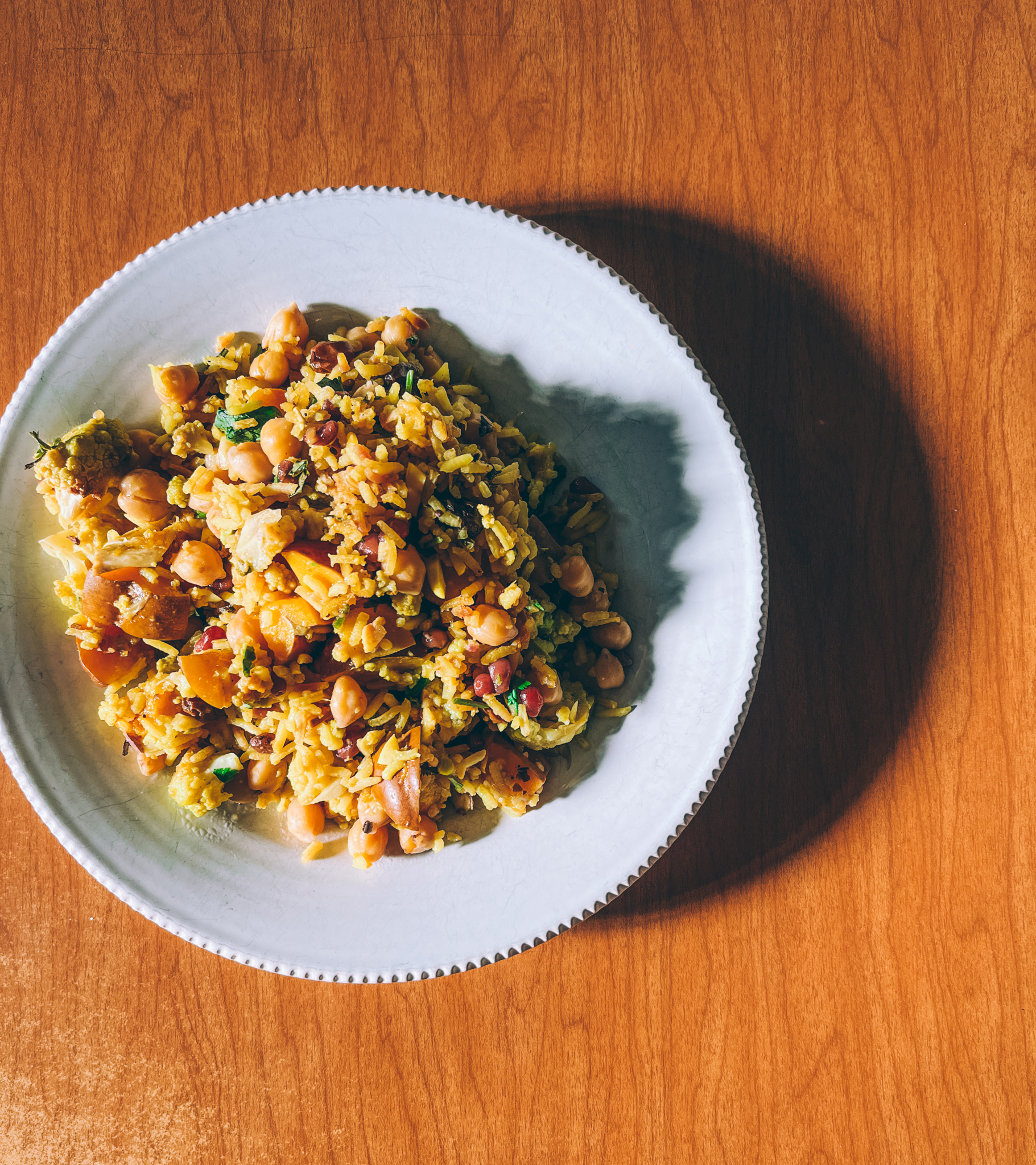
As we weave into the summer months in the northern hemisphere, it’s often that the qualities on display in the environment become hotter, dryer (or more humid, depending on where you live), and this can be mirrored in the body more rapidly, especially when we likewise choose heating and drying foods. Here’s a recipe for summer that can give you a good example of how to balance the heat and dryness with cooling spices, coconut and gently cooked, more liquid-containing meals. 

Observing what’s occurring internally and externally and adjusting to quickly reach equilibrium is the very definition of true intuitive eating. It’s tuning into what the body needs rather than what the mind craves. 


If you’d like to know more, there is a free download in more detail to use this idea in the Resources section. I also work with clients in individual nutrition consultations, and as a Licensed Dietician / Nutritionist (LDN /LD) and Certified Nutrition Specialist (CNS), use medical nutrition therapy, integrative health measures, and a root cause approach to heal imbalanced health conditions. 

If you’d like to learn more about how you can improve your symptoms of imbalance, I’d love to speak with you in a quick phone consultation

New Year, Same Me? Reflections and Moving Forward


December and early January flew by as always. I did my usual December baking creative joy – a new thing I baked this year was Stollen, the Christmas bread originating in Germany. It’s an enriched bread meaning it usually contains more butter, eggs, and sugar, and also features candied citrus, almonds, raisins and spices, and the like. I spent a weekend candying my own citrus peels before the baking commenced and that in itself was a fun adventure.

I adapted my cinnamon roll dough – and dropped the sugar to not too much, per a few traditional recipe comparisons. It was absolutely delicious and turned out well, and I loved it so much that after two loaves, I took some of the same add-ins and incorporated them into a regular yeast whole-grain loaf without the extra enrichment.

We’re finally getting back to “regular season” bread around here as my somewhat dormant holiday-season sourdough culture has been back in action. I make about one loaf every couple weeks, usually.

Otherwise, we enjoyed an easier version of Biryani, the Persian/Indian rice dish, to celebrate New Years Eve, and promptly began dozing through an old episode of All Creatures Great and Small before 9pm. We’re not much for New Years Eve celebrators, or maybe we just don’t have enough of a reason to stay up into the wee hours in the last few years, but it was nice to wake up to a new day and year refreshed and having slept well, even with all the intense fireworks that went off at midnight. 

Now that we’re firmly in January, I’ve been reflecting a bit about the direction of this blog and my newsletter

I began the blog and recipe sharing very shortly after I graduated from my undergrad degree in 2009 – feeling inspired to continue my creative joy for writing and food (I did initially begin college as an English major, which eventually became an English minor – and either way, that basically means I enjoyed a fair bit of writing on the way to a degree.) 

My first blog was not a recipe, but a food story about picking cherries and making my dad a cherry pie. My mom had come to visit at the end of school – not being one for celebrations particularly, I skipped graduation and signed up for one of my teacher examinations instead – and after the visit to my house and to pick cherries in our rental front yard, we took  a trip together to the coast. I remember now that I was an absolute teenager on that trip (even though I was not), with all the petty and huffy responses to my mom that a teenage girl could give. We did a tour of one of the lighthouses which was really enjoyable, and I got all irritated at not finding / remembering the “right” restaurant along the Newport bayfront for a brunch. We ended up at a fine enough place instead (truthfully there never have been great restaurants for breakfast along the bayfront so I don’t know what I was looking for), and I was huffy and irritable all throughout the meal. In retrospect, it was really dumb and colors an enjoyable trip in a negative way. I did not feature that story in my first blog post – just the idealism that came before and after it.


With the transition to providing nutrition consultations through Hope Wellness, I’ve spent less time curating recipes and articles for this website and newsletter, and may eventually abandon the project entirely. (You’re welcome to sign up for the Hope Wellness newsletter which I write and publish half of the time). But this also remains a space that has morphed with me as I’ve shifted and grown. I’m not quite ready to walk away completely. It may be an educational space for you – or an inspirational one for food and lifestyle shifts – but it’s still and to this day a space for creative joy for me. 

Beyond that, let’s speak to New Year Resolutions for a moment. 

I don’t particularly aspire to them, but there’s also something about the collective momentum and freshness of a new year to wipe the slate clean and begin something new, or at least refresh an intention or habit shift we’ve been working on. 

I’ve spent the last couple years refining my morning routine so I set a better foundation for my day, and my priority for this season and year is to continue cementing the consistency I’ve accomplished with that. Not striving for perfection, but getting back to consistency as soon as possible when the routine goes astray for a day or a few. 

I show up internally and externally, as a more grounded, clear-minded, better person when I start the day with breathing, prayer/meditation, and a little yoga (more breathing and getting into my body, and out of my head). 

That space in my head is the entire intention for the practice. 

And in fits and starts this past year, I’ve begun playing the piano again. By the time I left home at 18 for college, I was fairly good at the piano and could play several advanced pieces. It took until the end of 2021 to have my childhood piano in my possession again, and after a couple months to rest before I got it tuned to play, I dipped my toe in. 

Like pulling a long ago language from the depths of my brain, I had to first re-learn even the basics. And because the piano bench is a time capsule to the early 2000’s, it was disheartening to see where I was in 2005, and to start nearly back at the beginning to relearn again (which C is middle C again?

My intention with the piano is to keep up the consistent playing: a few minutes, a handful of times per week. Nothing too out of the way – consistency being the most important thing. 

The goal for playing is not to get to the point of “being really good,” but to be able to sit down and play an enjoyable song without stretching my brain so hard that it’s more work than pleasure. 

It’s a continuation of the creative joy I spoke to above about food and writing.  

Beyond that, I have a couple long-term and ongoing intentions with my nutrition and running: chewing my food better, single-tasking while eating, preparing meals in a way that is most supportive of my digestive system, as well as race goals and more community in running. None of these are particularly dramatic, new, or different than before.

I’m all for subtle and slow, yet significant shifts over time.

If you’ve read all that I’ve rambled on about by now, I’d love to know about your end of year / beginning of year. What’s going well with you? What are you working to maintain or shift?

If it’s food and nutrition related, can I help? And if it’s getting to finding some space in your head or more creative joy, I’d love to hear about your own process. 

Iron Deficiency + The Athlete: Part II

If you recognize the food on the left side of the plate above as red lentils (a red lentil soup), then you may also know it to be a rich source of the mineral iron. 

I’ve written about iron in detail before, but a recent research paper on  impaired iron and endurance athletes reminded me that I need to periodically review this topic. 

Nearly all of my female clients in the past few years have come to me with iron deficiency, iron-deficiency non anemia, or iron-deficiency anemia. This has been true whether they are endurance athletes or not. And whether they’re highly active or not.

Here’s a refresher on the difference between those three:

Stage 1: Iron Deficiency: Iron stores in the bone marrow, liver, and spleen are depleted, indicated by ferritin values less than 35 ng/mL, Hemoglobin values > 11.5 g/dL and transferrin saturation >16%

Stage 2: Iron-Deficient Non-Anemia: Red blood cell production decreases as the iron supply to the bone marrow is reduced, indicated by ferritin values less than 20 ng/mL, Hemoglobin >11.5 g/dL, and transferrin saturation < 16%

Stage 3: Iron Deficiency Anemia: Hemoglobin production falls, resulting in anemia, indicated by ferritin values less than 12 ng/mL, Hemoglobin <11.5 g/dL, transferrin saturation less than 16%. 

While iron deficiency may be much more likely in women, it’s not a female-only issue. 

It used to be that when there were signs, symptoms, and laboratory results indicating deficiency of a nutrient, I did just the typical nutritionist thing of recommending eating more foods rich in that nutrient, increasing bioavailable co-factors in the diet, adjusting timing of nutrient intake so absorption increases, and according to the circumstances, recommending varying amounts of supplementation. 

Generally, that’s a pretty good and standard game plan.  But to a certain extent in many cases, it was band-aiding the real issue. Or at least not getting all the way there. 

Why is nutrient absorption impaired in the first place?  Did the individual merely need to increase nutrient intake and we’d solve the problem? Was it just an issue of increased demand or not eating foods rich in that nutrient?

What I started finding was that even with continued intake of iron-rich foods, or in some cases high-dose supplementation, we’d still have low levels of iron (and often of other nutrients).

So what’s happening here? 

It wasn’t until I had continued professional training on gut health and malabsorption that I began having some personal aha moments. 

When I began addressing the issue of nutrient deficiency from the standpoint of improving the person’s digestion and absorption and calming the nervous system (which is so incredibly entwined with gut health), absorption of iron and many other nutrients drastically improved. 

We were finally treating the issue. 

Which is to say, that still doesn’t mean it’s easy. Figuring out which puzzle piece or perhaps multiple puzzle pieces of the GI system are impairing absorption of nutrients and digestibility of food can take some time and it can take some persistence. But it’s so worth addressing. 

Here are some factors that might be causing impaired absorption of dietary and supplementary iron and/or increased need.  Check all that apply for you. The more that apply, the more likely absorption and/or intake of iron will need addressed.

  • Female of menstruating years 
  • Endurance athlete
  • Digestive Symptoms – Pain, Bloating, Gas, Loose Bowel Movements, Undigested Food in Stool, etc.
  • Have low stomach acid (quite common and most people are completely unaware)
  • Follow a vegetarian, vegan, or plant-based dietary pattern
  • Omnivore who avoids red meat
  • Fast eater or eats while distracted or stressed
  • Low estrogen or testosterone levels
  • Supplemental intake of other minerals at the same time as iron, not-including nutrient cofactors when consuming iron rich foods or supplements, and/or consuming foods and beverages that prevent absorption at meals rich in iron
  • Taking prescription medication(s) – depending on the medication if may impact nutrient absorption or change physiology so there’s an increased need
  • Lack of knowledge about how to eat a balanced diet or poorly planned dietary pattern
  • INFLAMMATION! – Particularly inflammation of the gut (may be asymptomatic or not obvious)

Want to Know More?

If you’d like a refresher on iron, check out my first article on this topic.

Need help with iron or absorption of other nutrients? Within my nutrition practice, I specialize in endurance athletes and digestive imbalances. If you’ve struggled with chronically low iron or poor absorption of other nutrients, I encourage you to reach out to me for more personalized support.