Breakfast Tacos with Black Beans + Egg Scramble

A couple weeks ago, I made puff pastry, a cooking project I’ve long considered, but never before attempted. Puff pastry is so rich in butter, containing nearly more butter than anything else, that’s its the ultimate antithesis of a food you might think a nutritionist would make and eat.

It was a project well worth my time and effort. Gluten free, dairy-free (using Miyoko’s cultured ‘butter’), and more rich in refined starches than would be my norm. And it was an eight-hour kitchen project just to turn and fold and chill the dough.

The process and end result was so satisfying. I used the pastry the following day to make a spring asparagus, radish, and egg-topped tart which was super easy to finish and bake, but tasted like, well, I’d spent more than eight hours meticulously turning and folding it.

That puff pastry crunch as our teeth sank into each bite.

In the days that followed, the topic of puff pastry has come up again and again on repeat. In The Great British Baking Show, a past season I’ve been watching for the first time ever. And, multiple nights in a row, I woke up somewhere around 3am from a dream about getting my pastry baked in time, having enough room in the oven, measuring and folding my puff pastry correctly. A direct result of watching the show with apt attention for too many nights in a row.

Puff pastry again in a book I’m listening to on becoming a French chef.

And then another in a new recipe sent to my email from a baking blog I follow, but have never actually baked from.

I consider that when topics or ideas keep repeating themselves in rapid succession in my life, there’s meaning there. But what’s the meaning of puff pastry on repeat?

And what does that have to do with these breakfast tacos?

One thing I realized was just how much joy I found in the process. How little nutrition brain was involved in the making. Is the puff pastry good for me? Yes, unequivocally yes. For any creative process that brings that much joy, present moment awareness, and time just being lost in the process is certainly good for me / us.

Is it nutritionally sound? Certainly not everyday.

It’s taken me nearly 15 years and a whole lot of practice, therapeutic reprogramming, health crises, and grad school to realize that health is about a lot more than just the nutritional components of what we put into our mouth.

Does what we eat matter? Absolutely.

But what our body does with the food, what mindset or stress-state we eat it in, are we enjoying it with full attention or just half-heartedly chewing while doing something else? I’m coming to believe those matter even more. It took me something like these past 15 years to achieve puff pastry freedom from the food police in my brain, and just have joy in the process.

And that’s something to be proud of.

In an earlier article I wrote this year on Intuitive Eating and Cravings, which has quickly become a popular one, I spoke to the idea that we often need to balance our body first before we can decipher between what our body actually wants (intuition) and what our mind desires (cravings).

Was puff pastry an intuition or a craving?

For me, it was neither. It was a cooking project that I’ve long considered quite challenging, especially with gluten-free flour. That I just happened to eat. I love that there’s room for that in my current life.

One thing I’ve realized after I spent more time learning about the purpose of balancing flavors and optimizing a food’s digestibility is that when those two are done, the flavor and yum-factor is usually there by default. And in contrast, some of the recipes I see published that I might have reached for previously stand out to me as overly spiced, one-sided, leaning too heavily on one taste aspect or effect, and containing too many components that stimulate me/us on various levels. Or are just plain too difficult to digest. The more I notice it, the more I notice the effect it has on my mind and body.

As I focus on the balancing flavors in the everyday meal-after-meal routine, the intuitive of what my body needs / wants becomes infinitely more clear. And what it doesn’t want when I temporarily stray from that does too.

So that’s what these breakfast tacos are.

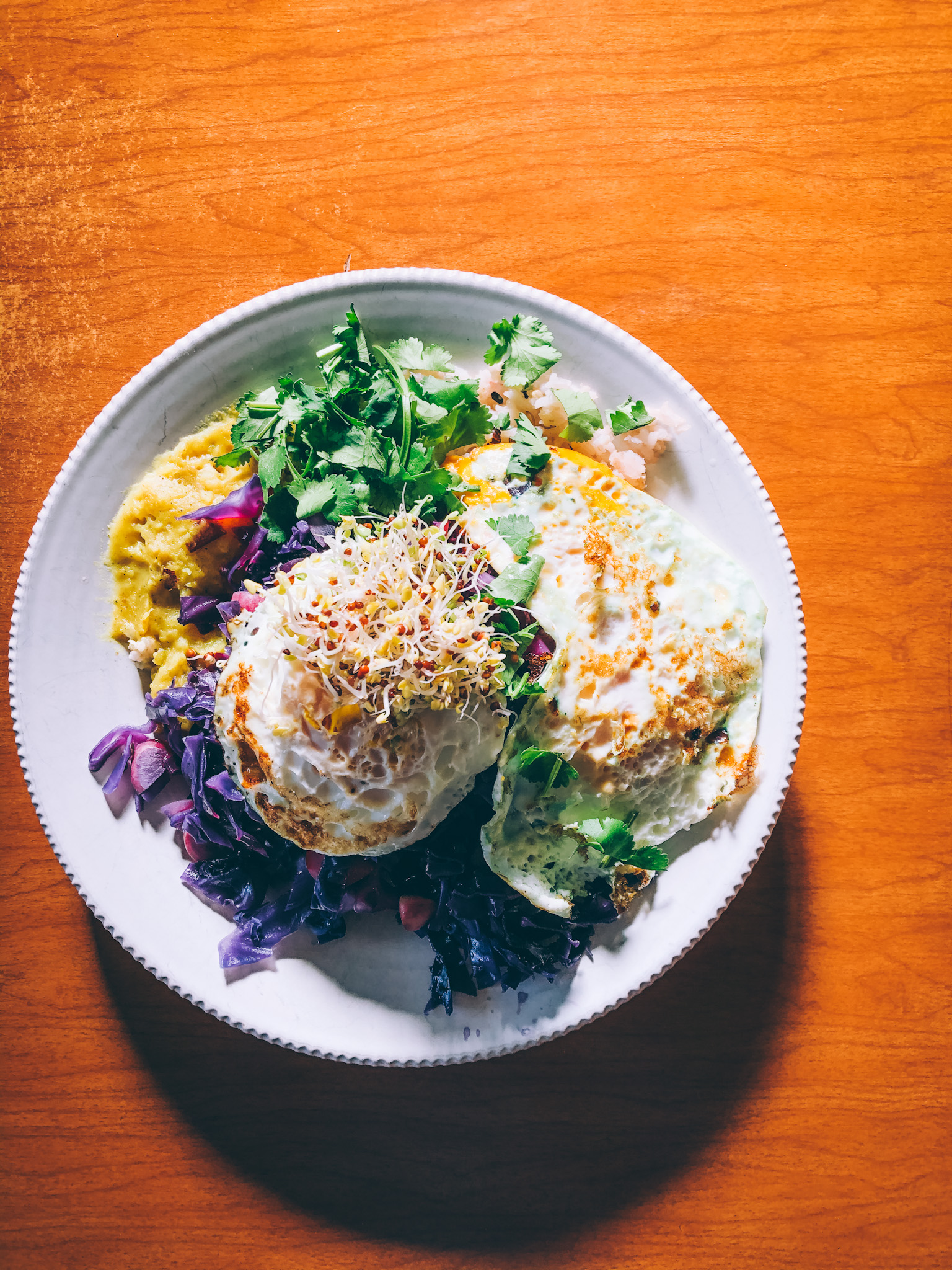
A colorful, flavorful, texture-rich, balanced taste, and for all that, actually-easy taco plate. They may have breakfast in their title, but I enjoy them much more as a weekend after-run brunch or weeknight meal.

Hope you enjoy! If you try them out, leave a comment and let me know how you enjoy them.

Breakfast Tacos with Black Beans and Egg Scramble

Switch up radishes for another seasonal vegetable as desired, add more of your tortillas as needed, or switch them out for rice to make more of a plate-style meal instead of tacos.
The black beans should make enough for a double batch (about 4 servings) to be used for another meal. 

Prep:  overnight   | Cook: 3-4 hours (for beans); 15-20  minutes  to finish  | Serves: about 2

1 small avocado
1 lime, zest and juice
olive oil for cooking eggs
pinch of mineral salt
2 eggs
1 tsp. olive oil
⅛ tsp. salt
½ tsp. smoked paprika
1 bunch of radishes, quartered
cooked black beans, see below
6 small  tortillas (6”)
small handful of cilantro, minced

Black Beans
1 cup dry black beans, soaked overnight
¾ tsp. mineral salt
1 ½ tsp. ground cumin
1 tsp. ground coriander
¼ tsp. ground black pepper
1 bay leaf
water to cover by 3-4 inches

  1. A few hours before or in the morning, cook black beans in a medium pot in the spices and water until very soft and flavorful. This is best done for at least 3-4 hours, adding water as needed. 
  2. To prepare breakfast tacos, peel and pit the avocado and mash in a small bowl. Zest the lime and stir in lime zest, salt, and then juice from at least half of the lime. Add more juice as needed. Set aside. 
  3. Scramble the uncooked eggs in a small bowl, add a dash of salt and pepper, and set aside. 
  4. Add the olive oil, ⅛ tsp. salt, and paprika to a sauté pan. Heat until the aroma comes up and then add in the radishes and a splash of water to cover the radishes by about a ¼. Simmer, covered, until the radishes are just soft. Transfer to a bowl, and then use the sauté pan to scramble the eggs in a little oil. 
  5. Heat the tortillas in a clean pan. 
  6. Enjoy the various elements including the seasoned black beans, eggs, sautéed radishes, mashed avocado, tortillas and cilantro, either as traditional taco toppings, or as a plate with tortillas on the side. 
The Six Tastes for Balanced Meals and Digestion

For a long time, it’s felt appropriate to share a food as medicine approach to eating in this space, but I’m not so sure I’ve adequately explained how to do this other than to share meals that are largely based on whole, minimally processed from-nature ingredients. 

I know you want to eat food and meals that taste good, and are also good for you, but it’s important to recognize that everything we eat also has an effect.

That effect can be incredibly subtle or super obvious and I don’t mean just the effects of the caloric, macro or even micronutrient content of your meal, but because each subtle flavor within a food and meal will affect your body and your mind. 

Particularly when you eat in the same pattern of meals and flavors day in and day out. 

The Six Flavors 

There are six primary flavors within foods and ideally, all six flavors are incorporated into main meals, and at least four flavors are enjoyed at breakfast when we tend to eat a smaller amount. The six flavors are: sweet, salty, sour, bitter, pungent, and astringent

Now, what foods have which flavor? And what are their effects? 

Sweet 

The SWEET taste comes from foods that contain natural sugars: sweet root vegetables like carrots, squash, beets, all fresh and dried fruit, whole grains, natural sweeteners like honey, maple syrup, and molasses, and fresh dairy products such as milk, butter, and ghee. 

The sweet flavor builds tissues within the body, calms the nerves and nervous system, and relieves hunger. It’s the flavor you likely reach for when you’re eating to soothe an emotion or for comfort. This is natural since the flavor of our first food of milk is sweet. That food-memory association between sweet food, love, and being comforted is particularly strong. 

If you are dry, thin, nervous, anxious, scattered, or have nerve disorders, more naturally sweet foods are indicated and may be missing in adequate amounts in your meals – these are the whole grains, root vegetables, sweet fruits, and natural sugars. 

Salt 

The SALTY taste comes from foods that are naturally salty including seaweeds like kombu, arame, wakame, and nori. Some water-based vegetables are also naturally a little salty including celery, tomatoes, zucchini, and cucumbers. And of course, natural salt such as sea salt or pink mineral salt provides this flavor. Adequately cooking our foods in salt, and adding in a teaspoon per serving of dried seaweed when cooking beans or other stewy meals is an excellent way to build the salty flavor into a meal that will help us to retain the water we consume and have tissues that are more deeply hydrated, as well as provide a natural source of iodine – a critical and often missing nutrient for optimal thyroid health. 

If you are dry, drink plenty of water but are still dehydrated, experience constipation or find that the meals you cook taste “flat,” incorporating the salty flavor during the cooking process, rather than at the end, can be especially helpful. 


Sour

The SOUR flavor comes from foods such as lemons, lime, vinegars, unripe fruit, and fermented foods such as yogurt, pickles, kimchi, sauerkraut, sourdough bread, soy sauce and tamari. Many individuals either avoid sour foods or over-do them in meals. Both not enough and too much can cause problems. Adding in just a little squeeze of fresh lime juice or a little spoonful of apple cider or white wine vinegar at the end of cooking meals is frequently just enough of the sour flavor to lubricate tissues and stimulate the digestion process.

If you tend to run extra warm or frequently experience hot, agitated emotions, experience acid indigestion or reflux, have loose or sticky, incomplete stools, rashes, inflammation, or itchy, acne-prone skin, you may be over-doing the sour taste in your meals. 

Pungent

The PUNGENT flavor comes from hot and spicy peppers, black peppercorn, onions, garlic, ginger, mustard, horseradish, wasabi, raw radishes and turnips, asafoetida, cinnamon and cloves. 

This flavor increases heat and stimulates digestion and metabolism. As such, you should incorporate it into your meals in slightly larger amounts if you are routinely cold, experience poor circulation, or have low digestive fire –meaning you don’t digest or tolerate foods well

But for many others, too much pungent flavorings causes extra heat, excessive sweating and inflammation, skin rashes, acne, or eczema, agitated emotions, acid indigestion or reflux, and loose stools and diarrhea. 

If you tend to be a person that’s eternally on the move, both physically or mentally, and find it difficult to slow down your mind or pause for a relax break or day, it’s safe to say you may also benefit from cutting out too much of the pungent flavor — take a couple weeks without onions, garlic, and spicy peppers and then take note of how you feel.

Bitter

The BITTER taste is one many of us avoid. That’s unfortunate because the actions of bitter are to stimulate the digestion process by telling the body to begin releasing essential digestive acids and enzymes. The bitter flavor also helps the liver performs its routine detoxification process (necessary to get rid of waste products, excess hormones, and toxins), and it lightens tissues that are puffy and retaining water. 

Bitter foods include aloe vera, dandelion leaves and root, dark leafy greens, all vegetables in the brassica family, burdock root, eggplants, Jerusalem artichokes, sesame seeds and oil, dark chocolate, coffee, and fenugreek seeds.

Like the pungent flavor, we want just a small amount of bitter flavors in our meals — not an excess. Where many people tend to consume too much bitter is in the form of coffee. Coffee is a stimulant, and caffeine can be particularly troublesome for the liver, especially if you have hormonal imbalances. Try to reduce your coffee intake to no more than one to two 8-oz. cups in the morning if you enjoy coffee regularly. 

Astringent

The ASTRINGENT taste comes in beans and legumes, cruciferous / brassica vegetables such as kale, cabbage, broccoli, and brussels sprouts, unripe bananas, pomegranates, cranberries, and most herbs and spices including basil, bay leaves, caraway seeds, coriander, dill, fennel seeds, marjoram, nutmeg, oregano, parsley, rosemary, saffron, turmeric, vanilla, coffee, tea, wine, and alcohol. 

The astringent flavor helps us to absorb water, and dry and tighten tissues. I’ve used an alcohol-based (astringent) toner on my face a couple times a day for years, and to no surprise, I’ve also tended to experience frequent dry skin. The astringent nature of my facial toner is a wonderful example of what happens internally when we consume astringent foods. This can be excellent and necessary, in small amounts! 

If you experience chronic diarrhea or varicose veins, two examples of the tissues not being able to hold onto their fluids, astringent foods or herbs may be beneficial in slightly larger amounts. On the other hand, if you have routinely dry skin, or a dry internal condition like constipation, eating and drinking less astringent foods will be helpful. 

Six Flavors in Balance

Above all, a great way to begin to understand the effect of the different flavors and particular foods is to really pay attention to the flavor of the foods you are eating. Can you taste the sweetness when thoroughly chewing a whole grain or a steamed carrot? Can you pick out the drying, astringent effect as you take a sip of black tea, coffee, or wine? Do you notice how you internally heat up after a sandwich with spicy mustard or a bowl of particularly spicy soup? And then what do you notice in the minutes or hours afterwards?

When you begin to eat more meals that have a balance of the flavors, you’ll also notice that ongoing digestive symptoms and food intolerances might begin to reduce and eventually may even go away. And because meals simply taste better without being elaborate or extra complicated, cravings or over-eating begins to be less of an issue.

Much of my nutrition practice is focused on individuals and athletes with digestive health issues such as leaky gut, food allergies and intolerances, chronic GI distress, malabsorption of foods and nutrients, and inflammation. If you’re tired, stressed, and not really sure what to eat to help or hurt anymore, I invite you to reach out to me for more personalized support.

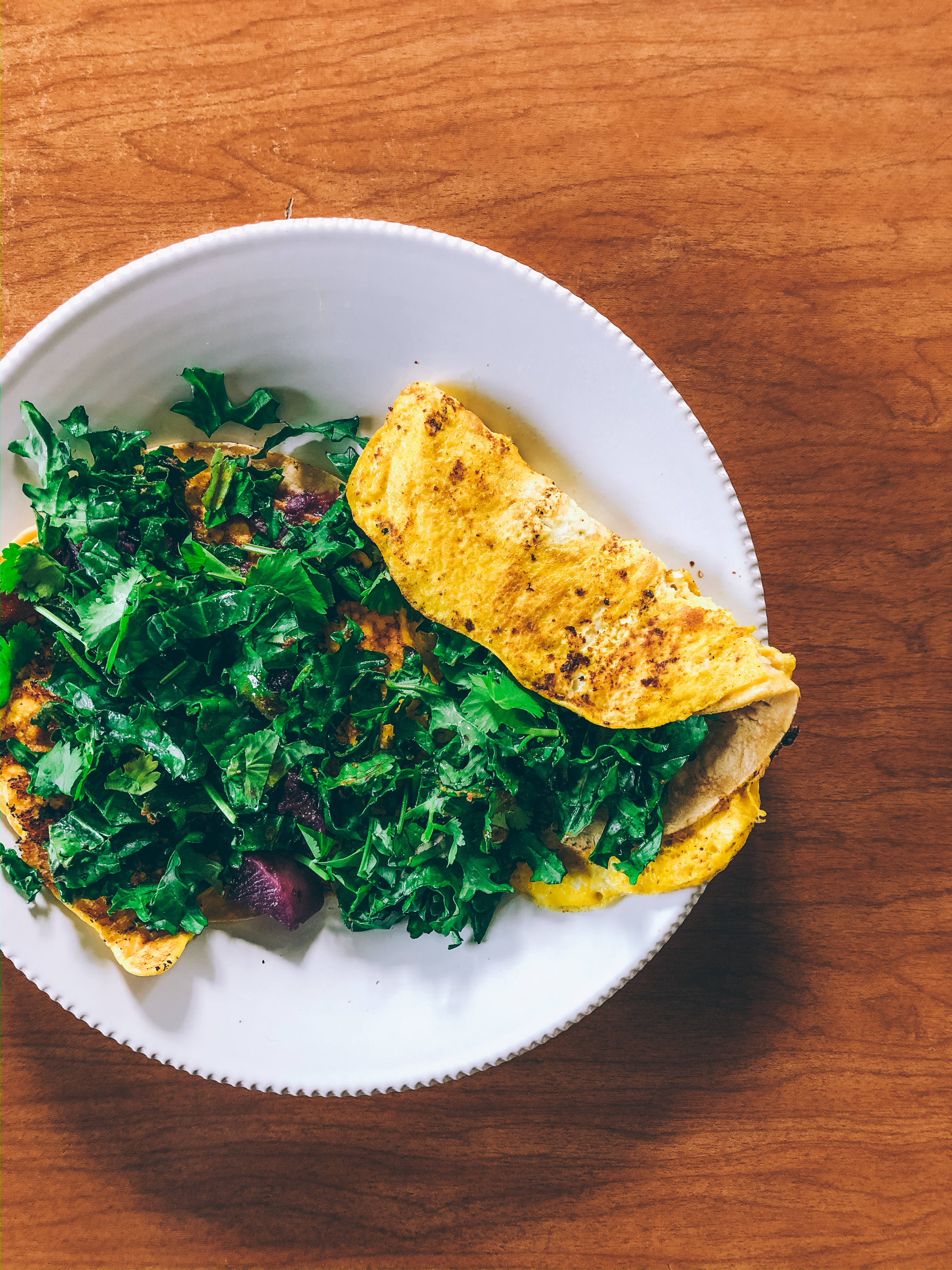
Lunchtime Basics: Quick Egg Flatbreads with Greens + Gold Spice Dressing


Dropping in to share a realtime lunch idea for you all lately. This is a meal concept that’s super seasonal, which makes it all the more delicious. 

Food Confusion and Eating Seasonally

I know some of you who read this regularly may not eat eggs. But some of you do. I’ve personally waxed and waned about eggs and many other foods over the years but ultimately have come right back to my initial conclusion: Eating is personal. And over time you change, go through phases, or learn more of what is needed to sustain you.

One thing that is very personal to me about eating is seasonality and locality. It’s what helped me through a time when I was as perplexed about what to eat as some of you – when I was following too many food trends and afraid of what to put in my body or of eating “too much.” I compared myself to everyone around me but I didn’t know how to gauge my own hunger, symptoms of imbalance, or simply get out of my head and into my body. 

William began keeping hens about three years ago, and prior to that I had largely avoided eggs for several years. That phase where eggs didn’t sound good, I didn’t like spending $7+ per dozen for local eggs, and didn’t like the conditions involved in the traditional egg production industry. But also that phase where I was following trends and wasn’t entirely eating for me.

And so, slowly, two new chicks each spring that began laying a few months later and brought such big personalities. I grew up on a farm with lots of various animals but in the years in between that time and the introduction of our first two hens, Marge and Pepper, I had somewhat forgotten how every animal comes with her own personality and desire to please. 

It’s normal for hens to stop producing eggs over the winter due to less daylength and it being cold outside. Though this winter has actually been the first for ours to take a break. Not being a daily or often even a weekly egg-eater, the winter egg break was just fine at first. But as it went on for weeks and then became a few solid months, I started to realize how I was dropping even more into the quiet of the winter season – and eating even more that way too.

Eating seasonally traditionally means less variety and abundance in the winter. It also traditionally means a change in gut microbes that can help us break down the foods that are in season.  

As the first eggs began to arrive back in the laying box and our hens began strutting around, proud of their golden tokens, it made me more aware of the gifts of each season.

Which is all to say, whether you choose to eat eggs or not, I encourage you to look for signs of the changing season as you’re out and about in your neighborhood or community, and especially next time you’re shopping. I encourage you to choose at least one new seasonal food each week–and if you struggle with confusion about what to eat, really pay attention to how you feel physically and mentally in the hours after you eat your chosen new food.

Just notice what comes up.

Quick Egg Flatbreads with Bitter Greens + Gold Spice Dressing, Serves 1
I use two things that make this super quick. A ready-made dressing and some leftover veg to add in and round out the meal. Otherwise, you can steam what vegetables you have on hand while you’re cooking the rest. Or skip the extra vegetables, but it will be a fairly light meal and may not be enough – this of course depends on the person.
One other note about the method: this late winter/early spring time of year is marked by a season of cold and wet in most regions (in the northern hemisphere). To counter that and retain balance in the body, it’s best to eat meals that are warm and cooked, and to start to add in more astringent greens like kale, chard, and spinach, while avoiding excess foods that cause mucus and damp in the body such as dairy and rich, heavy meals or sauces.

1-2 Tbs. Gold Spice Dressing
1 handful of seasonal bitter-ish greens, chopped or torn
splash of water
2 small (6-inch) corn tortillas
2 eggs, scrambled one at a time
salt and pepper

toppings/add-ins to accompany:
leftover roasted or steamed vegetables OR roasted/steamed sweet potato, daikon radish, etc.
cilantro, parsley or dill

  1. Make dressing or prep it ahead.
  2. In a medium sauté pan over medium-high heat, add a splash of the Gold Spice Dressing and a pinch of salt, and wait until the spices are just beginning to smell. Then add in the greens and a splash of water. Stir and then cover to steam-sauté for just a minute or two. Remove from the pan and set aside for a minute.
  3. Wipe the sauté pan clean and then add another small splash of the dressing. Pour in the first scrambled egg and a little sprinkle of salt. Don’t stir. Let it cook for 30 seconds to a minute and then set the first tortilla over the top of the egg. Cook another minute or more, just until the bottom is set. Then flip and cook 1-2 minutes more until the egg is cooked all the way through and the tortilla is warm.
  4. Repeat with the remaining egg and tortilla.
  5. Finish by layering your plate with the egg / tortilla flatbreads, the sautéed greens, and the steamed or roasted vegetable add-ins and herbs. Drizzle a little extra dressing on top as desired.