Oatmeal Date Chocolate Nut Butter Cookies

Dropping in quick with a delicious and nutritious treat to share. May, my favorite and birthday month, is whirling by too quick. I want to grasp late-spring and hold on to it for weeks longer. Bury my nose in the spring flowers. But alas, we move and run on.

I’m on for a longish Friday morning run once I hit publish on this recipe share, and will follow it with a full weekend of running before next week’s rest week. I’m all for the higher mileage weeks in spring and summer, and somehow the busy work and life weeks are lining up with the higher mileage running weeks. Not sure if that’s a good thing but it’s nice to have the lighter running weeks also be the lighter work weeks.

It’s some sort of balance anyway.

Related, just a teensy bit, to the running commentary above, I found out this morning that my childhood and teenage riding instructor/coach/mentor passed away in the last couple days. He was 92 and lived a full life of loving, encouraging, teaching, and leaving a lasting impression on so many — horses and kids/people. He will be deeply missed. By me certainly, but also by so many others.

Even though I’ve barely seen him in person the last few years, he is a person I think of often. That’s what happens when we have wonderful mentors. They leave an impression far beyond the period of life when we needed them for riding lessons or whatever it is, and weave their good-life-advice into our minds where it shows up at just the time we need it over the years beyond.

So even though I didn’t run regularly when I worked with him back then, his advice has often shown up in the way I handle a tough run workout or a bad result, and certainly in my work life with how I want the best for those I work with, and wonder about how they’re doing long after I’ve stopped teaching or working with them.

Those impressions that rub off and are pressed in.

Oatmeal Date Chocolate Nut Butter Cookies, makes about 12
recipe updated: 2/25/24
These are a delicious quick treat to make and eat, kind of like a more nutrition-packed monster cookie (especially if you add the peanut gems! They’re excellent for those who are active and want to enjoy snacks or treats that contribute to optimal athletic recovery rather than take away from it with excess refined sugars and flours. For the same reason, they work well for most when you’d love a sweet treat but are eating a gut healing/therapeutic diet or learning to eat with less processed dessert products. Note these are flour-free but not grain free.
Helpful Notes:
– Grind old-fashioned oats into a smaller texture by pulsing a few times in a food processor or coffee/spice grinder.
– For certified organic and gluten-free oats in the US, my preferred supplier is Edison Grainery.
– If you’re avoiding nuts, use sunflower butter or tahini and grind raw sunflower seeds into a “flour” using a clean coffee grinder.
– Purchase a good-quality dark chocolate bar and chop it into chunks. You’ll taste the difference over purchasing a lower-quality chocolate. For a list of good quality/fair-trade chocolates and which ones are better to avoid, see here. These are also good with coarsely chopped Unreal Peanut Gems in place of the chocolate

1/4 cup / 37 gr packed pitted dates (about 3 large dates)
3 Tbs. / 45 ml warm water
2 Tbs. / 27 gr coconut oil
2 Tbs. /40 ml maple syrup
2 Tbs. / 14 gr ground flax seeds
1 tsp. pure vanilla extract
1/2 cup / 128 gr nut or seed butter of choice (or a mix of a couple)
1 cup / 103 gr quick oats
3/8 tsp. baking soda
1/8 tsp. salt
1/4 cup / 35 gr dark chocolate chunks, (chop a dark chocolate bar until you have 1/4 cup of chunks – see notes!)

  • Preheat the oven to 350 degrees F. Place the pitted dates and warm water in a food processor or blender and soak for at least 5 minutes.
  • Add the coconut oil and maple syrup to the dates and water, as well as the ground flax, vanilla and nut butter. Blend until smooth. Then transfer the mixture to a small mixing bowl.
  • Stir in the remaining ingredients until well combined. I haven’t tried it yet, but in enjoying some of this last batch, I’ve decided that just a little finely diced candied ginger added to the mixture would be a truly excellent addition. Try it if you think so too. :)
  • Drop the dough by tablespoons or using a cookie scoop into 12 equal portions on a baking pan and bake for 10-14 minutes, depending on your pan and oven. These will be a little softer at first, but will also stay softer for a few days compared to other drop cookies.
  • Let cool on the pan for a couple minutes before transferring to a cooling rack.

Breakfast Tacos with Black Beans + Egg Scramble

A couple weeks ago, I made puff pastry, a cooking project I’ve long considered, but never before attempted. Puff pastry is so rich in butter, containing nearly more butter than anything else, that’s its the ultimate antithesis of a food you might think a nutritionist would make and eat.

It was a project well worth my time and effort. Gluten free, dairy-free (using Miyoko’s cultured ‘butter’), and more rich in refined starches than would be my norm. And it was an eight-hour kitchen project just to turn and fold and chill the dough.

The process and end result was so satisfying. I used the pastry the following day to make a spring asparagus, radish, and egg-topped tart which was super easy to finish and bake, but tasted like, well, I’d spent more than eight hours meticulously turning and folding it.

That puff pastry crunch as our teeth sank into each bite.

In the days that followed, the topic of puff pastry has come up again and again on repeat. In The Great British Baking Show, a past season I’ve been watching for the first time ever. And, multiple nights in a row, I woke up somewhere around 3am from a dream about getting my pastry baked in time, having enough room in the oven, measuring and folding my puff pastry correctly. A direct result of watching the show with apt attention for too many nights in a row.

Puff pastry again in a book I’m listening to on becoming a French chef.

And then another in a new recipe sent to my email from a baking blog I follow, but have never actually baked from.

I consider that when topics or ideas keep repeating themselves in rapid succession in my life, there’s meaning there. But what’s the meaning of puff pastry on repeat?

And what does that have to do with these breakfast tacos?

One thing I realized was just how much joy I found in the process. How little nutrition brain was involved in the making. Is the puff pastry good for me? Yes, unequivocally yes. For any creative process that brings that much joy, present moment awareness, and time just being lost in the process is certainly good for me / us.

Is it nutritionally sound? Certainly not everyday.

It’s taken me nearly 15 years and a whole lot of practice, therapeutic reprogramming, health crises, and grad school to realize that health is about a lot more than just the nutritional components of what we put into our mouth.

Does what we eat matter? Absolutely.

But what our body does with the food, what mindset or stress-state we eat it in, are we enjoying it with full attention or just half-heartedly chewing while doing something else? I’m coming to believe those matter even more. It took me something like these past 15 years to achieve puff pastry freedom from the food police in my brain, and just have joy in the process.

And that’s something to be proud of.

In an earlier article I wrote this year on Intuitive Eating and Cravings, which has quickly become a popular one, I spoke to the idea that we often need to balance our body first before we can decipher between what our body actually wants (intuition) and what our mind desires (cravings).

Was puff pastry an intuition or a craving?

For me, it was neither. It was a cooking project that I’ve long considered quite challenging, especially with gluten-free flour. That I just happened to eat. I love that there’s room for that in my current life.

One thing I’ve realized after I spent more time learning about the purpose of balancing flavors and optimizing a food’s digestibility is that when those two are done, the flavor and yum-factor is usually there by default. And in contrast, some of the recipes I see published that I might have reached for previously stand out to me as overly spiced, one-sided, leaning too heavily on one taste aspect or effect, and containing too many components that stimulate me/us on various levels. Or are just plain too difficult to digest. The more I notice it, the more I notice the effect it has on my mind and body.

As I focus on the balancing flavors in the everyday meal-after-meal routine, the intuitive of what my body needs / wants becomes infinitely more clear. And what it doesn’t want when I temporarily stray from that does too.

So that’s what these breakfast tacos are.

A colorful, flavorful, texture-rich, balanced taste, and for all that, actually-easy taco plate. They may have breakfast in their title, but I enjoy them much more as a weekend after-run brunch or weeknight meal.

Hope you enjoy! If you try them out, leave a comment and let me know how you enjoy them.

Breakfast Tacos with Black Beans and Egg Scramble

Switch up radishes for another seasonal vegetable as desired, add more of your tortillas as needed, or switch them out for rice to make more of a plate-style meal instead of tacos.
The black beans should make enough for a double batch (about 4 servings) to be used for another meal. 

Prep:  overnight   | Cook: 3-4 hours (for beans); 15-20  minutes  to finish  | Serves: about 2

1 small avocado
1 lime, zest and juice
olive oil for cooking eggs
pinch of mineral salt
2 eggs
1 tsp. olive oil
⅛ tsp. salt
½ tsp. smoked paprika
1 bunch of radishes, quartered
cooked black beans, see below
6 small  tortillas (6”)
small handful of cilantro, minced

Black Beans
1 cup dry black beans, soaked overnight
¾ tsp. mineral salt
1 ½ tsp. ground cumin
1 tsp. ground coriander
¼ tsp. ground black pepper
1 bay leaf
water to cover by 3-4 inches

  1. A few hours before or in the morning, cook black beans in a medium pot in the spices and water until very soft and flavorful. This is best done for at least 3-4 hours, adding water as needed. 
  2. To prepare breakfast tacos, peel and pit the avocado and mash in a small bowl. Zest the lime and stir in lime zest, salt, and then juice from at least half of the lime. Add more juice as needed. Set aside. 
  3. Scramble the uncooked eggs in a small bowl, add a dash of salt and pepper, and set aside. 
  4. Add the olive oil, ⅛ tsp. salt, and paprika to a sauté pan. Heat until the aroma comes up and then add in the radishes and a splash of water to cover the radishes by about a ¼. Simmer, covered, until the radishes are just soft. Transfer to a bowl, and then use the sauté pan to scramble the eggs in a little oil. 
  5. Heat the tortillas in a clean pan. 
  6. Enjoy the various elements including the seasoned black beans, eggs, sautéed radishes, mashed avocado, tortillas and cilantro, either as traditional taco toppings, or as a plate with tortillas on the side. 

What Does Your Tongue Say About Your Digestion?

Sometimes our bodies are really weird. And sometimes they’re super cool.

Today let’s chat about how they’re cool. Did you know our bodies have all sorts of ways to indicate and reflect externally, what is going on internally?

One of these ways is by looking at your tongue. Let’s take a look at what we can learn from assessing our tongues today!

But first, if you’re a regular reader in this space, yes, I changed my website and business name. But, it’s the same old mostly serious, sometimes goofy me (Rebecca). I’ll continue to share recipes here interspersed with more just-plain-nutrition-topics. Thanks for continuing to read and follow. Now let’s get to learning about your tongue!

When you look at your tongue, you can see clues about internal moisture (or lack thereof), heat and cold, tissue integrity and health, and overall vitality. All of this begins in the digestive tract, since the food you eat literally becomes the cells and tissues of your body within the following days and weeks. 

There are several aspects of the tongue that clue us into what is going on, including: 
Color
Shape, including width and vertical thickness
Cracks
Marks (spots, swollen papillae)
Coat (its presence, thickness, color, and how rooted it is)
Tension
Under tongue vein conditions and/or teeth indentations

For instance: The color of a healthy tongue is generally a moderate shade of pink. If yours is darker or paler, that indicates there may be something going on with the blood and/or blood circulation, such as excess heat and internal inflammation, or anemia (which at its most basic definition means lack of blood). A tongue that is purple or bluish, or has spots of those colors tells us the blood isn’t moving. You might really be suffering from a lack of circulation and feel particularly cold compared to others. Adding warmer spices to your foods and circulation-promoting herbs can particularly help cold, stagnant blood circulation. 

The tongue size and shape indicates the state of fluids and hydration within the body, as well as overall tissue nourishment and balance. A swollen, wide tongue usually indicates there’s excess moisture, mucus, or edema, and a dry, thin, tongue is often the opposite. A tongue that’s thick vertically often indicates excess heat and internal inflammation. 

Likewise, lack of vertical or horizontal cracks indicate there is adequate bodily moisture. Are you routinely dehydrated? Do you have cracks on your tongue? 

The tongue’s coat and the color of the coat in particular are tell-tale signs of how digestion has become imbalanced and can be improved. If there is no coat at all or it’s present in patches, this tells us your digestive capacity is a bit insufficient. We need to work on helping the digestive system assimilate and absorb those nutrients from your foods!

And a particularly thick coating tells us there’s some sort of excess going on, in the way of imbalanced gut bacteria, excess moisture which often presents as bloating after meals, or stagnant digestion, where you feel like your food just sits in your gut. 

One of the most common indications of imbalance I see is tooth marks or indentations or ripples on the sides of the tongue. This means the digestive fire is low, and you’re not assimilating the foods you’ve eaten, leading to poor tissue quality and all sorts of bodily presentations of feeling not optimal.

Take a look at your tongue. What do you see? 

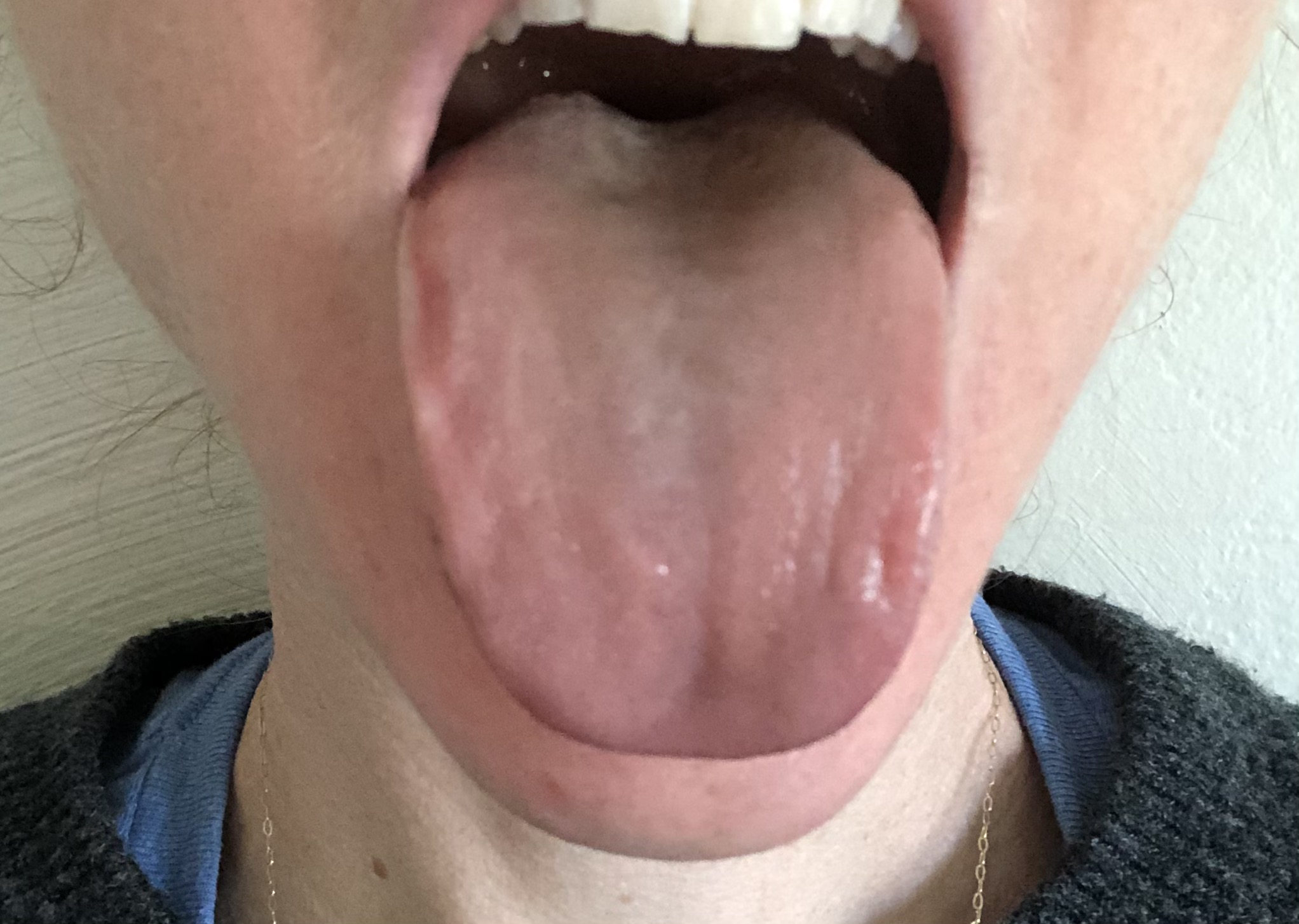
Here’s mine. What can you determine about my digestion by looking at it?

My tongue assessment:
Shape: A little wide, indicating possible lymphatic stagnation or mucus.

Color: Somewhat pale (not shown super well in this photo); indicating possible anemia and/or malnourishment.
I tend to float back and forth on the line between clinical anemia and low-normal red blood cells, have fairly chronic low digestive ability, and need for a ton of supplements to stay in “health” despite consistent focus on optimizing digestion and food first. This clue checks out with my actual lab data and long-term health tendencies.

Thickness and Color of the Tongue Coat: Spotty. Mostly absent from the front; thicker than ideal in the back, indicating poor digestive capacity in the middle and lower GI (stomach and small intestine), and excess mucus or stagnation in the lower GI (colon), probably as a result of the under functioning section above. The color is a transparent white which is ideal!

Tongue Moisture: Moist – which is ideal.

Cracks on the Tongue Body: none – ideal.

Lastly, I tend to have mild indentations or tooth marks on the sides of my tongue in the middle to front; particularly in the morning when I wake up. This indicates I’m likely not digesting the last meal of the day well and could use simpler to digest evening meals – and a little more help in getting digestive functioning to optimal: as reflected in the above areas.

Overall, my tongue indicates fairly exactly what I tend to find with my digestion, and what long-term lab data has shown: Sub-optimal digestion with a tendency to not digest and assimilate nutrients well.

I will say with consistent work at it, my digestion has improved substantially from what it used to be, and I’m less super-obviously symptomatic. I rarely experience bloating, sharp or low-grade GI pain, etc.

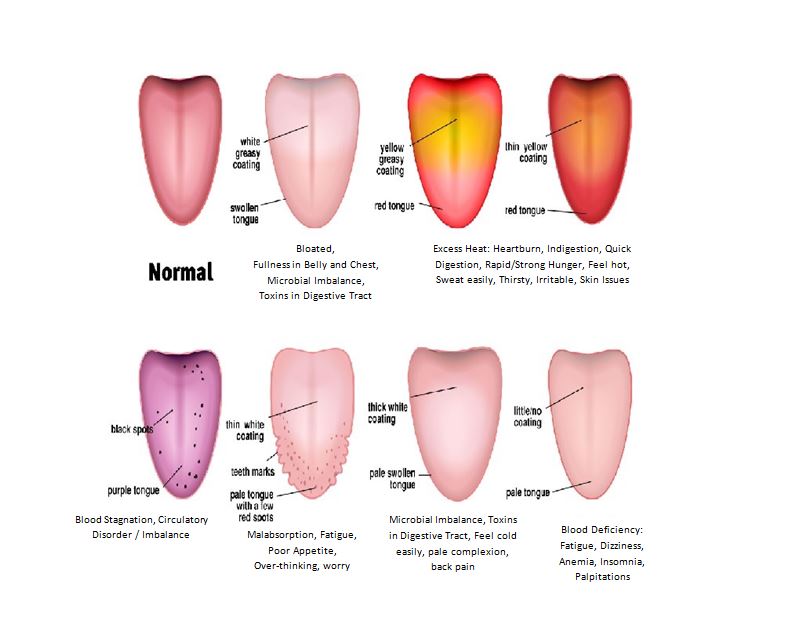
Here’s another illustration with notes about what the presentation is indicating in terms of digestion and health: 

Tongue Types – Digestive Health

Does your tongue suggest your digestion is functioning optimally? Or do you find indications that reflect exactly what you’ve had going on in there? If you’d like to learn more about how you can fix it, I’d love to speak with you in a quick phone consultation! Or learn more about your digestion in my other articles on the topic of optimal digestion and gut health

References:
Bunce, L. (2017). Tongue Assessment for Western Herbalists: A Primer.
Coatzee, O. (2017). NUTR 663: Sports Nutrition; Eastern Medicine Tongues. [Lecture]. Maryland University of Integrative Health. Retrieved from: https://learn.muih.edu