

Years ago in the thick of my disordered eating days, I regularly frequented a forum on the Runner’s World site in which runners would post their daily meals. I participated a bit, but I mainly monitored what these people ate and compared my own meals to theirs. It was a terrible habit that led to nothing good. There were a few runners in other forum topics that deemed this “Nutrition and Weight Loss” forum a breeding ground for all the eating disorders to proliferate. To an extent, I agreed, as there were many runners recovering from and/or struggling with eating disorders who collected their meals there and I could see it was mostly a terrible place for me to frequent.
I’m remembering this now as I reflect on my seemingly lifelong troubled relationship with food, my body, control, and ultimately comparison. When I wrote a few months ago about my eating disorder and the idea of restriction, I shared that I have no food rules, no off-limits items (other than gluten and dairy for allergen reasons), no black and whites. I meant what I wrote.
But I need to air out a big elephant looming in the room which I get asked about, weekly. I had a hamburger in May at my niece’s birthday party, a bit of pork loin the weekend before at my in-laws, and a short handful of meals with meat since at the homes of friends and family, and even at our own table as William had been requesting that I cook a roast for weeks and I recently gave in. I didn’t necessarily feel like eating any of those meals but not wanting to be the weird, offensive one, hungry and standing out eating only fruits and vegetables, I partook. Some of those meaty bites were just fine when I stopped thinking about them, but in others I actually had to coach myself through eating.
Way before I began my disordered eating, I had issues with meat and beef in particular. Being raised on a ranch, my parents making their livelihood in cattle, beef is what is and has always been for dinner. Being the oddball in my family from the get-go, I never really developed a taste for it. Ground beef in particular has always been a struggle and there were many meals that became ordeals growing up. In my family, it was protocol to sit at the table until the plate and glass were empty. I inevitably always got to the end of the hamburger gravy and the milk in my glass, only when I had drained all the tears, spent all my stubborn rage, and finally plugged my nose and got on with it.
Throughout the years since, I’ve gone through phases of eating and barely eating meat. I attempted to be vegetarian during the days when I was avoiding foods with substantial fat and calories. Along with a few other foods, I put all meat into an off-limits category, with the idea that if I cut out an entire food group, I would not eat as much. Later, I left the country a couple times and rarely ate it because it was expensive. In the year that William and I lived apart, I barely ever cooked it. During the periods when I either actively or passively ate less meat, I did not miss it. Most of the times that it was reintroduced, it was because it was just there, our cultural norm, or I thought it was needed for a balanced diet. It was also the first food group that I was commanded to add back in to gain weight and for this reason alone, it will likely always have a lot of stigma attached.
For whatever reason in the last 18 months or so, along with the onslought of refiguring myself out that I’ve been dealing with, the idea of meat has become more of an issue again. Like when I was young, I’ve stopped enjoying the flavor and texture. A couple of months ago, I started noticing my reaction to when people ask me if I eat it, as they often do. I was emphatically answering yes, as in oh yes, definitely, of course; just not too often as I really like vegetables. I have been saying this as if I’m pleading with them to accept me as not that weird. Lately, I’ve been taking a back seat mentally in these dialogues, watching my thoughts and cataloging what is going on. After further reflection and digging beneath the surface, these experiences have me realizing a few things:
I realize that when people don’t like a food, they usually don’t make a big deal out of it. They just don’t eat it. And when they are allergic or intolerant to something, they don’t treat it as if it’s a nasty disability to be hidden. I tend to do both because I fear being an inconvenience and different. (Ironically, I have a giant individualistic streak and I like being the one doing my own thing.) I’ve spoken to William often about this and he always tells me, Look, there are foods I don’t like. And I don’t eat them. It’s okay if you don’t like meat. Just don’t eat it. His words are incredibly encouraging because I’m the one who decides what we eat most evenings and I’m especially thankful he’s okay with (mostly) foregoing it nightly and can enjoy it at meals we don’t share, or on days when he or we eat out. I am aware more than ever of where my mind goes in desiring to create “rules” to live by, to make me feel like I’m somehow in control of my circumstances. I have needed both to continue testing out meat periodically to see what the deal is mentally, and to hear William’s affirmations. More than the still-lurking-beneath-the-surface-fear of many social situations with food, I fear fixating on foods and unnecessarily labeling them good or bad. Doing so was the primary characteristic of my disordered eating days and I have no desire to retrace that path again.
Several months ago, I started reading Gena Hemshaw’s Green Recovery Stories on her blog, Choosing Raw. Gena is vegan and the green recovery stories are shared by women who have healed their relationship with food and recovered from eating disorders by adopting a vegan lifestyle. Mostly, their reasons center around reaching beyond themselves to find compassion for animals. I grew up showing and raising animals for meat and still feel substantially connected with the farming and ranching community. This closeness to the source of my food has me feeling differently than most of the ladies on Gena’s blog.
After reading many of the stories, however, I realize that I did find a similar eating lifestyle which ended up being a direct route to the beginning of healing my struggle with food. In the throes of this messed up relationship, when I feared every kind of fat and sugar and food of caloric significance, I recognized how distant I had become from the producers. Having grown up on a ranch and studying agriculture as a degree, this pained me but I could not seem to get out of it. At some point in my junior year of college, when I set out to expand my horizons by learning as much as I could about the different types of food production and farming methods, I learned of Alice Waters and Slow Food. A transition began. Shortly thereafter, I left the country and while abroad, the process was expedited due to the farm-tour-type classes and experiences I took, and the significance and national pride in eating local food that I witnessed in much of Ireland’s traditional eating patterns. After returning home and finishing school, I took the entirety of the monetary graduation gift I received from my grandparents and I went off to a cooking-farm-school for a week in remote, northeast Washington. I picked up a girl I’d met via email on the way and we carpooled the nine-hour drive, getting to know each other over Indie music and mutual interests in food and farming. That week–a week in which we began the day milking the goats, harvesting the produce for breakfast, making cheese and wood-fired, slow-fermented sourdough bread among other things–stabilized much of the healing process that had begun with learning the philosophy of Alice Waters and experiencing Ireland’s food culture.


Growing food is incredibly difficult work. I admire all farmers. But the more I learned about all types of food production, the more I resonated with biodynamic and sustainable agriculture. It made absolute sense to me that the truly exceptional farmers focus on the soil and let the soil feed their crops. This was a slow and gradual learning process and as such, my diet and lifestyle habits changed quite gradually. The more I learned about and respected the process of food production, the more I have steered towards eating whole, minimally processed, and sustainable, organic, locally-produced foods. Making what the land around me can produce in each season the bulk of what is on my plate has been central to healing this broken relationship and can be summarized into one word: consciousness. The more farms of all types that I got my feet and eyes and hands on and into, the more I read of this book and then slowly over-hauled my diet, the better my relationship with food and my body became. I began to change my paradigm of “never” foods. I could sit down to a meal and eat without a thought for calories or nutrients or where on my body that food was going to end up. I instead focused on the flavor and on the process of what it took to get it to my plate. How many hands helped in getting it to my table? What kind of life did those people live? Would I be proud to produce that kind of food if I were the farmer? If not, why was I then supporting it as an eater? Essentially, this is the ethos of Slow Food–eating food that is good, clean, and fair. Recognizing the finite resources we take for granted and the impact of every one of our consumerist choices, learning more about the connection between the microbes in our soil and in our bodies and their subsequent impact on our health–these learnings have had a powerful impact on my recovery process. There is now much more to my relationship with food than “what’s in it for me.” And so, my diet has ended up being more or less vegan without putting particular intentionality to it since being vegan is not my focus. The more I learn of myself, the more strongly I feel that I should not be eating meat right now. I do eat eggs on rare days when they sound good but I often bake without them because it is difficult–and I enjoy a good challenge. I like honey. I am constantly learning and adapting. I make exceptions.
When I shared a big piece of my history a few months ago, one of my best friends reached out to me about being able to process and share a tough experience. She told me I was inspiring to her and to many others. Her comment meant a lot because I don’t feel like my relationship with food is one that anyone I know can relate to or draw inspiration from. Most of the time, I feel like the black sheep at the party and I want to go hide in a corner or politely decline social situations involving food. I don’t think it should have to be this way. It is okay to have different ideas and different preferences. It is okay to be the one person in the room that is eschewing social norms for their own sake. In fact, these types of people are the change makers in our society that I’ve so often looked up to. I’m sharing all of this today because perhaps there is truth in my friend’s statement. Perhaps there is a little part of my experience that can be an inspiration and sharing can make someone else’s uneasy relationship with food and body image a little less messy than my own.
When I look at where I was years ago and where I am now, I am so incredibly grateful that I can largely enjoy days and weeks of meals with little guilt, few negative thoughts, and almost non-existent calorie counting, nutrient tallying, and labeling of good, bad, and off-limits items. I feel entirely comfortable going home to visit my parents, knowing they will be supportive in whatever decisions I make and whether or not they agree. I’m also able to take eating day by day, loosening up a little and being less in control, and developing significantly less anxiety when eating meals prepared by others, especially when they are not the meals I would make for myself.
At the end of the day, I love food. I love conviviality, I love cooking for and sharing meals with others. I loved them before I ever knew what a calorie or a nutrient or a “superfood” was. I also really dislike hiding. Getting this all down makes me realize I’m incredibly close to being able to eat exclusively on my own terms, to care less about what other people think–and stop comparing–to just eat what makes me feel satisfied, roll with the phases life brings, and live a little.
Perhaps sharing my experience is not what was meant by the being-an-inspiration comment from my friend. Regardless, I think we can all be a little better off for caring less about normalcy and fitting in and more for being true to the one person we get to live with constantly–ourselves.
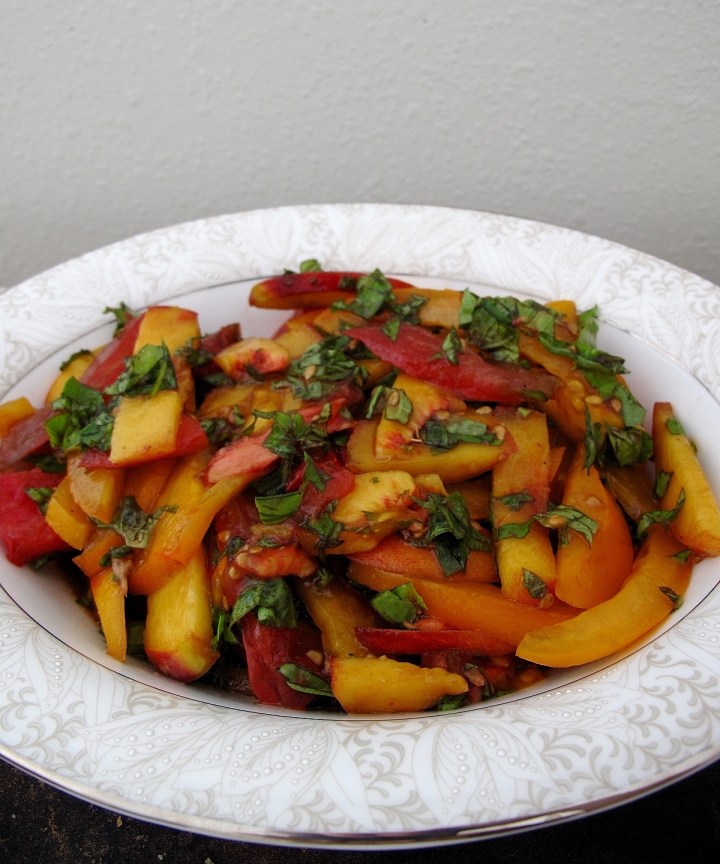
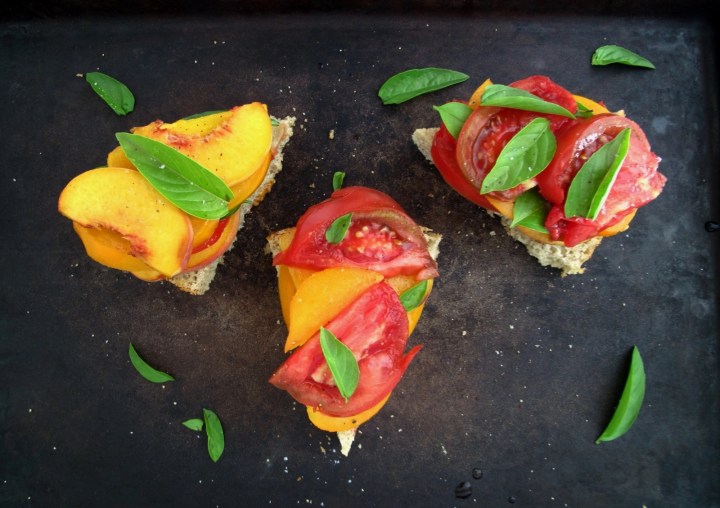
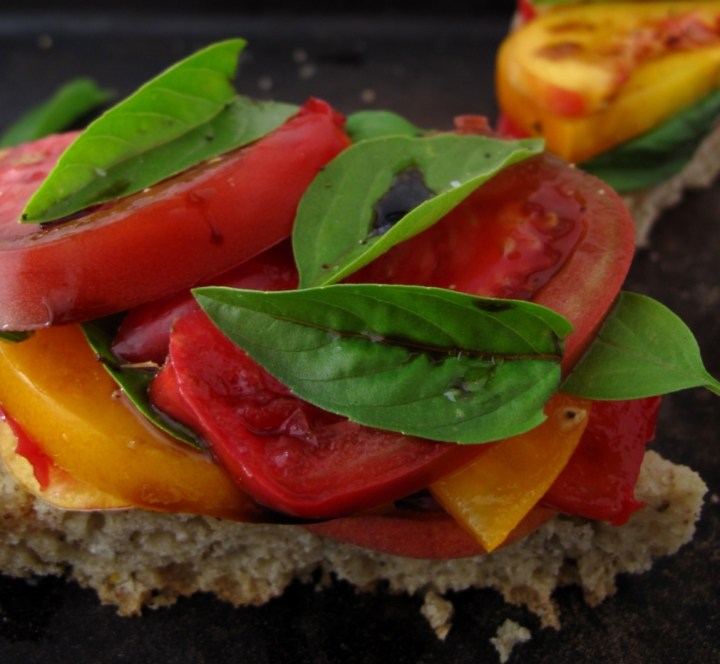
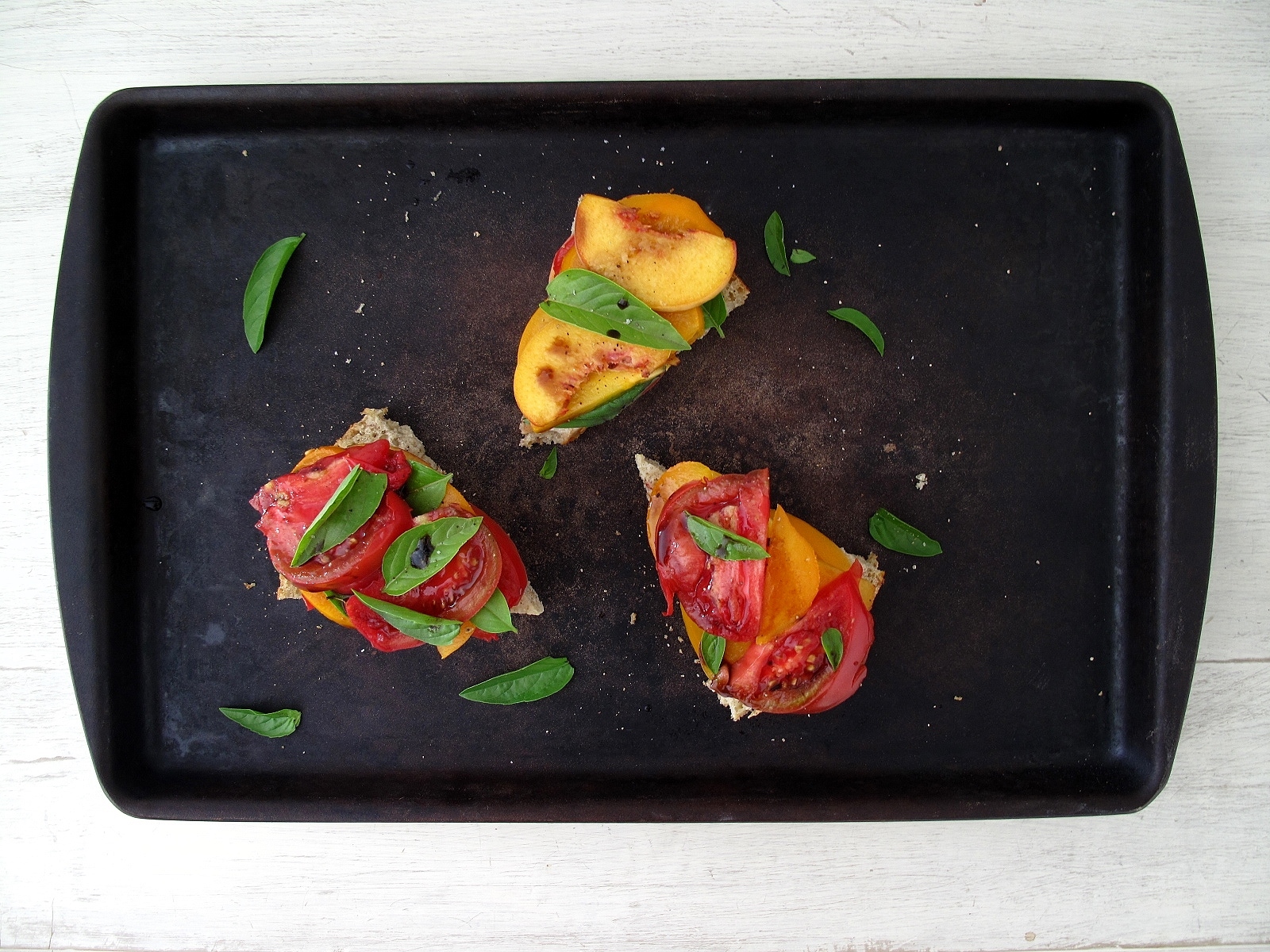
Tomatoes, Basil + Peaches, on Toast. serves 2-3
This is the simplest of summery dishes, which can be thrown together in a flash and enjoyed with some sort of protein to make a full meal. We are getting nearly to the end of the peach season here, but if you can find tree and vine-ripe peaches and tomatoes from a local source, the difference is magical — and worth the wait until next season once they are gone!
1 peach, thinly sliced
2 large juicy tomatoes, sliced
a small handful of basil leaves, finely diced
a pinch of salt and ground black pepper
1 1/2 Tbs. extra virgin olive oil
1 1/2 Tbs. balsamic vinegar
whole-grain, gluten-free bread, toasted (or good slices of whatever you prefer)
- Combine the sliced peach and tomatoes with the basil in a large bowl.
- Measure in the balsamic and olive oil and salt and pepper to taste.
- Stir to combine, and then spoon atop, crusty toasted bread.






 GUTSy Performance Nutrition