Polenta with Lemon-Garlic Raab + Chickpeas

Polenta with Lemon-Garlic Raab + Chickpeas

IMG_9373


In our marriage counseling, William and I learned about family of origin and the long-held beliefs, values, and challenges we bring into our relationship. Like many relationships, the arguments we often have are about money. I have a vivid memory of a late-night ‘discussion’ my parents had when I was quite young, which I wasn’t supposed to overhear. It was about money, of there not being enough to make it to the end of the month, and I laid in bed that night unable to sleep, as if the panic and fear in their voices transitioned directly into my pysche and lodged there permanently.

To this day, I hate thinking about money. I’ve grown to avoid the responsibility of it in our marriage because in doing so, maybe its stresses will go away (logical, I know). I fought hard with William for years about having a credit card because despite his logic that it’s wise to build credit, I couldn’t get over the memories of watching my parents painstakingly climb out of debt from this system, of the shame of growing up eating free hot lunch at school, of wearing shoes that cost $10 from the local budget store when all my friends were wearing the trendy $100 ones.

It is interesting to me now how I never went hungry growing up (quite the opposite with a large garden and ranch) and I never lacked anything I needed. But as soon as I was able to compare myself to others, I decided that I lacked some of the trendy material things my peers had. I feel nothing but deep admiration for my parents for climbing out of a tough place and gratitude for their teachings about wise spending and saving. And I wouldn’t choose to go back and change those early circumstances even if I could. Perhaps because of my parents’ teachings, and probably more out of fear, I operate largely as if I don’t have money and jump to panicky reactions when talking about spending. It tends to create tension and resentment.

I also feel guilty and ashamed of spending on things my parents are frugal about.


Like food. I prioritize spending on food.

I volunteer for a local food action team whose mission is near and dear to my heart, to promote eating food that is grown or processed locally within a six-county region. The group’s reasons for striving for a more locavore diet are many, and I’m sure every member would answer differently as to why eating local food is important: for the local economy, for the environment, for health, etc. I like all of these reasons and more, but the one that is most important to me is the connection to a place and to a people, to feel as if I am a part of something meaningful, rather than consuming the mass-produced commodity of our time.


For most people, the largest barrier to purchasing foods grown locally is usually cost. I’ve heard it across the board from individuals I know are well-off to those that surely are not. Like the choice of what we eat, how we spend our money is highly individual and emotional. And though I choose to support people, businesses, and values I believe in, I really strive to eat frugally too. Our action team goal for the past couple years has been to promote eating ‘local on a budget,’ and I have been very interested in this topic.

I often feel like a fraud though, when I even talk about eating frugally or consuming local foods. As I’ve mentioned before, I’m not overly rigid about sourcing or labels. We still have olives in our fridge from Greece, tea from China by way of Ireland, and staples in our pantry from all across the globe. A lot of my food choices have more to do with my tendency to explore one or two ingredients in a variety of ways for weeks at a time–and it often leaves less consideration for a budget and a place. William I and have been eating loads of broccoli this last month, for example, and not one of those tasty florets has come from a local farmer. Likewise, my weird current craving for coconut yogurt is not a frugal indulgence. So to help me walk the talk of eating local on a budget, I plan to share a little more of the meals in this space that help me engage in what I believe in. I hope you’ll be inspired to think about the seasonality of ingredients and recall there are persons behind our foods that worked hard to provide that nourishment–and perhaps even explore more of the local offerings in your area.
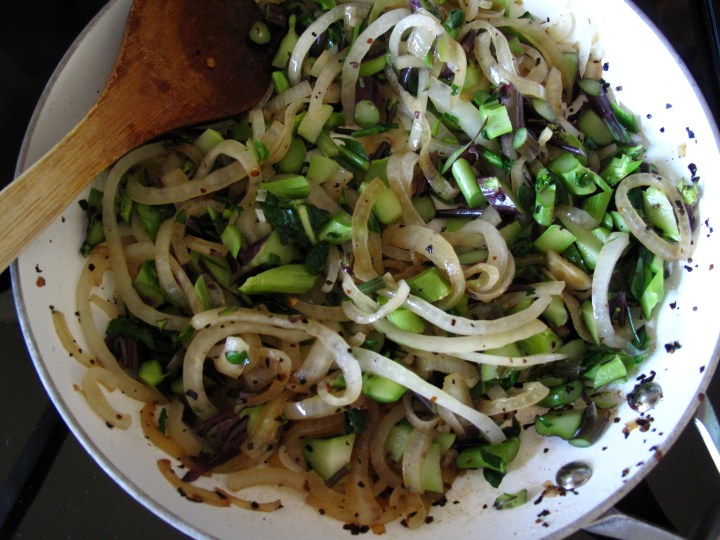


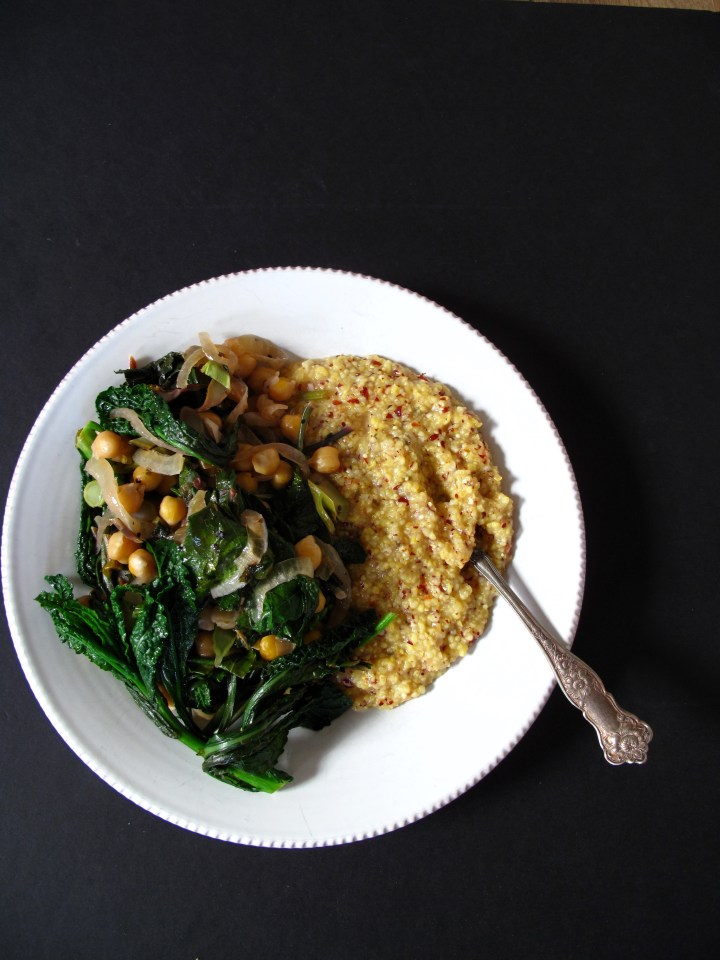
This polenta dish features raab, which can also be called rabe and rapini. If you google it, you might read that it is a unique variety related to broccoli; this is not necessarily the case to the farmers and gardeners I know. At this time in the season, all of last year’s brassica crops that have overwintered are finally telling us their time has come, the weather and light are changing, and instead of continuing to produce nice big leaves, they’re putting their energy into flowering and eventually setting seeds. So all the local farmers are selling the last of what these plants are offering as kale, sprouting broccoli, arugula, and mustard raabs. They are tasty, nutritious, and have cute little broccoli-like florets. We are currently in the three-four week window where these plants are available and they’re likely to be found from a farmer or perhaps a grocery store which sources directly from farmers.

Secondly, I used Abenaki corn polenta in this recipe, which comes from a local farmer specializing in grains and legumes. Abenaki is a heritage corn and is quite beautiful when ground, with its speckling of red and gold pieces.

Due to some dedicated farmers, this meal came almost entirely from the two counties I live and work in, and given our food action team parameters of an $8 meal for a family of four, can be counted as ‘local on a budget’ as well. Lastly, it is a meal I’ve made more times than I can count during the late-winter/early-spring months, and it is one I’d gladly make for all my friends.


IMG_9377


Polenta with Lemon-Garlic Raab + Chickpeas, serves 4

1 tablespoon olive oil

1 clove of garlic, minced

3 cups vegetable stock or water

1 tsp salt

1 cup polenta


1 teaspoon red pepper flakes

1 tablespoons olive oil

½ a medium onion, or 2 large leeks, minced/sliced

1 clove garlic, minced

2 medium bunches of raab (kale, sprouting broccoli, mustard, arugula, etc.)

2 cups cooked garbanzos

juice from ½ a lemon

pinch of salt


Directions:

  • Heat oil in a medium-sized saucepan with the minced garlic. As the garlic starts to sizzle, add stock or water, and salt. Bring to a boil. Gradually whisk in the polenta. Reduce the heat and simmer gently, stirring frequently to prevent sticking until the mixture is very thick, about 30 minutes. Add additional salt to taste.
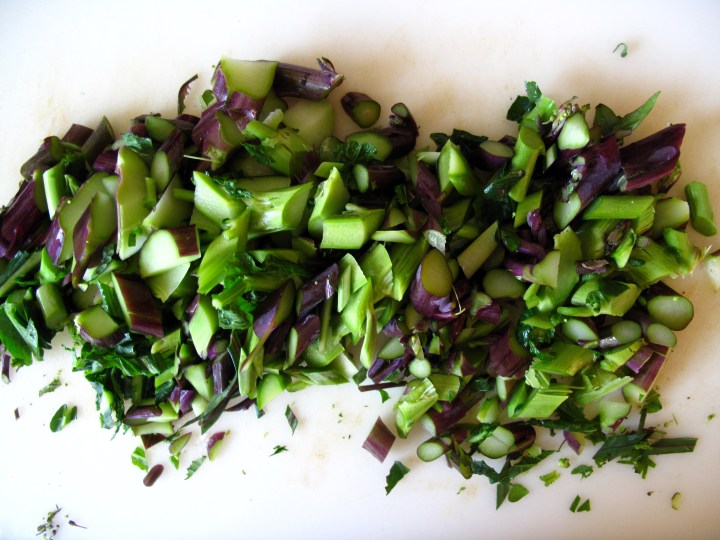
  • Meanwhile, remove the longer stems from the raab and chop into 1-2-inch pieces. Slice the leaves and florets into longer 3-4 inch pieces and set aside.
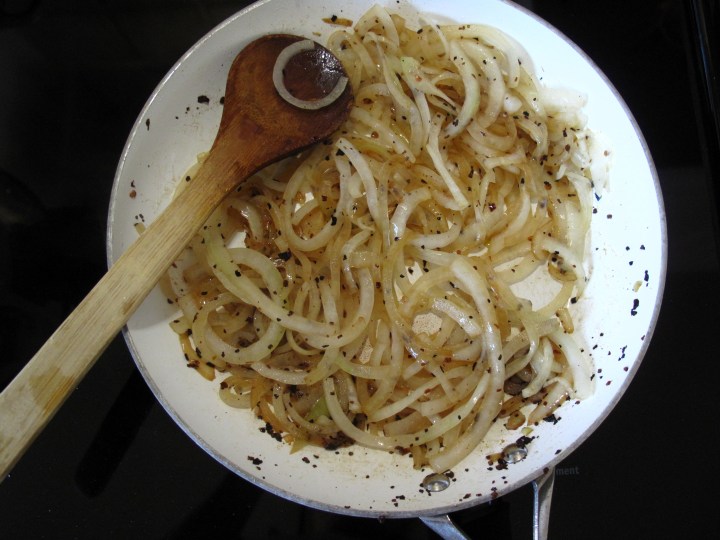
  • In a medium-sized pan, toast the red pepper flakes for 30 seconds or so over medium heat. Add the olive oil and onions and cook over slightly lower heat until they begin to caramelize. Add the raab stem pieces and garlic and cook for 3-5 minutes more. Then add the raab leaves and florets and let wilt, untouched for a couple minutes before stirring together. Add the garbanzos, lemon juice, and salt to taste. Stir and remove from heat.
  • Serve in a bowl, all together.


and Flying

and Flying

IMG_9132


I’ve finally accepted I don’t handle big, celebratory life events like most people. So I wasn’t jumping up and down excited the day we got the keys to our new house. Actually, I was wishing it would go away, the moving, the moving-on from the town that is home and the many special places there that I consider mine. My high school students asked my age the other day, and when we started talking about it, I shared how I won’t consider myself “grown up” until I reach 30. They laughed at me but were also surprised because as teenagers eager for freedom, they think becoming grown up happens at the exact turn of the clock to 18.  Moving on from Corvallis means much to me for so many reasons, but at the bottom of it, it is the place where I’ve done all my formative growing up, where I belong to and am invested in the community, where my work is, and many individuals have shaped my life perspective.

William’s grandma accused me of not being very happy about the new house over the Christmas holiday. I explained it away with, I’ve only been in it once so it’s a little difficult to love yet, but I was well aware my lack of enthusiasm went deeper. Since then, many people have asked me if I love it and I can tell by their tone of voice that my honest response will burst all their happy-for-us excitement. Ultimately, loving a place (or person) comes from deeply knowing it, and this little space and I are only just getting acquainted. So no, I do not love it yet. But knowing we were eventually moving, I prayed about it for a long time. Finally, just a few days before William brought up the idea of purchasing instead of renting, I felt the peace with relocating that I had been asking for. Later, a couple days before we got the keys, I felt very strongly that there is work for me to be done in this new place, that He is calling us to Eugene for a reason, that it is okay to have little clarity right now.


A week and a half in to being a Eugene resident, I told William, I’ve skipped straight to the angry stage of culture shock with this town. I prefer a community a little smaller, a little less busy at 5:57 am, a little friendlier to my idea of getting across town, a few less barking dogs in our neighborhood, and many more cats(!). I was complaining, irritated, and aware of it. In other words, I was adjusting.

I have still to figure out which will be “my” grocery store, where I will enjoy running on a regular basis, how to take all the quiet(er) little shortcuts to where I am going. And I’ll have to meet and make some new local friends.

Corvallis taught me these things take time. But even though I’ve felt a little upended this last month since moving, I’m diving in to learning this community in the ways I tend to, with running and with food:


IMG_3697


A couple weeks into the relocation, I was out running out at the edge of Alton Baker Park, near where the river gets a little wild and Eugene becomes Springfield. I remembered being on my pony, Angel, back at the ranch, about a mile from the house, on the road between the creek and the calving shed. I was around nine years old.

I remember leaning forward over Angel’s neck, letting the reins out, the hairs of her long mane tangling into mine, and feeling her fly, as fast as her legs could carry her. And I remembered that wild, heady freedom that a nine-year-old feels, completely absorbed in that moment, no fear, no coulds, shoulds, if-thens, but just there, all there in that rush, that moment, going as fast as we could go.

I relived that memory a moment and then I turned to run back towards home and my car, and my nine-year-old self and Angel faded behind me.


Back at that exact same spot a couple weeks later, the memory came back, just the same as before, unexpectedly, as if waiting for me. And then I connected the dots. So that’s why I’ve been running all these years, I thought. That’s why I love running fast especially. Perhaps I’ve been searching for that part of me I experienced with Angel all those years ago, that wild, carefree little girl who wasn’t afraid to go all out and live.


And then I smiled. This little city and I will get along just fine, I thought. There will undoubtedly be some growing pains, and I do miss the comforts of home in Corvallis, but I can tell there will be good things for me here.


So when friends ask, do I love the new house? my answer will likely continue to be hesitant. I don’t know that I will ever love the house, as I’ve never grown too attached to a building before. But I do get especially attached to places. And I’d like to tell them, in time, that I absolutely love this new place.


IMG_9106


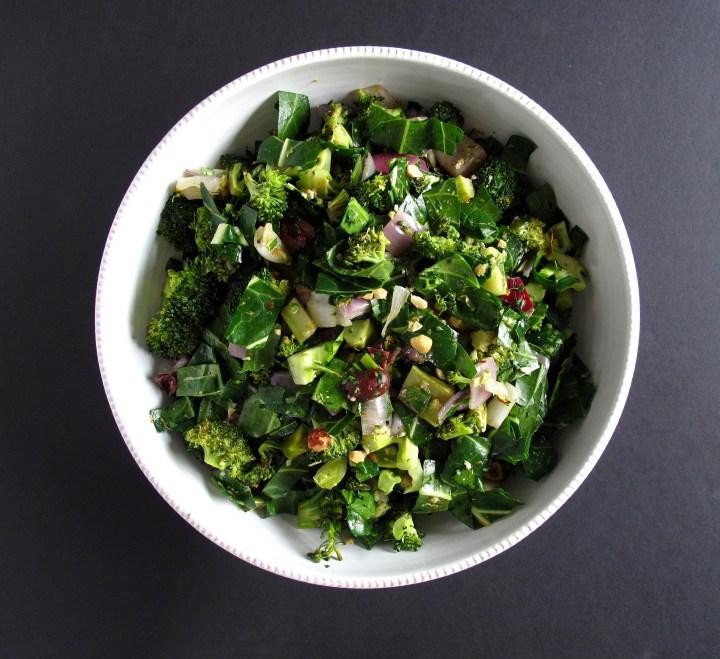
Broccoli, Collards + Kalamata Salad, serves 4-6

inspired by Sara’s Emerald Salad

William is on a broccoli kick lately. He asks for broccoli in everything. I had no idea he is partial to this vegetable until now, but glad I am because our school-garden-broccoli was such a success last year and I’m now planning on upping my broccoli-growing game in our new home garden this spring. Planning has already begun!

2 lbs. broccoli

1 large red onion

3 Tbs. extra-virgin olive oil, divided

zest of 1 orange

3 cloves garlic, minced

1 tsp. salt

1 tsp. ground black pepper

3-5 cups collard greens (or other winter greens), thinly sliced

red pepper flakes

3 Tbs. orange juice

1 small handful flat-leaf parsley

¼ cup kalamata olives, sliced

¼ cup toasted hazelnuts, chopped


– Preheat the oven to 425 degrees F.

– Chop the broccoli into 2-inch pieces; include the stems but discard the large, tough ends. Roughly chop the onion into large pieces. On a large bar pan lined with parchment paper, mix the broccoli pieces, onions, 2 Tbs. olive oil, orange zest, garlic, salt, and pepper. Once all the vegetables are nicely coated, roast in the oven for about 20 minutes, until the broccoli is starting to brown on top. Rotate the pan or stir halfway through.

– While the vegetables are roasting, remove the tough center stem and thinly slice the collards. Put them in a large mixing bowl. When the vegetables are roasted, pour them atop the collards to soften slightly and give the mix a good stir. Add the orange juice, pepper flakes, remaining tablespoon, if necessary, and toss with olives, parsley, and hazelnuts.

– Serve warm or chilled.

Roasted Sweet Potato with Cashew Butter + Za’atar

IMG_9086


No matter how healthy I think my relationship with food is, there are a few foods that I am still cautious about. They’re ones I was once told to eat more of, with the implication that they would lead to some good, healthy weight gain. Those stigmatized foods are ones I mostly enjoy in my diet now but still I tend to eat them in small amounts, less often and/or cautiously. William has gotten hooked on Trail Butter in the past months, and he’ll slurp down two or three packets after dinner when we have it in the house. I’ve watched each time with a little twinge of envy, not for the desire to eat the Trail Butter itself, but to be able to down heavy doses of nut butter without a thought for anything other than the taste. Nuts and nut butters are on my caution list along with seeds, bananas, eggs, avocados, and the one I’ve shared about before, meat.


It is interesting to me now, how stigma around a food is far less healthy than any food itself. As I mentioned in my last post, I’m taking a class right now about redefining nutrition and I really love the conversations we’ve been having about nutritionism, reductionism, culture, and the similarity between diets and religion. What I didn’t mention is that I’m actually at the beginning of a nutrition and integrative health graduate program, with a focus on clinical nutrition and herbal medicine. It’s exciting and scary to think about a future off in the distance which I’m sure will look far different than the one I now imagine. Perhaps the biggest theme I’ve learned in these past few years is that much joy can be found in learning to let go of control and live in the unknown. After spending the last several years exploring options and figuring out what is true to me, this step is another case of trusting what I feel to be true will lead in the right direction.

As I embark on the learning and forming of the next few years, I want to have my preliminary intentions dropped here in this space to guide and remind of the bigger picture, as I inevitably get bogged down in the details of shaping what’s to come:


– I set out on this journey because I want to serve others. Stepping away from teaching in my own classroom these last three years, I’ve particularly missed the ability to build deep relationships with students and see and guide their progress. I want to be able to see that I am helping make a difference again.

–  I’ve experienced many obstacles in my own pathway to health and had to navigate through the noise to find what is true for me. I’ve spent more time with specialists in the medical field in this last year than ever before because I still haven’t been able to kick whatever has been making my feet hurt. In the process, I’ve realized why it has taken me so long to trust this career direction is the right one for me:  In the past, I had many specialists tell me “eat this,” “gain this,” “add this,” “stop this,” “take this pill,” etc., without understanding my journey as a patient, as a really fucking scared human inside a body, feeling very much alone. In this last year, I’ve come to terms with the fact that I go into every new encounter with a doctor or specialist with my guard up, with a “you-aren’t-trustworthy-until-you-prove-yourself” attitude—because of how my physical recovery was handled in the past. And though I’ve had better experiences this last year, there are still some that were remarkably similar to those not-great ones in the past.

I get that behavior change is incredibly challenging and I want to always remember what it’s like to be “on the other side”, to be the patient, to understand that his or her experiences change the way the things I will say are taken. I want to remember that much of what has been said to me in helpfulness when I am a patient has been taken wrongly by my mind that is either “fixed in illness” or focused only on fixing the problem so I can maintain my current behavior symptom-free. I won’t be able to always understand another person’s point of view or get an interaction right all the time. But I’d like to stay mindful about a perspective and an experience different than my own and respond accordingly, in a way that is more personal and personable than “eat this,” “add this,” “do this,” etc.

– I chose a program with a focus on integrative health and a specialty in herbal medicine because I cannot believe that any aspect of health operates in a bubble. When I’m short-changing the healthy fats in my diet, beginning to restrict quantities, or having a day when I come home stressed and tired and eat mindlessly and then guiltily judge myself for having consumed “too much,” my actions and reactions are generally not about the foods themselves. I get that food, nutrition, diets, and health are more complex than the focus on only food itself, I want to learn more of how others experience that, and be able to bring that understanding into practice.

I’ve chosen to learn more of herbal medicine particularly, as the healing of many of my major ailments and imbalances these past few years has been facilitated through herbs, food, and mindfulness alone. My own experience with plants has been life-changing; and I’ve long felt a connection to plants as if they hold life’s answers. I simply cannot wait to know (and share) more. Of interest to me now is the intersection between herbal medicine and sports nutrition. I don’t know if this will be an area I focus on in the future, but there are currently quite a few herbs of interest among the athletic community, considered “superfoods” by many, to help the body adapt and recover from stress. I’m excited to delve into both the ancient traditional use of these plants as medicine, and the modern evidence-based science of continuing to use them now.  

– I believe there is great power in the mind and the human experience and I think we as individuals have a lot of power as patients and as self-healers. We tend to see our health as something to fix, or to have another person tell us how to fix with an “easy” answer. Most of us don’t view our bodies as friends, as guides, as part of our health journeys that have just as much to say (and perhaps more wisely than our rational minds) in how we become the persons we envision ourselves to be. I want to help others find their friend in their body, and reconnect their rational self with the self that already knows what it needs. I’m working on this myself these days. In fact, I’m thinking it might be both the biggest ongoing challenge and achievement I’ve undertaken.


So now, back at the beginning, I recognize I’m much like everyone else, down in the trenches with my own set of challenges:  The Recipe Redux theme this month is to try something new in this new year. My new discovery comes in the way of a snack that I started craving one day during a run in the wet, (wet, wet) Oregon rain. It’s got one of those in-small-amounts foods I mentioned above that up until now I hadn’t tried—Cashew Butter—slathered in little spoonfuls atop a roasted sweet potato (or microwave-baked for those of us who come in hungry with sweet potato now cravings), and a hefty pinch of za’atar sprinkled atop. Admittedly, I slid back into old patterns one day and tried it without the cashew butter because I was afraid of too many of those nuts (point in case, I’m a work in progress), but the sweet potato and za’atar were definitely missing their key ingredient. So if you try it, I suggest adding all the ingredients.


IMG_9071


Roasted Sweet Potato with Cashew Butter + Za’atar, serves 1

1 medium sweet potato, scrubbed and stabbed with a knife a few times to vent

1-2 spoonsfuls cashew butter

Za’atar, to taste 

  • Roast the sweet potato on a square of foil in an oven, preheated to 400 degrees F, for about 40-50 minutes, or until soft all the way through. Alternatively, if in a hurry, it can be microwave-baked.
  • Slice open the sweet potato, mash gently, and then spoon the desired amount of cashew butter atop, allowing it to sink in, soften, and melt slightly.
  • Then add a pinch or two of za’atar, and serve!