Gluten Free + Vegan Irish Soda Bread

IMG_4275

For a few weeks in the late winter or early spring, I inevitably begin cooking more simply, or more simply than I usually do, and turn my meat and potatoes-snubbing nose towards the flavors of home, or of home in the old country. It’s been nearly nine years now since I lived in Ireland, a place that some deep ancestral vein in me recognized as home from the first moment I stepped out for an exceptionally early morning run there, in the late summer of 2008. I rarely talk so much about my time in Ireland any longer, but on rare days I find myself especially longing for that feeling I recognized there immediately, that of truly having an origin and belonging to a place in a way that goes beyond this lifetime.

Rather than dwell on the past, I instead tend to celebrate the memories I have. And just when I especially long for spring, it comes, and I invite it in all the more because the earliest spring vegetables here are the exact same as from the Irish countryside and farms, what with nettles, watercress, overwintered cabbage, sprouting kale, parsnips, potatoes, and the like. And then of course, I bake brown bread.

I read recently that Myrtle Allen of the esteemed Ballymaloe House in County Cork once said, I was many years married before I first triumphantly put a really good brown soda loaf on the tea table. I smiled when I read it because Myrtle’s Brown Soda Bread recipe was the one I baked on repeat before making major dietary changes. And it just so happens that six years after I first began experimenting with a gluten and dairy-free version, and incidentally nearly six years married, I baked a really, really good loaf.

IMG_1482


Gluten-Free + Vegan Brown Soda Bread
Recipe Updated: 3/18/22
Brown bread is dense, craggy, and in the traditional recipes, contains no more than wholemeal flour, salt, baking soda, and buttermilk. It’s the best bread for afternoon tea, with thick vegetable-heavy chowders, or simply to provide some extra nourishment to your Irish-themed march meal(s). When I lived in Ireland, it’s the item I’d always order when out for a midday meal, along with whatever pureed vegetable soup was on for the day. If you choose to make this, know that I’ve begun baking almost exclusively by weight these days, which makes the flours a little more interchangeable, if you’ve a kitchen scale. Amaranth and/or teff provide a good dose of nutrition and hearty flavor while the sorghum and brown rice flours lighten it up a little. You can also interchange the sorghum for millet flour or likely oats, milled into a flour. Substitute flours by weight, if you choose to, instead of volume measurements.

1 cup amaranth or teff flour (120 g)
1 1/2 cups sorghum flour (180 g)
2/3 cup brown rice flour (110 g)
3/4 tsp. baking powder
3/4 tsp. baking soda
16 g psyllium seed husks 
1 Tbs. ground flax seed + 3 Tbs. warm water
1 1/2 – 1 3/4 cups (350 – 415 ml) plain non-dairy milk
2 Tbs. apple cider vinegar

  • Preheat the oven to 450 degrees F and prepare a baking pan with a piece of parchment paper on top; set aside.
  • Combine the ground flax with water to form a slurry, and then measure out the milk and add a splash of cider vinegar in a separate dish and allow it to thicken a little. Set aside.
  • In a bowl, combine the dry ingredients.
  • Pour the flax slurry and milk into the bowl with the flours, and then mix, stirring gently until the ingredients come together and form a ball (sticky but not too wet). Work quickly and do not overwork the dough as it will make the end result more dense.
  • Flour your hands and work the dough gently to shape it into a round, or alternatively bake in a 8 1/2 x 4-inch loaf pan. Using a sharp knife to make a cross on top of the bread. (This as you may know, lets the fairies out). Transfer the round to the baking pan and bake for 15 minutes. Reduce the heat to 400 degrees F and bake for 20 minutes, or until the top of the bread is golden in color and a thermometer comes out at 190-200 degrees F. If at this point it is still not quite done , turn down to 350 degrees and bake for 10-15 minutes longer. Depending on the humidity of the day and room, and the shape you choose for your loaf, baking time will vary.
  • Let cool on a rack. Like all true soda breads, this bread is dense, and it’s best eaten within a day or so.

Post-Run Pancakes, and creating a food community

IMG_7133

Over the past few months, William and I have been hosting, or being treated to, many shared meals with friends. We’ve been living in Eugene for over two years now, and though we still don’t love the city or consider it our long-term home, we’re slowly finding ways to make a community while we’re here. In almost every way, that developing of community centers around food.

We have a couple friends here that, unlike virtually any others so far, I trust can cook for me. I won’t be unknowingly eating gluten and getting cross contaminated, and I’ll enjoy the food and company. I won’t stress about what will be on the menu beforehand and if I’ll have to miss out on half the spread, or need to plan to take a side dish just in case. I can go about the whole experience being totally relaxed and spontaneous. This experience, though I know is the norm for those who don’t have food allergies and/or a history of disordered eating, feels like the biggest of victories for me, and one I don’t take lightly.

Like many people who have struggled with an eating disorder, I’ve always been drawn to food. I grew up just completely fascinated with it, always experimenting and exploring, always wanting to know more. Nothing about that has changed but the sharing of it, either at a friend or relatives’, or just spontaneously going out to eat, has shifted dramatically in the last decade as I began to develop more tactics for avoiding eating with others, or later, when I realized many of my health problems were attributed to food intolerances, and most friends and family no longer knew how to prepare food that was gluten, dairy, and for the most part meat-free.

That left me (and still leaves me), generally really stressed and anxious about gatherings that involve food. I don’t like to be the center of attention. I don’t enjoy having to make special requests. But I also don’t enjoy going to meals knowing I won’t really get to participate in them. As much as many of us have heard the advice to just focus on the people rather than the food, there’s something about the food that draws us together and opting out of that aspect is to me, a little like trying to arrive at a complete and finished puzzle, without having half the puzzle pieces.

Related to this, I like what Aran Goyoaga of Cannelle et Vanille said recently in an interview on the emotion of food:

I think my eating disorder and having left my roots really left me in limbo for many years. I stripped myself of identity so I could know who I am inside and what my purpose is while I am here. I have realized that the vulnerability I have felt the last few years by sharing a bit more of my true story of anxiety and depression have connected me to people and myself in ways I didn’t think were possible. And it’s interesting that I did this through cooking and sharing food, which for many years had such an emotional weight attached to it. It’s through the act of cooking for others and sharing a table that we can make time to connect at deeper levels. We can access levels of empathy and intimacy that are hard to feel in other ways. Also let’s not forget that food has tremendous healing energy. It can ground us and make us stronger or totally mess us up both physically and emotionally.

Other than being really grateful for friends that love to eat and cook similarly to me, and for those that go out of their way to accommodate my gluten and dairy-free needs by learning how to cook and/or bake in this way just so I can be included, I’m learning that being more assertive, giving, and willing to educate others, both about food intolerances and allergies, and about the mental health aspects that some of us bring to eating, are really important. Both of these often parallel topics are ones that I feel a little more called to having a conversation about with friends over a good meal, rather than brushing them under the table and pretending everything is just okay.

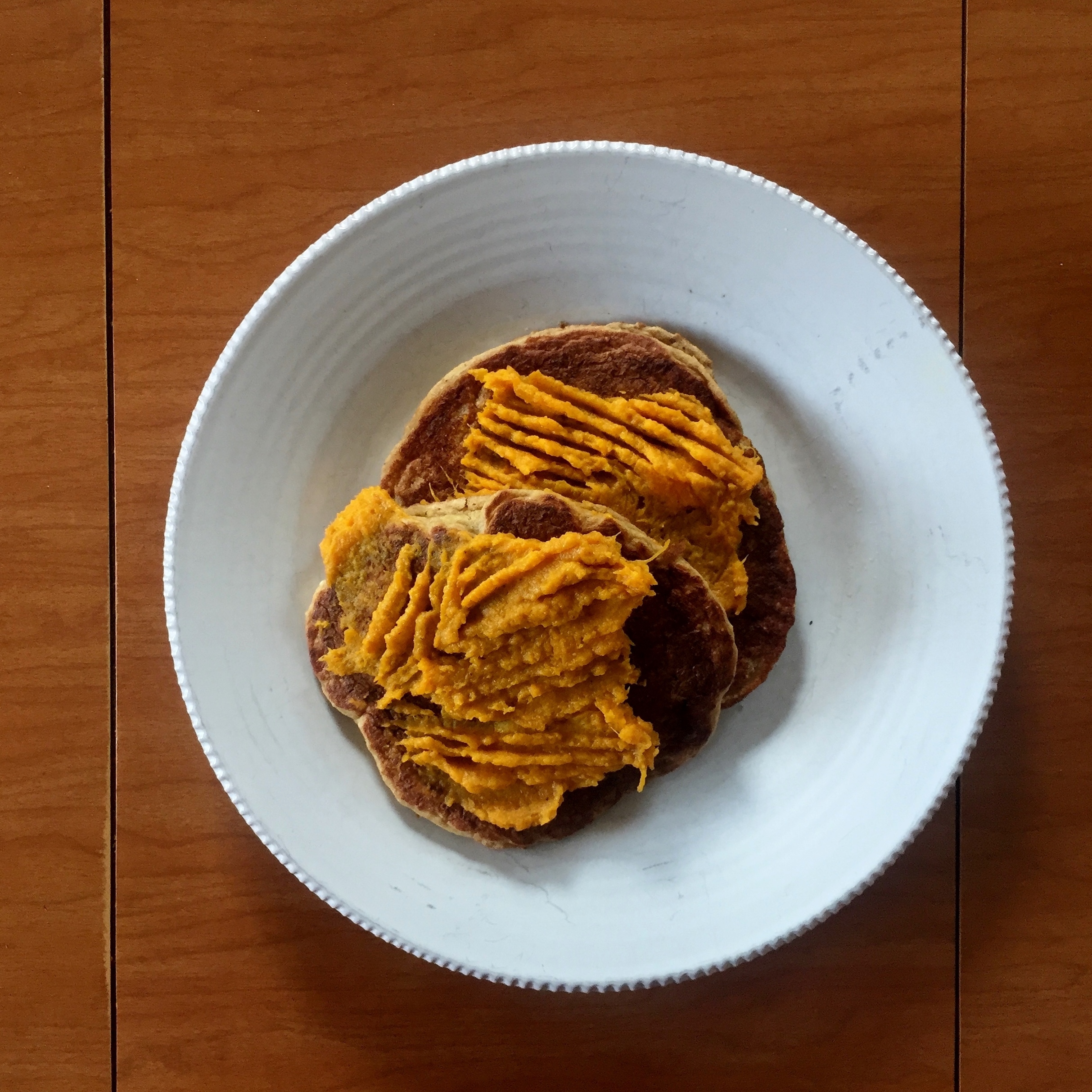
With that, The Recipe Redux invited us to to make and share bread this month. Though I’ve alluded to my current sourdough fixation here and on instagram many times over the last year, I’m still in the experimenting stage — because the art and perfection of slow bread is something I’ve long been called to and having a finished recipe that is ready to share still feels a long way off. I do have a really decent sourdough pizza crust going lately but given this dreary, cold, late winter season, my own personal need for comfort foods in the way of pancakes, and past history of pancakes making quite the meal to share with others, this quick little bread-based meal is one I hope you get the time to make. It makes my favorite gluten-free and vegan pancakes so far, is 100% whole-grain, and with the help of a coffee/spice grinder, most of the flour is fresh milled so it’s really quite nutrient-packed. I’ve also taken out all the oil and added in antioxidant-rich sunflower seed butter which gives it a really nice rich flavor. And because I’m still working my way through the last of the season’s winter squash, I find a really nice topping is a spiced squash and sunflower butter puree.

All together, both because these are comforting yet wholesome, and packed full of all the antioxidant nutrients (vitamins A, E, selenium, zinc), B-vitamins, magnesium, and iron that athletes need, I think these are great with the winter squash topping for after workout meals (that’s running for me), or perhaps just to share with a friend or loved one when you both need good conversation and lots of late-winter nourishment.

Enjoy!

IMG_7135

Post Run Pancakes, serves about 2
These make nice, fluffy, whole-grain pancakes. If you’re without or adverse to a little xanthan gum, either leave out or add a little more ground flax. They won’t be quite as fluffy, but still really good!
 
1/3 cup / 60 grams millet
1/4 cup / 40 grams buckwheat
1/4 cup / 20 grams chickpea flour
1/4 tsp. xanthan gum
1/8 tsp. salt
1 tsp. baking powder
1/2 tsp. baking soda
1 Tbs. ground flax mixed with 3 Tbs. warm water
3/4-1 cup non-dairy milk
1 Tbs. raw apple cider vinegar
1 Tbs. sunflower seed butter
coconut oil, for cooking
  • Whisk the vinegar into 3/4 cup of non-dairy milk and set aside for a few minutes.
  • Heat your skillet or griddle where you will be cooking the pancakes. They’ll cook over medium-high heat.
  • In a coffee/spice grinder or food processor, add buckwheat and millet grains and grind until they reach a smooth flour consistency. Then, mix them in a medium bowl with the chickpea flour, xanthan gum, salt, baking powder, and baking soda.
  • In a separate bowl, whisk together the flax-water mixture, milk, and sunflower butter. Pour the liquids into the dry ingredients and whisk lightly until combined. Add more milk as needed.
  • Lightly oil the skillet with coconut oil, and use about 1/3 cup of batter per pancake. Flip the pancakes when the bubbles appear on top and the bottoms are browned.
  • Cook on the second side until cooked through and browned on the bottom.

Spiced Winter Squash Puree
1-2 cups mashed/pureed winter squash
2 Tbs. sunflower seed butter
a few dashes each of cinnamon, ginger, turmeric, cloves, and black pepper
a pinch of sea salt

  • In a little dish, mash together all the ingredients and season to taste with sweetener, as desired. Serve over the pancakes.

recipe-redux-linky-logo

a primer on cooking with fats and oils + quick-sautéed greens

IMG_2332

One of my goals for this space this year is to share a nutrition tip each month which can guide us towards preparing and enjoying better meals. I’ve been sitting on this first topic for the better part of the last year, and it’s one that has been increasingly on my mind.

Let’s talk about cooking with different types of fats and oils.

For quite some time, I’ve tended to use olive or coconut oil for a lot of recipes. Up until a few years ago, I almost exclusively used extra virgin olive oil for all purposes outside baking sweets, at all temperatures. While I was familiar with the term “smoke point,” I never thought much of it, because I never saw smoke. What I didn’t realize was that I was wrong.

While there are many different kinds of fats and oils, some are more delicate than others, meaning their beneficial compounds break down or oxidize easily, creating harmful chemicals in the process. Those chemicals damage cells, promote widespread internal (and invisible) inflammation, and lead to a vast number of health concerns now considered common such as cardiovascular disease and cancer.

The three factors that cause fats and oils to oxidize and create harmful chemicals include exposure to heat, light, and oxygen, and the more unsaturated a fat is, and thus a lower smoke point, the more easily one of these factors will cause it to become highly inflammatory to our system.

My longtime go-to, extra virgin olive oil, is similar to most vegetable/plant oils, and is not particularly stable at temperatures above 320 degrees F (its smoke point). This means it is not suitable for stir-frying, sautéing, baking or roasting, or other high-heat cooking methods. What’s more, unsaturated oils such as corn, soybean, sunflower, and others which we’ve heard can stand up to high heat have instead been found to break down extremely easily at high temperature. In research, these were found to be some of the worst types of oil to cook with.

IMG_2318

So the question remains: what type of fat or oil can you use (safely) for high temperature cooking, such as roasting, baking, sautéing, and stir-frying?

Essentially, I no longer recommend cooking much above 350 degrees using any type of fat or oil unless it’s a special occasion. But when those high-heat-necessary meals are prepared, using fats that are more stable (and thus more saturated), hold up the best. This means coconut oil, butter and ghee (if you’re not sensitive to or actively avoiding dairy) are best. The other option is to choose a lesser quality (non virgin) olive, sesame oil, and possibly small amounts of non-gmo canola oil for baking. These oils are rich in monounsaturated fats, which tend to be slightly more stable at temperatures up to 350 degrees. And because they’re less refined and ideally cold-pressed, that fatty acid oxidation won’t be happening as much during the processing/pressing, since we’re aiming to avoid oxidized and rancid oils, especially before they even makes it home to cook with!

This also leaves the really-good-for-you extra virgin olive oil, as well as omega-3 rich flax and walnut, for drizzling on dishes after they’re off the heat. And if you really want to get right down to it, using less oil of all types and more fat-rich whole foods (like nuts, seeds, olives, and avocados) can never be a bad way to go.

IMG_2335

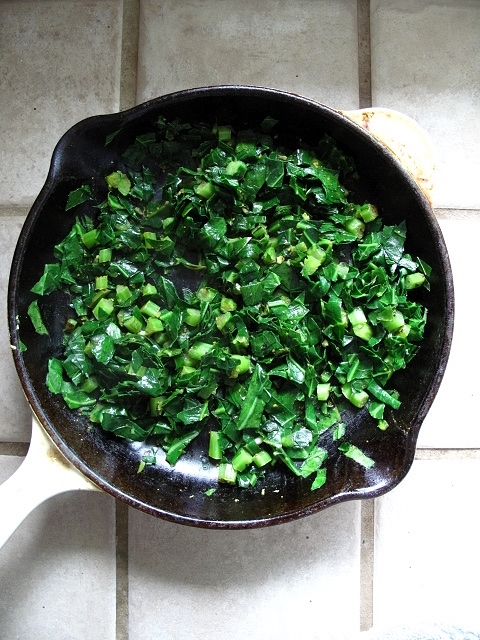
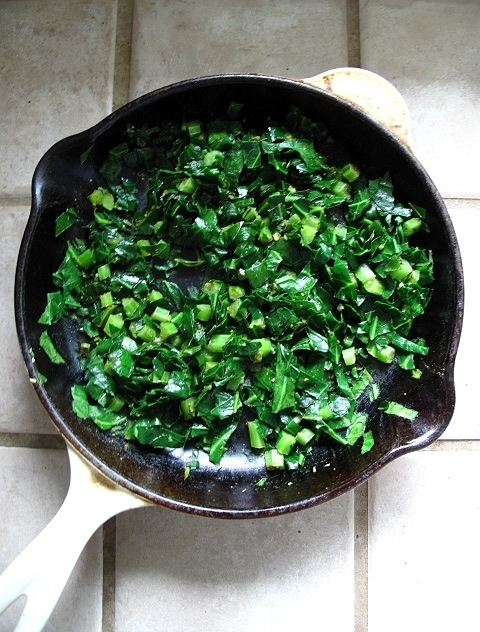
Quick Sautéed Greens, serves 1-2
Early in the new year might be the time when some of us are actively adding more greens to our routines, but a cold kale or green salad is often not the best when it’s cold outside and we’re bundled in layers. This is my favorite way to eat greens in the winter. The cooking process takes but a minute and the result is garlic-y, lightly spiced, and delectable. They’re a great addition to almost any meal. 

1 tsp. unrefined coconut oil
1 large clove garlic, smashed and minced
1 bunch winter greens (Collards, Kale, Swiss chard, etc.), stems chopped, leaves sliced
1 tsp. grounding masala, optional
salt and pepper to taste

  • In a medium sauté pan, heat the oil over medium-high. Add stems from the greens and allow to cook until beginning to soften.
  • Then add in the garlic, sliced leaves, and masala and heat just until the leaves begin to wilt. Remove from heat and add salt and pepper to taste.

RESOURCES:
Malhotra, A. (2016). The toxic truth about vegetable oil: Cooking with ‘healthy’ fats increases the risk of disease, type 2 diabetes and cancer. Retrieved from http://www.dailymail.co.uk/health/article-3574810/The-toxic-truth-vegetable-oil-Cooking-healthy-fats-increases-risk-heart-disease-type-2-diabetes-cancer.html?utm_sq=fjjqojxgyn.

Peng, C.Y., Lan, C.H., Lin, P.C., and Kuo, Y.C. (2017). Effects of cooking method, cooking oil, and food type on aldehyde emissions in cooking oil fumes. Journal of Hazardous Materials, 324(Pt B), 160-167. doi: 10.1016/j.jhazmat.2016.10.045.

Pitchford, P. (2002). Healing with Whole Foods: Asian Traditions and Modern Nutrition (3rd ed.). Berkeley, CA: North Atlantic Books.

Uribarri, J., Woodruff, S., Goodman, S., Cai, W., Chen, X.,…and Vlassara, H. (2010). Advanced glycation end products in food and a practical guide to their reduction in the diet. Journal of the American Dietetic Association, 110(6), 911-16.e12. doi: 10.1016/j.jada.2010.03.018.