Honey-Amaranth Waffles with Spiced Pears

IMG_9255

I woke up at 4:30 again this morning with a head full of words needing to come out. I proceeded to write solidly for over two hours before walking away, thinking all I had written needed to be shared.

Given the heaviness of what I’ve already shared in this space these last few days, weeks, and months, and the miraculous way that my lightness of being directly correlates with letting heavy thoughts go, those words may make their way into this space yet.

For now, I’d like to just settle my mind down and get cozy with high-vibe breakfast things, like waffles. And then, try to take a nap.

The Recipe Redux this month is all about breaking out of breakfast boredom and these waffles are one of the ways I’ve been doing that lately. Like a lot of people, I go through phases with breakfast meals, and the current one, hot porridge, has been going steady for four+ years.

But for the last month I’ve been revisiting my favorite waffles most Monday mornings. I generally have nothing planned for Mondays except to fill my brain with scientific literature and APA formatting for eight solid hours, as I’ve got the day off from work and it’s full of school instead. I’ve found that eating these is a great way to start the week.

The recipe for these waffles was a work in progress for about a year and a half after gluten and dairy were removed from my diet, and though I made a lot of different flavor combinations throughout my year teaching (comfort food after a stressful day, I suppose), these are the ones that became my go-to once that phase ended. I like them because the amaranth flour lends an earthy flavor, they’re almost entirely whole-grain, and they have just enough sweetness to need no extra sugar poured on top. All of this is my sort of thing because half the time waffles are more of a dinner item and I don’t like the idea of sugar and starch for my evening meal. I also can’t handle sugar for breakfast, so there’s that as well.

IMG_9245

If you haven’t tried amaranth before, it is technically a tiny-seed pseudograin, like quinoa. In fact, the two are related botanically and share many characteristics. Historically, amaranth was very important to the ancient Aztecs. Nutritionally, it is one of the highest-quality grains to add to your diet and is especially useful for individuals who do a lot of physical work, athletes, infants, children, and pregnant and nursing women. I like it because it is a good source of calcium and an excellent source of iron, and has more protein than most other grains. Even though its nutritional effects are minimal in these waffles, adding more amaranth to meals cannot hurt. Flavor-wise, I find that amaranth goes particularly well with autumn and winter fruits, like pears, and I prefer that combination over anything savory I’ve tried.

This recipe is inspired by Kim Boyce’s Honey-Amaranth Waffles in Good to the Grain, but is now so far removed that I can’t say they’re anything like her original. If you have no reason to avoid gluten, use whole-wheat pastry flour in place of the gluten-free, and if using your own gluten-free flour mixture, keep in mind that mine is 70 percent whole-grain by weight and has 10 percent buckwheat flour, which is another stronger flavor.

How do you break up the breakfast boredom?

IMG_9230

Honey-Amaranth Waffles with Spiced Pears, makes 3
Recipe Updated: 10/25/22

3 Tbs. ground flax, separated
3 Tbs. warm water
1 cup non-dairy milk
1 tsp. apple cider vinegar
2 Tbs. amaranth flour
1 cup all-purpose gluten-free flour
1 tsp. baking powder
1/2 tsp. baking soda
a pinch of salt
1 1/2 Tbs. honey
1 Tbs. (untoasted) sesame oil, melted + additional for the waffle iron

To Finish:
1 pear, chopped into a large dice
1/4 cup water
1/8 tsp. ground ginger
1/16 tsp. each cinnamon, nutmeg, cardamom and black pepper
pinch of ground cloves
unsweetened non-dairy yogurt, optional
pomegranate molasses, if you’d like an extra fancy drizzle of sweetness atop

Directions:

  1. Turn the waffle iron to a medium-high setting. In a small dish, whisk 1 Tbs. ground flax with the 3 Tbs. water. Set aside to form a thick slurry. In a liquid measuring cup, stir the milk together with the vinegar, and allow to curdle slightly.
  2. In a large bowl, stir the remaining dry ingredients together.
  3. Combine the oil and honey, and then add them to the milk along with the flax slurry. Whisk the liquids briefly to make sure they’re uniform, and then pour them atop the dry ingredients.
  4. Stir the batter lightly. Depending on the day and air moisture, a little extra liquid may need to be added.
  5. Brush the waffle iron with a small amount of additional sesame oil, and then ladle 3/4 cup of batter onto the iron. Cook until the indicator light tells you it’s done, or a quick peek shows a golden-brown color.
  6. Remove from the iron, and plate up, along with a spoonful or two of yogurt and a pile of spiced pears.
  7. For the pears: In a small saucepan over medium-high heat, combine the diced pears, water, and spices. Once they begin to really cook, turn down the heat to a low simmer, cover, and cook until they are soft and beginning to be a little syrupy. This can all happen while waiting for those waffles to cook.

References:

Boyce, B. (2010). Good to the Grain: Baking with Whole-Grain Flours. New York, NY: Stewart, Tabori & Chang.

Pitchford, P. (2002). Healing with Whole Foods: Asian Traditions and Modern Nutrition. Berkeley, CA: North Atlantic Books.

Roasted Sweet Potato with Cashew Butter + Za’atar

IMG_9086


No matter how healthy I think my relationship with food is, there are a few foods that I am still cautious about. They’re ones I was once told to eat more of, with the implication that they would lead to some good, healthy weight gain. Those stigmatized foods are ones I mostly enjoy in my diet now but still I tend to eat them in small amounts, less often and/or cautiously. William has gotten hooked on Trail Butter in the past months, and he’ll slurp down two or three packets after dinner when we have it in the house. I’ve watched each time with a little twinge of envy, not for the desire to eat the Trail Butter itself, but to be able to down heavy doses of nut butter without a thought for anything other than the taste. Nuts and nut butters are on my caution list along with seeds, bananas, eggs, avocados, and the one I’ve shared about before, meat.


It is interesting to me now, how stigma around a food is far less healthy than any food itself. As I mentioned in my last post, I’m taking a class right now about redefining nutrition and I really love the conversations we’ve been having about nutritionism, reductionism, culture, and the similarity between diets and religion. What I didn’t mention is that I’m actually at the beginning of a nutrition and integrative health graduate program, with a focus on clinical nutrition and herbal medicine. It’s exciting and scary to think about a future off in the distance which I’m sure will look far different than the one I now imagine. Perhaps the biggest theme I’ve learned in these past few years is that much joy can be found in learning to let go of control and live in the unknown. After spending the last several years exploring options and figuring out what is true to me, this step is another case of trusting what I feel to be true will lead in the right direction.

As I embark on the learning and forming of the next few years, I want to have my preliminary intentions dropped here in this space to guide and remind of the bigger picture, as I inevitably get bogged down in the details of shaping what’s to come:


– I set out on this journey because I want to serve others. Stepping away from teaching in my own classroom these last three years, I’ve particularly missed the ability to build deep relationships with students and see and guide their progress. I want to be able to see that I am helping make a difference again.

–  I’ve experienced many obstacles in my own pathway to health and had to navigate through the noise to find what is true for me. I’ve spent more time with specialists in the medical field in this last year than ever before because I still haven’t been able to kick whatever has been making my feet hurt. In the process, I’ve realized why it has taken me so long to trust this career direction is the right one for me:  In the past, I had many specialists tell me “eat this,” “gain this,” “add this,” “stop this,” “take this pill,” etc., without understanding my journey as a patient, as a really fucking scared human inside a body, feeling very much alone. In this last year, I’ve come to terms with the fact that I go into every new encounter with a doctor or specialist with my guard up, with a “you-aren’t-trustworthy-until-you-prove-yourself” attitude—because of how my physical recovery was handled in the past. And though I’ve had better experiences this last year, there are still some that were remarkably similar to those not-great ones in the past.

I get that behavior change is incredibly challenging and I want to always remember what it’s like to be “on the other side”, to be the patient, to understand that his or her experiences change the way the things I will say are taken. I want to remember that much of what has been said to me in helpfulness when I am a patient has been taken wrongly by my mind that is either “fixed in illness” or focused only on fixing the problem so I can maintain my current behavior symptom-free. I won’t be able to always understand another person’s point of view or get an interaction right all the time. But I’d like to stay mindful about a perspective and an experience different than my own and respond accordingly, in a way that is more personal and personable than “eat this,” “add this,” “do this,” etc.

– I chose a program with a focus on integrative health and a specialty in herbal medicine because I cannot believe that any aspect of health operates in a bubble. When I’m short-changing the healthy fats in my diet, beginning to restrict quantities, or having a day when I come home stressed and tired and eat mindlessly and then guiltily judge myself for having consumed “too much,” my actions and reactions are generally not about the foods themselves. I get that food, nutrition, diets, and health are more complex than the focus on only food itself, I want to learn more of how others experience that, and be able to bring that understanding into practice.

I’ve chosen to learn more of herbal medicine particularly, as the healing of many of my major ailments and imbalances these past few years has been facilitated through herbs, food, and mindfulness alone. My own experience with plants has been life-changing; and I’ve long felt a connection to plants as if they hold life’s answers. I simply cannot wait to know (and share) more. Of interest to me now is the intersection between herbal medicine and sports nutrition. I don’t know if this will be an area I focus on in the future, but there are currently quite a few herbs of interest among the athletic community, considered “superfoods” by many, to help the body adapt and recover from stress. I’m excited to delve into both the ancient traditional use of these plants as medicine, and the modern evidence-based science of continuing to use them now.  

– I believe there is great power in the mind and the human experience and I think we as individuals have a lot of power as patients and as self-healers. We tend to see our health as something to fix, or to have another person tell us how to fix with an “easy” answer. Most of us don’t view our bodies as friends, as guides, as part of our health journeys that have just as much to say (and perhaps more wisely than our rational minds) in how we become the persons we envision ourselves to be. I want to help others find their friend in their body, and reconnect their rational self with the self that already knows what it needs. I’m working on this myself these days. In fact, I’m thinking it might be both the biggest ongoing challenge and achievement I’ve undertaken.


So now, back at the beginning, I recognize I’m much like everyone else, down in the trenches with my own set of challenges:  The Recipe Redux theme this month is to try something new in this new year. My new discovery comes in the way of a snack that I started craving one day during a run in the wet, (wet, wet) Oregon rain. It’s got one of those in-small-amounts foods I mentioned above that up until now I hadn’t tried—Cashew Butter—slathered in little spoonfuls atop a roasted sweet potato (or microwave-baked for those of us who come in hungry with sweet potato now cravings), and a hefty pinch of za’atar sprinkled atop. Admittedly, I slid back into old patterns one day and tried it without the cashew butter because I was afraid of too many of those nuts (point in case, I’m a work in progress), but the sweet potato and za’atar were definitely missing their key ingredient. So if you try it, I suggest adding all the ingredients.


IMG_9071


Roasted Sweet Potato with Cashew Butter + Za’atar, serves 1

1 medium sweet potato, scrubbed and stabbed with a knife a few times to vent

1-2 spoonsfuls cashew butter

Za’atar, to taste 

  • Roast the sweet potato on a square of foil in an oven, preheated to 400 degrees F, for about 40-50 minutes, or until soft all the way through. Alternatively, if in a hurry, it can be microwave-baked.
  • Slice open the sweet potato, mash gently, and then spoon the desired amount of cashew butter atop, allowing it to sink in, soften, and melt slightly.
  • Then add a pinch or two of za’atar, and serve!

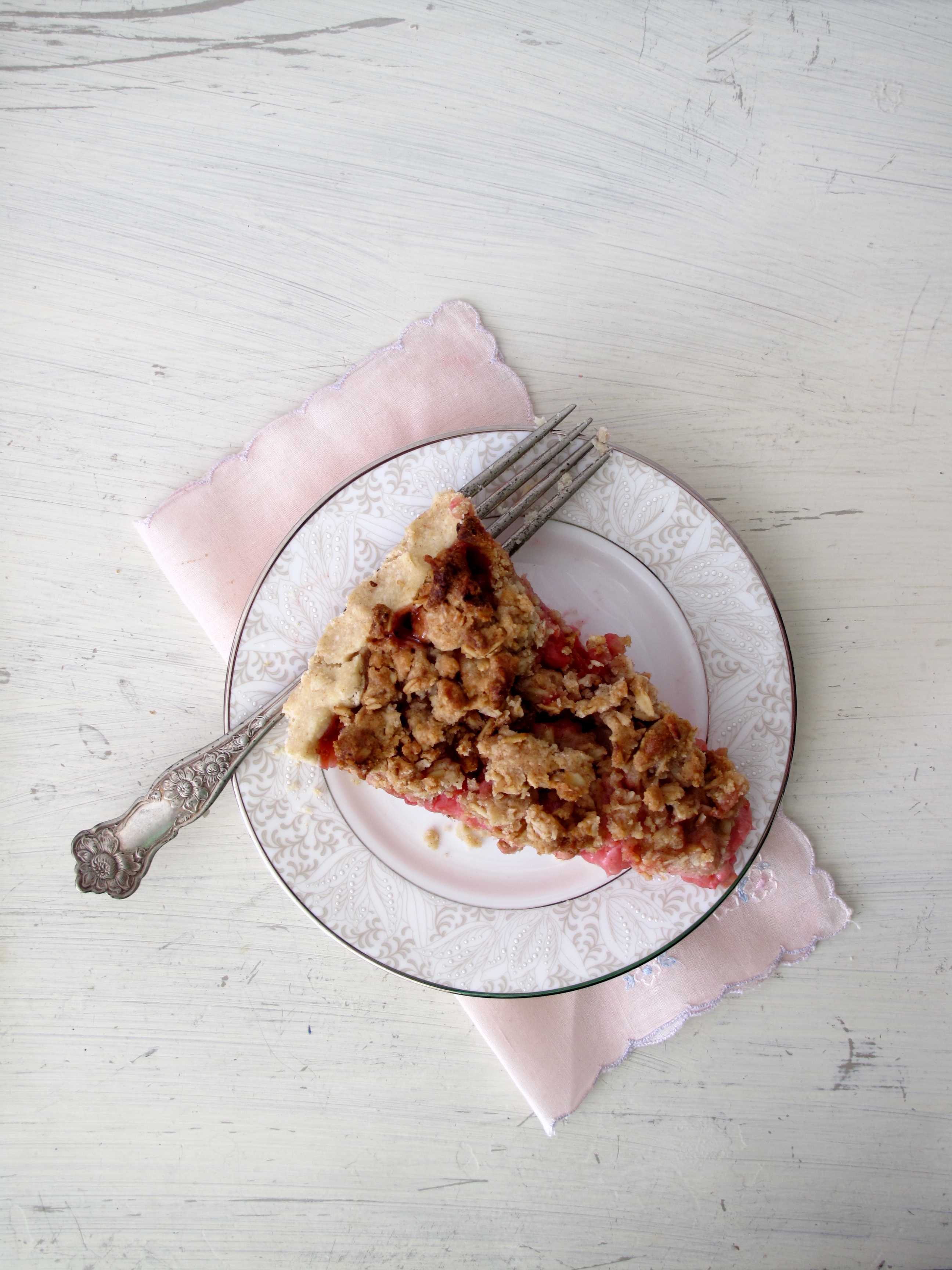
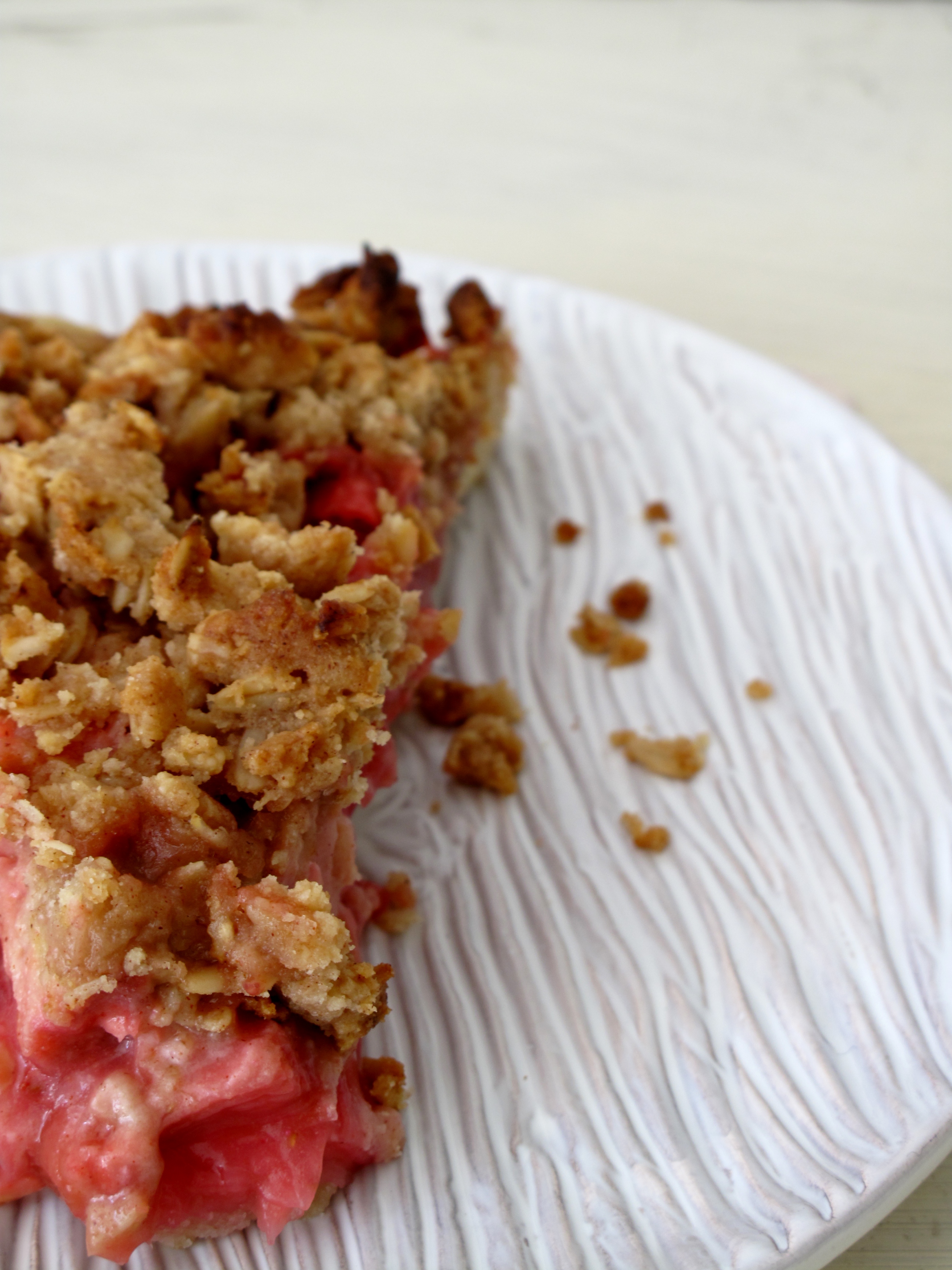
Strawberry Rhubarb Pie {Recipe Redux}

IMG_5631

My first year in college, after a long winter of heavy snow and hibernation in semi-remote Eastern Oregon, I trekked home for my first annual Easter weekend visit. I brought my roommate, Christine, and my mom made Strawberry-Rhubarb Pie. After months of food hall meals, it was the best pie I had tasted.

IMG_5605

Every pie since has been held to the standard of that memory of tart, sweet, vibrant spring-ness. Nothing compares to the picture in my mind of being home, surrounded by family and a friend, and slowly savoring each bite.

IMG_5586

When asked about her strawberry rhubarb pies, and any others for that matter, my mom answers exactly as I would expect and as I expect my grandma would also have answered: “I don’t ever follow the recipe, I just add ingredients until the pan is full and add sugar as needed.” While I concede her reasoning, I’m slightly more type A, and I foolishly think that if only I had that recipe, I could better relive the memory.

IMG_5590

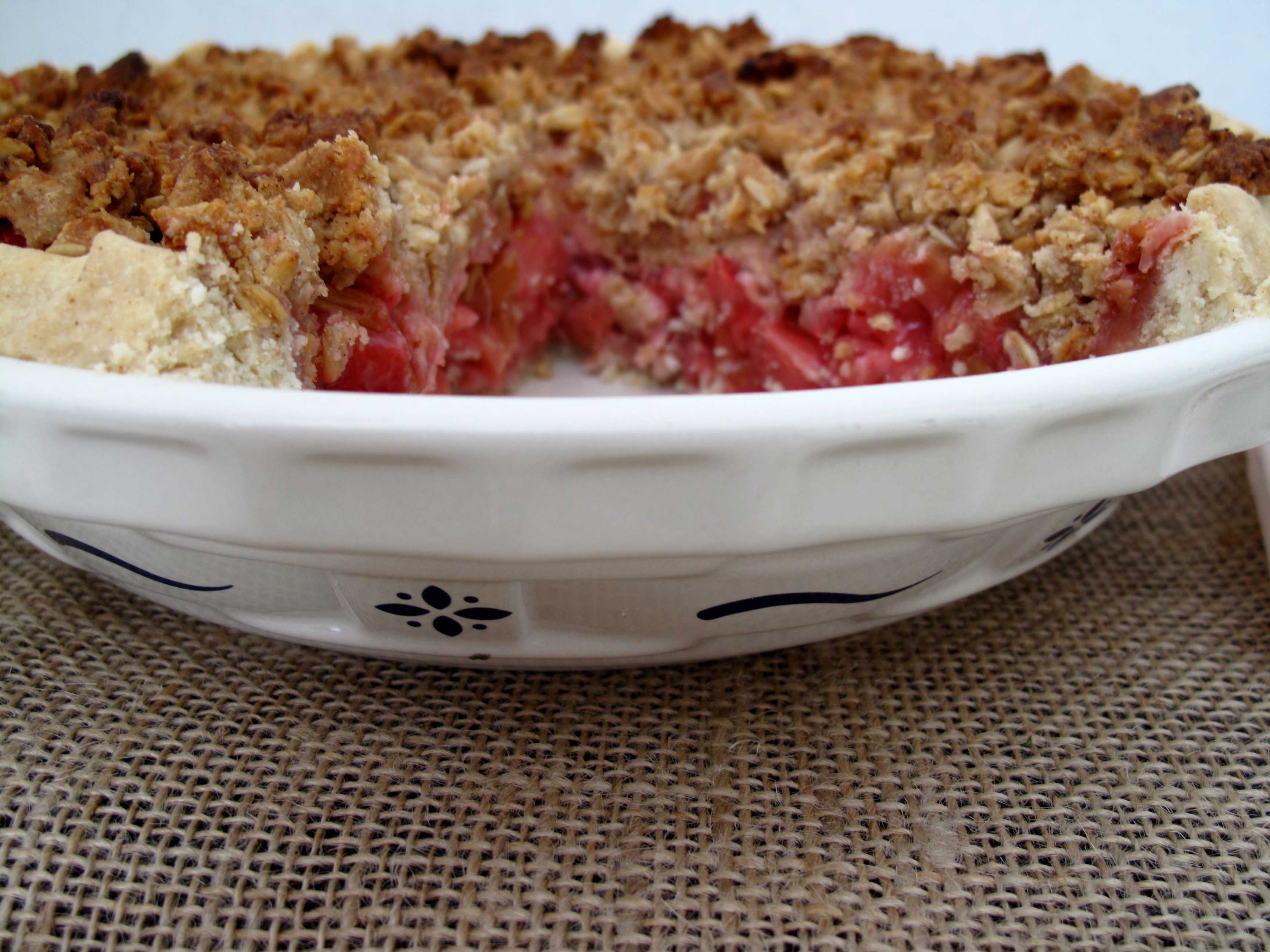
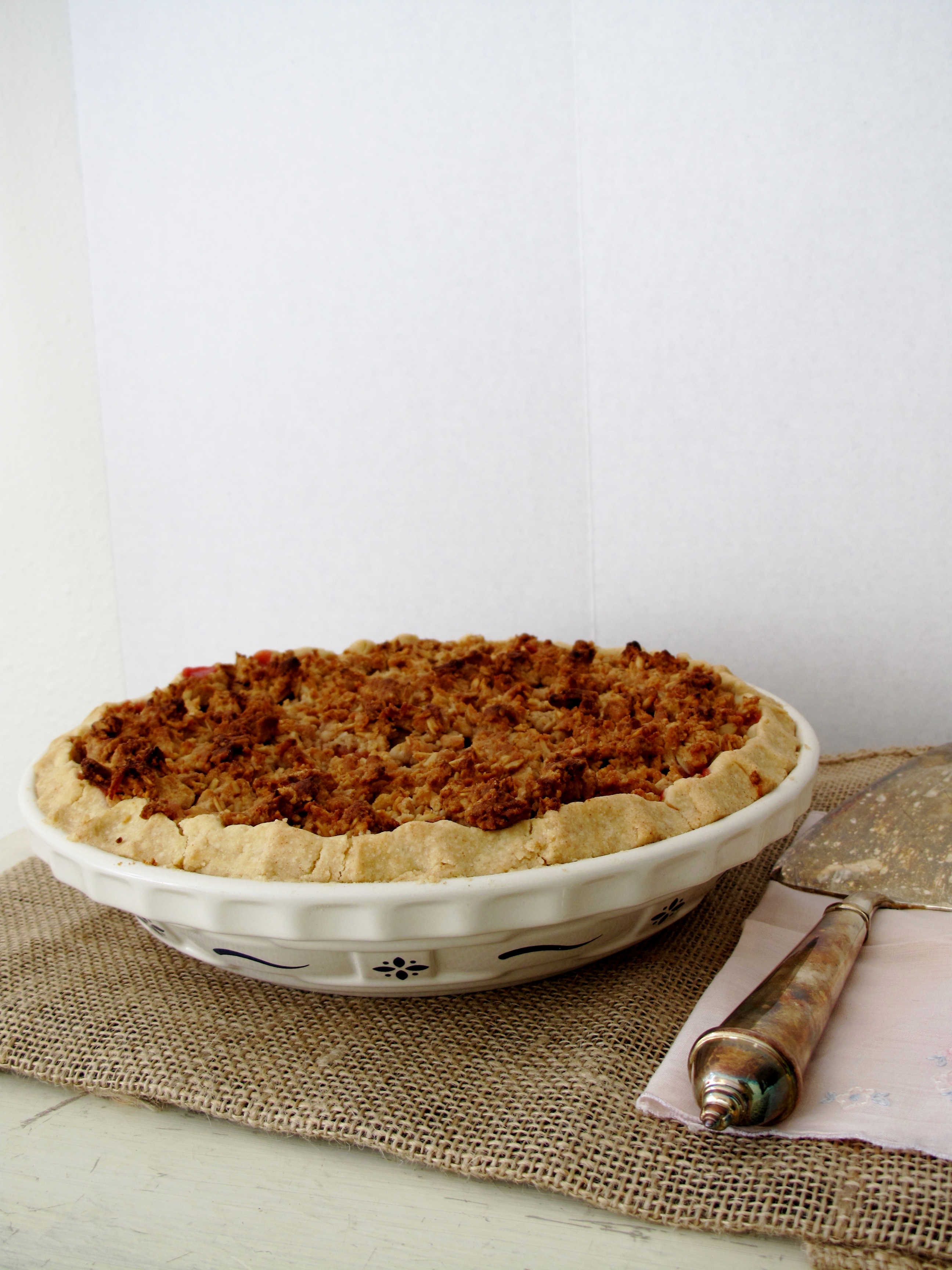
Though I was left to my own devices as to the amounts and types of ingredients, my tiny apartment kitchen happens to have a couple pie-baking essentials thanks to my mom and grandma. Like a good luck charm, I always use this pie dish, which mom had the forsight to know I was going to need waaay back when I was in high school. Grandma Neah’s old copy of The Fannie Farmer Cookbook is also a regular kitchen fixture for pie making inspiration, though I’m a bit too much like these ladies to actually follow the recipes. Even so, I’m glad Neah made sure I received it before she passed. With these feel-good implements to boost my confidence in measuring up to that pie, I began.

IMG_5560

This year, a full eight years after that first annual Easter weekend trek, I made it home again. Though this pie was decidedly missing from our Sunday table, strawberries were bought and ate, and like firewood, mom loaded me up with a couple armfuls of rhubarb for the road.

IMG_5618

The important thing and what I keep holding on to in this sort of strawberry rhubarb tradition, is that family was gathered around, more family than before, and we lived a spring day to rival my memory.

IMG_5615

 
Strawberry Rhubarb Pie with Streusal Topping
 
Pastry, adapted from Gluten-Free and Vegan Pie
1 cup brown rice flour
1/2 cup millet flour
1/2 cup sorghum flour
1/3 cup tapioca flour
1/3 cup arrowroot starch
2/3 cup potato starch
1 1/2 Tbs. sugar
1/2 tsp. salt
1 cup + 2 Tbs. refined coconut oil
2 Tbs. water
1 tsp. vanilla 
3/4 cup oats
2 Tbs. honey
3/4 tsp. cinnamon
1/4 tsp. ground ginger
 
Filling
4 cups rhubarb, chopped
2 cups strawberries, chopped
3/4 cup sugar
1/4 cup honey
1/3 cup brown rice flour
2 Tbs. tapioca flour
1 Tbs. lemon juice
dash of ground ginger
 
To make the crust, measure flours, sugar, and salt into a food processor. Pulse a couple times until they are mixed. Measure in coconut oil and pulse until the mixture is crumbly. Then add in water and vanilla until the mixture just comes together. Turn out onto a piece of parchment paper and split the dough into a larger piece (about 2/3 of dough), and a smaller piece.  
 
Roll out the larger piece and fit it into the bottom of a pie pan. If it falls apart in the process, gently piece it back together and flute the edges. Using the tines of a fork, make several stabs into the crust, and then put it into the freezer for about 45 minutes. Meanwhile, put the remaining 1/3 crust back into the food processor, along with the honey, oats, cinnamon and ginger. Pulse until they come together and set aside for the streusal topping.
 
Preheat the oven to 350 degrees F.
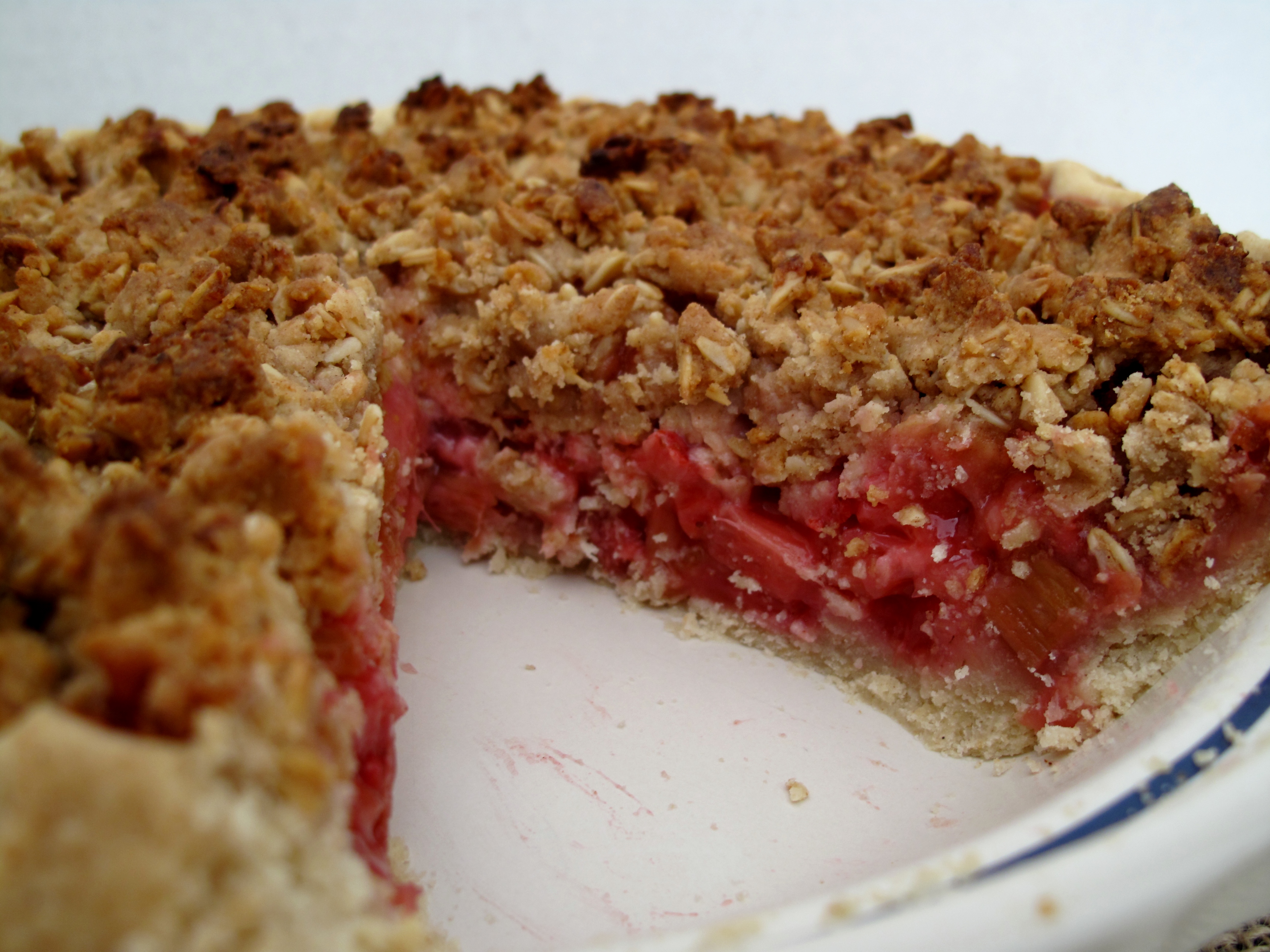
To make the filling, stir together the rhubarb, strawberries, sugar, honey, flours, lemon juice and ginger. Once the bottom crust has chilled, turn the filling into the pan. Evenly spread the streusal topping over the filling and bake for about 50-60 minutes, or until the filling is bubbling properly. During the bake time, you may need to cover the pie with foil, to prevent excessive browing.
 
If the filling seems a little liquidy at this point, don’t worry.  It will set up nicely once it cools!