Apricot, Date + Turmeric Bars

Apricot, Date + Turmeric Bars

img_0822

Over the summer, I learned about 30 herbs and/or spices that are commonly used in western herbal medicine in my second herbal medicine class, and I really relished the opportunity to both broaden and deepen my understanding of natural plant medicines. In addition to learning that skullcap, the plant I had chosen to focus on learning about for an entire term in my first class, is the most popular herb sold through my university’s herbal dispensary, I spent the summer delving into a lot of research about specific herbs for treating inflammation and allergies due to my project for a client with seasonal allergies. I was limited to working with only the herbs in our class list, however, and because of that I chose a fairly non-traditional approach to working with allergies. Turmeric was among the herbs we studied, and though I did not end up recommending turmeric for allergies, I realized I easily could have and was probably expected to.

Though I know a lot more about the benefits of turmeric than I did before, there is much research to suggest that the curcumin compound it contains has extremely strong anti-inflammatory and anti-oxidant abilities and it is beneficial in all manner of disorders and imbalances. Among others, it has antibacterial, anticancer, anti-rheumatic, anti-tumor, antiviral, anti-phlegmatic, and anti-parasitic properties. I’ve recommended it to my mom who has arthritis, runner friends for pain, and have taken it myself for (nearly instantaneous) relief after slamming my knee into a door. Though my knee incident was an exception, I take a different approach to using herbs than we would for pharmaceutical drugs; I don’t take them for their quick effect. Instead, herbs work to slowly and gently bring the body back into balance, and they work better in conjunction with other lifestyle supports, like getting enough rest, a balanced diet, exercise, etc.

Turmeric is extremely trendy right now, and while there is good reason for it to be, I also like this article about practicing caution with it, as with all herbal medicines. Too much of anything, even a supposed health food, can push us into imbalance. While I came to this conclusion on my own and no longer pop a curcumin supplement for running recovery “insurance” on a regular basis, I do tend to use it in small amounts frequently–and mostly because I really enjoy its flavor.

What I really enjoyed about the class is that we delved into the research on a number of common herbs and spices–ones we are already using and that aren’t the new trendy superfoods–like the ginger and cinnamon these bars contain. After 14 weeks of reading a ton of research articles, I finished the class even more in support of the importance of eating healthfully as the norm and using herbs and spices in small amounts throughout the day in whatever foods we’re eating so perhaps there’s a little less need to use any medicines–herbal or otherwise–to “fix” imbalances.

img_0817

Apricot, Date + Turmeric Bars, makes 4
Recipe updated: July 2024
I regularly rely on bars for after workouts and for busy afternoon snacks on the go. While I have a few versions of granola or energy bars on this blog that I do go back to, for the last few months I’ve been opting away from oats and grains as a main ingredient. Instead, I’ve been adapting a favorite packaged bar. It has taken many renditions but now that I’ve finally gotten the base consistency to my liking (actually better than the packaged bar which I find a little too sweet,) I’m excited to begin delving into a few different flavor combinations, especially as William doesn’t favor my heavy affinity for the ginger/cinnamon/cardamom/turmeric spice combination and prefers the berry/fruity realm instead. For these bars, don’t forego the black pepper, as it helps the turmeric to be become more bioavailable. Additionally, for the options I’ve listed, the first is my favored ingredient but I also enjoyed the other options listed. Enjoy!

1/3 cup / 40 gr sunflower seeds
1/4 cup / 40 gr dates, pitted
1/3 cup / 40 gr dried apricots
3 Tbs. / 30 gr hemp protein powder
1/8 tsp. sea salt
1/4 tsp. turmeric
1/4 tsp. cinnamon
1/8 tsp. ginger
1/8 tsp. nutmeg
dash of black pepper
3/4 tsp. blackstrap molasses
1 Tbs. water, as needed
1 Tbs. / 10gr hazelnuts
1 square /10 gr candied ginger, chopped  (optional)
1 cup /28 gr crispy rice cereal

  • Puree the sunflower seeds in a food processor until turning into a butter. Then add the dates and apricots and puree for about a minute.
  • Add the hemp protein, salt, spices, and molasses and process until combined; stop before it becomes completely smooth. Add  about 1 Tbs. water as needed to bring it together.
  • Then add the hazelnuts, candied ginger and about 90% of the rice cereal, and pulse until they are all just mixed in. Add in the remaining cereal and either hand-stir in, or pulse one to two more times. You want some texture remaining.
  • You should be able to pinch the mixture in your fingers and have it stick together, but not be just one big fruit/nut mass in the processor.
  • Turn out and press into an small square or rectangular dish, such as a 4×3-inch lidded-glass storage container. Cut into individual bars when you’re ready to eat, and chill/store any remaining in the fridge for up to 10 days. Ultimately, this will last much longer, but it dries out and tastes less fresh over time.

Moroccan Tagine with Sweet Potatoes + Beets, food for runners (or this runner)

Moroccan Tagine with Sweet Potatoes + Beets, food for runners (or this runner)

IMG_0359


There is nothing like a few days spent living with others to put into perspective how truly personal is our choice in food. While I will happily eat roasted broccoli or leftover kale salad for 9am snack (and frequently do), even the idea of kale salad at a seemingly more appropriate time of day might leave others running for the door.


This point is driven home in my frequent conversations about food with others. My work at the university has often left me chatting about the differences between foods here in the U.S. and elsewhere in the world–how everything is just sooo sweet–and how diets inherently change even without the individual really attempting to when taking up residence here.


IMG_0370
IMG_0368
IMG_0362

In sharing this recipe, I’ll make a point in saying first that I question the title and definitely the authenticity as I’ve never been to Morocco and have only eaten at one semi-Moroccan restaurant. And yet I love the flavors of “Moroccan” foods, particularly the tagines with sweet, savory, and spicy notes. So I’ll take liberty and call this my own version of a Moroccan tagine.

Second, I can see some camps loving this and others, again, running for the door because whoa, there are tooo many vegetables and don’t get me started on Rebecca’s fondness for spices.


IMG_0307


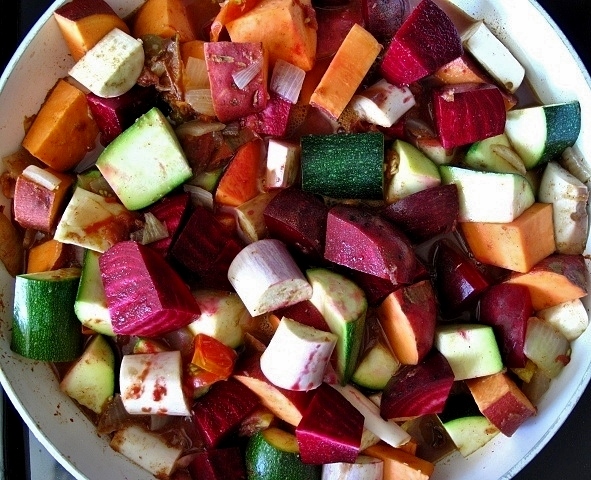
But basically I call this the type of food that I like to eat to fuel my running life. Or more adequately, it is the food I tend to crave before a big run or race. So when William and others were packing sandwiches for our relay race a few weeks back, I found myself making and then eating Moroccan sweet potato + beet tagine with quinoa to fuel my runs and turning to it again a few more times throughout the ensuing weeks.

It is also a recipe I know I will adapt and make further into the fall season and the months (and miles) to come.


IMG_0311


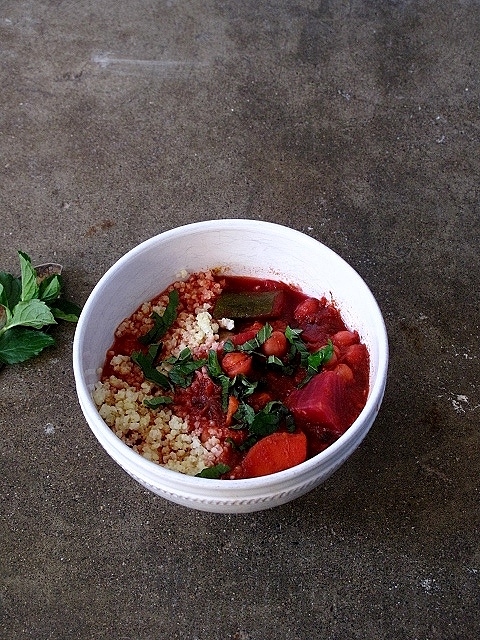
Moroccan Sweet Potato + Beet Tagine, serves 6-8
Inspired by Vegetarian Everyday

Though I tend to use a heavy hand with the harissa, I haven’t yet purchased or made one that has been nearly as spicy as the kind I’ve had in a restaurant–and its flavor tends to get muted by all the sweet notes of the apricots and currants. Use more or less, or even leave out, as you see fit.

1 tablespoon extra virgin olive oil
1 large onion, chopped
4 cloves garlic, minced
1 1/2 inches fresh raw ginger, finely grated
1 1/2 tablespoons cinnamon
1  1/2 teaspoons cumin
sea salt, to taste
2 tablespoons harissa
4-5 large tomatoes, diced
zest and juice of one lemon
3-4 beets, sliced into 2 inch pieces
1 medium eggplant, sliced into large pieces
1 medium zucchini, sliced into 2-inch pieces
2 medium sweet potatoes, sliced into 2-inch pieces
10 dried apricots, each sliced into about six pieces
2 cups cooked garbanzo beans
1/4 cup currants
thinly sliced fresh mint, to serve
cooked millet, quinoa, brown rice or other, to serve

Directions:

  1. Heat the olive oil in a large saucepan and sauté the onion for a few minutes until it becomes soft and translucent. Add the garlic and ginger and the spices and allow to cook for about 30 seconds more.
  2. Stir in the harissa, diced tomatoes, lemon zest and juice. Bring the sauce to a boil and then lower the heat to simmer.
  3. Add the beets, eggplant, zucchini, sweet potatoes, and apricots. Stir well so everything is nice and mixed, then cover and simmer for about an hour. Keep it covered as much as possible, but stir a couple times throughout the hour.
  4. Once the vegetables are tender all the way through, add in the cooked beans and currants, cook for about 5 minutes more to heat through, and then season with additional salt and pepper, if needed.
  5. Serve over cooked millet or other grain with a garnish of sliced mint on top.

a powerful place: running, faith, life lessons

a powerful place: running, faith, life lessons
IMG_3916
I want to stand as close to the edge as I can without going over. Out on the edge you see all the kinds of things you can’t see from the center.  – Kurt Vonnegut


I’ve shared little snippets about my running injury over the last year or so, and even more about the upheaval to do with my eating disorder which came to the surface when I stopped running. My thinking about my body and my relationship to running was exceptionally anxious, fearful, obsessive, and controlling, and it took me a while to become aware, accept, and then work on that. At the same time, I feel less anxious and obsessive, and much more connected and active in my faith through running. This is a continuation of my processing, and I’ll share a summary at the end of this post:


Something changed one day. Or perhaps it was a gradual transition and one day it came into awareness. I was running in Alton Baker Park. It was mid-February and I was on the outer edge of Pre’s Trail and I had this thought: What if it all just doesn’t matter? What if all these things I’ve been worrying about and building up are not big deals? What if I set them down and walk away? What if this were my last run and tomorrow I go back to riding horses instead? Immediately, the response was there. It was a very noncommittal shoulder shrug saying, Sure, that would be fine. 

The manic part of my brain fired back, You’re thinking that because you’re in the middle of a long run, in your happy place. You won’t be so happy tomorrow when you’re not experiencing this. There was fear in that thought, the fear of the what-ifs related to my body and my desire to control it. Those fears have plagued me.

But over the next several weeks, I kept circling back to that shoulder shrug, that lets not give such a fuck attitude. And I think right there I set down a little of the load, the attachment to an outcome, and there has since been a little space between where I’m at in the moment and what I wish for the future with running.

I am a little less attached to it, and certainly less anxious. On days when my feet or legs or body hurts in ways that are unexplainable, I’m often able to set down the pain and feel it only in the moment, not worrying so much about whether it will be there in the next moment, in the next day, in the way of the things I want to accomplish out there. I’ve stopped printing my weekly training plan and some days I have no idea what the next day will bring, nor do I overly care so much. I used to know every detail of what the week ahead would hold. 

I really don’t know what led to the change in my relationship with running, but because it was important, I prayed about it. I prayed for well over a year, often desperately. In January and February of last year, when I was not running, I was at a low point. William tried to console me one evening, It’s just a little injury. Give it a couple of weeks and you’ll be back to normal. You’re fine. 

It’s not, though, I responded. This is major. This is going to take a very long time. I don’t know how but sometimes I just know things. I knew the ‘little’ injury no one could explain was not so little, that it went way beyond the physical, that it was going to change me. That I had a long climb down before I could start climbing back up. In my desperate conversations with Jesus, I asked him to make it obvious if the answer was no, if I needed to set down this running hobby. I asked him to slam the door shut in my face and please, oh please God, just take away my desire to run. Help me find other hobbies. Help me find balance that is healthy. Help me not trade one obsessive, addictive tendency for another, i.e. food for running and vice versa.


IMG_3875


He did not slam the door shut in my face. There was a crack, and I cautiously, fearfully tip-toed through it, all the while expecting it to still slam closed. Even so, I’d catch glimpses of affirmation, out of nowhere, often on days that were otherwise real downers. One came sometime in the fall. I was in the middle of a run, in pain, frustrated, and a little depressed about the situation. Even so, I was like an earthworm; I could feel the light at the end of the tunnel, even if I could not see it. That little gift of His affirmation was enough to keep me trudging upwards through the mud. 

At some point, months before that February run in ABP, I stopped praying about running or physical healing without even realizing it, and my conversations with Jesus were more friend-like, not so tied to an outcome, and more in line with asking for direction with the big-picture of life, and not some non-essential hobby.

It’s often hard to say where one story ends and another begins. I don’t know when I began identifying myself as perpetually injured, or not good enough, or not worthy enough to go after goals. Or when I decided to set down that story and begin another one. It probably doesn’t matter. And I can’t really explain it, not even to myself. Why running? And why share about it? Why write and have an often too-personal blog? During the past year of prayer, several things became clear: It’s not really about me and there’s a purpose here that I don’t get to understand right now. I have some unsettled, fuzzy, too-big-to-understand running dreams that won’t go away, no matter how much I try to make them. The door keeps quietly opening, little by little, and though I’m afraid to try, I hear Him asking me to keep walking with faith, a few steps each day.

Like that day in Alton Baker Park, more recently on another run that wasn’t going all that well, I had another flash of realization. I realized I feel in a very powerful place these days, truly as if there is an energy in my physical and spiritual self not entirely of me, as this unexplainable journey I’ve been on, with all its painful, difficult, individual traumas is part of the transition upwards, out of the mindset of I can’t, I don’t get to, and I’m not good enough that I’ve been carrying around during this lifetime. In that moment, the journey itself sparkled beautifully before me, with all its ups and downs. I realized then I want to explore a concept I haven’t explored in a while: What if I can? What if I get to? What if I am good enough? What if I stop worrying about whether the door will slam in my face and instead concentrate on finding out what’s on the other side of the door? 


IMG_3989


I want to find out what I’m capable of; I want to find out what He is capable of doing in me. I want to do His work. I want to walk to the edge where He leads and see what He has for me to see. Right now, for whatever reason, running is part of that. And even though I feel in a powerful place, there are still doubts. There are days and little moments where I take a step back, look at the bigger picture of how I currently feel physically and what quiet affirmations I feel in my heart, and tell myself, lady, you’re either really fucking crazy, or on to something. I prefer to believe I’m on to something.


Reflection: I want to make clear this is my journey, and I’ve had a whole slew of professionals advise me. I do not recommend running through an injury unless under the supervision of a professional. I also have explored, in depth, my relationship between running, my eating disorder, and other behaviors that allow me to gain control. Running has always been intricately linked to my eating disorder, as I began running shortly before I began controlling food, and it likely served as a catalyst for the ensuing food and body image problems to surface. With that being said, those problems were there long before I began running regularly, and running has become one of the ways I deeply connect with my faith, with where I learn about myself, with how I finally came to love and feel comfortable in my body, and where I let go of other life problems. Two great articles I’ve enjoyed over the last few weeks include Gena’s reflection on How it Feels to Leave an Eating Disorder Behind and When Exercise Becomes an Addiction. I believe there is a place for endurance and/or competitive sports in the recovery process, and really enjoyed Julia’s podcast interview with Rich Roll on How to Take Ownership of Your Evolution, especially his thoughts on how athletic endeavors can fit into the recovery journey.