Gluten Free Flour Tortillas or Flatbread Wraps

A few years ago, I started making various quick gluten-free flatbreads to use in meals when I wanted a grain but needed something quick, easy and different from the usual rice or quinoa or millet or buckwheat. I would often choose a slice or two of my whole grain gluten-free sourdough in that instance, but often I don’t have any bread handy either.

The flatbreads, made with just a couple flours, a pinch of salt and water, were a little lackluster, and William ate them unenthusiastically. Somewhere in the many months of making them, I happened upon the addition of psyllium seed husk. I also use psyllium husk in my sourdough recipe – it’s an essential ingredient for the stretch that gluten-free bread doughs will otherwise lack.

The psyllium addition has been a gamechanger. The flatbreads have become flour tortillas, or wraps, which I went over a decade without, and burrito size tortillas for various burritos and wraps – also a warm welcome after so long without.

The bonus is: these come together really quick! Like just as quick as the much less pliable flour/water/salt version. And if you only want enough for a meal, any leftover dough can easily be refrigerated until the next day, and rolls out super quick as you’re reheating leftovers.

Probably the only thing you’ll be wishing you had is an even larger pan to get these as absolutely large as you can possibly want them. :)

Gluten-Free Flour Tortilla or Chapati Flatbread

This is a quick and easy flatbread that can be used to make thin flour tortillas, or as chapati flatbread as a whole-grain addition to a balanced meal.

Prep:  15-25 minutes  | Cook: 20-30  minutes  | Serves: 4

12 grams / 2.5 Tbs. psyllium husk (rough husk form, not powder
240 ml / 1 cup warm water
180 grams / 1 ½ cups whole grain gf flour mix
  (or a 50:50 mix of  brown rice and sorghum flour)
¼ tsp. mineral salt

  1. In a bowl, whisk the psyllium husk and warm water. Within a few seconds, a gel will start to form. Set aside until needed. 
  2. In a separate larger bowl, stir the flour(s) and salt together, then add the liquids and mix with a wooden spoon until all the flour is mixed in.
  3. Then, give it a thorough knead by hand. Squeeze the dough through your fingers and work your way around the bowl, scraping off the sides as necessary. The final dough should come away from the sides of the bowl and be very springy to the touch. It shouldn’t be too sticky. It doesn’t have to be perfectly smooth – so long as it’s homogeneous with all the ingredients well combined and no clumps of flour or psyllium gel, you can proceed to the next step.
  4. Turn out the dough onto a lightly floured surface. Divide into 4 to 6 equal portions. If making four, this will yield burrito size tortillas or flatbreads – if you’re making them quite thin.
  5. Cover the pieces you are not currently working with with a towel to prevent them drying out.
  6. Use a rolling pin to roll out the dough into a thin tortilla, or if you’re wanting a thicker flatbread, you can also use your hands.
  7. For a tortilla, aim for very thin, about 1mm thick. This works best when your countertop is well-floured and you rotate the dough frequently to prevent it from sticking to the surface. As necessary, dust the top of the tortilla and your rolling pin with more flour.
  8. To cook: Heat a large cast-iron pan over medium-high heat. The pan is ready when a droplet of water sizzles on its surface.
  9. Place a tortilla into the hot pan and cook it for about 45 seconds. 
  10. Once you flip it, it should puff up in places with bubbles of varying size appearing. Cook on the other side for about 45 seconds to 1 minute. The tortilla is done when you begin to see large dark brown spots on the underside.
  11. Tip: If your tortillas are cooking/browning too quickly, reduce the heat. If they’re taking longer than a minute per each side to cook, increase the heat.
  12. Transfer to a clean dish towel and cover – this will help it stay soft and flexible. Continue cooking the remaining tortillas.

Notes: The tortillas are best served warm immediately after cooking, but can be stored for 1-2 days and reheated.
You can also store the uncooked dough in a covered container in the fridge for a day to quickly make 1-2 fresh tortillas as needed.

Coconut Macaroon No-Bake Cookies

GUTSY Performance Nutrition Coconut Macaroon No-Bake Cookies

I have a handful of routine no-bake cookie and energy bar formulas I frequently use to make tasty (and still nutritious) treats and snacks. In the winter, I often make a gingerbread variation. Or for routine mid-afternoon snacks, I’ll make a date / hemp protein / apricot / nut or seed energy bar variation.

A couple years ago, I taught a cook-along class with my local Oregon Oiselle running group, and we made one of the recipe variations of these no-bake cookies as a dessert. A couple weeks later while on a run, one of the attendees mentioned she’d adapted the recipe just slightly to make it even easier to whip together, and she was using it for long run and ultra training fuel.

With the combination of milled oats and ground nuts, coconut oil, and a quickly absorbing sugar source (honey or maple syrup), these will indeed make a good fuel option for longer (slower) runs or cycling rides, where the digestive system can take its time a bit and handle a little more complex carbohydrates and fats as fuel.

And I’m all for taking a recipe and making it your own.

I give a variation to make these sort of like no-bake truffles that are coated in a dark chocolate shell, but realistically, I almost never do that. I don’t tend to be a big chocolate person (I do like chocolate! I just rarely crave it or set out to make chocolate infused foods.) But if that sounds good to you, the chocolate / coconut flavor pairing is generally a good one.

Hope you enjoy – as a dessert, a post-workout quick fuel, afternoon snack, or training fuel – or whatever way works for you!

GUTSy Performance Nutrition Coconut Macaroon No-Bake Cookies

Coconut Macaroon No-Bake Cookies

Nothing like a traditional macaroon but rich in coconut and almond flavor, these are tasty little bites to have as a quick snack or end of day dessert – or training fuel for longer, lower intensity (easy day) efforts.

Prep:  10-15 minutes | Makes: 6-7

½ cup + 2 Tbs. / 70 grams rolled oats
¼ cup / 28 grams almond flour
¼ cup / 20 grams unsweetened coconut flakes
⅛ tsp. salt
2 Tbs.  / 32 grams raw coconut butter
½ Tbs.  / 7 grams coconut oil
2 ½ Tbs. / 50 grams maple syrup or honey
¼ tsp. vanilla extract
Optional: melted dark chocolate

  1. In a food processor, combine the oats until broken down in a rough flour-like consistency. Then add the remaining ingredients and process until everything comes together.
  2. Scoop out heaping tablespoons of the dough and roll into balls in using your palms until they are firm and won’t fall apart when you pick them up. Put them on a plate or in a storage container.
  3. Store in the fridge for up to 1 week. They will last longer, but won’t taste as fresh. Allow them to come to room temperature before enjoying.

Note: if you’d like a slightly more decadent dessert, melt a small amount of chocolate in a double boiler and dip each cookie into the chocolate. Set in the fridge to firm up.

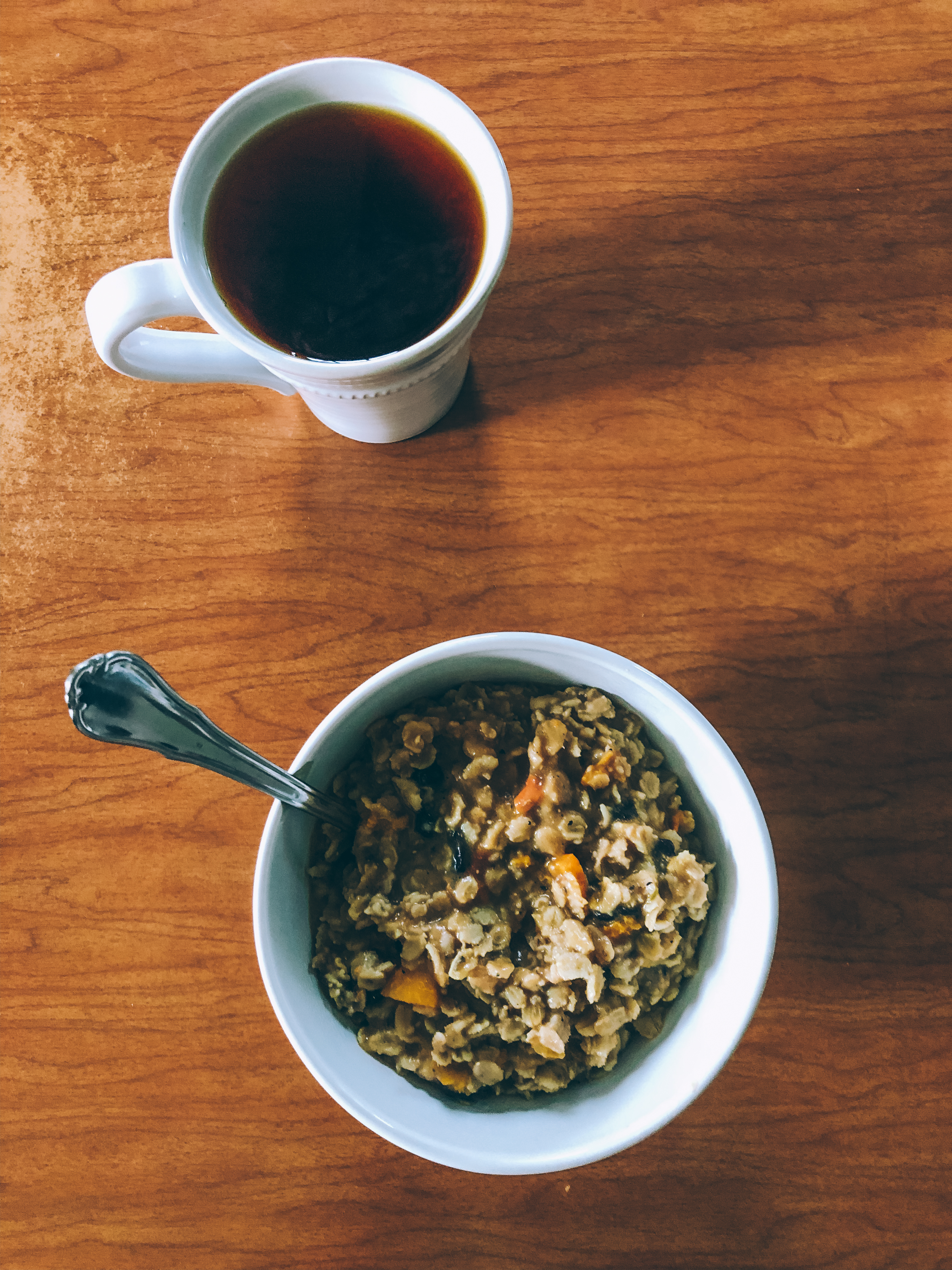
Tart Cherry + Apricot Oatmeal

Just in time for summer, here’s a delicious new way to start your day.

So many athletes and active individuals tend to eat oatmeal as a morning go-to, and inevitably get stuck in a rut with the same ingredient and flavor combinations day in and day out.

Oatmeal is super nourishing, filling, fiber-rich, and generally an all-around superb breakfast option. But changing it up every now and again is also optimal to encourage digesting and absorbing a wide range of micronutrients as well as feeding diversity in the gut microbial community.

Another challenge that you might find yourself in, is that active individuals often don’t start the day with “enough” food.

Classified as a “within-day energy deficiency,” an example is starting your day with a small breakfast, slightly larger lunch, and then having a moderate to large dinner. OR expending more energy than you’ve consumed (through both activity and daily living), in the early hours of the day and not topping up the tank until hours later, creating metabolic and physiological stress.

I also used to eat this way. It was part of my restrictive eating and diet mentality paradigms.

Not only is this style of consuming most of the day’s caloric energy late in the day problematic for digestion, since eating larger meals late at night is challenging for the body to digest and negatively impacts sleep quality, but it also creates a feast and famine cycle in the mind and body.

When I was caught in this pattern, I was routinely hungry all the time because I was training fairly heavily, and not proportioning all my meals to be adequate for what I needed.

For more information on the topic of Within-Day Energy Deficiency, here and here are two great articles.
And two of the scientific studies frequently referenced on this topic:
Within-Day Energy Deficiency and Reproductive Function in Female Endurance Athletes
Within-Day Energy Deficiency and Metabolic Perturbation in Male Endurance Athletes

The portion size below is “larger” than usual, but just about right for moderately active individuals. If you’re more or less active, or in a larger or smaller body (than average), feel free to adjust portion size accordingly.

Tart Cherry + Apricot Oatmeal 

Prep:  none  | Cook: 10-15  minutes  | Serves: 1

1 1/2 cups water
1/8 tsp. mineral salt
⅛ tsp. ground ginger
⅛ tsp. ground cardamom
¼ tsp. fennel seeds
3/4 cup old-fashioned oats, certified gluten-free as needed
2 Tbs. dried tart cherries
2 apricots, diced (approx. 150 grams)
2-3 tsp. sunflower butter
1-2 tsp. chia seeds

  1. On the stovetop, bring the water, salt, and spices to a boil in a small saucepan.
  2. When boiling, turn down to medium-low, and stir in the oats and dried cherries. Let cook until it is soft and nearly all the water has been absorbed, about five minutes.
  3. Then add in the diced apricot and stir. Turn off the heat and stir in the sunflower butter, and chia seeds, making sure they are spread evenly throughout.
  4. Spoon into a bowl and enjoy!

Notes / Substitution Suggestions:
– adjust the spices as needed for your energetics
– omit the tart cherries and increase to three apricots
– for a smaller portion, use ½ cup rolled oats
– omit either the sunflower butter or chia seeds and double the amount of the one you keep in. 

Within my nutrition practice, I specialize in endurance athletes and digestive imbalances. If you’re curious about how to improve your performance, health, and digestion, I encourage you to reach out to me for more personalized support.