Hot Cross Buns {gluten + dairy-free, sourdough option}

As I opened my daily planner this morning, I was reminded that I had originally been slated to be teaching a lesson today about healthy breakfasts and how to tell when one is hungry and full to several kindergarten classes I work(ed) with.

Of all the nutrition and cooking lessons I teach in public schools, that particular one is my favorite. And because the funding source leaves me tied to teaching particular curricula that I often find wanting in terms of what we should actually be teaching our children about nutrition (i.e. developing a healthy relationship to food more than focusing so much on all the food groups), this particular lesson is one I really look forward to. Hunger presents itself in numerous ways beyond just a painful, rumbly tummy, and food and nutrition is far more than just calories in/calories out, macro and micronutrients, and following the ‘right’ plan until whatever prefabricated goal is reached. If I could fill out my entire kindergarten series with this topic of developing a healthy relationship to food alone, I think my students would be far closer to having the basis of a firm foundation in healthy lifelong eating than most of us have ever gotten.


One thing I’m noticing a lot in the last couple weeks as we all go into isolation and quarantine is a few different but similar conversations about food. Panic-buying and hoarding as lack of clear leadership, lack of control over life situations, and messages about what to do change nearly daily. Bingeing or overeating on a kitchen full of food, or stress not-eating as we stay home and navigate a completely different routine. Stress-baking to put at least our hands in motion, and choosing comfort foods when nothing else is comfortable. And then stacking guilt on top of our already stressed and anxious systems as we berate ourselves for not having some willpower or not taking care of ourselves adequately, etc.

One of the questions I like to ask, not to my kindergarteners, but in clinical practice, is ‘what’s that about?’ When our minds go into worry and circular thinking about whether there’s any flour, yeast, eggs (or TP) to be found at the store. When we find ourselves needing a comfort food or snack while working from home when we’re not actually hungry. When we skip a meal or two and are ‘not hungry’ when we’ve clearly not eaten much in the last day or days. When our hands at the grocery reach for ice cream, cookies, chips and crackers, or the ingredients to make something sweet / salty. When we panic at the thought of missing a workout or being sidelined from normal training due to this situation. When we’re anxious. When we wake every night at 3am.

In any or all of these instances, ask yourself, ‘What is that about?’ What’s the underlying feeling, belief, or reason I’m doing this thing? Ask yourself without judgement, and just be okay with whatever answer comes. And if there’s no immediate clear answer, that’s okay too.

As an adult, having an awareness and lack of judgement at the reason for our actions is incredibly helpful in navigating uncertainty and beginning to form trust in yourself that you are strong and able to deal. For even when we judge our actions and ourselves incessantly, there are always fairly wise reasons for them that we are somehow protecting ourselves against.

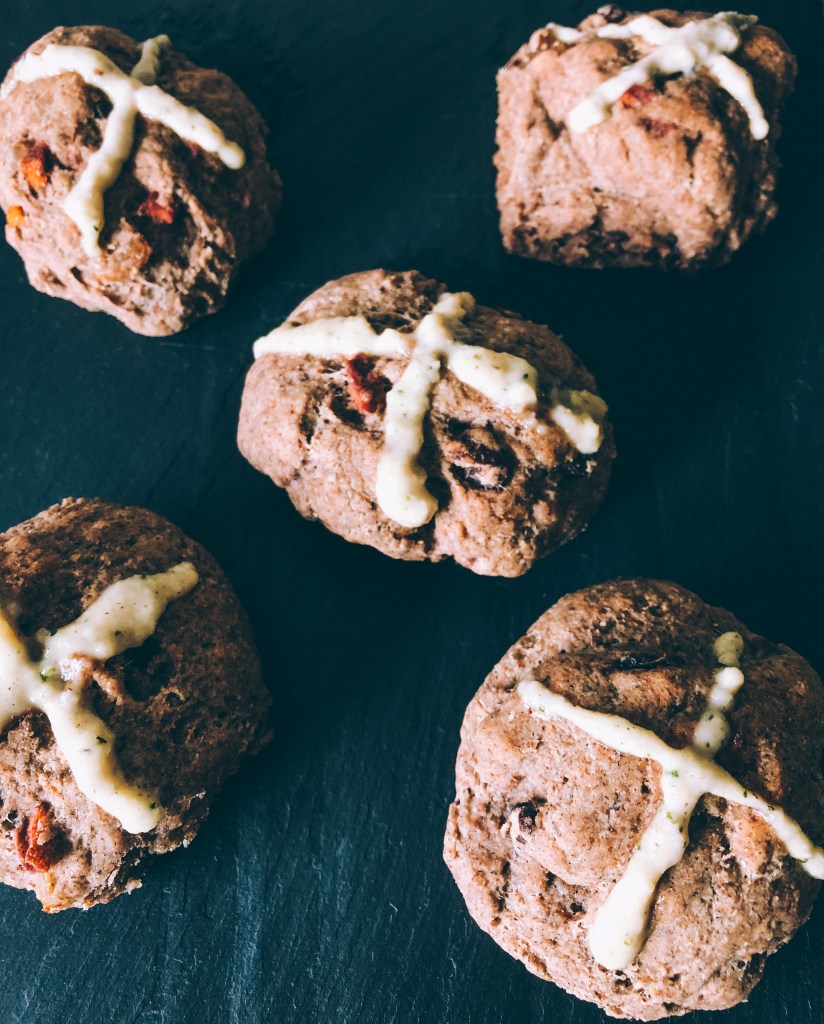
Today as I’m writing this, it is also the beginning of Holy Week, a special solemn few days in the Christian calendar before Easter, and given the state of the world right now, the solemn state of things appears to run parallel to it. Hot Cross Buns are also a traditional specialty this time of year, at least in parts of the US, and for sure in the UK and Ireland. It you’ve never enjoyed them, they are a spiced and fruit-filled yeast bread roll, often made quite a bit richer due to extra butter/oil, added sweetener and perhaps an egg. They were traditionally eaten on Good Friday, which is also a traditional day of religious fasting. If you like to delve into the history of food traditions like me, you can learn more about hot cross buns on Good Friday in this short article and its fascinating discussion/comments.

Otherwise, may you work on asking yourself this week, ‘What’s that about?’, and if you’ve the inclination, try baking hot cross buns.


Hot Cross Buns {gluten-free and vegan, sourdough method}, makes 5
This recipe appropriately fits the needs for those avoiding all (or some) of the most common food sensitivities and allergies, and because my nutrition-brain is always on when developing recipes for this space, these are a delicious, slightly enriched and sweetened whole-grain bread option that doesn’t get too far into the super decadent category.
As you’ll note, I’ve created two options to make these, with a sourdough starter, and without. I’ve made and enjoy them both ways, and because I don’t do away with the yeast in the sourdough option or dramatically change the method, they both turn out fairly similar. Instead, I tend to use my sourdough discard for the recipe and reduce the other flours and liquid.
If you’re finding gluten-free flours difficult to source right now, substitutes work well. Sorghum flour subs in well for either brown rice or millet, oat flour made from ground up oatmeal will likely work well in part, and any of the starches (arrowroot, tapioca, potato, or corn) can be used in place of the arrowroot and tapioca combination. As always when baking and especially when using substitutions, it’s always best to measure by weight.
There are a few ways to make the cross on top, either with a bit of icing after baking, by cutting a cross in the dough before baking, or by making a flour and water paste and drizzling it on top before baking. I meant to cut my dough before baking but then forgot, and decided to use a quick couple spoonfuls of cashew, vanilla and honey ‘frosting.’ I haven’t added that in here because I think it’s too fussy and these don’t need a sweet finish. They taste great on their own!

Wet Ingredients:
6 Tbs. non-dairy milk
2 1/2 Tbs. water
1 1/8 tsp. dry active yeast
¼ cup mixed dried fruit (raisins, golden raisins / sultanas, orange peel)
2 Tbs. orange juice or tart cherry juice or water
1 Tbsp. ground flax seeds 
1 Tbsp. psyllium husk (or use ground chia seeds OR flaxseed meal)
2 Tbsp. coconut oil, melted
½ Tbsp. apple cider vinegar
1 Tbsp. honey or maple syrup

Dry ingredients:
130 grams / ~1 cup gluten-free all purpose flour
(or 13 g buckwheat flour, 19 g tapioca flour, 20 g arrowroot flour, 26 g each sorghum, brown rice, and millet flours)
100 grams / ~ 1 cup gluten-free sourdough starter (equal parts flour and water)
1.5 tsp mixed spice  (1/2 tsp. cinnamon, ¼ tsp. allspice, ¼ tsp. nutmeg, 1/8 tsp. cloves, 1/8 ginger, 1/8 tsp. coriander, 1/8 tsp. cardamom)
¾ tsp. baking powder
¼ tsp. baking soda
¼ tsp. sea salt

  1. Warm up the non-dairy milk and water together until lukewarm or at about 100 degrees F / 38 degrees C. Whisk in the yeast and allow to froth up for about 10 minutes.
  2. While waiting combine the dried fruit and juice or water. Warm for a few seconds in the microwave and set aside to let the liquid soak in and soften up the fruit. I use about 1 Tbs. finely diced orange peel in this mix to make these extra festive and more traditional.
  3. Add the ground flax, psyllium, oil, vinegar, and honey to the frothy yeast liquid. Whisk together and set aside so it can thicken a little.
  4. In a large bowl, stir together the dry ingredients. Dump the wet ingredients and fruit into the middle of the flour mix and stir. Your dough will begin to look scrappy. Keep stirring with your spoon or hands until the ball of dough becomes somewhat smooth.
  5. Put a cloth over your bowl and let rest / rise for one hour.
  6. Next stir the dough well again, and then divide into 5 equal balls. Lay parchment in a small baking pan and then roll or shape each of the dough balls into rolls. Place them on the dish, cover with cloth again, and rise again for 1 hour in a warm, non-drafty space in your kitchen. These should rise enough to be touching each other in the pan, but will not double in size.
  7. Preheat your oven to 375 degrees F / 190 C. Before baking, make a little flour/water paste and pipe onto the top of the buns in crosses. Then bake for 2025 minutes or until the edges have firmed up. Place the pan on a wire rack to briefly cool down. You can also make your own frosting /sugar glaze and pipe atop when they are finished baking instead of the more traditional flour/water paste.

EXTRA NOTES

1. Tastes best when eaten warm and straight out of the oven.
2. Store in an airtight container and keep for about 3 days.
3. The dough can be made ahead of time. Simply place in the fridge during the second rise time and allow to sit overnight. Baking time might need to be longer.

Hot Cross Buns {gluten-free and vegan, regular non-sourdough method}, makes 5

Wet Ingredients:
6 Tbs. non-dairy milk
6 Tbs. water
1 1/8 tsp. dry active yeast
¼ cup mixed dried fruit (raisins, golden raisins/sultanas, orange peel, etc.)
2 Tbs. orange juice or tart cherry juice or water
1 Tbs. ground flax seeds 
1 Tbs. psyllium husk (or use ground chia seeds OR flaxseed meal)
28 grams / 2 Tbs. coconut oil, melted
½ Tbs. apple cider vinegar
1 Tbs. honey or maple syrup

Dry ingredients:
180 grams / 1 ½ cups gluten-free all-purpose flour
(or 18 g buckwheat flour, 27 g tapioca flour, 27 g arrowroot flour, 36 g each sorghum, brown rice, and millet flours)
1 1/2 tsp. mixed spice
(1/2 tsp. cinnamon, ¼ tsp. allspice, ¼ tsp. nutmeg, 1/8 tsp. cloves, 1/8 ginger, 1/8 tsp. coriander, 1/8 tsp. cardamom)
¾ tsp. baking powder
¼ tsp. baking soda
¼ tsp. sea salt

  1. Warm up the non-dairy milk and water together until lukewarm or at about 100 degrees F / 38 degrees C. Whisk in the yeast and allow to froth up for about 10 minutes.
  2. While waiting combine the dried fruit and juice or water. Warm for a few seconds in the microwave and set aside to let the liquid soak in and soften up the fruit. I use about 1 Tbs. finely diced orange peel in this mix to make these extra festive and more traditional.
  3. Add the ground flax, psyllium, oil, vinegar, and honey to the frothy yeast liquid. Whisk together and set aside so it can thicken a little.
  4. In a large bowl, whisk together the dry ingredients. Dump the wet ingredients into the middle of the flour mix and stir. Your dough will begin to look scrappy. Keep stirring with your spoon or hands until the ball of dough becomes somewhat smooth.
  5. Put a cloth over your bowl and let rest / rise for one hour.
  6. Next stir the dough well again, and then divide into 5 equal balls. Lay parchment in a small baking pan and then roll or shape each of the dough balls into rolls. Place them on the dish equally apart, cover with cloth again, and rise again for 1 hour in a warm, non-drafty space in your kitchen. These should rise enough to be touching each other in the pan, but will not double in size.
  7. Preheat your oven to 375 degrees F / 190 C. Bake for 2025 minutes or until the edges have firmed up. Place the pan on a wire rack to briefly cool down.

EXTRA NOTES

1. Tastes best when eaten warm and straight out of the oven.
2. Store in an airtight container and keep for about 3 days.
3. The dough can be made ahead of time. Simply place in the fridge during the second rise time and allow to sit overnight. Baking time might need to be longer.

Berry Bran Muffins and what to cook right now

A somewhat humorous discussion amongst some of the current and past students of my nutrition program last week was “What is Eleonora cooking right now?” Eleonora is my former cooking lab instructor, since we were required to take a few cooking courses during the program to really cement our ‘food as medicine’ approach to clinical nutrition practice.

While I consider myself an experienced cook, I never expected to learn a ton from these courses, but a day before that conversation emerged about Eleonora, a conversation with my childhood best friend brought realization that those simple courses cemented several cooking foundations that were otherwise learned haphazardly over time, or not at all.  

In that conversation with my friend, which not surprisingly went on as she was cooking dinner and subsequently asking for advice on the right temperature and amount of oil for roasting vegetables, she asked if I’d heard of a popular cookbook, Salt Fat Acid Heat. I explained that I was indeed familiar, but haven’t actually picked up the book. We learned those concepts in cooking lab, I explained.

What I got most from that conversation, however, wasn’t that I’ve picked up some culinary school concepts over time, or that I should give myself a pat on the shoulder, but that the conversation was so normal. Having not had a real conversation in months and going long stretches with much less since my friend’s life work is in ministry and she’s been abroad for most of the last decade, the ebbs and flows and even pauses to wait for another discussion on the other end of the line to begin and end were exactly as they would be between us—at any point in the last twenty and more years we’ve been close friends.

That maybe is a benefit to slowing down a little. We both all of a sudden were available for a conversation that as the years go, grows greater distance between each one.

The other thing, one of the students actually knew the answer to What is Eleonora Cooking?, since they were doing raw food lab last week. Eleonora is making and eating lots of sprouts. You know, just about the healthiest, most nutritious food on the planet.


When I was in her classes, I both loved and feared Eleonora. She has a brusque way about her, a heavy accent, and though you wouldn’t guess it, she was also a former Olympian. I suspect in some sort of track and field or gymnastics discipline, though I never did get that answer.

So in the midst of a global pandemic, my former Olympian-now nutritionist and cooking instructor is teaching the newest round of students about the benefits and how-tos of growing and eating sprouts. And my long-time friend and minister is not doing her work in visiting and being with people, but sewing masks and cooking roasted vegetables. And though many of us are attempting to keep some semblance of normalcy, we’re definitely not in normal times.

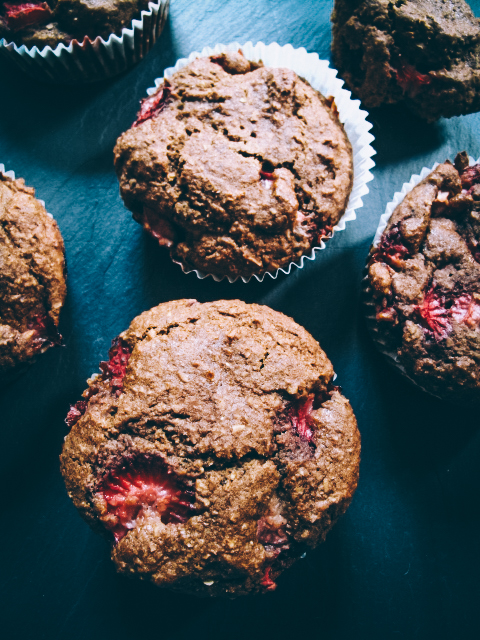
Instead of following in Eleonora’s food-steps and providing a guide on sprouts, or the best pot of beans, or the finer details on making gluten-free sourdough, today I offer you Berry Bran Muffins (but yes, I’m otherwise making and eating all three of those nutritious, gut-health and therefore immune boosting foods.)

Muffins are basically my go-to semi-nutritious baked good to make and experiment with, and though I know it’s common practice to eat them at breakfast, I much prefer them as dessert.

Because we all need as much cheer as possible right now, whether it’s in making something warm and delicious in the kitchen, finding funny videos, books, or movies to be entertained by, or in another creative project. I am lucky and grateful enough to still have a semi-normal routine –as much as one can in self-imposed isolation or quarantine or whatever you may call it when the wisest thing to do is to avoid everywhere except the open road or trail or neighborhood walkabout.

And I understand if where you’re located doesn’t quite have all the ingredients for these stocked on the shelf—or you’re not going back to the store for a while. That’s the thing about cooking, baking, and muffins in particular. The adventurous, creative part is in improvising when the way forward is not exactly as the recipe goes.

And yes, that’s a metaphor for life. I encourage you to have faith in yourself and the process.

Other things that held me up and gave me faith this week:
– A reminder of the Proverb of the Chinese Farmer
– The ever wise insight from Julie Piatt on taking care in the time of Coronavirus
The two words that will guide you (mine are faith and nature – which maybe explains a lot of what I share here and how I work)
This book I’m reading during the season of Lent along with daily reflections by Matthew Kelly
– Rebecca Altman’s Surrender + Magic mini-course (of meditations and finding peace)
– running, my normal routine and as if my scheduled April race is still happening as planned

Berry Bran Muffins, makes 6 standard size muffins
If using a store bought gluten-free flour mix, the one I’ve found most similar to mine is the Krusteaz Gluten-Free Flour. If using that or others, it is best to measure by weight, and omit xanthan gum from the recipe if your flour mix contains it. As much as possible, I avoid adding xanthan gum unless I believe a recipe really needs it–and after much testing, this one does because the batter is heavy on flavorful, but juicy berries.

1/2 cup / 50 g oat bran
1/2 cup / 120 mL non-dairy milk
2 Tbs. molasses
1/2 tsp. pure vanilla extract
1 cup / 120 g gluten-free flour mix
1 tsp. baking powder
1/2 tsp. baking soda
3/4 tsp. xanthan gum
1/8 tsp. salt
1/2 tsp. cinnamon
1/4 tsp. ground cardamom
1/8 tsp. ground ginger
2 Tbs. / 28 g coconut oil
1/4 cup / 50 g sugar
3 Tbs. aquafaba (liquid from cooked or canned garbanzo beans) or 1 egg
1 1/2 tsp. apple cider vinegar
1 cup fresh or frozen berries (choose your berry of choice or use a mix)

  1. Preheat the oven to 350 degrees F / 180 degrees C., and prepare a standard six-cup muffin pan by wiping with oil and dusting with flour or using paper muffin liners.
  2. Stir the oat bran, milk, molasses, and vanilla together in a small bowl until combined. Then allow to sit for at least 10 minutes.
  3. Meanwhile, in a smaller bowl, combine the dry ingredients including the flour, soda and baking powder, and spices. Set this bowl aside also.
  4. In a medium mixing bowl, stir and mix together the coconut oil and sugar until it is light and fluffy. This may take 3 to 5 minutes. Then add in the aquafaba or as an alternative, the egg. Mix well.
  5. Now add the flours, bran and milk mixture, and vinegar to the creamed sugar. Mix this just until all the ingredients are incorporated.
  6. Gently fold in the berries. If using frozen, you don’t need to pre-thaw them. Using a large scoop or spoon, divide the batter between the muffin cups. Bake until they become golden and a toothpick in the center comes out with just a few crumbs attached, about 25-30 minutes.
  7. Cool the muffins in the pan for about 5 minutes, then flip onto a wire rack and cool for at least 10 minutes before eating.

Winter Tabbouleh and How Fiber Helps Support your Health — and Hunger

In the health, wellness, and fitness community, we often hear all about the macronutrients (fat, protein, and carbohydrates). Yet, a nutrient that’s incredibly beneficial to our health is far less mentioned. That’s fiber.

Fiber is best known to keep you regular or prevent constipation, but there are many more benefits. In the athletic community, the one that comes to mind first is helping to relieve that ‘hungry all the time’ feeling that often comes with heavier training loads. Next is gut health, lowering disease risk, and helping to regulate the body’s use of sugars.

Dietary fiber consists of the non-digestible carbohydrates from components of plants. The human body does not make the types of enzymes needed to break the bonds in these fibers, so they pass through relatively intact.

Fiber is found in most plant foods, primarily vegetables and whole grains, as well as nuts, seeds, and fruit. There are two types of fiber— soluble and insoluble.  Both are beneficial to our health.

Soluble fiber absorbs water and turns into a gel-like consistency that slows down digestion. Ever had chia pudding or chia in a smoothie and felt full and satisfied for hours? That’s the soluble fiber at work.
Soluble fiber also helps slows the absorption of sugar into the bloodstream so blood sugar levels remain more stable. Food sources include chia, psyllium, flax and other seeds and nuts, oats and oat bran, lentils, peas, and some fruits and vegetables.

Insoluble fiber is not digested by the body. It is helpful for clearing out the buildup of undigested food and environmental and metabolic toxins in the digestive system as it moves through. Insoluble fiber also helps get the digestive system moving and eliminate any constipation. (Side note: constipation is not just having difficulty having a bowel movement. That’s the extreme. It also refers to spending more than just a couple minutes on the toilet, passing hard, dry, small pieces, failing to eliminate daily, and transit time beyond 12-24 hours.) Now that we’ve got that cleared up, insoluble fiber can be found in whole grains such as oats, millet, quinoa, sorghum, amaranth, brown rice, farro wheat, beans, and fruits and vegetables.

Fiber Nourishes Your Gut

Your digestive system is home to trillions of beneficial bacteria, called the gut microbiome. They live in an (ideally) symbiotic relationship with you. This means you and they both benefit from them being there. Just like you, the microbes need to eat to live and grow, so they obtain nourishment from the food you eat. In the case of beneficial bacteria, they feed on the undigested part of the food, (fiber), that is passing through your large intestine by fermenting it into short chain fatty acids such as Butyrate.

A healthy gut microbiome can protect you against disease-causing bacteria because the good bacteria compete for space in the intestines, literally out-populating the bad bugs from taking hold. It can also help you absorb otherwise non-absorbable nutrients like certain antioxidant polyphenols, produce some micronutrients like vitamin K, and provide needed fuel for the cells in the colon. Production of short chain fatty acids by bacteria in the intestine plays an important role in the maintenance of the intestinal barrier. What’s more, Butyrate has also been shown to be protective against colon cancer.

Whereas we don’t want an overgrowth of bad bacteria, having ample and diverse beneficial bacteria is a hallmark for optimal health. Low beneficial bacteria can impact your protective mucus lining in the intestinal tract, which supports up to 80% of our immunity. The commonly used phrase “leaky gut” comes into play here when the interplay between a low fiber diet, low beneficial bacteria count, and difficult to digest macromolecules poke holes in the cheesecloth-like fragility of the intestinal lining and then opens the way for the immune system to do its job –in overdrive – resulting in sensitivities, intolerances, and allergies to many foods that are in your normal routine. Prolonged problems here are part of the pathophysiology of autoimmune diseases. 

Fiber Keeps You Feeling Full Longer – Read this again during your next heavy training cycle!

Because fiber is so difficult for your body to break down, it stays in your gastrointestinal tract longer compared to simple carbohydrates like table sugar. Having food in your system helps you feel full longer. This is partly why eating an apple is better than 100% apple juice (stripped of fiber), which is then better than apple-flavored juice (stripped of all nutrients). We even have studies showing that diets rich in high-fiber whole foods help reduce the perception of hunger. This is good information if you experience the “hungry all the time” feeling during heavy training cycles when you’re actually eating enough.

How much do we need?

Research has found that hunter-gathers ate a large quantity of fiber compared to modern humans, upwards of 100g of fiber per day. The average American has around 10-15g per day, and the US Dietary Reference Intake is around 25-38g of dietary fiber per day – which is well above that of the average person –but easily achieved by gradually increasing plant-foods in the daily routine. Can we consume too much? Yes, that is possible. Too much fiber can lead to a bowel obstruction and diarrhea (which is also caused by many other factors).

Caveats

Some therapeutic diets eliminate fiber-rich carbohydrates temporarily with the aim of improving long-term health and shifting the microbial population. For example, this is the purpose of the low FODMAP diet for small intestine bacterial overgrowth (SIBO), and the candida protocol. Individuals who try an extreme low-carbohydrate or ketogenic diet also do so with the intention of improving health –often by way of improving the body’s response to sugars. But what’s commonly left out of the conversation is that all of these diets are meant to be temporary, because they all come with long-term negative health consequences such as eliminating all those beneficial bacteria that feed on fiber.

One more thing, we often hear the advice to reduce fiber in the days before a big athletic race, or eat ‘quick sugars’ in the few hours before athletic activity. This advice largely depends on the person, since just like we can train our bodies, we can also train our gut. Some of my best marathons were run after eating my routine high-fiber dinner and breakfast. I’ll delve more into this topic soon! 😊

Summary: Dietary fiber is an essential nutrient required for proper digestion of foods, proper functioning of the digestive tract, and for helping you feel full. A deficiency of fiber can lead to constipation, hemorrhoids, and elevated levels of cholesterol and sugar in the blood. Conversely, an excess of fiber can lead to a bowel obstruction and diarrhea. Individuals who increase their intake of fiber should do so gradually since this internal adjustment is going to adjust the populations of beneficial (and not so beneficial) microbial species in the lower GI –and thus might initially come with uncomfortable symptoms.

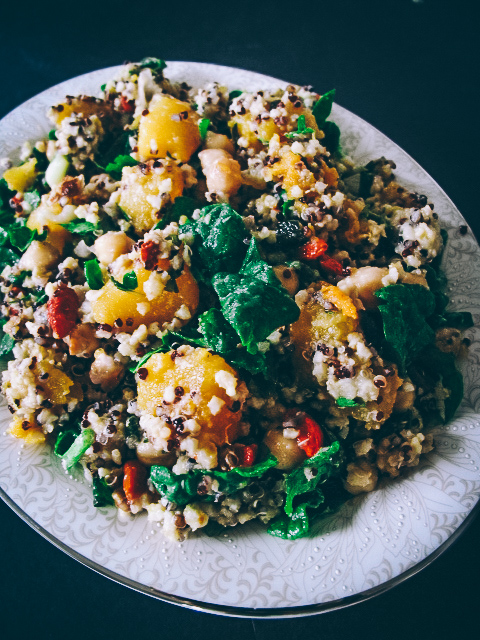
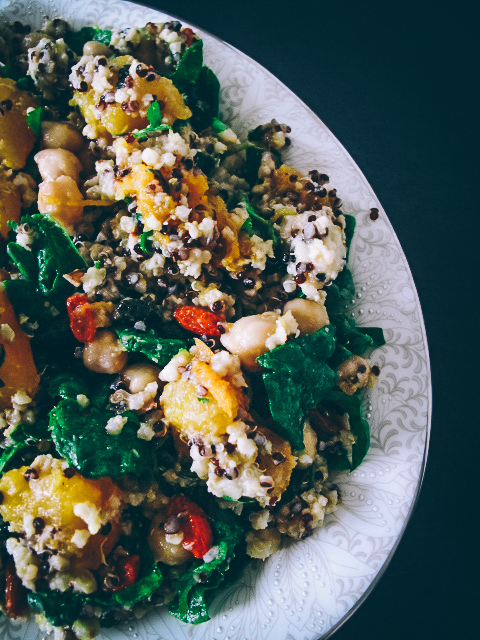
Now that we’ve got our daily dose of nutrition wisdom, let’s eat! William labeled me the queen of grain salads the other night after presenting this dish. It’s a seasonal variation on a plethora of other fiber rich tabbouleh-like grain salads in the recipe archives of this space –and one I’m really favoring right now for the bright colors, balance of slightly sweet and savory, and all in one dish for dinner. I routinely use millet or quinoa, but used both in this version. We had a stockpile of pumpkins in our house from last season’s harvest which I’ve by now mostly used up, but I noticed at our local farmers market last weekend that winter squash and pumpkins are still going strong—locally we tend to have them until mid to late March. If they’re less available near you, swap them out for some other seasonal vegetable – or leave out completely.


Winter Tabbouleh, serves 4-6
1 small pumpkin or winter squash (about 2 cups cubed)
1 cup millet or quinoa or a combination of both
2 cups water or vegetable broth
¼ tsp. cinnamon
1 cup cilantro
½ cup mint
3 green onions
¼ cup walnuts, chopped and lightly toasted
¼ cup goji berries
2 cups cooked garbanzo beans
1-2 handfuls spinach or other greens, optional
2 Tbs. apple cider vinegar
2 tsp. honey
1 Tbs. olive oil
salt and pepper to taste

Instructions

  • Heat oven to 400 degrees F.
  • Cook millet by combining with 2 cups of water or broth, along with the cinnamon, in a medium saucepan and bring it to a boil. Turn down to a simmer, cover and cook until the liquid is completely absorbed, 25 minutes. Set aside to cool.
  • Place the squash cubes on a baking sheet with a little water. Bake for 25-35 minutes until the squash is soft. Alternatively, you can bake the squash whole until soft, then peel off the skin and chunk into pieces. This is my preferred quick-prep-ahead method lately.
  • In a large bowl, toss together the garbanzos, cilantro and mint, gojis, toasted walnuts, cooked squash and green onions. Then add the millet and spinach greens and give it all a good stir. Finish it off with the apple cider vinegar, honey, olive oil and salt and pepper to taste. Serve warm or at room temperature.