Lunchtime Basics: Quick Egg Flatbreads with Greens + Gold Spice Dressing


Dropping in to share a realtime lunch idea for you all lately. This is a meal concept that’s super seasonal, which makes it all the more delicious. 

Food Confusion and Eating Seasonally

I know some of you who read this regularly may not eat eggs. But some of you do. I’ve personally waxed and waned about eggs and many other foods over the years but ultimately have come right back to my initial conclusion: Eating is personal. And over time you change, go through phases, or learn more of what is needed to sustain you.

One thing that is very personal to me about eating is seasonality and locality. It’s what helped me through a time when I was as perplexed about what to eat as some of you – when I was following too many food trends and afraid of what to put in my body or of eating “too much.” I compared myself to everyone around me but I didn’t know how to gauge my own hunger, symptoms of imbalance, or simply get out of my head and into my body. 

William began keeping hens about three years ago, and prior to that I had largely avoided eggs for several years. That phase where eggs didn’t sound good, I didn’t like spending $7+ per dozen for local eggs, and didn’t like the conditions involved in the traditional egg production industry. But also that phase where I was following trends and wasn’t entirely eating for me.

And so, slowly, two new chicks each spring that began laying a few months later and brought such big personalities. I grew up on a farm with lots of various animals but in the years in between that time and the introduction of our first two hens, Marge and Pepper, I had somewhat forgotten how every animal comes with her own personality and desire to please. 
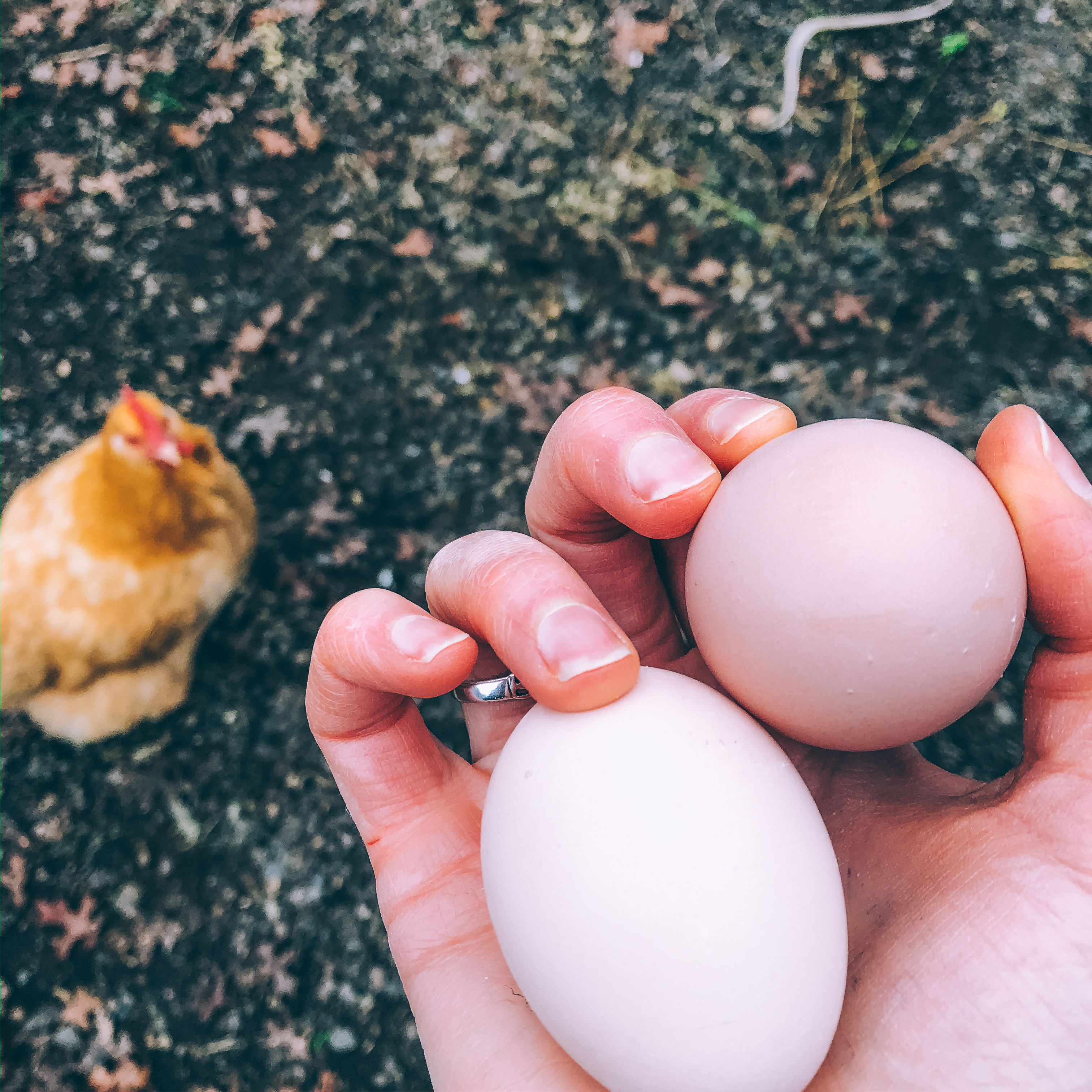
It’s normal for hens to stop producing eggs over the winter due to less daylength and it being cold outside. Though this winter has actually been the first for ours to take a break. Not being a daily or often even a weekly egg-eater, the winter egg break was just fine at first. But as it went on for weeks and then became a few solid months, I started to realize how I was dropping even more into the quiet of the winter season – and eating even more that way too.

Eating seasonally traditionally means less variety and abundance in the winter. It also traditionally means a change in gut microbes that can help us break down the foods that are in season.  

As the first eggs began to arrive back in the laying box and our hens began strutting around, proud of their golden tokens, it made me more aware of the gifts of each season.

Which is all to say, whether you choose to eat eggs or not, I encourage you to look for signs of the changing season as you’re out and about in your neighborhood or community, and especially next time you’re shopping. I encourage you to choose at least one new seasonal food each week–and if you struggle with confusion about what to eat, really pay attention to how you feel physically and mentally in the hours after you eat your chosen new food.

Just notice what comes up.

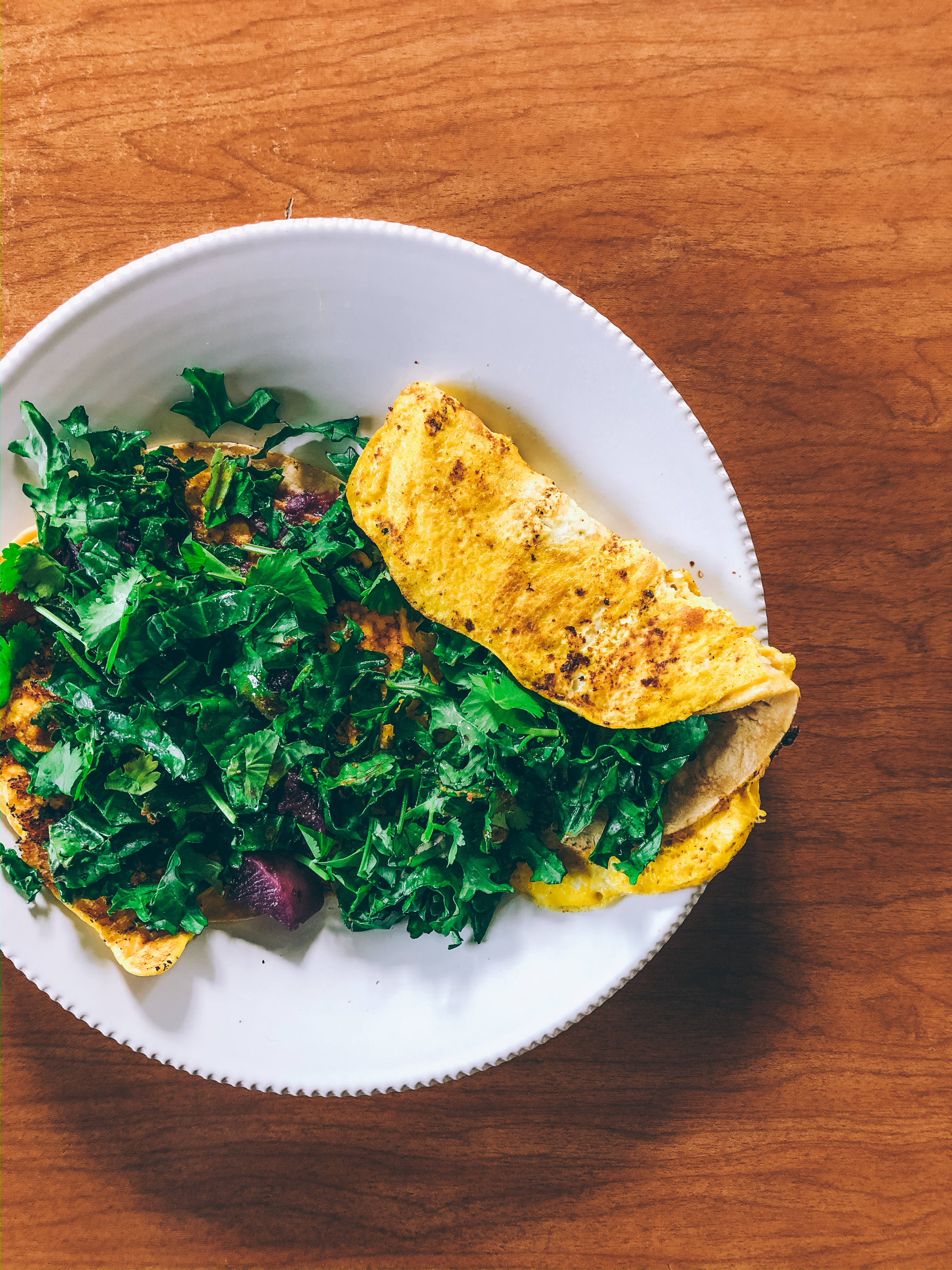
Quick Egg Flatbreads with Bitter Greens + Gold Spice Dressing, Serves 1
I use two things that make this super quick. A ready-made dressing and some leftover veg to add in and round out the meal. Otherwise, you can steam what vegetables you have on hand while you’re cooking the rest. Or skip the extra vegetables, but it will be a fairly light meal and may not be enough – this of course depends on the person.
One other note about the method: this late winter/early spring time of year is marked by a season of cold and wet in most regions (in the northern hemisphere). To counter that and retain balance in the body, it’s best to eat meals that are warm and cooked, and to start to add in more astringent greens like kale, chard, and spinach, while avoiding excess foods that cause mucus and damp in the body such as dairy and rich, heavy meals or sauces.

1-2 Tbs. Gold Spice Dressing
1 handful of seasonal bitter-ish greens, chopped or torn
splash of water
2 small (6-inch) corn tortillas
2 eggs, scrambled one at a time
salt and pepper

toppings/add-ins to accompany:
leftover roasted or steamed vegetables OR roasted/steamed sweet potato, daikon radish, etc.
cilantro, parsley or dill

  1. Make dressing or prep it ahead.
  2. In a medium sauté pan over medium-high heat, add a splash of the Gold Spice Dressing and a pinch of salt, and wait until the spices are just beginning to smell. Then add in the greens and a splash of water. Stir and then cover to steam-sauté for just a minute or two. Remove from the pan and set aside for a minute.
  3. Wipe the sauté pan clean and then add another small splash of the dressing. Pour in the first scrambled egg and a little sprinkle of salt. Don’t stir. Let it cook for 30 seconds to a minute and then set the first tortilla over the top of the egg. Cook another minute or more, just until the bottom is set. Then flip and cook 1-2 minutes more until the egg is cooked all the way through and the tortilla is warm.
  4. Repeat with the remaining egg and tortilla.
  5. Finish by layering your plate with the egg / tortilla flatbreads, the sautéed greens, and the steamed or roasted vegetable add-ins and herbs. Drizzle a little extra dressing on top as desired.

Butternut Buckwheat Porridge from Living Ayurveda

About a year ago near the solstice, I wrote the words grounded/focused on a bookmark. The back was painted with a small cross-section of watercolor tulips from a local artist; her cast-offs she’d cut into cards for an intention setting gathering. Grounded and focused were my intentions for how I wanted to feel by the end of this year. Little did we know then what 2020 would entail, but what I did know was that I struggle with being mentally cluttered and scattered, sometimes switching topics mid-sentence in conversation, and often letting my thoughts and ideas run away from me and having nothing to show for it minutes (and sometimes hours) later. I also knew that the internal atmosphere of being grounded and focused wasn’t so much an end goal for months away, but a daily, and sometimes minute by minute practice.

It’s safe to say I have succeeded and failed in my intention, multiple times a day.

But I’ve also been able to add a lot of tools and practices for how to gain a less scattered mind and actions over the years. One of which is continually learning from Ayurveda.

Ayurveda is the indigenous health system of India, and arguably the oldest health system (or one of the oldest) in the world. While I didn’t learn Ayurveda outright in nutrition graduate school, mine was a program that married traditional systems of health with the latest nutritional and medical sciences, and thus incorporating components of Ayurveda in my nutrition classes and clinic was widely accepted – and especially in my herbal classes. In the meantime, as if I didn’t need to study more, I was studying it on the side and incorporating increasingly more aspects of Ayurveda in my own life, helping to get closer to healing many of my GI and autoimmune struggles.

The cluttered and scattered mind is a common feature of imbalanced vata in the body, and like many people in our modern lifestyles, I struggle with this imbalance, a lot. As well as many other high-vata tendencies. Vata is one of the three energies or forces which can be observed in all things, and which are ideally in balance. Pitta and Kapha are the other two energies. Eating foods that support high vata or perhaps foods that support one of the other two doshas that make up our body and mind, is a primary way we can return our ailments to balance, but it’s certainly not the only practice.

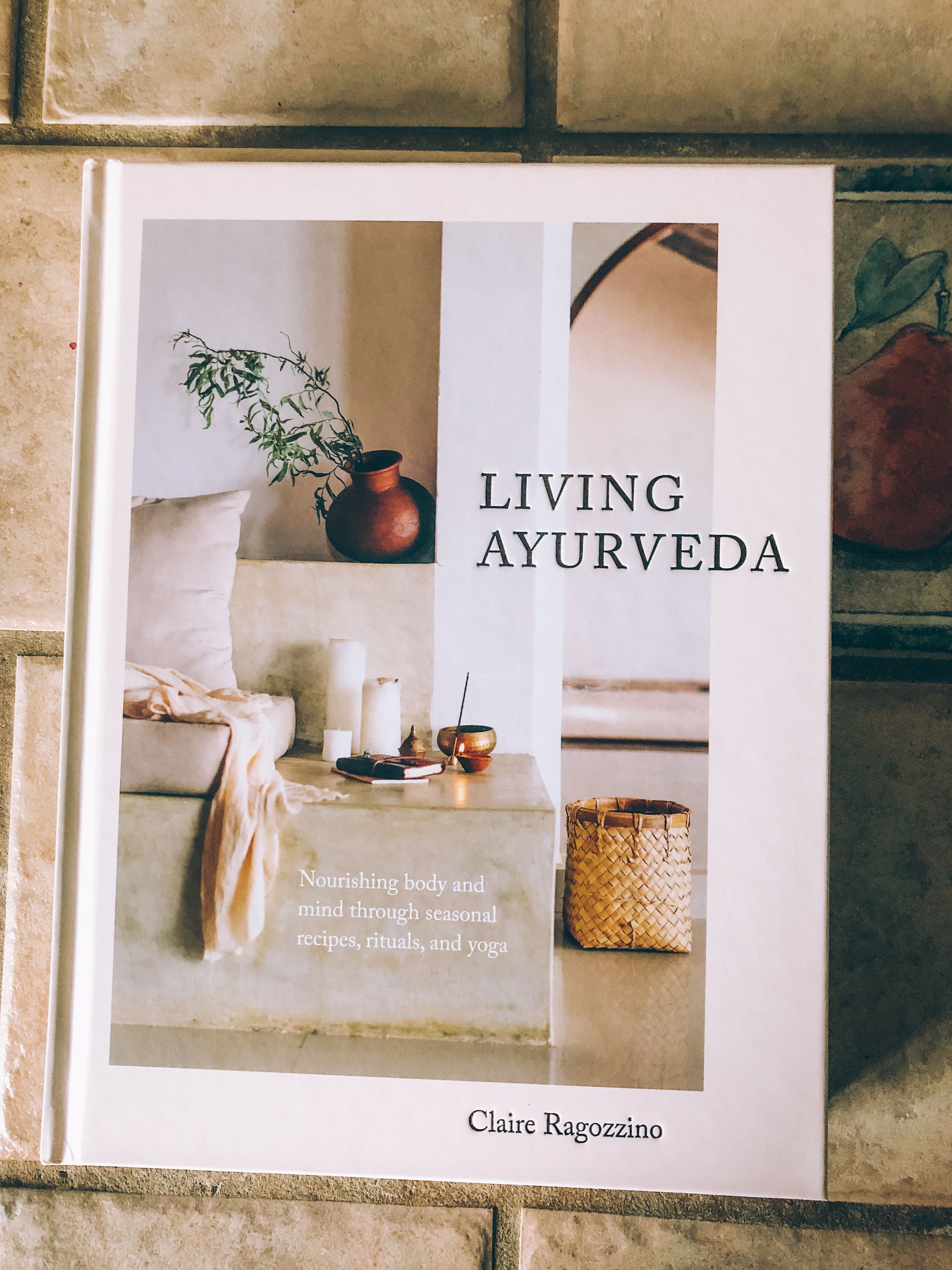
So many years ago that I don’t remember, but around the time I first learned of Ayurveda, I discovered Claire’s blog with simple delicious Ayurvedic recipes. Claire has recently released her gorgeous book, Living Ayurveda, which is full of the kind of guidance that helps us achieve a little more balance in our lives. It encourages us to make the connection between time of year and patterns that afflict us (but don’t have to), incorporating building and lightening ingredients in the right ratios in our meals, and recipes that can be adapted depending on the season and our individual doshas or imbalances. Likewise, there are yoga sequences for each season too.

Some of the recipes that I’ve already tried and truly will make again and again include:
Pumpkin Empanadas with Cashew Crema
Shakti Chai
Simple Stewed Apples
and this Butternut Buckwheat Porridge

So many more are on my list – actually all of them really:
Warm Cinnamon Date Shake
Creamy Miso Tahini Dal
Delicata, Wild Rice & Pomegranate Salad
Kitchari Burgers
Fall Harvest Muffins
and most definitely the Yogi Bowl, a variation on something I could eat daily.

Butternut Buckwheat Porridge from Living Ayurveda, serves 2-4
To be completely transparent in portion sizes, I make this recipe as a half batch for one meal. That is a perfect amount for me, as a very active person, to go several hours between breakfast and the midday meal with excellent energy and ‘fuel’. Claire’s suggestions include adding an extra spoonful of ghee for vata support on very dry and cold days, reducing the cinnamon slightly for high pitta (cinnamon in large amounts is quite heating so good for some with high vata and kapha, but less so for others), and taking out the oats and doubling the buckwheat for high kapha. For a completely vegan and/or dairy-free version, I suggest using untoasted sesame oil, especially for vata/kapha, or coconut oil instead.

3 cups water
1/2 cup (untoasted) buckwheat groats or short-grain brown rice
1/2 cup steel-cut oats
1 cup peeled butternut squash, cut into 1-inch cubes
1/4 cup raisins
1 tsp. ghee
1 tsp. ground cinnamon
1/4 tsp. salt
milk of choice and maple syrup, for serving (optional)

  • In a medium pot, combine all ingredients and bring to a boil on high heat. Cover with a lid, reduce heat to medium, and simmer for 30 minutes, until butternut squash is tender and the grains are fully cooked. You might need to stir once or twice during that time. Toward the end, add a splash of water if needed.
  • If using a pressure cooker, reduce the water to 2 1/2 cups and follow instructions for pressure-cooking porridge. Once done, remove from heat and serve hot with a splash of milk of choice and a drizzle of maple syrup on top. I found the milk and syrup is a preference, and I enjoy this without either.

Potato + Artichoke Frittata and summer guidance

It seems that time is getting away from me this summer. In the midst of this tough year, I’ve found I’ve needed more of a break from the virtual world these last few weeks. In the midst of doing some checking in with myself, I retook a character strengths test around the time of my last post in late June from the Via Institute on Character. Having last took the same test in early grad school, I found that most of my top character strengths are truly mine and have hardly changed, but having moved into my own nutrition clinical work, some of the strengths that were lower as a student have truly risen to the top. The results highlight how much we become what we practice. From that assessment, my top character strength is spirituality, as it has nearly always been. What the institute means by the Spirituality character strength is:

Having coherent beliefs about the higher purpose and meaning of the universe; knowing where one fits within the larger scheme; having beliefs about the meaning of life that shape conduct and provide comfort.

All of which has guided the majority of what I’ve written here this year and for the last several.

But the too-much-online-all-the-time and never-ending negative news cycle has gotten in the way of that a bit this spring and early summer. My internal guidance has gotten harder to hear and less obvious. On the daily, I have often felt torn between too many demands and not enough complete alone time. And so, in early July, I took a time out. I took a week off completely, from my public health job, from nutrition clients, from running, and from all technology. If I’m honest, what I hoped to gain from it was a flash-bang inspiration and guidance, if only for a moment, to make me feel better about all of this we’re living through.

But I didn’t get it.
It’s often said that God speaks in the whispers of the heart. That his guidance for us dwells in the silent spaces.

One of the things I’m coming to over the last few months is directly on this topic. When I work with individuals with nutrition, I provide guidance and of course my opinion, but I see each encounter with each client as a true collaboration; because as much as I have the professional training and knowledge of nutrition and its impact on physiology, we are each experts on our bodies, or should be. And I think each of us has the intuitive feels right for me knowledge about our bodies hidden underneath the clutter of all our everyday stimulation and egotistical desires.

This year, so many of us have been going through hard things, personally, professionally, with health, and more. It’s been my intention to start writing and sharing more here on the everyday aspects of that that are applicable. Frustratingly, that everyday application has only come easily when working individually with each person. Instead of resisting against this frustration, or forcing something that I’m finding difficult, the right answer for me today is to follow the strings and share here what comes with more ease. All that’s to say, I’m practicing having more grace with myself. And hope you can do the same with you.

And also,
If you are struggling with your relationship to your body this year, or finally beginning to address it, I hear you.
and If you are struggling with your digestion and/or are in the midst of a long frustrating battle with it, I hear you.
and If you are overwhelmed and/or losing hope with this pandemic and lack of true normal or return to it in the foreseeable future, I hear you.

Perhaps I’ll soon begin to provide more concrete words on those topics soon, like I have been meaning to. In the meantime, I’m leaning in to feeding myself and William wholesome meals lately, like this potato and artichoke frittata, and trying to keep the quiet spaces open to allow in the guidance I prefer.
Hope you are taking care.

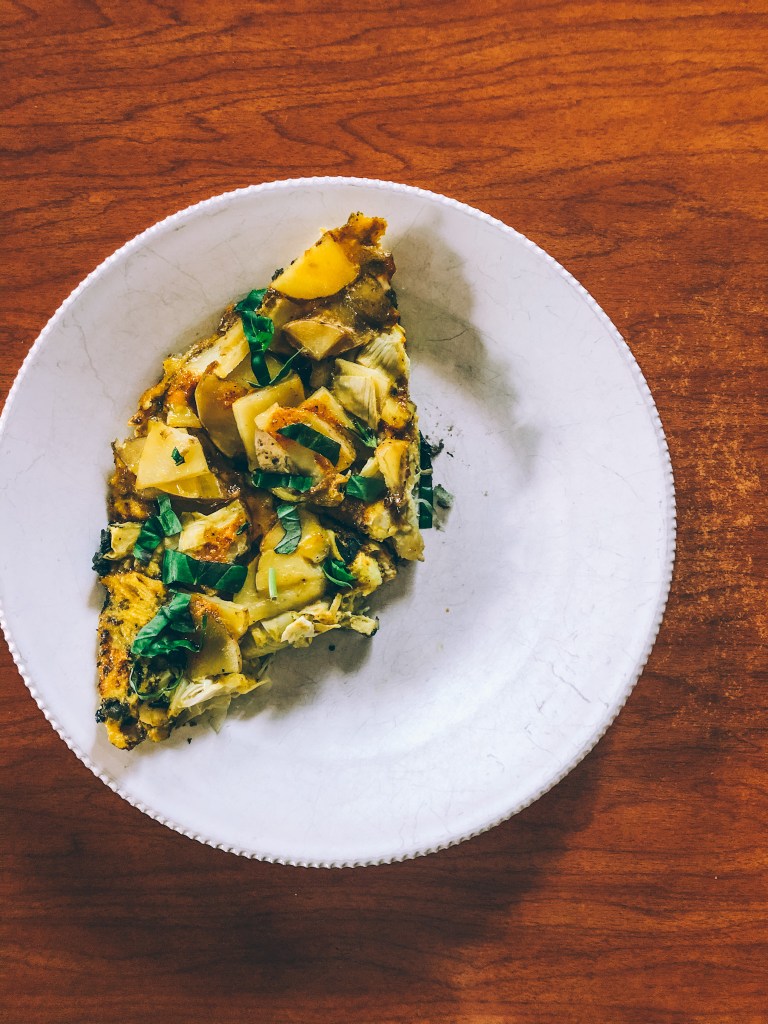
Potato + Artichoke Frittata, serves ~3
I’ve never been much of a potato person, except the year-ish I lived in Ireland, but William insisted on growing potatoes this year. He chose a variety from Row 7, a seed company founded by chef Dan Barber, whose intent is to work with farmers who are developing vegetable varieties with flavor in mind, a notion that realistically is not done when it comes to developing commercial / commodity foods. It’s clear to me now that good potatoes make all the difference. If you can, I encourage you to buy locally from a farmer near you. I promise, they will taste infinitely better than anything in a standard supermarket.

300 gr. / 2-3 medium potatoes, unpeeled, medium-diced.
a dab of coconut oil or ghee, to cook
6 large eggs, whisked
a dash of black pepper and 1/4 tsp. salt
200 gr. / 1/2 a can of artichoke hearts, drained, rinsed, chopped
1 tsp. olive oil
1/4 tsp. turmeric
1/4 cup fresh basil, finely minced

  • Over medium-high heat, warm a little coconut oil or ghee in a medium-large heavy skillet that is oven-safe. Stir in the potatoes and sprinkle with a bit of salt. Cover and cook until they are tender, stirring occasionally, about 8-10 minutes.
  • Whisk the eggs along with the remaining salt and black pepper. Turn down to medium-low heat and pour the eggs into the skillet with the potatoes, along with the chopped artichokes.
  • Cook for a few minutes, until the eggs are just set and there isn’t a lot of liquid running around the pan on the top. To help with this, you can run a spatula underneath the sides of the frittata, and tilt the pan so the uncooked eggs run ot the underside.
  • Remove from the heat and place in the oven under the broiler for a couple minutes, until the top has puffed up and set. If your broiler has two settings, choose the low setting.
  • Remove from the broiler and let it sit for a minute or two. In the meantime whisk together the remaining olive oil and turmeric. Drizzle the turmeric mixture over the top, and sprinkle with fresh minced basil.
  • Serve warm or at room temperature with fresh greens or other meal accompaniments.


Are you in need of extra nutritional support?
If so, I invite you to reach out to me for more personalized support. Conditions I often work with include digestive health and food intolerances, meeting needs of endurance athletes, vegan/vegetarian diets, intuitive eating, and autoimmune disorders.