Almost Spring Brown Bread Breakfast

I have been a fan of Irish Brown Bread since I moved away to college nearly six years ago, and wanting to make my own bread, but never having the time to knead and proof, fell back on a staple of the Old Country.  Brown Bread is wholemeal or wholegrain soda bread, and unlike the many American versions floating around this time of year, it’s truly the real deal.     Brown bread is always the best bread for a thick bowl of steaming vegetable soup, a quick yogurt and toast breakfast, and an open-faced sandwich with all the toppings.  In fact, I make it whenever the whim strikes or I have extra buttermilk hanging about in the kitchen, as was the case today.

Brown Bread is one of those national pastimes that arose out of necessity–due to the type of soft wheat grown in the cool Irish climate, which doesn’t yield an adequate rise for yeast bread, the abundance of buttermilk or sour milk left about in homes where there were always cows producing fresh milk, and the fact that it was filling and cheap during a time when the majority of residents were impoverished.

I’ve tried what seems like hundreds of brown bread recipes over the years in search of a perfectly moist loaf, as the bread can tend to be dry, all the while wanting a bread  that still has a sweet wholesome flavor, without sacrificing it’s simple nature.  After spending a Bank Holiday weekend last summer at Ballymaloe House in Shanagarry, County Cork, I found it–Myrtle Allen’s Brown Bread recipe.  It’s truly perfection.  I would expect nothing less from the famed woman who started the Ballymaloe Cookery School.
Myrtle Allen’s Brown Soda Bread
4 cups wheat flour
1 cup white flour
1/2 cup steel-cut oatmeal, oat bran, or thick-cut oats
1 tsp. baking soda
1 tsp. salt
2-4 cups buttermilk
  • Preheat the oven to 375 degrees F.  Grease or oil a baking sheet or large loaf pan and set aside.
  • Mix the dry ingredients together in a large bowl.
  • Make a well in the middle of the bowl and add the buttermilk, stirring with a wooden spoon until dough is soft but not too wet, with no dry flour left.  (About 2 1/2 cups of buttermilk but more or less may be necessary).
  • Turn the dough out on a floured board and shape into a round about 3 inches thick.  Alternatively, pour the dough mixture from the bowl into an oiled loaf pan and spread evenly.  Cut a deep cross in the top of the loaf with a wet or floured knife.  If making a round, transfer to a large baking sheet.
  • Bake for 45 to 60 minutes, until the the bottom is nicely browned and the bottom of the load sounds hollow.

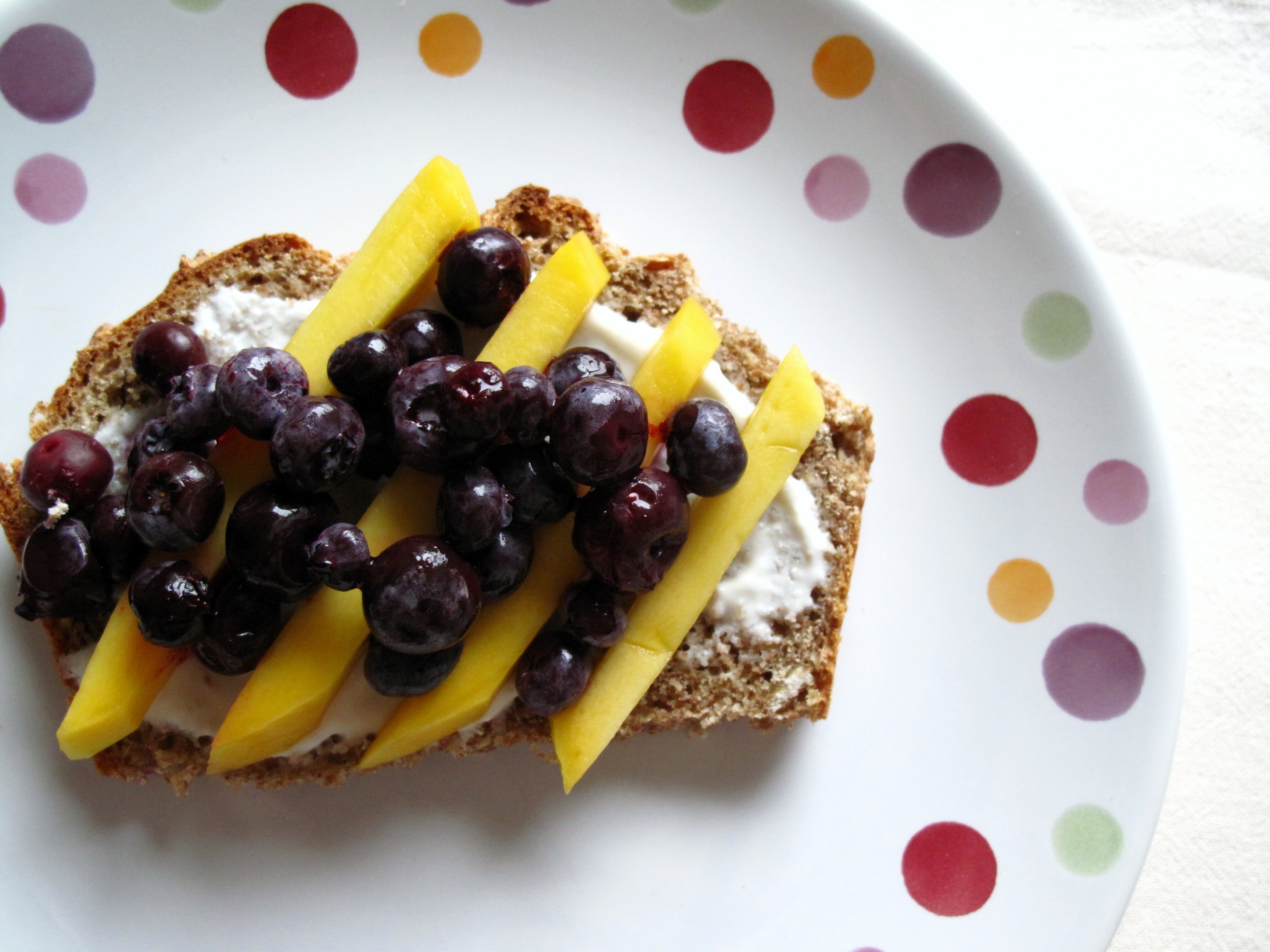
For a beautiful tasty breakfast that makes me think of spring with all it’s fresh colors and flavors, thinly slice bread and toast.  Top with plain yogurt, sliced mango, and fresh blueberries.  Delicious!

The Comfort of Minestrone

Lately, I’ve been living without.  Without wheat, dairy, eggs, soy, corn, sugar, processed foods, coffee, and chocolate, all in the name of the Whole Living Action Plan 28-Day Challenge.  I must say I’ve had some surprises.  Sure I’ve missed my daily-mid-afternoon pick-me-up (coffee).  And it’s been a large adjustment to forgo my daily lunch sandwich, or a nice chunk of bread with soup at dinner.

What I’ve missed most, however, has been sugar.  I am a sweet-eater at heart.  I generally enjoy some sort of dessert nearly every day.  My day just isn’t truly complete without it.  Blame it on my dad–who in the absence of sweets in the house, will begin to nip spoonfuls of plain-white-granulated from the sugar bowl.  I kid you not.  And while I will likely never resort to that level of sugar-deprivation-induced-behavior, I do most definitely love my sweets.

One thing this challenge has given me is some perspective and sense of accomplishment.  I know I don’t need these things I’ve been giving up.  I feel my metabolism has kicked up without them.  I realize the things I’ve given up are mere luxuries I’ve been indulging in every single day.  And while my meals this past week have been rather wholesome, they are challenging as well.  They require some thought and advance planning, and much recipe manipulating.  They equire me to forgo most restaurant meal items (or perhaps even all).

They’ve also given me an opportunity to simplify.  Because at the end of the day, when you remove most allergen-inducing ingredients from your diet, you are only left with the most simple, basic, nourishing meals. Like minestrone.  This minestrone was pure simplicity.  I started with dry white beans and cooked them until they were really soft.  A long simmer really helps the beans soak into all the other flavors.  The soup was delicious and was consumed with much approval.

Minestrone (adapted from Good Mood Food)
1 medium-sized zucchini, chopped into small chunks
2 cups diced tomatoes, canned
5 cups cooked great northern beans
2 cloves garlic, minced
1 large onion, finely chopped
2 stalks of celery, chopped
8 cups chicken stock
3 oz. rice noodles
2 Tbs. olive oil
A pinch paprika
Sea salt and fresh ground pepper, as needed
  • Begin with 1 1/2 cups dry white beans and cook until soft.  Set aside.
  • In a large pot, heat the olive oil and sauté the garlic and onion until they become soft.
  • Stir in the celery, carrots, zucchini, and cook for about five minutes.  Add the tomatoes and chicken stock, and bring to a boil, then reduce heat and simmer for 40 minutes.
  • Add the rice noodles, paprika and beans.  Stir in and cover the pot.  Cook gently for 10 minutes or until rice noodles are cooked.
  • Season with salt and pepper.