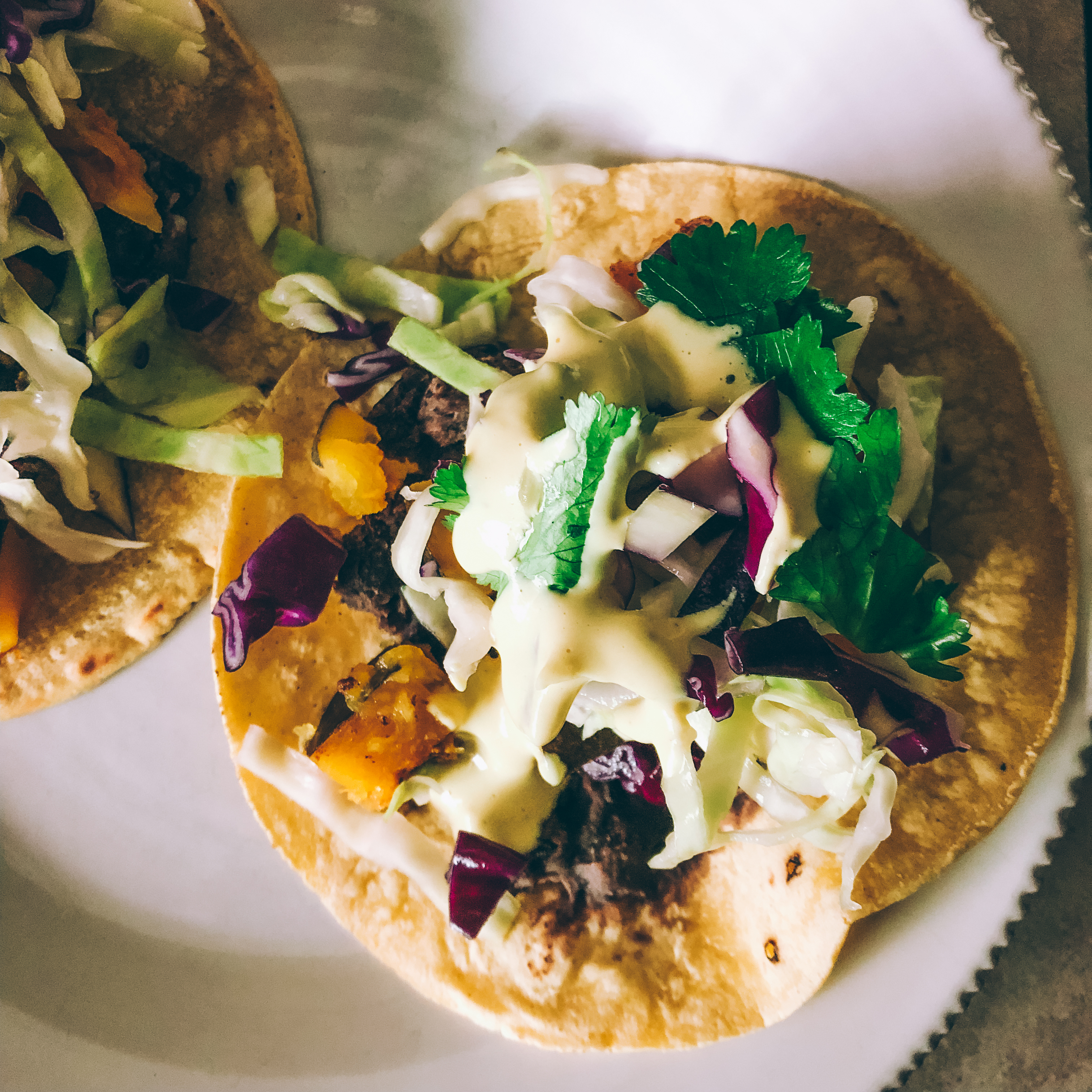
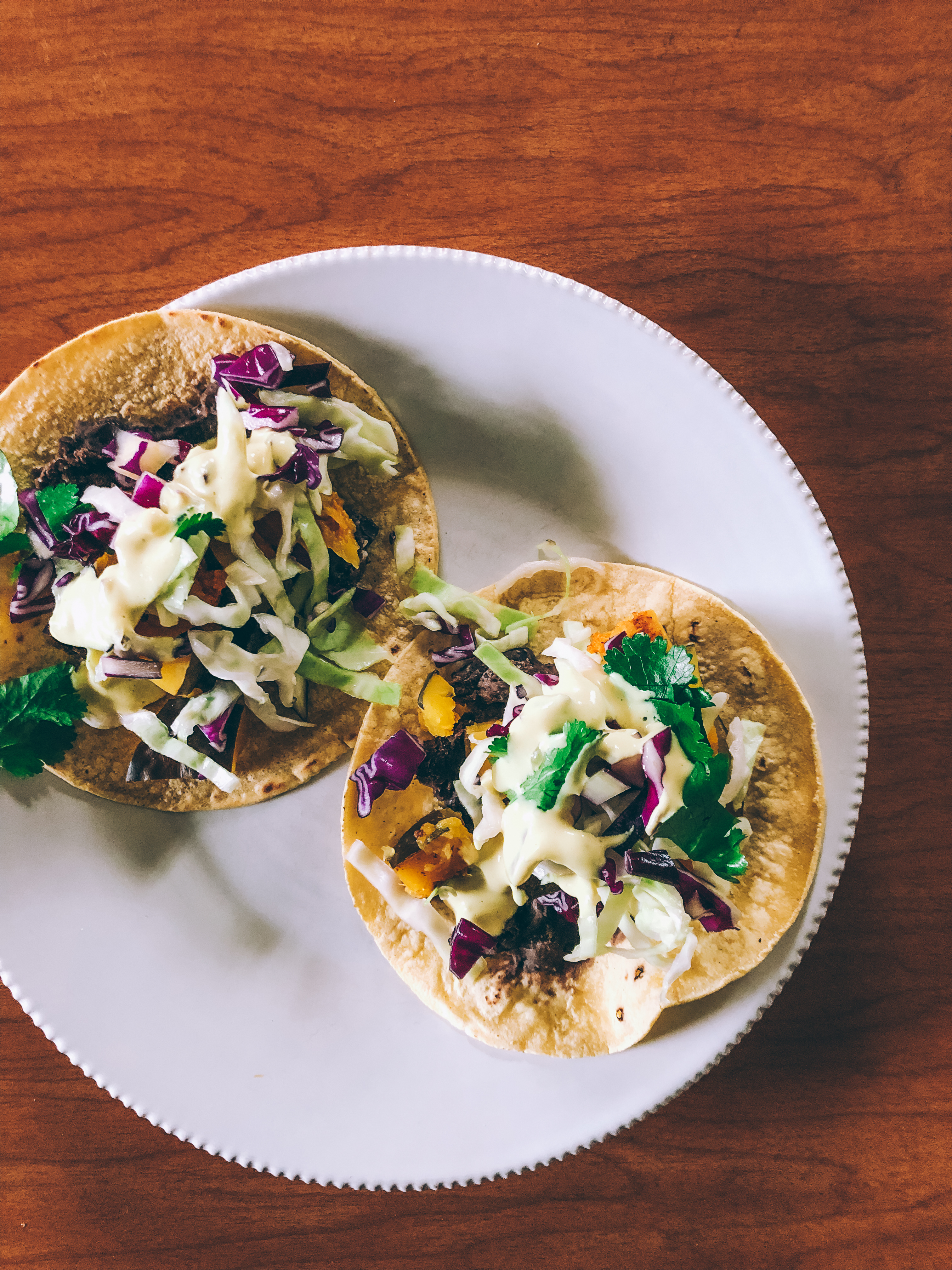
Buttercup Squash + Creamy Black Bean Tacos

I frequently share with nutrition clients about the connection between mental and physical health, particularly between the gut and brain, but also just a reminder that it’s all connected. We’re all connected. Something that’s been labeled “all in your head” is also in your body, and vice versa.

That’s the paradigm I work out of.
In my own life, I’ve had a long journey with things in the realm of “mental health;” in the last few years mostly related to low grade anxiety that can simply be summarized as high vata dosha in Ayurveda. So I try to balance myself with daily habits that invite in slowing down (physically and as a result mentally), practices that sooth my nervous system, and a practice of breathing and meditation that’s begun to infuse into my days.

For the last few weeks, I’ve felt like I really hit a flow with presence and slowing down my brain’s looping and too-quick thoughts.

I’d cracked the code! (haha, right).

Then over the weekend, I set out on the longest run of my current marathon training cycle. As I settled into the last hour of running, when my body was tired and my pace/effort was meant to get higher, my brain kicked in.

My brain kicked in in all the ways I’ve been working to slow my thoughts down or just observe them rather than let them dictate my actions.

The run wasn’t a failure. Today, a few days beyond it, I mostly feel really good about how it went physically. But I’m disappointed with how I coped and let my mind decide to take it easier than planned in that last hour when I’d prepared for and practiced something else.
I guess that’s why we call it a practice. A running practice. A meditation practice. A breathing practice.

In fact, my last conversation with my long-time naturopath who sadly moved away was on this very topic. She told me that if I wanted to keep running marathons, I was going to have to balance the running out with yoga. And she didn’t mean the physical asasa of yoga poses–although that can be helpful too! She meant that if I was going to continue the going fast of running, I needed to balance it out with the slowing down of practicing breathing, presence, and eating slowly and mindfully, to digest food well.

It’s safe to say I’ve made progress from where I was then. But I have not cracked the code of always getting it right. Nor will I.

We’re all works in progress but as reminder to you, and to myself, we rarely make linear progress.

This recipe for creamy black bean tacos with lightly baked and seasoned winter squash, a simple sliced cabbage and creamy sauce to drizzle over the top, is one of those many-years-in-progress, mind and body are all connected recipes. It’s truly delicious for your fall and winter taco nights.

But I also wouldn’t have been eating it a couple months ago, when my gut health had temporarily returned to a compromised phase – I had to do a bit more healing and re-balancing first to return to eating a “more complicated meal.” That’s all to say, if you’re still in an iffy-digestion state, save this one for a little later. And let’s see about getting your system working optimally first.

And if you’re like me and tend toward too-fast, scattered thoughts, I encourage you to keep up the practice of breathing and returning to presence. I’ll be right there with you.
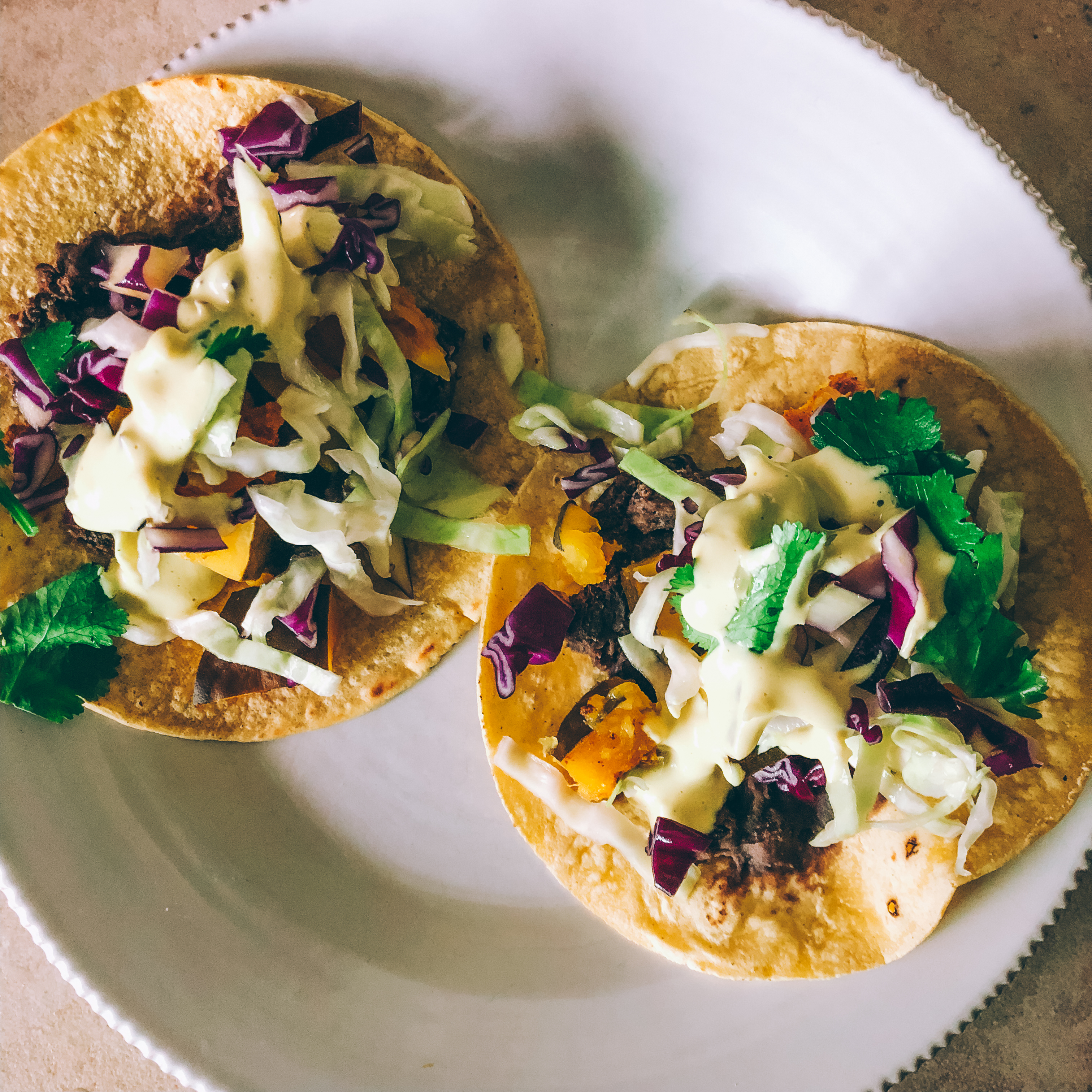
A true fall and winter favorite, these tacos have all the elements of a balanced meal with the six tastes, and are prepared in a way that makes them easier on digestion. The black beans are next level flavorful when cooked from scratch into a creamy, easier to digest consistency.
Any type of full-flavored winter squash works for this recipe. That includes basically all varieties of winter squash commonly used for eating except spaghetti squash and delicata. See what you have available from your local farmers and try a couple new varieties! I used a super tasty variety called Burgess Buttercup.
Nearly all components of this can be prepped ahead and gently reheated if you want to turn this into a weeknight meal. Additionally, I’ve shortened the preparation time with the way I slice and bake the squash.

Prep:  overnight   | Cook: 3-4 hours (for beans); 45  minutes to finish  | Serves: about 4

1 medium buttercup squash, or similar variety (butternut or any hubbard variety of squash)
Pinch of mineral salt
½ tsp. smoked paprika and/or taco seasoning (without preservatives/fillers added)

3-4 cups of red and/or green cabbage, thinly sliced
⅛ tsp. mineral salt
1-2 Tbs. lime juice

Cooked black beans, see below
Cashew crema, see below
12 small corn tortillas (6”)
Cilantro, minced

Black Beans
½ pound /  1 cup black beans, soaked overnight
¾ tsp. salt
1 ½ tsp. ground cumin
1 tsp. ground coriander
¼ tsp. ground black pepper
1 bay leaf
Water to cover by 3-4 inches

Cashew Crema
1/2 cup cashews, soaked for 4-8 hours or overnight
¼ tsp. garlic salt
1-2 tsp. freshly squeezed lime juice, to taste
a pinch of ground turmeric and dash pepper
a pinch of ground cayenne, optional
1 Tbs. nutritional yeast, optional
½ cup water or more

  1. For the Black Beans: A few hours before or in the morning, cook soaked black beans in a medium pot in the spices and water until very soft and flavorful and creamy, almost to a refried bean consistency.
    This is best done for at least 3-4 hours, adding water as needed.
  2. For the Baked Squash: Preheat the oven to 400 degrees F.
    Slice your squash in half, and remove the seeds and pith. Then rub the salt and smoked paprika and/or taco seasoning onto the flesh of the squash.
    Then place the two squash halves in a large, rimmed baking pan (like 13×9-inch), with cut side down/skin facing up. Add water to about ⅓ of the way up the side of the squash and bake until completely soft when pierced with a fork. This will take about 30-4o minutes.
    Remove from the oven and allow to cool before slicing. The water should all be absorbed and the spices infused into the flesh.
  3. For the Cashew Crema: Drain and rinse the cashews.Put all the crema ingredients, except the water, in a high-speed blender or food processor and blend, adding water a little at a time until the desired consistency is reached.
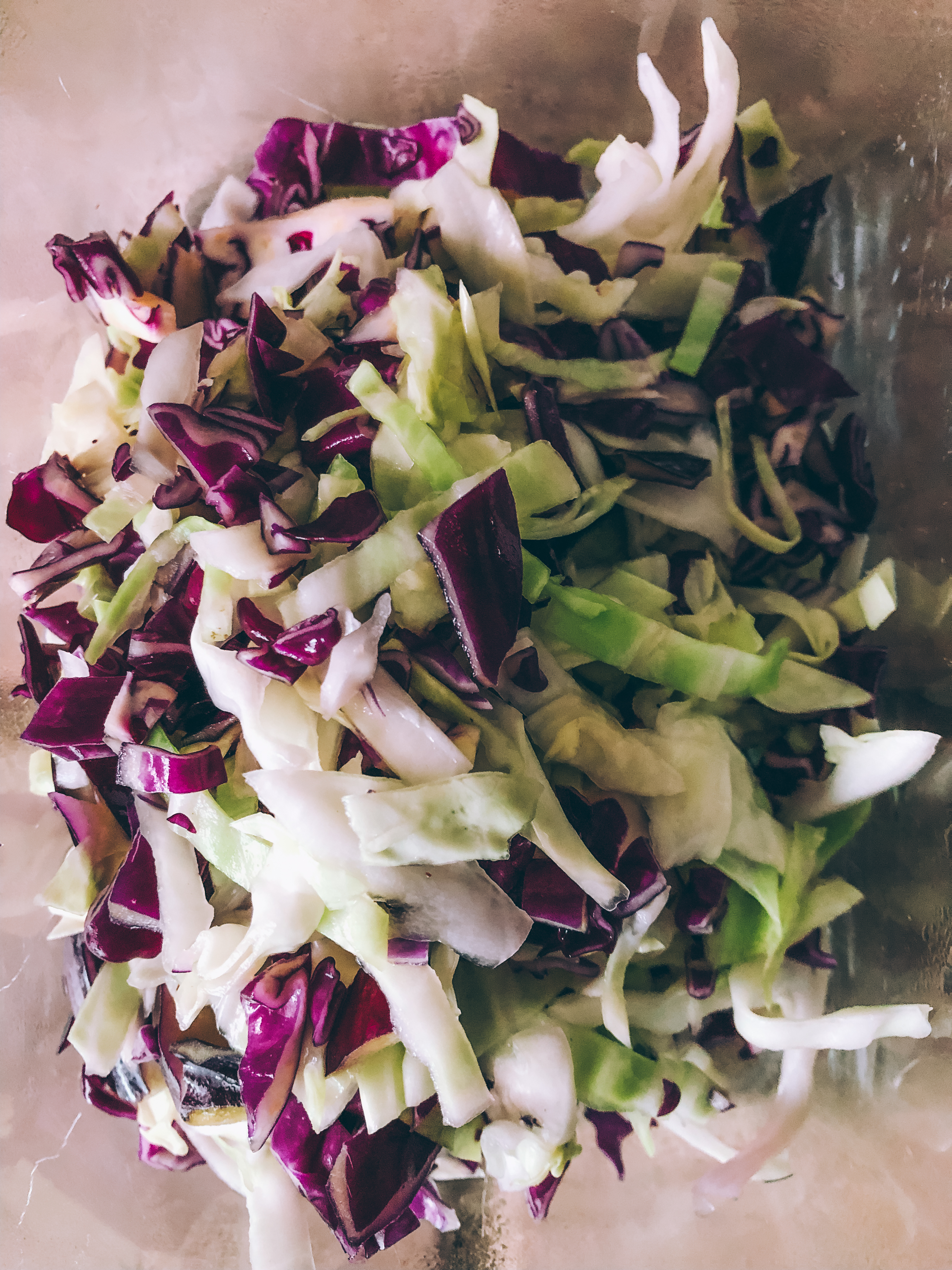
  4. While the squash is baking, prepare the sliced cabbage. If your digestion is strong, you can thinly slice and dice the cabbage, stir in the salt and lime juice, and allow to sit at room temperature for 20-30 minutes to soften.
    If digestion is compromised, gently steam the cabbage instead, just until lightly soft. Then remove to a bowl or dish, add the salt, and lime juice.
  5. Heat the tortillas over high heat, in a clean cast iron skillet.Do this by working in batches, two tortillas at a time and heat for 30-60 seconds per side of each tortilla.
  6. To serve, spoon the black beans into each taco, followed by sliced squash pieces, cabbage, a pinch of minced cilantro, and then a drizzle of crema. Enjoy!

Much of my nutrition practice is focused on individuals and athletes with digestive health issues such as leaky gut, food allergies and intolerances, chronic GI distress, malabsorption of foods and nutrients, and inflammation. If you’re tired, stressed, and not really sure what to eat to help or hurt anymore, I invite you to reach out to me for more personalized support.

Iron + The Athlete: Considerations for Intake and Absorption

I took my first formal nutrition class back in 2014. At the time, I already had a ton of nutrition knowledge, both from on-the-job training and from personal study, but I was beginning to realize I wanted to shift my career from public health into individual nutrition.

As a female and athlete (with digestive issues), I had always struggled with iron, despite eating a fairly high iron diet. At first, I also ate some red meat, and in my nutrition class, we had to complete a three-day food log and perform a nutritional analysis. I was easily meeting the recommended dietary allowance (RDA) for iron. When I asked my instructor about it, a locally practicing registered dietician, she told me, “If you’re consuming the RDA in iron,  you should not have low iron status.”  

That conversation turned out to be a good jumping off point for wanting to know a whole lot more about nutrition, and nutrient and lifestyle interactions.

If you’re an athlete (male or female), and you’ve ever wondered about what all the hype is on iron, or why you have low iron, or what exercise has to do with iron regulation and absorption, this article is for you.

The Role of Iron and How Iron Deficiency Impacts Athletic Performance

First let’s review what iron does in the body. When we speak about iron, we’re often speaking about it in the context of iron-deficiency anemia. There are many reasons for anemia, not just low iron stores, but iron-deficiency anemia is the most common. Anemia at its most literal means “without blood.” And that’s where we start to talk about iron (though again there are other nutrient depletions that can also cause anemia). 

Iron is an essential part of oxygen transport and energy production at a cellular level, and is important for cognitive and immune function (1,2). Hence the reason you feel fatigued when your body is without iron. Note that low energy is also a feature of many nutrient deficiencies since many nutrients are involved in cellular energy production.

For endurance athletes, iron is dually important because it is used for multiple metabolic pathways, including 1) it is used for oxygen transport to the exercising muscle and 2) the production of ATP (energy) is highly reliant on iron.  

Common symptoms of compromised iron status include fatigue, lethargy, negative mood, and poor performance during endurance exercise. 

A Hormone Called Hepcidin and its Impact on Iron Absorption  

Hepcidin is an inflammatory and iron-regulatory hormone that increases for 3 to 6 hours after exercise. This is likely a result of the exercise-induced inflammatory response, and associated increases in an inflammatory cytokine, interleukin-6 (IL-6). Increases in hepcidin result in a decrease in iron absorption as well as decreases in recycling iron from the gut.  

So there’s likely a window of time following exercise where the body has altered iron metabolism. 

Who is at risk for iron deficiency? The mechanisms that influence iron absorption in athletes

Traditionally, we think of compromised iron status as something that females suffer from. This is because women in their menstruating years generally lose iron through blood loss each month; whereas men should not be losing blood. However, active women are estimated to be twice as likely to present with Iron Deficiency Non-Anemia (stage 2 of iron deficiency) than sedentary, non-active women. Among athletes, we see much higher iron deficiency rates than in the general population with estimates of greater than 50% of female athletes and up to 30% of male athletes having compromised iron stores (1).

Both testosterone and estrogen can influence iron metabolism because they suppress hepcidin (more on this hormone above). When women are exercising at a high training load, this may result in an altered hormonal profile, with gonadotropin-releasing hormone (GnRH), which is a sex-hormone precursor, being suppressed. Consequently, luteinising hormone (LH), follicle stimulating hormone (FSH), and then estrogen will be suppressed. So lower estrogen leads to higher hepcidin (or at least less suppression of hepcidin), and thus more difficulty in absorbing iron. 

Likewise, the same result can happen in males with a high training load, with gonadotropin-releasing hormone being suppressed, and consequently suppressed testosterone, and less suppression of hepcidin. In turn, chronically low testosterone in males may be linked to higher hepcidin levels, potentially impairing iron regulation. 

Another variable is relative energy deficiency- what I call not eating enough for one’s activity level. Overall low energy availability (LEA) and energy intake may relate to either an overall deficit in dietary iron intake, and/or a dysfunction in iron absorption from the foods that are consumed. 

Further, we’re also finding that the makeup of one’s microbiome also affects iron absorption, with iron-deficient individuals lacking lactobacilli species–a key species often cited with good health. Many other bacteria also require iron for growth (3).

Otherwise, vegetarian and vegan / plant-based diets can also impact iron absorption and stores since non-heme plant sources of iron are more difficult to absorb. A big one though, is the general state of your digestion. You have to have good digestive function to assimilate the nutrient.

Finally, some good news: the inflammatory response following exercise can be reduced after long exercise bouts of two hours or longer by consuming carbohydrates during exercise. Eating during exercise decreases the depletion of glycogen stores in the muscle (2), and ingesting carbohydrate during exercise has also been shown to improve the recovery response from long/high intensity efforts.

The Stages of Iron Deficiency:

Stage 1: Iron Deficiency: Iron stores in the bone marrow, liver, and spleen are depleted, indicated by ferritin values less than 35ug/L, Hemoglobin values > 115 g/L, (11.5) and transferrin saturation >16%

Stage 2: Iron-Deficient Non-Anemia: Red blood cell production decreases as the iron supply to the bone marrow is reduced, indicated by ferritin values less than 20ug/L, Hemoglobin >115 g/L (11.5), and transferrin saturation < 16%

Stage 3: Iron Deficiency Anemia: Hemoglobin production falls, resulting in anemia, indicated by ferritin values less than 12 ug/L, Hemoglobin <115 g/L, transferrin saturation less than 16%. 

From current research, it appears that depleted iron stores (in stage 1) have minimal or no impact on physical performance, but this is likely particular to you as an individual–some athletes will notice the impact sooner.

What You Are Eating in Your Diet and Iron Status

The timing, amount and source of iron from your diet, in combination with the overall composition of the diet are all important factors to consider when looking at iron status. The most easily absorbed source of iron is heme iron (from meat).

The presence of Vitamin C can enhance non-heme iron absorption, but vitamin C is destroyed by heat (and light), so cooking a vitamin C-rich food into a dish will likely not help much. A couple squeezes of citrus juice at the end of cooking when the food is on your plate can be an effective method to get around this.

Otherwise, polyphenols, phytates, oxalates, calcium, zinc, copper, and vitamin E, which are all part of many nutritious, plant-rich diets and in particular are in whole grains, legumes, leafy greens, and tea and coffee, can decrease the amount of non-heme iron that is absorbed in a meal. Suddenly, your (or my) quinoa salad bowl with nuts, seeds, lentils, spinach and other dark leafy greens, and tahini or almond sauce is not a recipe for a hearty, iron-absorptive meal. Note, these are foods that are frequently on the high-in-iron list! And there are ways to prepare them to make their iron more absorbable, such as soaking, sprouting, fermenting, etc.

Want to Know More?

Within my nutrition practice, I specialize in endurance athletes and digestive imbalances. If you’ve struggled with chronically low iron, or recently have experienced it, I encourage you to reach out to me for more personalized support about how to boost iron around your exercise load.

References:

1). Sim, M., Garvican-Lewis, L.A., Cox, G.R., Govus, A., McKay, A.K.A.,…and Peeling, P. (2019). Iron considerations for the athlete: a narrative review. European Journal of Applied Physiology, 119: 1463-1478. https://doi.org/10.1007/s00421-019-04157-y

2). McKay, A.K.A., Pyne, D.B., Burke, L.M. and Peeling, P. (2020). Iron Metabolism: Interactions with Energy and Carbohydrate Availability. Nutrients, 12: 3692. https://doi.org/10.3390/nu12123692

3. Frame, L. (2021, October 7th). Mixed Diet and the Microbiome- Challenges with Complexity. Linus Pauling Institute Diet and Optimum Health Conference, Corvallis, OR, United States. 

A simple digestion tip for when you’re struggling

The last few weeks, I’ve dropped back into a pattern I always wish to avoid. Feeling those frequent low-grade, lower belly aches, and sometimes feeling simultaneously heavy and like a giant airy balloon resides in my midsection. It’s most noticeable two to three hours after a meal, when the food has left my stomach and reached my small intestine, and around the time I’m either about to begin or am in the first few miles of my daily run or workout. 

Not so enjoyable.

This used to be my norm. It used to be so much my norm that if it were just these mild symptoms, I wouldn’t have noticed it  or done anything about it at all. I wasn’t quite as in tune with my body then, you could say. But then it became chronic. And got a lot worse before I figured out, with help, how to make the sour, painful digestion situation better.

So when you come to me and say, “I can’t believe I’m telling you this,” well, I know what you’re talking about and it’s not something that should be hush hush or shameful — at least not when you’re talking to a nutritionist. 

In the interest of providing some guidance before you start removing random foods, purchasing specialty digestive products or just holding your belly and whimpering / running to the bathroom, here’s one quick tip to improve digestion for you. 

Try One Simple Shift

It’s a shift that worked for me the last couple weeks as I switched from eating more cold/raw summer meals to putting those same foods in meals and gently cooking them.

That’s right. That’s the shift. 

Just switch to eating all your meals warm and gently cooked. 

It’s simple but especially in the end-of-summer warm days, you might have to remind yourself daily, if not with every meal, to just heat everything up. I don’t heat up some foods, and eat others raw, like including a side salad with a meal. Warm all of it up. Do a quick 30 second to 1 minute sauté of your salad ingredients in your vinaigrette in a sauté pan, if that’s easiest. Oh, and chew it all well.

Think of your digestive ability like a campfire. Too hot and everything burns up and gets singed too quickly, like that marshmallow or hot dog you’re roasting. Too cold and nothing really cooks at all. It just smolders along half-heartedly. That smoldering is what we’re trying to avoid here, since it’s most common when you struggle with symptoms of the lower GI.

If you’re interested in more simple digestion shifts, I wrote a mini-guide for improved digestion featuring no products, special foods, or diets which you can download. Or check out the last few blog articles on improving digestion for more ideas.