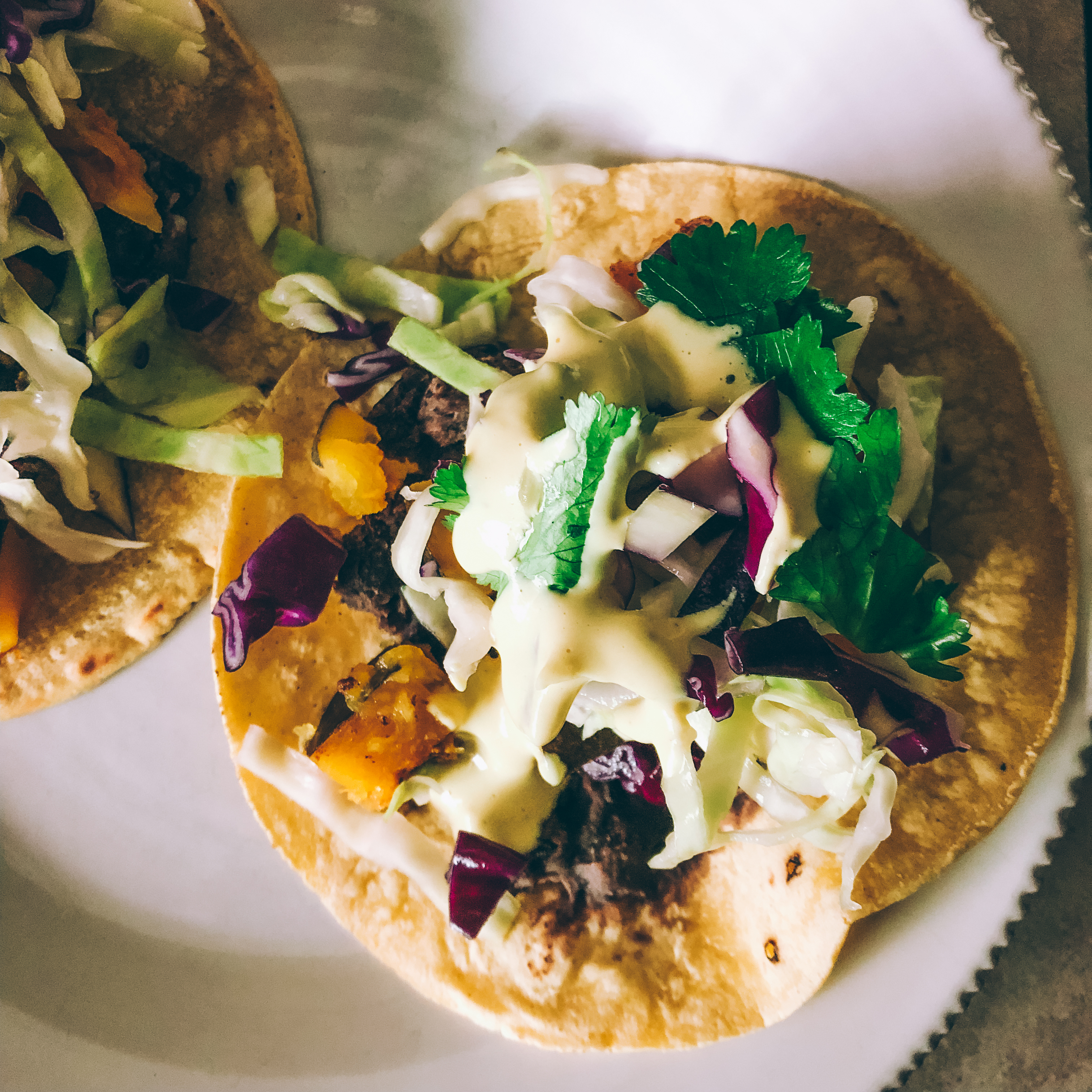
Buttercup Squash + Creamy Black Bean Tacos

I frequently share with nutrition clients about the connection between mental and physical health, particularly between the gut and brain, but also just a reminder that it’s all connected. We’re all connected. Something that’s been labeled “all in your head” is also in your body, and vice versa.

That’s the paradigm I work out of.
In my own life, I’ve had a long journey with things in the realm of “mental health;” in the last few years mostly related to low grade anxiety that can simply be summarized as high vata dosha in Ayurveda. So I try to balance myself with daily habits that invite in slowing down (physically and as a result mentally), practices that sooth my nervous system, and a practice of breathing and meditation that’s begun to infuse into my days.

For the last few weeks, I’ve felt like I really hit a flow with presence and slowing down my brain’s looping and too-quick thoughts.

I’d cracked the code! (haha, right).

Then over the weekend, I set out on the longest run of my current marathon training cycle. As I settled into the last hour of running, when my body was tired and my pace/effort was meant to get higher, my brain kicked in.

My brain kicked in in all the ways I’ve been working to slow my thoughts down or just observe them rather than let them dictate my actions.

The run wasn’t a failure. Today, a few days beyond it, I mostly feel really good about how it went physically. But I’m disappointed with how I coped and let my mind decide to take it easier than planned in that last hour when I’d prepared for and practiced something else.
I guess that’s why we call it a practice. A running practice. A meditation practice. A breathing practice.

In fact, my last conversation with my long-time naturopath who sadly moved away was on this very topic. She told me that if I wanted to keep running marathons, I was going to have to balance the running out with yoga. And she didn’t mean the physical asasa of yoga poses–although that can be helpful too! She meant that if I was going to continue the going fast of running, I needed to balance it out with the slowing down of practicing breathing, presence, and eating slowly and mindfully, to digest food well.

It’s safe to say I’ve made progress from where I was then. But I have not cracked the code of always getting it right. Nor will I.

We’re all works in progress but as reminder to you, and to myself, we rarely make linear progress.

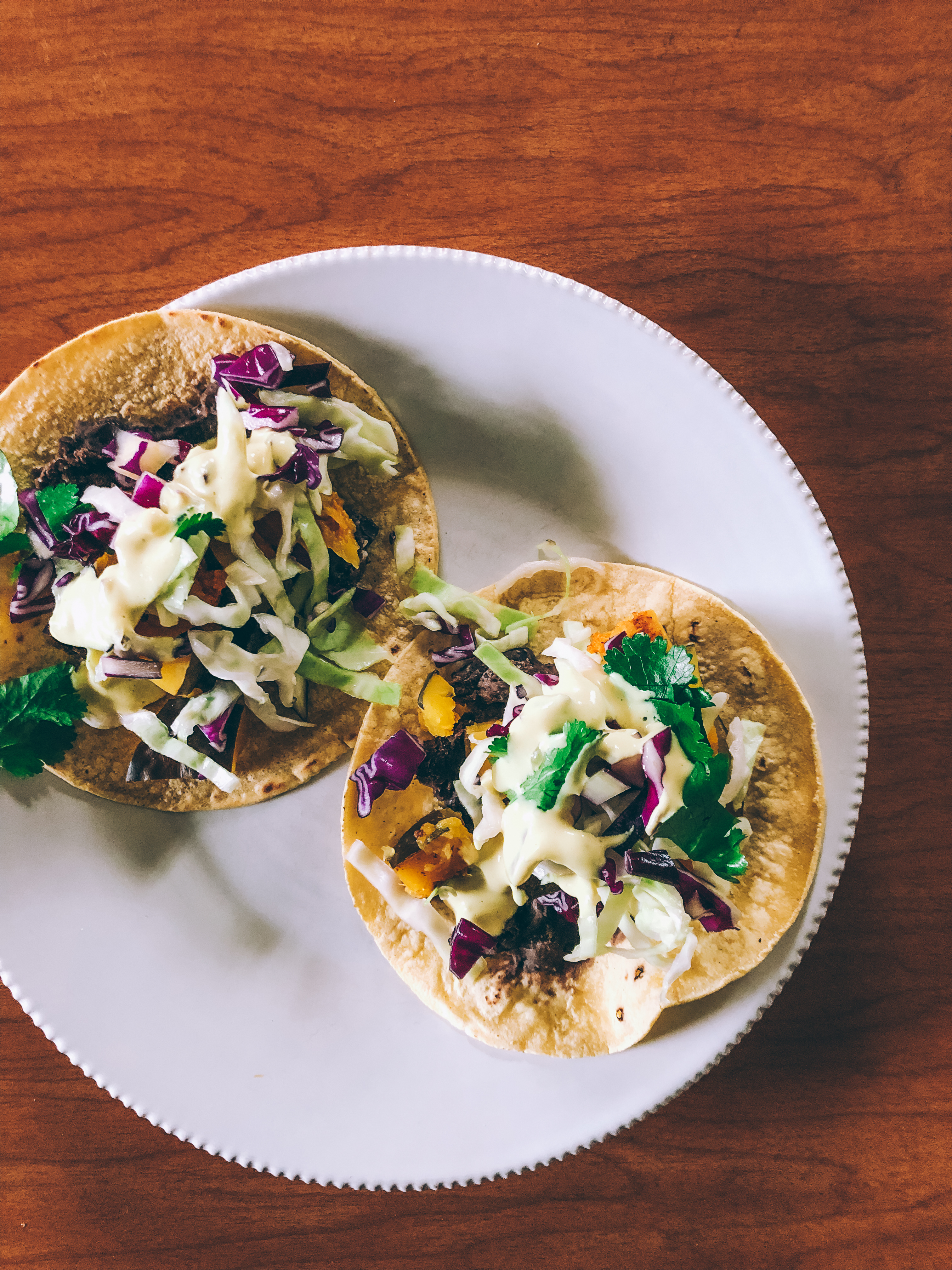
This recipe for creamy black bean tacos with lightly baked and seasoned winter squash, a simple sliced cabbage and creamy sauce to drizzle over the top, is one of those many-years-in-progress, mind and body are all connected recipes. It’s truly delicious for your fall and winter taco nights.

But I also wouldn’t have been eating it a couple months ago, when my gut health had temporarily returned to a compromised phase – I had to do a bit more healing and re-balancing first to return to eating a “more complicated meal.” That’s all to say, if you’re still in an iffy-digestion state, save this one for a little later. And let’s see about getting your system working optimally first.

And if you’re like me and tend toward too-fast, scattered thoughts, I encourage you to keep up the practice of breathing and returning to presence. I’ll be right there with you.
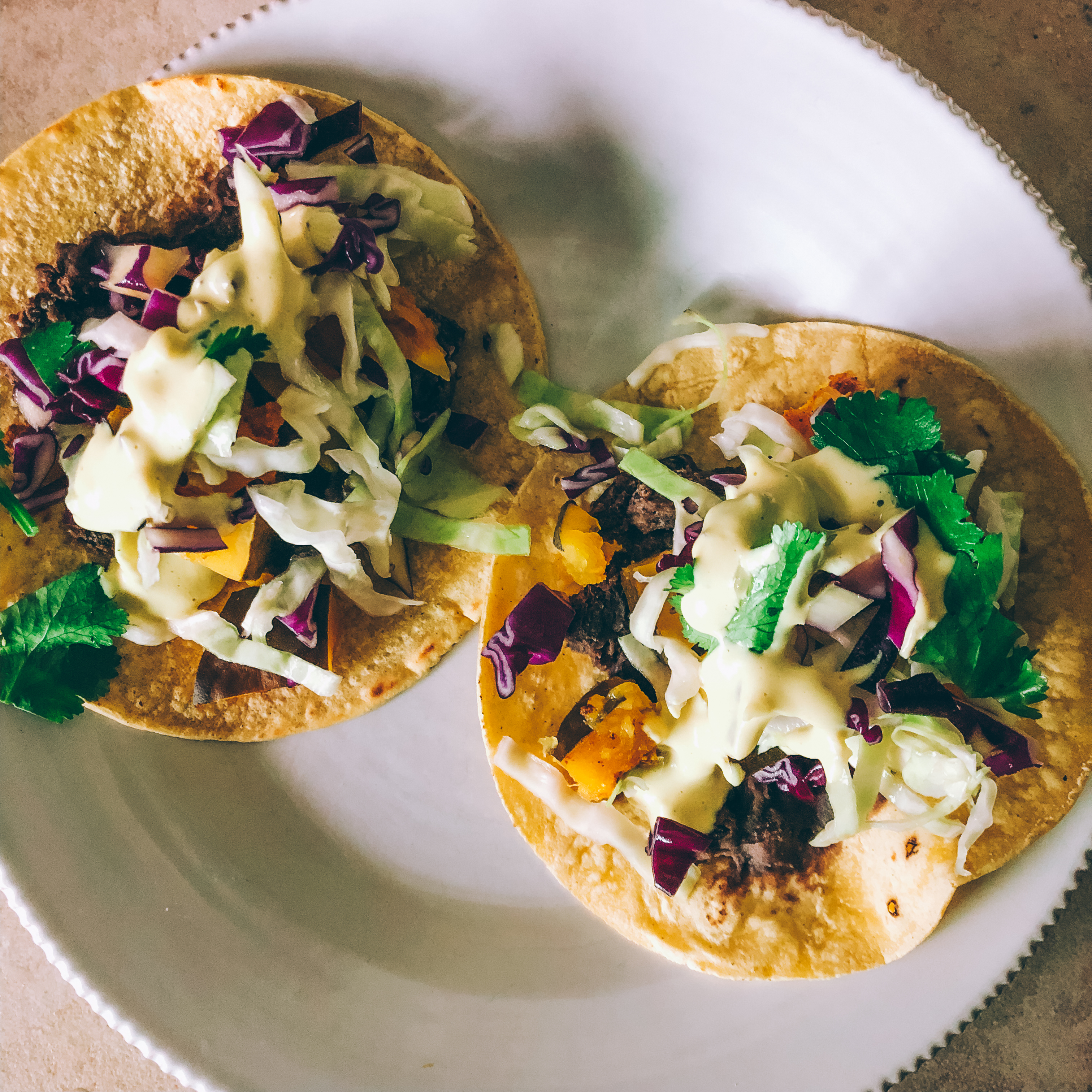
A true fall and winter favorite, these tacos have all the elements of a balanced meal with the six tastes, and are prepared in a way that makes them easier on digestion. The black beans are next level flavorful when cooked from scratch into a creamy, easier to digest consistency.
Any type of full-flavored winter squash works for this recipe. That includes basically all varieties of winter squash commonly used for eating except spaghetti squash and delicata. See what you have available from your local farmers and try a couple new varieties! I used a super tasty variety called Burgess Buttercup.
Nearly all components of this can be prepped ahead and gently reheated if you want to turn this into a weeknight meal. Additionally, I’ve shortened the preparation time with the way I slice and bake the squash.

Prep:  overnight   | Cook: 3-4 hours (for beans); 45  minutes to finish  | Serves: about 4

1 medium buttercup squash, or similar variety (butternut or any hubbard variety of squash)
Pinch of mineral salt
½ tsp. smoked paprika and/or taco seasoning (without preservatives/fillers added)

3-4 cups of red and/or green cabbage, thinly sliced
⅛ tsp. mineral salt
1-2 Tbs. lime juice

Cooked black beans, see below
Cashew crema, see below
12 small corn tortillas (6”)
Cilantro, minced

Black Beans
½ pound /  1 cup black beans, soaked overnight
¾ tsp. salt
1 ½ tsp. ground cumin
1 tsp. ground coriander
¼ tsp. ground black pepper
1 bay leaf
Water to cover by 3-4 inches

Cashew Crema
1/2 cup cashews, soaked for 4-8 hours or overnight
¼ tsp. garlic salt
1-2 tsp. freshly squeezed lime juice, to taste
a pinch of ground turmeric and dash pepper
a pinch of ground cayenne, optional
1 Tbs. nutritional yeast, optional
½ cup water or more

  1. For the Black Beans: A few hours before or in the morning, cook soaked black beans in a medium pot in the spices and water until very soft and flavorful and creamy, almost to a refried bean consistency.
    This is best done for at least 3-4 hours, adding water as needed.
  2. For the Baked Squash: Preheat the oven to 400 degrees F.
    Slice your squash in half, and remove the seeds and pith. Then rub the salt and smoked paprika and/or taco seasoning onto the flesh of the squash.
    Then place the two squash halves in a large, rimmed baking pan (like 13×9-inch), with cut side down/skin facing up. Add water to about ⅓ of the way up the side of the squash and bake until completely soft when pierced with a fork. This will take about 30-4o minutes.
    Remove from the oven and allow to cool before slicing. The water should all be absorbed and the spices infused into the flesh.
  3. For the Cashew Crema: Drain and rinse the cashews.Put all the crema ingredients, except the water, in a high-speed blender or food processor and blend, adding water a little at a time until the desired consistency is reached.
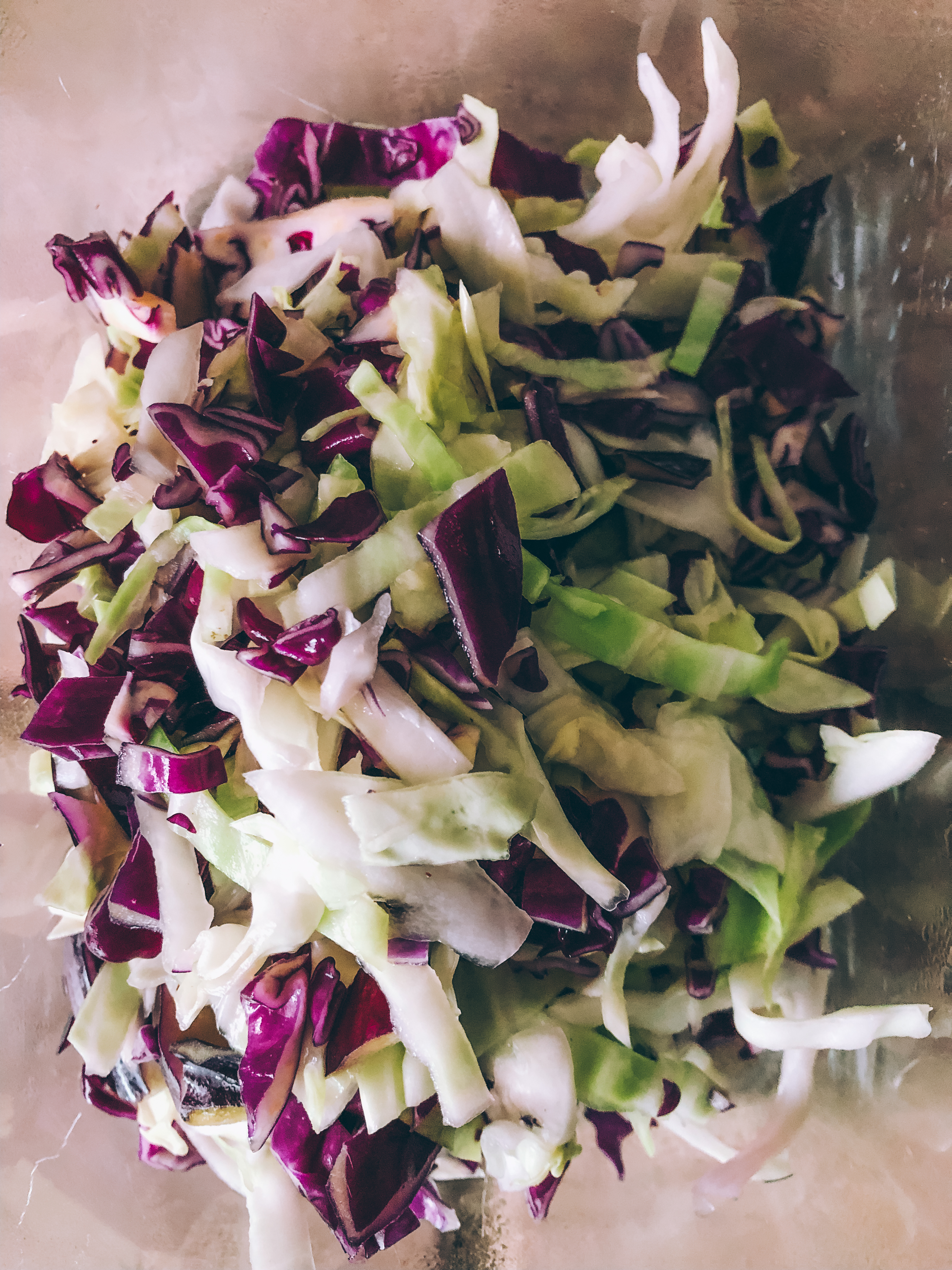
  4. While the squash is baking, prepare the sliced cabbage. If your digestion is strong, you can thinly slice and dice the cabbage, stir in the salt and lime juice, and allow to sit at room temperature for 20-30 minutes to soften.
    If digestion is compromised, gently steam the cabbage instead, just until lightly soft. Then remove to a bowl or dish, add the salt, and lime juice.
  5. Heat the tortillas over high heat, in a clean cast iron skillet.Do this by working in batches, two tortillas at a time and heat for 30-60 seconds per side of each tortilla.
  6. To serve, spoon the black beans into each taco, followed by sliced squash pieces, cabbage, a pinch of minced cilantro, and then a drizzle of crema. Enjoy!

Much of my nutrition practice is focused on individuals and athletes with digestive health issues such as leaky gut, food allergies and intolerances, chronic GI distress, malabsorption of foods and nutrients, and inflammation. If you’re tired, stressed, and not really sure what to eat to help or hurt anymore, I invite you to reach out to me for more personalized support.

Rooibos Masala Chai

Let’s talk about tea, and more specifically caffeine.

The last few years, I’ve taken a semi-annual mini break from my morning (caffeinated) black tea ritual. In part because caffeine can be both good and bad, helpful to athletic performance and health, but also contributing to imbalance.

The bad includes disrupting female hormone metabolism and stress hormones, providing another chemical for our often overloaded livers to break down and excrete, drying out the body over time leading to constipation and dryness, raising blood pressure, and being just a little too stimulating on certain days when we’re already naturally over-stimulated (hello, way too many open tabs and general 21st century overwhelm).

Perhaps because of my history with disordered eating and controlling-my-food tendencies, I also think it’s a good idea to periodically question what it is we’re attached to. Why are we attached to it? Can we loosen up the mind’s attachments, and then the body’s? Is it contributing to some of our other health symptoms?

My planned caffeine break coincided with just having finished reading Michael Pollan’s latest book, This is Your Mind on Plants. In his typical great-storytelling pattern, Pollan takes us into the history and politics of caffeine use in one third of the book, as well as his own personal experience going off, and then back on, caffeine. It made me even more curious about my — and our — attachment to the daily cup or two of warm and fuzzy stimulation.

In my case, going off my not-that-much-caffeine daily tea ritual was much more symptomatic than the idea of it I was attached to. (It turns out when you decide to change your mind about what you’re attached to, you’re already no longer attached to it). And though my mind was not suddenly cloudy and unable to do anything productive without caffeine – like Pollan’s– it also wasn’t suddenly more focused and productive when I added a little back in after a couple week break.

While I was on break from black tea, I began making this Rooibos Masala Chai instead, and still am most days. Its’ simple, lightly spicy, and nuanced. Red rooibos is a popular caffeine-free herbal option from South Africa, and is often pronounced “Roy Buhs.” Rooibos literally translates to “Red Bush” in the Afrikaans language, so think of that if it helps you to remember it’s pronunciation.

This is a nice break from caffeine option or when you’d like to enjoy a quick at-home masala chai. When making the masala chai spice blend, using freshly ground spices will result in the best, most potent flavor. Diaspora Masala Chai blend is an excellent alternative to purchase and supports the real cost of spices (premium quality, fair trade / fair wages).

Prep:  3-5 minutes   | Infuse: 10 minutes  | Serves: 1

12 oz. water
1 Tbs. red rooibos tea (loose-leaf)
1/2 -3/4 tsp. Masala chai blend (see below)
Non-dairy milk of choice, optional

Masala Chai Blend (makes enough for about 13-18 cups)
1 Tbs. ground cardamom
1 Tbs. ground ginger
1 ½ tsp. ground cinnamon
1 tsp. ground fennel seed
⅛ tsp. ground black pepper
1/16 tsp. ground cloves

  1. Bring water to a boil in a tea kettle or in a small pan on the stove. 
  2. In a tea basket, measure out the rooibos leaves and masala chai spices. 
  3. When the water has boiled, pour it over the tea and infuse for 10 minutes. Then add a couple splashes of non-dairy milk and enjoy warm.

To make the Masala Blend: 

  1. Combine all freshly ground spices in a small container with a tight-fitting lid. Stir to mix thoroughly or cap the lid and gently shake.  

Barriers to Healing: Ownership or Attachment to our Struggles

I’ve been reminded lately of barriers we put in place that prevent us from healing chronic health challenges, or negative habits.

That barrier is how we attach ourselves to and start to own our struggles.

Here are a few example statements that illustrate this:
– My typical GI struggles.
– I’ve always hated vegetables.
– I’ve always struggled with digestion. So have my parents.
– I’ve had that ever since I was kid. I’ve always had it.
– I never recover well during a (marathon) training cycle, and never get my nutrition and health to go right enough to be prepared for the race.
– My anemia pattern.

Another example is identifying with our diagnosis or diet pattern as if it were a job title. This is often easily visible on social media. You might witness or use something like IBS Warrior or Ulcerative Colitis Warrior, or Celiac next to a name in a bio, as an example.

I’ll use my past self as another example. For a long time, I felt like whatever medical mystery that presented as something autoimmune meant I’d be in daily chronic pain forever. This began at age 27. I was in constant fear and anxiety about the pain, and I felt like I couldn’t get outside that experience, even temporarily. Fast forward seven years and my body and mind feel remarkably different. The cloud of bleakness hanging over me, the fear of pain, the internal anguish that I couldn’t understand is no longer part of my everyday.

Yes, when it comes to healing something that has been chronic, finding the right nutrition plan and lifestyle practices are incredibly important. But healing is also energetic. You have to believe it’s possible. And you have to change your mindset and the energy you put around the process.

You have to believe your body is meant to heal.

And we start to believe what we say about ourselves. By saying we always struggle with something, that means deep down that we probably believe we will always struggle with it.

This simple, though definitely not easy, nugget of first changing what we say (out loud and internally) is what catalyzes healing. We start to believe lasting healing is possible. We seek out and then are put into connection with individuals who further light the healing pathway from whatever we’re currently experiencing – an autoimmune condition, IBS, chronic fatigue, a lifetime of emotional and disordered eating and body hate, weight woes, medical diagnoses that are largely written off, etc.

And sometimes our catalyst for healing is just an example from another person.

For instance, we all operate within a community, whether that’s in person in our daily lives, or people we follow online who influence us. Often, we identify with individuals who have journeyed through similar experiences and challenges as us.

What often distinguishes individuals who are incredibly good at healing themselves for the long term, and those that have chronic set-backs, lies in what the first group don’t spend their time doing.

These “experts at healing” don’t hang out in forums or self-help groups with individuals discussing the woes of their symptoms or how bad it is. They get out of their negative head space as soon as they notice they’ve fallen into it. They change their language in how they talk about their health. Instead of statements like “I always struggle with….” or “My faulty digestion….”, they view a health challenge as a temporary setback. My digestion is currently less than ideal — That’s a less permanent way to state that.

Or I haven’t yet arrived at the end of a training cycle feeling like I’ve nailed my nutrition and recovery strategies, but I believe it’s possible and I’m committed to exploring what has prevented me in the past.

Or My doctor believes I have lupus that I’ve put into semi-remission enough to be below the threshold for clinical diagnosis. I am not a victim. And I’m committed to my nutrition and lifestyle practices to continue my journey towards complete healing. This statement was my personal example.

In my case, I refused to mentally identify with or use the word lupus. For one, I didn’t have an actual diagnosis. But for me, that choice was energetic. This is similar to (before then) never using the words celiac, IBS, or dysbiosis about myself–though they were all either likely or true. These words we attach ourselves to are incredibly powerful. And here I am a handful of years later, and I haven’t thought about the words “autoimmune” or “lupus,” “IBS,” or “dysbiosis” as it relates to myself in quite a while.

Think about how you can shift the statements you make about your health. Catch yourself when you say what “you’ve always” said about your situation. Restate it in a less attached, or less in ownership, way.

Let the way you speak be a catalyst for how you think about your health.

*Note on the book pictured above: I don’t remember the plot. But I do remember it was part of my finding joy and rewiring how I thought about my health process.