roasted zucchini and crookneck squash with pumpkin seeds, oregano, and olives

I went out to harvest in the garden this morning and after using up about 20 crookneck squash in the last couple days, I harvested a dozen more. And a dozen cucumbers and three tomatoes. I trimmed the tomato plant back a bit so I can see several others are nearly ready, and William on corn duty tells me there are six or more ears that need to be used now. They’ll be as many or more of everything tomorrow.

I somewhat jokingly wrote in an instagram post several weeks back that I’ve found the best way to eat more vegetables is to grow a lot of vegetables. No jokes anymore since at this point in the season, it’s an incredible fact. For me anyways, this goes particularly because even though the romanticism of growing our own has long since worn off, there’s a huge sense of obligation to not waste what we’ve watched growing all season, to not waste the many hours William has spent watering and sifting compost, pulling weeds, and turning over beds.

Me? I mostly just harvest and cook and then take the glory. As is true for most gardeners and farmers, we tend to plant extra of everything because inevitably one or more crops fail– and people who grow things are slightly addicted to growing more things. (A slight problem when the backyard is producing so much). This year so far, nothing has failed. Literally nothing except a slow start and replanting of beets which thankfully won’t be ready until the summer squash, cucumbers, and corn are about done.

Anyhow, one thing I’ve been thinking about all summer is how very little has been stated publicly, in the mainstream US news anyway, about lifestyle factors that can help us through this pandemic season. Eating more vegetables, filling ourselves up on all the colors, nutrients, phytonutrients, and generally eating more whole, looks-like-it-came-directly-from-the-earth, foods can go a long way. I was asked to write a little more in-depth about this topic recently for Territory Run Co., so if you’d like more details on specific foods, nutrients, or lifestyle factors to help through this season (like mindfulness for stress relief), you can find the article here.

Meanwhile, I’ll be trying to figure out how to gift a few harvest extras this week, and chop, roast, sauté, etc. my way through the others. A little Italian flavor inspired, this combination of roasting zucchini and crookneck squash, and topping it with an herby, olive, garlic, and pumpkin seed topping is just one way to add some pizazz to eating your vegetables. If you have a grill basket and would like to take the cooking outside, grilling the squash instead of roasting will be a nice shift in methods.

Roasted Zucchini + Crookneck Squash with Pumpkin Seeds, Oregano, and Olives, serves 4 as a side
Use any type of summer squash you have available. The smaller, less seedy ones have the best texture.

4-8 small to medium summer squash, chopped (enough to fit a sheet pan or baking tray)
1 clove garlic
1/4 cup pumpkin seeds, toasted
1/4 tsp. salt
20 fresh oregano leaves, finely minced (about two large sprigs)
15 small black olives (about 1/4 cup), rinsed, drained and sliced

  • Preheat your oven to 425 F. Line a baking pan with parchment and then spread the chopped squash evenly, so it’s mostly a single layer. Sprinkle with a little salt and roast until soft and borderline mushy, about 30-40 minutes.
  • Meanwhile, lightly toast the pumpkin seeds in a pan on the stovetop, and then remove them to a cutting board. Chop them until they’re in medium-small pieces, small enough to not be able to tell they’re pumpkin seeds, but not super-fine.
  • Mince the garlic and add it to a small dish, along with the pumpkin seeds, salt, minced oregano and olives.
  • When the squash is done roasting, slide it into a serving bowl, and then stir the herby pumpkin seed mixture throughout and serve.
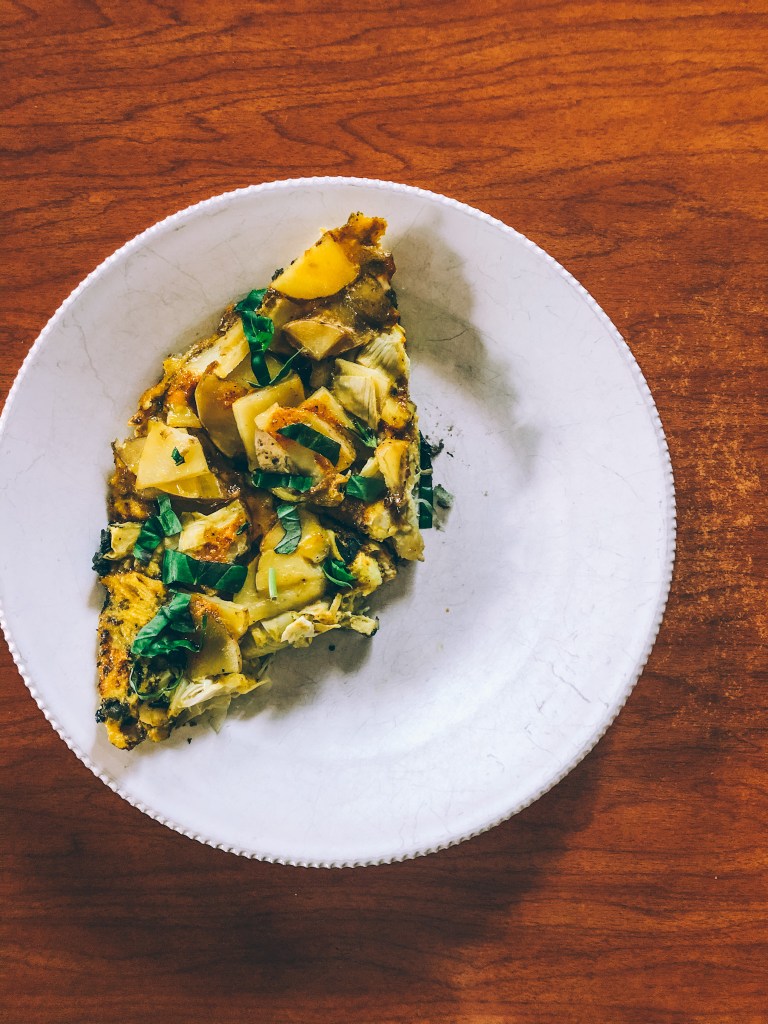
Potato + Artichoke Frittata and summer guidance

It seems that time is getting away from me this summer. In the midst of this tough year, I’ve found I’ve needed more of a break from the virtual world these last few weeks. In the midst of doing some checking in with myself, I retook a character strengths test around the time of my last post in late June from the Via Institute on Character. Having last took the same test in early grad school, I found that most of my top character strengths are truly mine and have hardly changed, but having moved into my own nutrition clinical work, some of the strengths that were lower as a student have truly risen to the top. The results highlight how much we become what we practice. From that assessment, my top character strength is spirituality, as it has nearly always been. What the institute means by the Spirituality character strength is:

Having coherent beliefs about the higher purpose and meaning of the universe; knowing where one fits within the larger scheme; having beliefs about the meaning of life that shape conduct and provide comfort.

All of which has guided the majority of what I’ve written here this year and for the last several.

But the too-much-online-all-the-time and never-ending negative news cycle has gotten in the way of that a bit this spring and early summer. My internal guidance has gotten harder to hear and less obvious. On the daily, I have often felt torn between too many demands and not enough complete alone time. And so, in early July, I took a time out. I took a week off completely, from my public health job, from nutrition clients, from running, and from all technology. If I’m honest, what I hoped to gain from it was a flash-bang inspiration and guidance, if only for a moment, to make me feel better about all of this we’re living through.

But I didn’t get it.
It’s often said that God speaks in the whispers of the heart. That his guidance for us dwells in the silent spaces.

One of the things I’m coming to over the last few months is directly on this topic. When I work with individuals with nutrition, I provide guidance and of course my opinion, but I see each encounter with each client as a true collaboration; because as much as I have the professional training and knowledge of nutrition and its impact on physiology, we are each experts on our bodies, or should be. And I think each of us has the intuitive feels right for me knowledge about our bodies hidden underneath the clutter of all our everyday stimulation and egotistical desires.

This year, so many of us have been going through hard things, personally, professionally, with health, and more. It’s been my intention to start writing and sharing more here on the everyday aspects of that that are applicable. Frustratingly, that everyday application has only come easily when working individually with each person. Instead of resisting against this frustration, or forcing something that I’m finding difficult, the right answer for me today is to follow the strings and share here what comes with more ease. All that’s to say, I’m practicing having more grace with myself. And hope you can do the same with you.

And also,
If you are struggling with your relationship to your body this year, or finally beginning to address it, I hear you.
and If you are struggling with your digestion and/or are in the midst of a long frustrating battle with it, I hear you.
and If you are overwhelmed and/or losing hope with this pandemic and lack of true normal or return to it in the foreseeable future, I hear you.

Perhaps I’ll soon begin to provide more concrete words on those topics soon, like I have been meaning to. In the meantime, I’m leaning in to feeding myself and William wholesome meals lately, like this potato and artichoke frittata, and trying to keep the quiet spaces open to allow in the guidance I prefer.
Hope you are taking care.

Potato + Artichoke Frittata, serves ~3
I’ve never been much of a potato person, except the year-ish I lived in Ireland, but William insisted on growing potatoes this year. He chose a variety from Row 7, a seed company founded by chef Dan Barber, whose intent is to work with farmers who are developing vegetable varieties with flavor in mind, a notion that realistically is not done when it comes to developing commercial / commodity foods. It’s clear to me now that good potatoes make all the difference. If you can, I encourage you to buy locally from a farmer near you. I promise, they will taste infinitely better than anything in a standard supermarket.

300 gr. / 2-3 medium potatoes, unpeeled, medium-diced.
a dab of coconut oil or ghee, to cook
6 large eggs, whisked
a dash of black pepper and 1/4 tsp. salt
200 gr. / 1/2 a can of artichoke hearts, drained, rinsed, chopped
1 tsp. olive oil
1/4 tsp. turmeric
1/4 cup fresh basil, finely minced

  • Over medium-high heat, warm a little coconut oil or ghee in a medium-large heavy skillet that is oven-safe. Stir in the potatoes and sprinkle with a bit of salt. Cover and cook until they are tender, stirring occasionally, about 8-10 minutes.
  • Whisk the eggs along with the remaining salt and black pepper. Turn down to medium-low heat and pour the eggs into the skillet with the potatoes, along with the chopped artichokes.
  • Cook for a few minutes, until the eggs are just set and there isn’t a lot of liquid running around the pan on the top. To help with this, you can run a spatula underneath the sides of the frittata, and tilt the pan so the uncooked eggs run ot the underside.
  • Remove from the heat and place in the oven under the broiler for a couple minutes, until the top has puffed up and set. If your broiler has two settings, choose the low setting.
  • Remove from the broiler and let it sit for a minute or two. In the meantime whisk together the remaining olive oil and turmeric. Drizzle the turmeric mixture over the top, and sprinkle with fresh minced basil.
  • Serve warm or at room temperature with fresh greens or other meal accompaniments.


Are you in need of extra nutritional support?
If so, I invite you to reach out to me for more personalized support. Conditions I often work with include digestive health and food intolerances, meeting needs of endurance athletes, vegan/vegetarian diets, intuitive eating, and autoimmune disorders.

Radish + Hazelnut Grain Salad

This is the type of meal situation that’s my bread and butter. It’s the sort of thing I’ll bring to a potluck or picnic-style situation, and it makes a routine visit in our regular meals much the same way tacos do – i.e. same concept, different ingredients depending on what’s on hand and seasonal. Over the years, I’ve also found that William usually takes some of the leftovers for his work lunch the next day – which only happens if it meets his slightly different than mine taste-bud standards. It also helps when I add raisins, which in our house grace many a main dish. We are both lifelong raisin affectionados. :)

While everything is fairly interchangeable here, you’ll note I only list gluten-free grains as options. I don’t tend to be outright against gluten-containing grains for those that can tolerate them, but many individuals tend to be at least slightly sensitive – especially those with pre-existing autoimmune conditions (since inflammation in the gut significantly contributes and/or is part of the cause, and gluten is inflammatory to everyone to a certain degree). I also find that many individuals running long miles, particularly in the summer heat, suffer from more achy tummy – not hungry – can’t tolerate lots of foods symptoms. That’s because these kind of long or hard workouts in stressful physical conditions contribute to damage of the endothelial tissue in the gut, which by design is very thin (one cell thick!) to allow for absorption. If you eat gluten and wheat products regularly, purchase a few non-gluten grains next time you’re out shopping. And if you do avoid wheat and gluten, try to find one or two new to you or haven’t tried in a while gf grains next time. Dietary diversity is also imperative for good long-term gut health.

One last note I’ll make here is that I left out a protein-rich ingredient to this. If you tend to follow a vegan or vegetarian way of eating, and especially if you’re active, please add one to your meal. You can read more here about the importance of protein, particularly for plant-based, active folks. Often I’ll add cooked beans such as garbanzos to make this type of salad a one-dish situation, but a side of seasoned/baked/grilled tempeh or tofu, grilled salmon or similar, a couple fried eggs, or whatever else is your protein of choice will round this out nicely into a true meal. Enjoy!

Radish + Hazelnut Grain Salad, serves 4
1 cup mixed grains (like millet, quinoa, buckwheat or any combination of these)
1 onion, thinly sliced
a large handful of baby spinach or kale leaves
1 cup radishes, thinly sliced
1/4 cup raisins
1/4 cup dried apricots, sliced into small pieces
1 cup parsley leaves, minced
1 cup mint and / or basil, minced
2 Tbs. olive oil
2 Tbs. white wine or raw apple cider vinegar
1/4 cup hazelnuts, toasted
salt and pepper to taste

  1. Place the grains in a medium saucepan and add 2 cups water. Bring to a boil, reduce the heat to low, and then cover. Cook for 20-25 minutes until the water is absorbed, and then set aside to cool slightly.
  2. While the grains are cooking, saute the thinly sliced onions in a skillet with a little of the olive oil. Cook them until they are soft and translucent, bordering on being caramelized. Pull off the heat and transfer them to a large serving bowl.
  3. Tear or slice the spinach or kale leaves into small pieces and then pile them on top of the the onions.
  4. Add the slightly still warm cooked grains to the mixing bowl on top of the greens. Stir through to wilt them slightly. Then mix in the radishes, dried fruit, and herbs.
  5. Add in the olive oil and vinegar, 1 Tablespoon of each at a time, and stir through. Add additional as needed to make it the right consistency for you, i.e. add more oil and vinegar if you like a wetter mixture. Also taste as you go, since you might need more vinegar to bring a little more acid flavor for balance. Salt and pepper to taste at this time as well. You might need up to 3/4-1 tsp of salt and 1/8-1/4 tsp. black pepper.
  6. Serve slightly warm or at room temperature.