Mejadra with Swiss Chard + Tahini

Mejadra with Swiss Chard + Tahini

IMG_9494

IMG_9424


I go on stints where I cook almost exclusively from one cookbook or blog. Actually, I take recipes, apply their concept, and change almost everything. I’ve been cooking from Ottolenghi’s Jerusalem lately.

I also share recipes on Food52 sometimes and I received the kindest comment on my beet and lentils with flatbread there. It made my whole week and reaffirmed why this blog remains mainly about food. The comment made me think, too, about the decisions I’ve made that were true turning points. One of those was during my senior year in high school when I decided to go to university rather than culinary school, and then after university, deciding to find a job rather than going back to Ireland for a course at Ballymaloe.

Sometimes I feel as if I was born to cook and feed people. I’ve loved everything about cooking for as long as I can remember. I love the creativity of selecting ingredients and flavor combinations. I love both its meditative aspects and the more fast-paced balance of doing multiple tasks simulanteously. I love sitting down to a special meal with William and sometimes friends or family, turning off the phone, computer, TV, pause and say grace, and then invite in the experience of enjoying a meal.

I remember bringing a beef and mushroom stew over to a friend’s one time in college, and how her then-boyfriend took two bites and then paused, looked at me, and said, Bec, I can tell this was made with love, before proceeding. And it was.

I know a lot of my friends and family do not get the food I make. I’ve long felt sensitive about it, as I’ve been cooking creatively since the beginning. When William and I first began dating, it was summer and I was in town for a week. There was very little to eat in my college house as my roommates and I were largely absent for the summer. I invited him over for lunch, knowing there were approximately five ingredients to make a meal—and I knew they could combine to provide a pretty spectacular combination. William survived college up to then on his grandma’s spaghetti sauce, made by his family and frozen in huge quantities, tuna sandwiches, plain spaghetti, pizza, and kraft mac + cheese. Anything outside of that lineup was super adventurous, and he didn’t exactly appreciate what I thought was a fabulous summer lunch—with ingredients largely from my self-watering garden. For months after, he approached every dinner I’d make with trepidation, knowing it was going to be awful, and a breach from his standard American diet. But he’d try it anyway. Nine times out of ten, he’d end the meal telling me he was pleasantly surprised, again. The weird things I made actually tasted good. All he had to do was try.

When left to my own devices, I tend to veer strongly in the direction of cooking with middle eastern influences. I don’t know exactly when I picked this up as I didn’t try the cuisine until mid-college at least. I like the combination of savory and sweet grains and spices, the vegetable-heavy emphasis of the traditional recipes, and the infinite possibilities as even the simplest of ingredients can taste rich and flavorful and nourishing.


IMG_9476


As I reflect on the statement above, I feel as if I was born to feed people, I realize I still haven’t found exactly what this means for me. I know my place is not actually feeding people in the standard chef/culinary sense. I know it is not in producing food, as I also once contemplated. Perhaps it is in sharing recipes here or elsewhere, but more likely, it might be in feeding people something other than actual food, in the form of kindness, hope, understanding, or inspiration. Ultimately, I know for me to be able to do that with authenticity, I have to be able to provide it to myself first.

William has been working late these days, and I’ve often been feeding only me. So I’ve been cooking with more mindfulness, taking recipes and adapting them intuitively to what I need, trying to eat meals a little more slowly with less distractions. I’ve been focusing on allowing the process to fill me up in ways that stretch far beyond the meal itself, to let light shine into the dark internal corners I’m afraid of, and let self-compassion and love in, when for so long I’ve projected it only outward, onto others.

I’m at a real turning point just now, and it feels like a good one. I’m finally coming to know and appreciate me. I’ve been learning (and still often failing) how to feed myself the essential nutrients that come from genuine self-care, rather than merely “nutritious food.” This is one of the meals I’ve been enjoying lately through the process.


IMG_9507


Mejadra with Swiss Chard + Tahini

The inspiration for these two recipes are drawn from Jerusalem. Mejadra is an ancient dish in the Arab world, considered a meal for the poor but fit for kings. At its simplest, it is rice and lentils cooked together with caramelized onions. Crazily enough, those simple ingredients can taste heavenly. I’ve incorporated a few wonderful spices in keeping with Ottolenghi’s version, and for William, I’ve added raisins. He loves raisins. He added another handful for good measure as he gobbled it up.  The Swiss chard and tahini-cream will make for a nice side. I’m loving Swiss chard lately, when for so long I discarded it completely. The trick, I think, is a quick sauté. 

For the Mejadra:

1 very large onion (1 1/2 lb.), sliced thinly into rounds

2 Tbs. olive oil, divided

1 tsp. ground cumin

2 tsp. ground coriander

1/2 tsp. turmeric

1 1/2 tsp. allspice

1 1/2 tsp. cinnamon

1 tsp. pomegranate molasses

1/2 tsp. salt

pepper to taste

1 cup long-grain brown rice, soaked and rinsed

1 cup lentils

1/2 cup raisins, optional

3 1/2 cups water

  • Begin by soaking the brown rice for at least 8 hours in a large bowl of water with a little apple cider vinegar or lemon juice. This breaks down some of the phytic acids which can bind the zinc, magnesium, calcium, and other important minerals. Prior to cooking, rinse and drain the rice.
  • In a large sauté pan, add 1 Tbs. olive oil and heat to medium-high. Then, add in the sliced onions, cook and stir for 3-5 minutes, and then turn down to medium-low and cook, stirring occasionally, until they soften and caramelize, about 25-30 minutes.
  • While the onions are cooking, add the remaining 1 Tbs. olive oil, spices, rinsed rice and lentils, pomegranate molasses, raisins, and water to a medium pot, and bring to a boil. Once boiling, turn down to low, cover, and allow to cook for 40-45 minutes, or until the water is absorbed.

For the Swiss Chard:

1 tsp. olive oil

1 large clove garlic, smashed and minced

1 bunch Swiss chard, stems chopped, leaves sliced

salt and pepper to taste

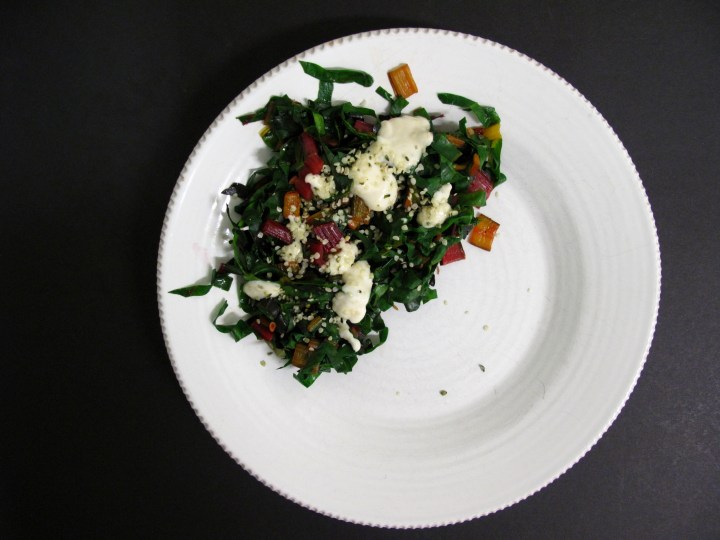
  • In a medium sauté pan, heat the oil over medium-high. Add garlic and chard stems and allow to cook until beginning to soften. Add a little water as necessary to help the chard stems soften up.
  • Then add in the sliced leaves and heat just until they begin to wilt. Remove from heat and add salt and pepper to taste.

For the Tahini-Cream:

2 Tbs. tahini

1 1/2 Tbs. lemon juice

1 small clove garlic, smashed and minced

2-4 Tbs. water, as needed

salt and pepper, to taste

  • Whisk together all ingredients in a small bowl, thinning as necessary with water.
  • Spoon the tahini-cream atop the Swiss chard as a side to the mejadra.
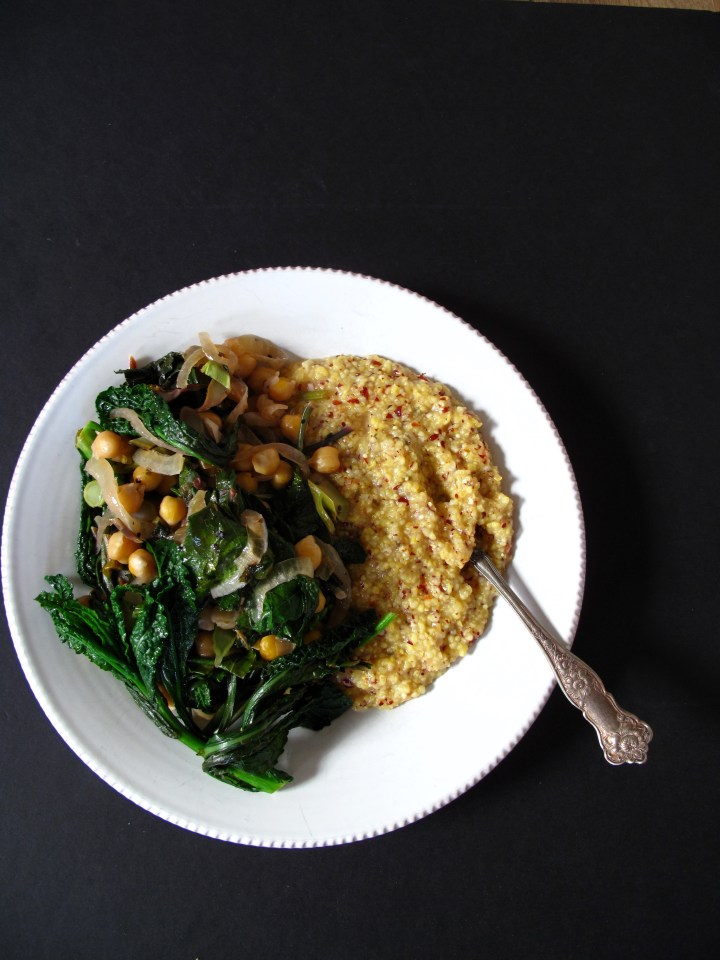


Polenta with Lemon-Garlic Raab + Chickpeas

Polenta with Lemon-Garlic Raab + Chickpeas

IMG_9373


In our marriage counseling, William and I learned about family of origin and the long-held beliefs, values, and challenges we bring into our relationship. Like many relationships, the arguments we often have are about money. I have a vivid memory of a late-night ‘discussion’ my parents had when I was quite young, which I wasn’t supposed to overhear. It was about money, of there not being enough to make it to the end of the month, and I laid in bed that night unable to sleep, as if the panic and fear in their voices transitioned directly into my pysche and lodged there permanently.

To this day, I hate thinking about money. I’ve grown to avoid the responsibility of it in our marriage because in doing so, maybe its stresses will go away (logical, I know). I fought hard with William for years about having a credit card because despite his logic that it’s wise to build credit, I couldn’t get over the memories of watching my parents painstakingly climb out of debt from this system, of the shame of growing up eating free hot lunch at school, of wearing shoes that cost $10 from the local budget store when all my friends were wearing the trendy $100 ones.

It is interesting to me now how I never went hungry growing up (quite the opposite with a large garden and ranch) and I never lacked anything I needed. But as soon as I was able to compare myself to others, I decided that I lacked some of the trendy material things my peers had. I feel nothing but deep admiration for my parents for climbing out of a tough place and gratitude for their teachings about wise spending and saving. And I wouldn’t choose to go back and change those early circumstances even if I could. Perhaps because of my parents’ teachings, and probably more out of fear, I operate largely as if I don’t have money and jump to panicky reactions when talking about spending. It tends to create tension and resentment.

I also feel guilty and ashamed of spending on things my parents are frugal about.


Like food. I prioritize spending on food.

I volunteer for a local food action team whose mission is near and dear to my heart, to promote eating food that is grown or processed locally within a six-county region. The group’s reasons for striving for a more locavore diet are many, and I’m sure every member would answer differently as to why eating local food is important: for the local economy, for the environment, for health, etc. I like all of these reasons and more, but the one that is most important to me is the connection to a place and to a people, to feel as if I am a part of something meaningful, rather than consuming the mass-produced commodity of our time.


For most people, the largest barrier to purchasing foods grown locally is usually cost. I’ve heard it across the board from individuals I know are well-off to those that surely are not. Like the choice of what we eat, how we spend our money is highly individual and emotional. And though I choose to support people, businesses, and values I believe in, I really strive to eat frugally too. Our action team goal for the past couple years has been to promote eating ‘local on a budget,’ and I have been very interested in this topic.

I often feel like a fraud though, when I even talk about eating frugally or consuming local foods. As I’ve mentioned before, I’m not overly rigid about sourcing or labels. We still have olives in our fridge from Greece, tea from China by way of Ireland, and staples in our pantry from all across the globe. A lot of my food choices have more to do with my tendency to explore one or two ingredients in a variety of ways for weeks at a time–and it often leaves less consideration for a budget and a place. William I and have been eating loads of broccoli this last month, for example, and not one of those tasty florets has come from a local farmer. Likewise, my weird current craving for coconut yogurt is not a frugal indulgence. So to help me walk the talk of eating local on a budget, I plan to share a little more of the meals in this space that help me engage in what I believe in. I hope you’ll be inspired to think about the seasonality of ingredients and recall there are persons behind our foods that worked hard to provide that nourishment–and perhaps even explore more of the local offerings in your area.


This polenta dish features raab, which can also be called rabe and rapini. If you google it, you might read that it is a unique variety related to broccoli; this is not necessarily the case to the farmers and gardeners I know. At this time in the season, all of last year’s brassica crops that have overwintered are finally telling us their time has come, the weather and light are changing, and instead of continuing to produce nice big leaves, they’re putting their energy into flowering and eventually setting seeds. So all the local farmers are selling the last of what these plants are offering as kale, sprouting broccoli, arugula, and mustard raabs. They are tasty, nutritious, and have cute little broccoli-like florets. We are currently in the three-four week window where these plants are available and they’re likely to be found from a farmer or perhaps a grocery store which sources directly from farmers.

Secondly, I used Abenaki corn polenta in this recipe, which comes from a local farmer specializing in grains and legumes. Abenaki is a heritage corn and is quite beautiful when ground, with its speckling of red and gold pieces.

Due to some dedicated farmers, this meal came almost entirely from the two counties I live and work in, and given our food action team parameters of an $8 meal for a family of four, can be counted as ‘local on a budget’ as well. Lastly, it is a meal I’ve made more times than I can count during the late-winter/early-spring months, and it is one I’d gladly make for all my friends.


IMG_9377


Polenta with Lemon-Garlic Raab + Chickpeas, serves 4

1 tablespoon olive oil

1 clove of garlic, minced

3 cups vegetable stock or water

1 tsp salt

1 cup polenta


1 teaspoon red pepper flakes

1 tablespoons olive oil

½ a medium onion, or 2 large leeks, minced/sliced

1 clove garlic, minced

2 medium bunches of raab (kale, sprouting broccoli, mustard, arugula, etc.)

2 cups cooked garbanzos

juice from ½ a lemon

pinch of salt


Directions:

  • Heat oil in a medium-sized saucepan with the minced garlic. As the garlic starts to sizzle, add stock or water, and salt. Bring to a boil. Gradually whisk in the polenta. Reduce the heat and simmer gently, stirring frequently to prevent sticking until the mixture is very thick, about 30 minutes. Add additional salt to taste.
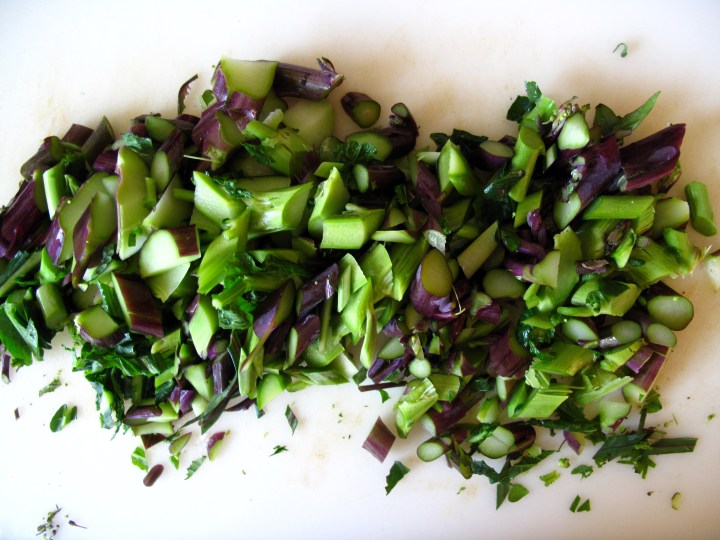
  • Meanwhile, remove the longer stems from the raab and chop into 1-2-inch pieces. Slice the leaves and florets into longer 3-4 inch pieces and set aside.
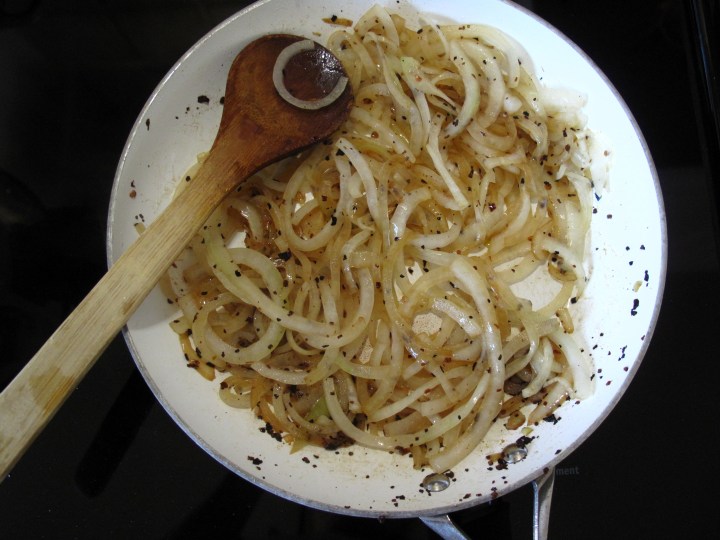
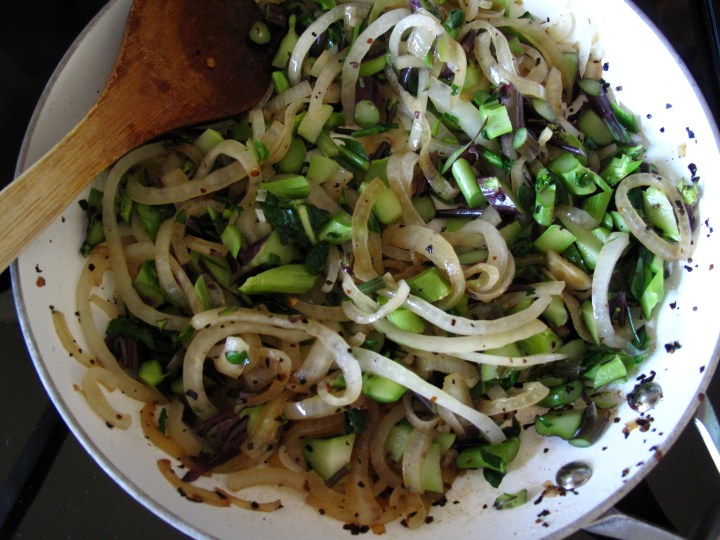
  • In a medium-sized pan, toast the red pepper flakes for 30 seconds or so over medium heat. Add the olive oil and onions and cook over slightly lower heat until they begin to caramelize. Add the raab stem pieces and garlic and cook for 3-5 minutes more. Then add the raab leaves and florets and let wilt, untouched for a couple minutes before stirring together. Add the garbanzos, lemon juice, and salt to taste. Stir and remove from heat.
  • Serve in a bowl, all together.


Honey-Amaranth Waffles with Spiced Pears

IMG_9255

I woke up at 4:30 again this morning with a head full of words needing to come out. I proceeded to write solidly for over two hours before walking away, thinking all I had written needed to be shared.

Given the heaviness of what I’ve already shared in this space these last few days, weeks, and months, and the miraculous way that my lightness of being directly correlates with letting heavy thoughts go, those words may make their way into this space yet.

For now, I’d like to just settle my mind down and get cozy with high-vibe breakfast things, like waffles. And then, try to take a nap.

The Recipe Redux this month is all about breaking out of breakfast boredom and these waffles are one of the ways I’ve been doing that lately. Like a lot of people, I go through phases with breakfast meals, and the current one, hot porridge, has been going steady for four+ years.

But for the last month I’ve been revisiting my favorite waffles most Monday mornings. I generally have nothing planned for Mondays except to fill my brain with scientific literature and APA formatting for eight solid hours, as I’ve got the day off from work and it’s full of school instead. I’ve found that eating these is a great way to start the week.

The recipe for these waffles was a work in progress for about a year and a half after gluten and dairy were removed from my diet, and though I made a lot of different flavor combinations throughout my year teaching (comfort food after a stressful day, I suppose), these are the ones that became my go-to once that phase ended. I like them because the amaranth flour lends an earthy flavor, they’re almost entirely whole-grain, and they have just enough sweetness to need no extra sugar poured on top. All of this is my sort of thing because half the time waffles are more of a dinner item and I don’t like the idea of sugar and starch for my evening meal. I also can’t handle sugar for breakfast, so there’s that as well.

IMG_9245

If you haven’t tried amaranth before, it is technically a tiny-seed pseudograin, like quinoa. In fact, the two are related botanically and share many characteristics. Historically, amaranth was very important to the ancient Aztecs. Nutritionally, it is one of the highest-quality grains to add to your diet and is especially useful for individuals who do a lot of physical work, athletes, infants, children, and pregnant and nursing women. I like it because it is a good source of calcium and an excellent source of iron, and has more protein than most other grains. Even though its nutritional effects are minimal in these waffles, adding more amaranth to meals cannot hurt. Flavor-wise, I find that amaranth goes particularly well with autumn and winter fruits, like pears, and I prefer that combination over anything savory I’ve tried.

This recipe is inspired by Kim Boyce’s Honey-Amaranth Waffles in Good to the Grain, but is now so far removed that I can’t say they’re anything like her original. If you have no reason to avoid gluten, use whole-wheat pastry flour in place of the gluten-free, and if using your own gluten-free flour mixture, keep in mind that mine is 70 percent whole-grain by weight and has 10 percent buckwheat flour, which is another stronger flavor.

How do you break up the breakfast boredom?

IMG_9230

Honey-Amaranth Waffles with Spiced Pears, makes 3
Recipe Updated: 10/25/22

3 Tbs. ground flax, separated
3 Tbs. warm water
1 cup non-dairy milk
1 tsp. apple cider vinegar
2 Tbs. amaranth flour
1 cup all-purpose gluten-free flour
1 tsp. baking powder
1/2 tsp. baking soda
a pinch of salt
1 1/2 Tbs. honey
1 Tbs. (untoasted) sesame oil, melted + additional for the waffle iron

To Finish:
1 pear, chopped into a large dice
1/4 cup water
1/8 tsp. ground ginger
1/16 tsp. each cinnamon, nutmeg, cardamom and black pepper
pinch of ground cloves
unsweetened non-dairy yogurt, optional
pomegranate molasses, if you’d like an extra fancy drizzle of sweetness atop

Directions:

  1. Turn the waffle iron to a medium-high setting. In a small dish, whisk 1 Tbs. ground flax with the 3 Tbs. water. Set aside to form a thick slurry. In a liquid measuring cup, stir the milk together with the vinegar, and allow to curdle slightly.
  2. In a large bowl, stir the remaining dry ingredients together.
  3. Combine the oil and honey, and then add them to the milk along with the flax slurry. Whisk the liquids briefly to make sure they’re uniform, and then pour them atop the dry ingredients.
  4. Stir the batter lightly. Depending on the day and air moisture, a little extra liquid may need to be added.
  5. Brush the waffle iron with a small amount of additional sesame oil, and then ladle 3/4 cup of batter onto the iron. Cook until the indicator light tells you it’s done, or a quick peek shows a golden-brown color.
  6. Remove from the iron, and plate up, along with a spoonful or two of yogurt and a pile of spiced pears.
  7. For the pears: In a small saucepan over medium-high heat, combine the diced pears, water, and spices. Once they begin to really cook, turn down the heat to a low simmer, cover, and cook until they are soft and beginning to be a little syrupy. This can all happen while waiting for those waffles to cook.

References:

Boyce, B. (2010). Good to the Grain: Baking with Whole-Grain Flours. New York, NY: Stewart, Tabori & Chang.

Pitchford, P. (2002). Healing with Whole Foods: Asian Traditions and Modern Nutrition. Berkeley, CA: North Atlantic Books.