
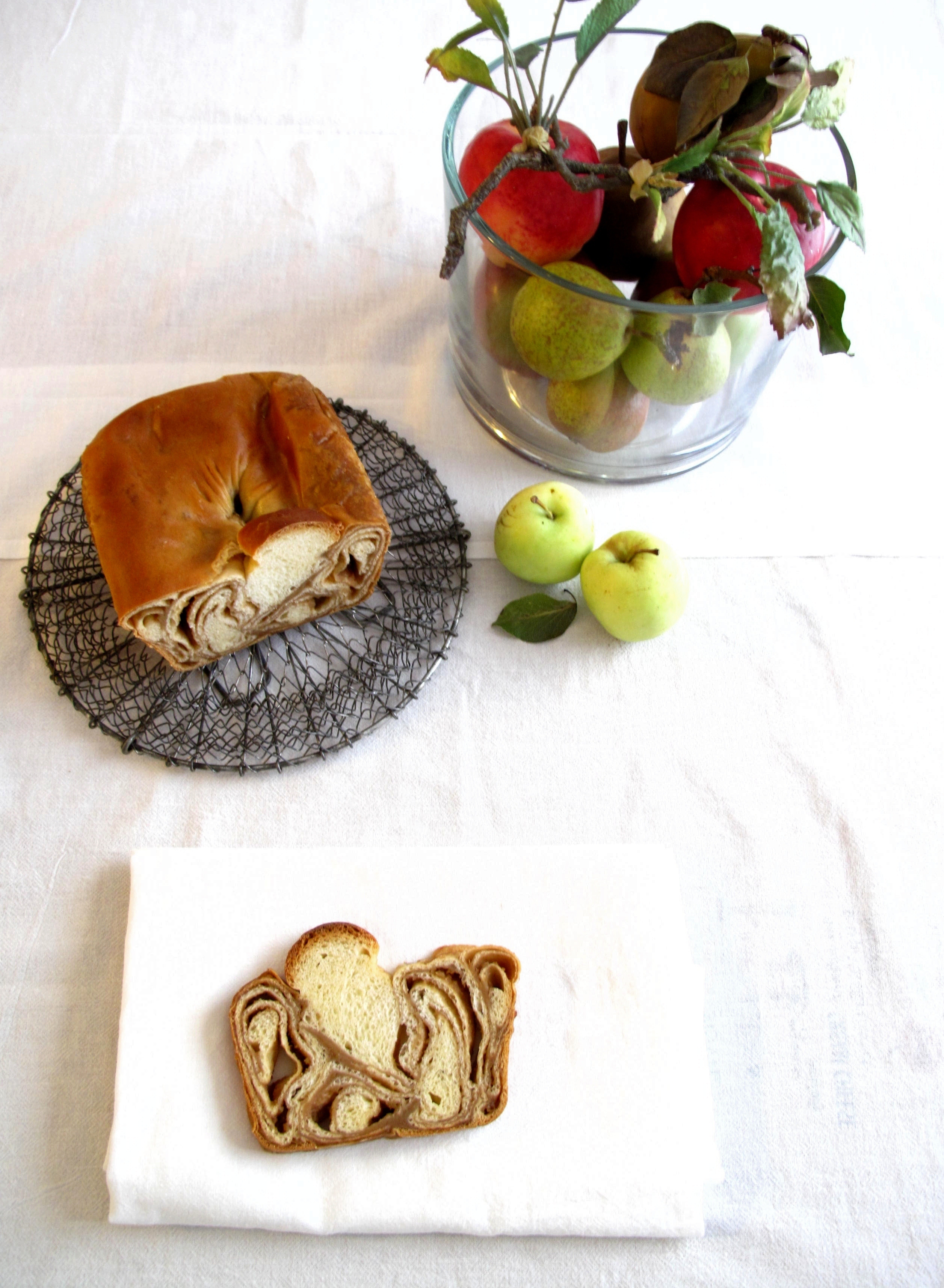
The Daring Baker’s October 2011 challenge was Povitica, hosted by Jenni of
The Gingered Whisk. Povitica is a traditional Eastern European Dessert
Bread that is as lovely to look at as it is to eat!
Back in the day I worked at a bakery. Much to my disappointment, I
didn't actually get to bake anything.  During the holiday season,
however, when the bakery got especially busy, I'd duck out of
serving customers, opting instead to put the final touches on the
holiday bread in the back.  This daring bakers challenge reminds
me of our signature apple bread. It's the one that all the parents
had to purchase to make their families happy. While this apple
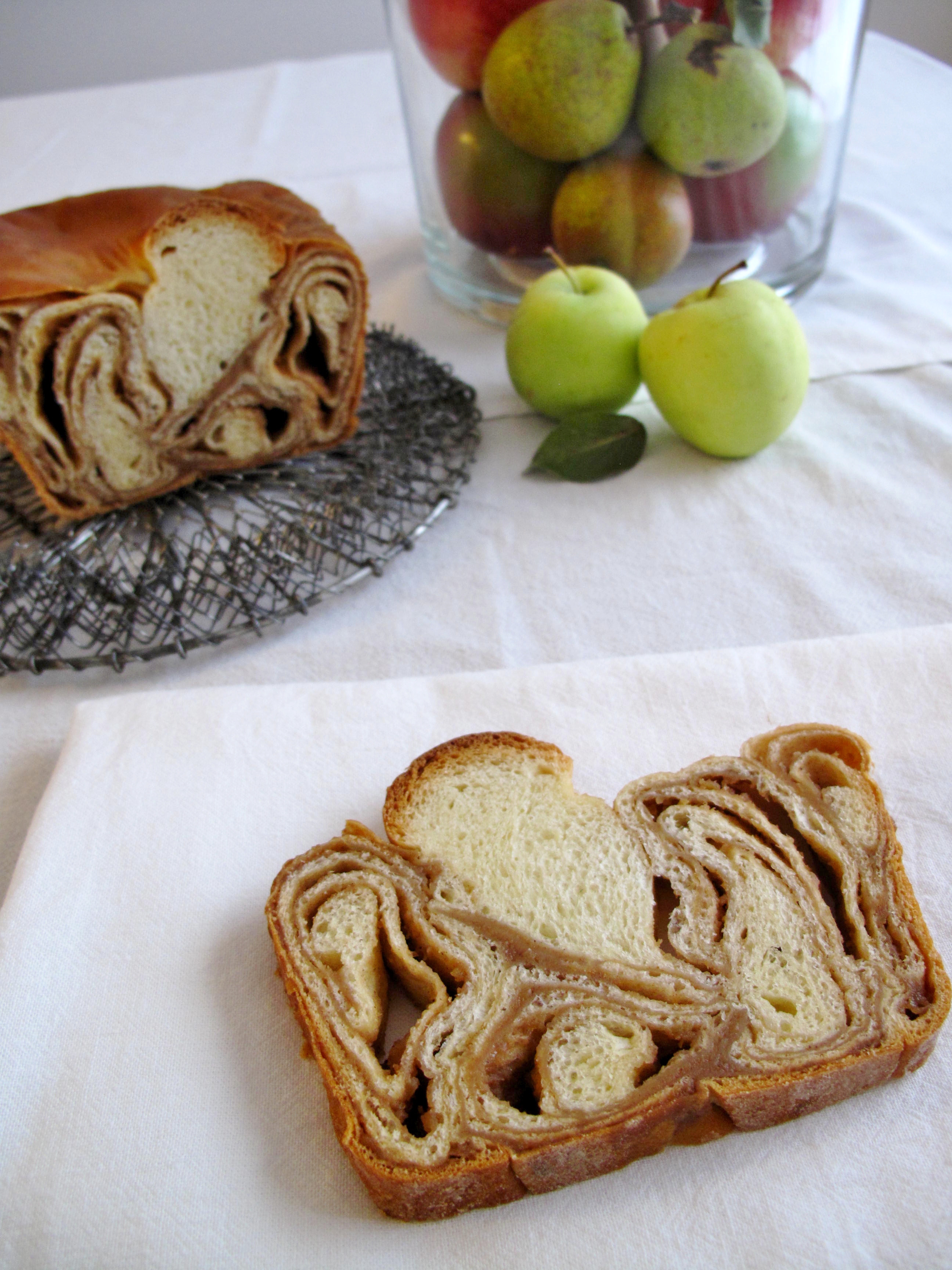
cinnamon povitica looks nothing like the bakery's signature delight,
it has a similar sweet crave-worthy taste that makes you never want
to stop eating--just like the holidays. You are warned!  And while
it looks particularly challenging, don't be turned away by it's
fancy good looks.  If you're in any way a baker, you will find it
won't be too much trouble.  One of these days soon, I aim to make
it again with a pumpkin butter filling--I can't wait for even
more autumnal goodness!
Ingredients (Makes one loaf)

To activate the Yeast:
1/2 tsp. sugar
3/4 tsp. all-purpose flour
2 Tbs. warm water
1 1/2  tsp. yeast

Dough:
1/2 cup milk
3 Tbs. sugar
3/4  tsp. salt
1 large egg
1 Tbs. unsalted butter, melted
2 cups all-purpose flour, measure first then sift, divided

Apple Cinnamon Filling:
2-3 small apples, cored and chopped (I used green apples)
1/2 cup brown sugar
1/4 cup cinnamon honey
1/4 cup unsalted butter
2 Tbs. flour
1 Tbs. cinnamon
pinch of nutmeg
pinch of allspice

Topping:
Egg White
Melted Butter

Directions:
To Activate Yeast:
1. In a small bowl, stir sugar, flour, and the yeast into warm water and
cover with plastic wrap.
2. Allow to stand for 5 minutes

To Make the Dough:
3. In a medium saucepan, heat the milk to just below boiling (about 180°F),
stirring constantly so that a film does not form on the top of the milk.
You want it hot enough to scald you, but not boiling. Allow to cool
slightly, until it is about 110°F.
4. In a large bowl, mix the scalded milk, sugar, and the salt until
combined.
5. Add the beaten egg, yeast mixture, melted butter, and 1/2 cup of flour.
6. Blend thoroughly and slowly add remaining flour, mixing well until the
dough starts to clean the bowl.
7. Turn dough out onto floured surface and knead, gradually adding flour a
little at a time, until smooth and does not stick. Note: I did not use all
2 cups of flour.  You want the dough to be fairly wet for best results.
8. Place dough in a lightly oiled bowl; cover loosely with a clean towel
and let rise an hour and a half in a warm place, until doubled in size.

To Make the Filling
9. In a small saucepan, combine chopped apples, brown sugar, butter, and
honey.
10. Heat the milk to boiling and cook for about three minutes, stirring
constantly.
11. Reduce heat to medium-low and cook for 10 minutes.
12. Stir in cinnamon and spices to taste (the cinnamon honey should already
make it spiced; if using plain honey, double the amount of spices).
13. Allow to stand at room temperature until slightly cooled.
14. Transfer to a blender and puree until smooth.
15. Set aside until ready to use.

To Roll and Assemble the Dough:
16. Spread a clean sheet or cloth over your entire table so that it is
covered.
17. Sprinkle with a couple of tablespoons to a handful of flour (use flour
sparingly).
18. Place the dough on the sheet and roll the dough out with a rolling pin,
starting in the middle and working your way out, until it measures roughly
10-12 inches (25½ cm by 30½ cm) in diameter.
19. Using the tops of your hands, stretch dough out from the center until
the dough is thin and uniformly opaque. You can also use your rolling pin,
if you prefer.
21. As you work, continually pick up the dough from the table, not only to
help in stretching it out, but also to make sure that it isn’t sticking.
22. When you think it the dough is thin enough, try to get it a little
thinner. It should be so thin that you can see the color and perhaps the
pattern of the sheet underneath.
Hint:  if dough is springy and difficult to roll, cover and let it rest for
about 15 minutes.  This will make it easier to work with.
23. Spoon apple cinnamon filling evenly over dough until covered.
24. Lift the edge of the cloth and gently roll the dough like a jelly roll
from both long sides toward the middle. Roll it tighter than you think is
necessary.
25. Once the dough is rolled up into a rope, gently lift it up and place it
into a greased loaf pan in the shape of a “U”, with the ends meeting in the
middle.
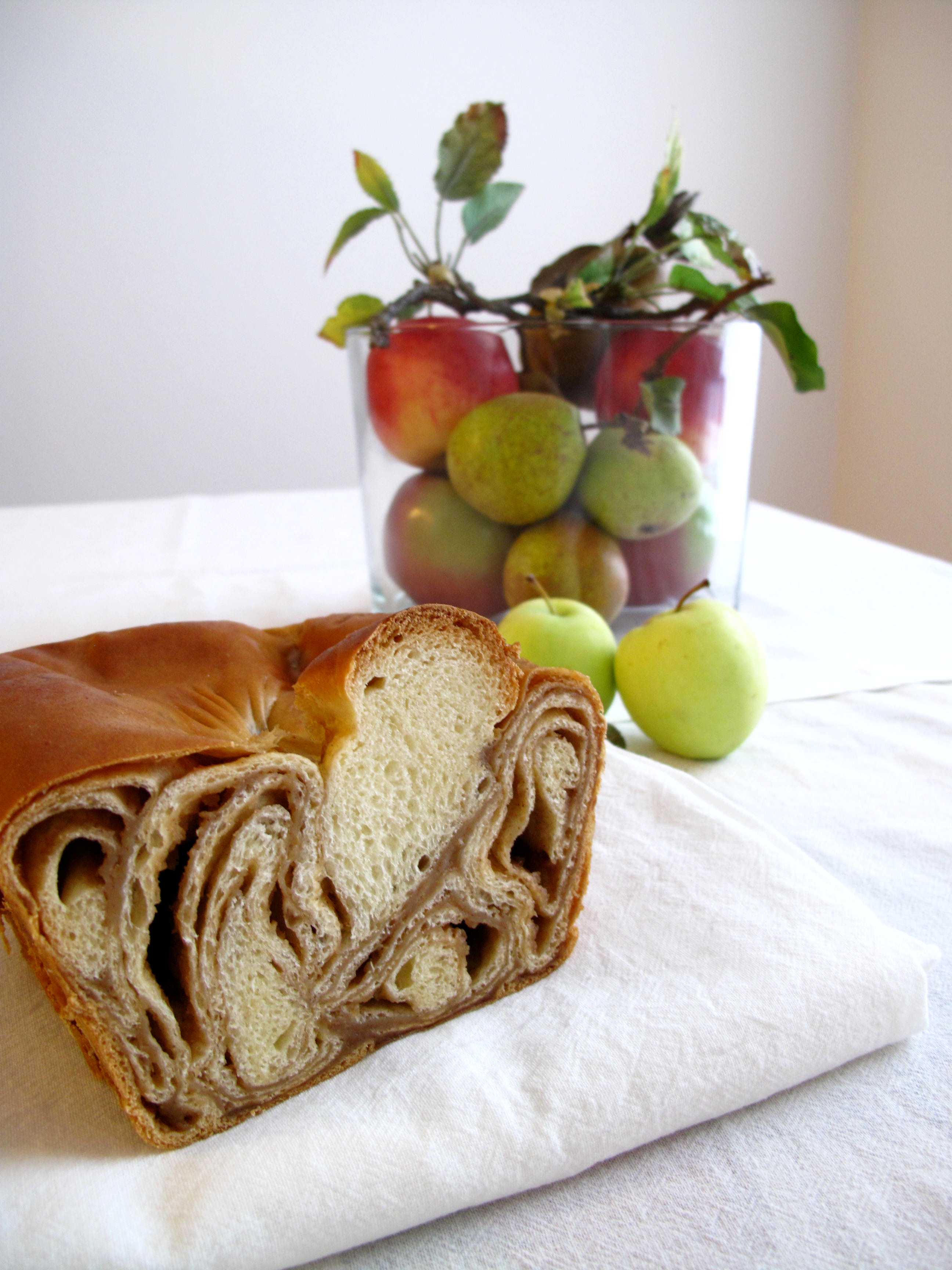
You want to coil the dough arounditself, as this will give the dough its
characteristic look when sliced.
27. Brush the top of the loaf with egg whites.
28. Cover pan lightly with a clean cloth and allow to rest for about an
hour.
29. Preheat oven to moderate 350°F.
30. Remove cloth from dough and place into the preheated oven and bake for
approximately 15 minutes.
31. Turn down the oven temperature to 300°F and bake for an additional 45
minutes, or until done.
32. Remove bread from oven and brush with melted butter.
Hint: Check the bread every 30 minutes to ensure that the bread is not
getting too brown. You may cover the loaves with a sheet of aluminum foil
if you need to.
33. Allow to cool on a wire rack for 20-30 minutes.
34. It is recommended that the best way to cut Povitica loaves into slices
is by turning the loaf upside down and slicing with a serrated knife.



 GUTSy Performance Nutrition