Transitioning Your Eating into Spring

When it comes to eating and ingredient choices, eating in tune with the seasons can go a long way towards creating an internal environment that leads to lasting health.

You know you don’t choose the same foods on a hot, sticky summer day as you do in the middle of winter. But what about a blustery spring day when the options at the farmers market (or grocery store) can be a little lackluster?
Below are a few tips for transitioning your eating into spring, as well as a deeper look at the why behind them.

Tips for Eating in the Spring

  1. Avoid congestive foods – these are generally foods that are heavy, cold, and wet.
    This includes refined grains and sugar, dairy (especially cold, sweetened dairy products, like ice cream, and fruit-sweetened yogurt), processed / pre-packaged meals and takeout, high fat foods, excessively salty foods (miso, soy sauce, restaurant meals), wheat products – a heavier grain that is inflammatory when digestion is compromised.
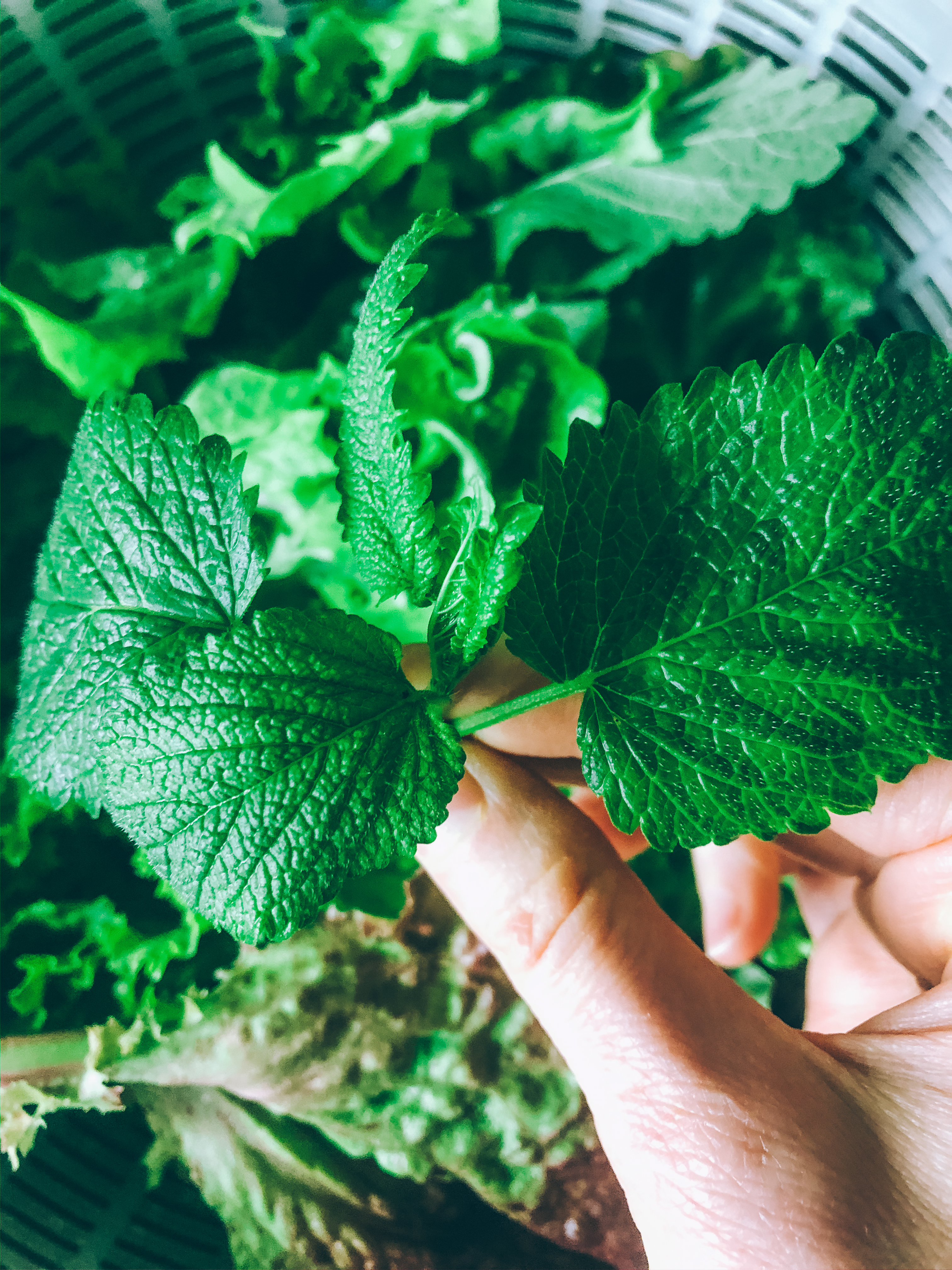
  2. Add in more dark leafy greens!
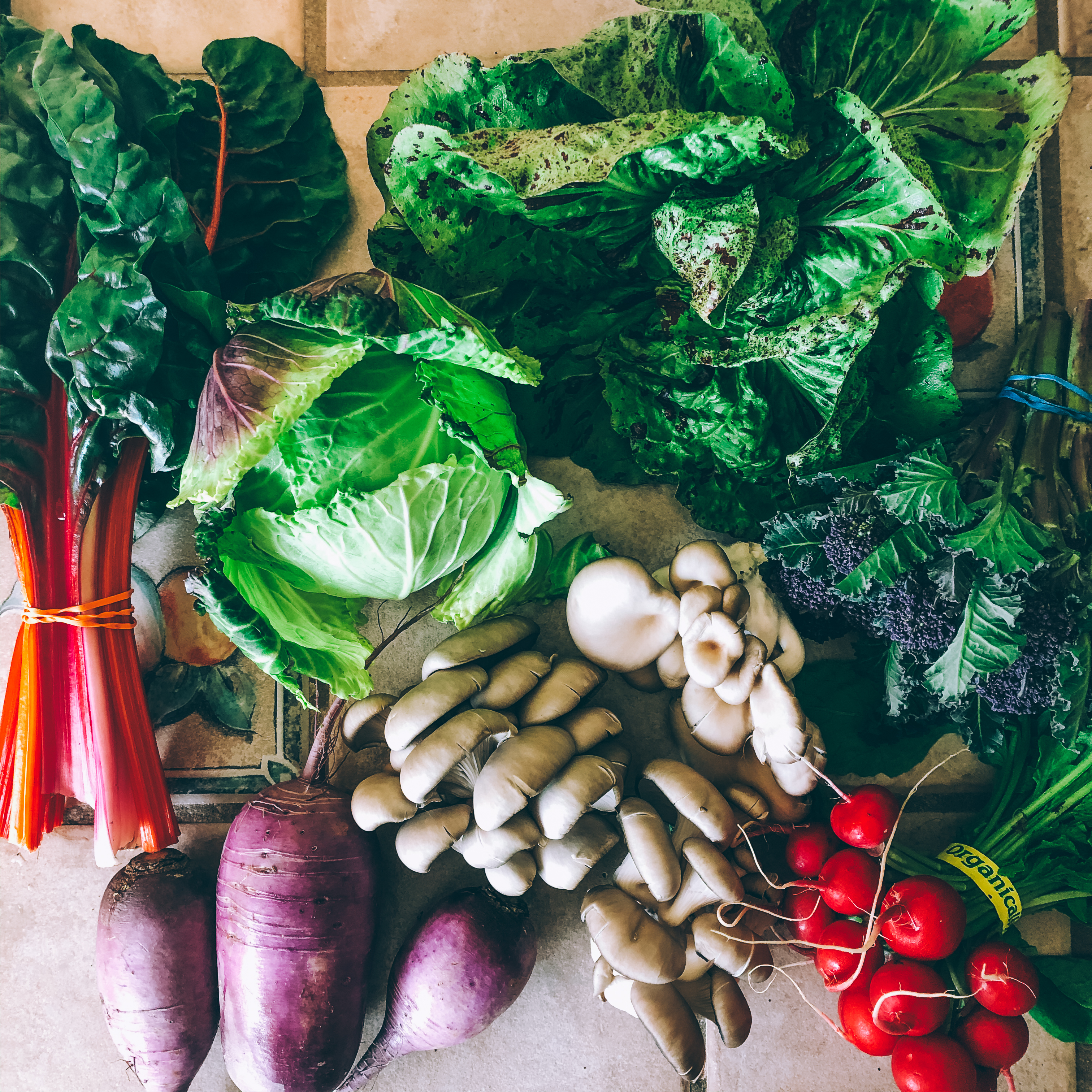
    What grows in spring? GREENS! Early spring greens tend to be bitter, pungent and cleansing. They’re perfectly designed to balance us after a winter of heartier fare.
  3. Sip on warm beverages rather than cold water and drinks.
    For many individuals with compromised digestion, this tip will always be true, but spring is a time of year when this is true for everyone.
  4. Sip on dandelion and/or burdock tea.
    These are bitter, detoxifying roots, and are nearly always included in any herbal “detox” formula. They support healthy liver function and help the body get rid of unwanted waste products and excess moisture.
  5. Try to eat three meals each day with little snacking.
    Or if you’re quite active, four balanced meals with no snacking in between. Giving the digestive system time to rest by about 3.5-6 hours after each meal really supports its ability to fully digest the last meal before the body has to begin digestion again.
  6. Get Moving!
    Getting your heart rate and circulation up and breaking a sweat regularly is an excellent way to promote optimal detoxification – of environmental toxins and pollens, of hormones, of inflammatory substances from foods. Moving promotes lymph flow, which when stagnated leads to congestion, mucous, retaining water, and sluggish digestion.
    If you’re already active, and perhaps training for a spring race, make sure you balance some of that heavier training with slower movement, and gentle yoga or daily self-massage that can gently move out some of the extra inflammation that can accumulate during this season.
  7. Up your spices!
    In the springtime, spices help the body to warm up and remove mucus. They also promote optimal digestion, and help to digest more difficult foods such as beans and legumes.

Broccoli Olive Sourdough Pizza – emphasis on the broccoli topping!

The Why: Energetics of Early Spring

First, look at the energetics of the season, or the energetics of the weather outside today. Energetics means the quality that is present in the environment, your body, or the ingredient, and the effect it has. The most basic energetics to work with are hot, cold, (and thus heating or cooling), and wet, dry (and thus (moistening/dampening, or drying).

In most places in the northern hemisphere, late winter and early spring tends to be cool or cold, and wet or damp. When we’re using a food as medicine approach, we do so by eating in a way that has the opposite quality of the body or of the seasonal environment that we’re a part of – eating in this opposite approach then provides balance for the body to be at, or return to equilibrium, where health occurs.

So in the cool, damp weeks of early spring, we want to eat meals that are warm and perhaps slightly drying in nature. One of the easiest ways to work with this component is by eating all meals cooked, and adding in more spices as we’re preparing foods. In terms of spices, nearly every common cooking spice will be drying in effect. Many of them will also be warming, and some will be more warming, or just plain hot, than others –like garlic, chilies, onion, and ginger.  

Energetics of Your Body

Now take a look at what’s going on in your body. Do you tend towards having symptoms of spring allergies, mucus, a wet phlegmy cough, swelling of the lower legs, retaining water, lack of appetite, or sluggish digestion where you eat and feel full for hours, like food is heavy and just sitting in your belly? This means you can use more warm and drying foods and spices! 

Key spices to incorporate into meals in late winter and early spring season include black pepper, cinnamon, ginger, cloves, nutmeg, horseradish, cayenne and chili in small amounts, garlic in small amounts, fenugreek, mustard seed, cumin, turmeric, ajwain, rosemary, thyme, sage, and oregano.

Putting Them Together: Cook with Three Spices


One of the best ways to start spicing your foods without it becoming an overwhelming task is to choose three spices to use in each meal. For breakfast, if you’re having something warm and porridge-like, such as oatmeal, incorporating a trio of spices in the total amount of ¼ – ⅜ teaspoon is just about right.

A couple combinations to start with include:
⅛ teaspoon each of ginger, cinnamon, and nutmeg
⅛ teaspoon each of ginger, anise seed, and cardamom
⅛ teaspoon each of ginger, turmeric, and cinnamon

In midday and evening meals, we can slightly increase the total amount of spices to about ½ – ¾ teaspoon total per person.

Some Spring Spice Combinations include (amounts per serving):
¼ fresh garlic clove, ¼ teaspoon each of rosemary, and oregano
¼ teaspoon each of cumin, mustard seed, turmeric
¼ teaspoon each of fenugreek, sage, and rosemary
¼ teaspoon each of fresh ginger, turmeric, and a pinch of black pepper

If you’re using other people’s recipes to cook with, adjust the spicing according to what you’ve learned above, particularly about your body. Most modern recipes over-rely on heating spices and condiments. 

An example is a recipe with several cloves of garlic, chilies, several tablespoons of fresh ginger, tamari, soy sauce, or miso, all in one. This is a recipe that’s probably going to burn us up internally, even if you and the season is running cold! You can tame the recipe and spice level by slowly reducing the amounts of each spice, or switching an ingredient out for one that has a milder effect of the same quality, such as using a pinch of black pepper instead of a ½ teaspoon of cayenne, or using 1-2 teaspoons of finely grated fresh ginger in a recipe that calls for 3-inches of the fresh root.

Signs of Balance and Imbalance

Ultimately, the goal is to feel good in your body and mind in each season. 

During this time of year, signs of balance include slowing down more than other times of year to rest more, having steady energy throughout the daylight hours, maintaining a healthy immune system and response, and eating to nourish yourself with no signs of impaired digestion.

Signs of imbalance include over committing, feeling depleted throughout the day, stagnation (mentally or physically), depression, mucus in the respiratory system, overeating  (especially high sugar, extremely rich, or cold foods), and having heavy, sluggish digestion with reduced or no appetite.

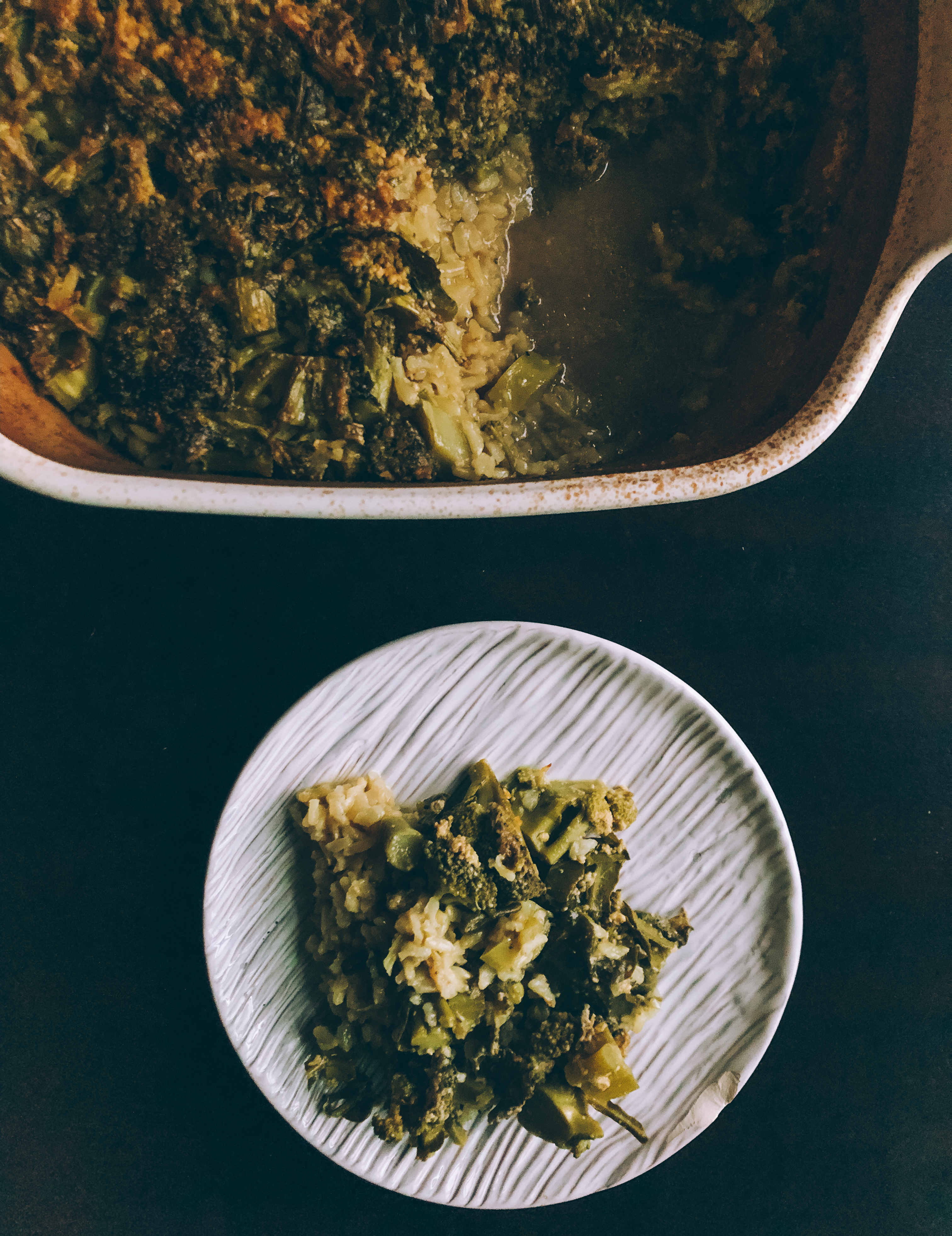
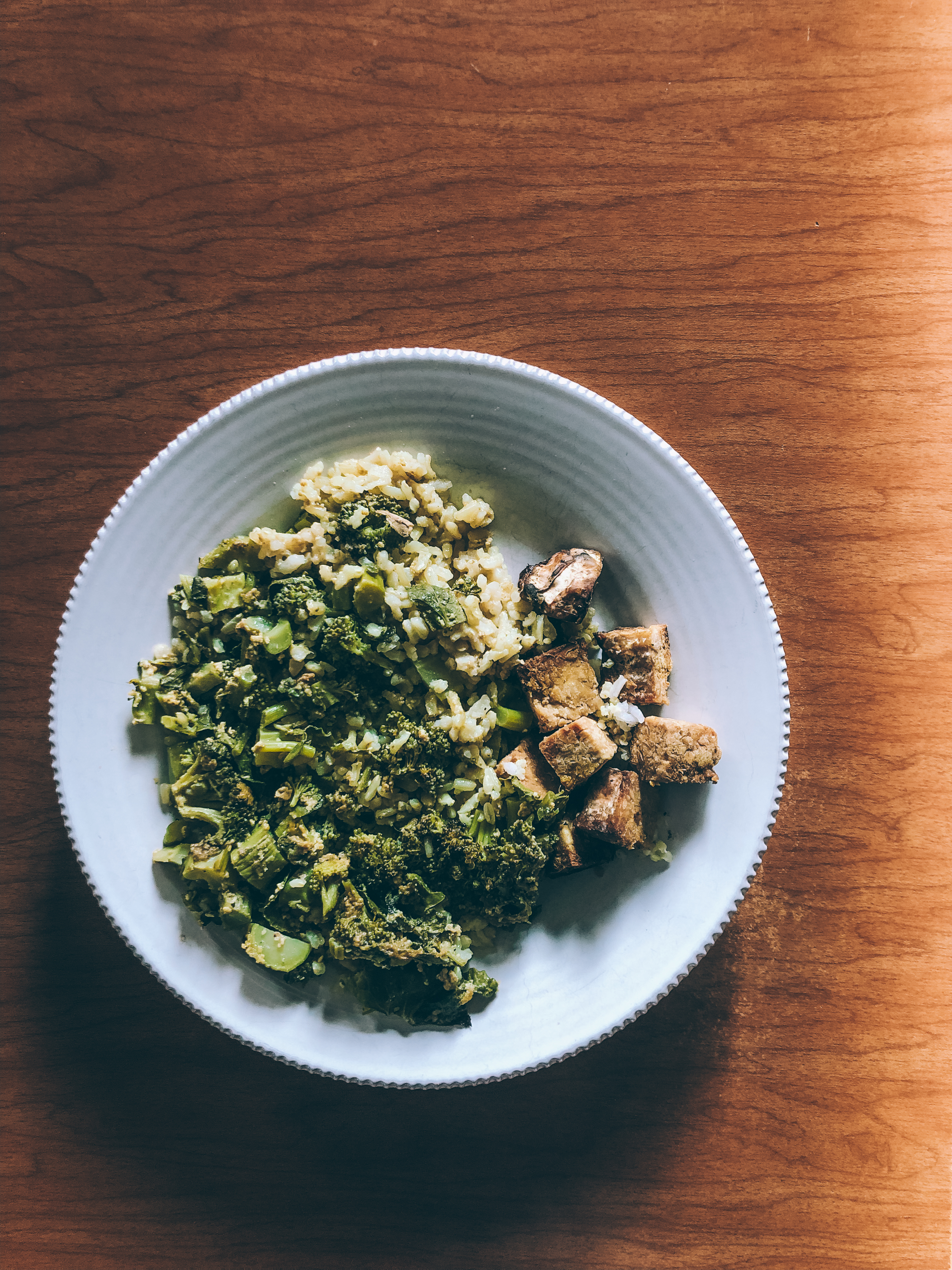
Broccoli Rice Bake

and a tip for taking care of digestion during the holidays and beyond

Before I get to the recipe below, there’s one little nutrition tip I want to share today that just about every one of us can use, especially during the holiday season. It’s simple – but can go a long way in terms of improving negative digestion symptoms, in addition to energy, having a steady appetite, clear skin, and focused thinking.

It’s that we should leave out habitually grazing or snacking throughout the day.

When we’re in a pattern of habitual grazing all day, or feeling constantly hungry or snacky, it’s often because we haven’t eaten enough at a previous meal. Or we’re eating for emotional comfort, or simply skipped a previous meal altogether. Or we’re doing those holiday gatherings that involve no real meal but constant “finger foods.”

In any of these cases, eating when the last meal hasn’t fully digested can put the body in a stressed state and leave us with indigestion, bloating, fluctuating energy levels, and a whole host of other symptoms. When we snack on the go or while distracted during our busy days, the same uncomfortable symptoms often occur.

But what about for athletes? I know many of you, like me, move your body a lot and need more food to be getting enough for your needs.

As endurance athletes doing daily workouts or training for an event, having a snack or two during the day is reasonable. But we should not feel constantly hungry, or hungry every hour or two.

Eating again before the last meal has finished digesting puts a lot of stress on the digestive system and it can’t do either job of processing the new food or assimilating the last meal effectively. This goes for everyone, regardless of whether you notice negative symptoms or not.

Aim to have snacks about four to six hours after your last meal has been eaten, and two to three hours before your next meal. This is the length of time it takes to fully digest your meals. For a person that is active less than an hour per day, three meals is usually plenty. For those who are more active, an eating schedule with a snack built in to get enough food might look like having breakfast at 7am, lunch between 11-12:00 pm, a snack around 3-4pm, and dinner between 6-7pm.

Do you feel worse when you constantly snack or graze throughout the day? I know I do. Try cutting all snacks or sticking to the above schedule for a week or two, and see how much better you feel.

Now, for something nourishing to eat during your actual meals. At least during one holiday of every year while growing up, there was my mom’s Broccoli Rice Casserole, which we all craved. Likely a holiday meal because it involved ingredients we didn’t eat any other time of the year (processed cheez whiz and instant rice), I have no idea when the tradition began, or when/if it ended, but we all enjoyed it.

Several years in to a dairy-free lifestyle, I tried upgrading the recipe to be based around whole foods and be dairy-free as a final project for one of my grad school cooking labs. Like most vegan / dairy-free recipes trying to mimic a cheesy taste, the result I got was trying too hard to stimulate all the taste buds with the nutritional yeast, miso, garlic, etc. combination of flavors, and I never really landed on a finished recipe that I wanted to remake year after year.

Then I stumbled upon the flavor/spice combination below while having a little creative session in the kitchen earlier this year. Without intending to, the result ended up being exactly what I was going for in the failed recipe revamp. And here we have it! A whole foods remake of the Broccoli Rice Casserole I loved from youth.

Broccoli Rice Bake

This is a far cry from, yet extremely reminiscent of the cheezy Broccoli Rice Casserole I grew up eating around the holidays. The combination of the spices, tahini and coconut milk seem like they’d yield a curry rice bake – but the result is actually far more subtle and more in line with the cheez whiz, instant rice, and cream of mushroom soup combination of childhood. It’s creamy, comforting, and a perfect addition to either a holiday or an everyday winter’s meal. 

Prep:  4-8 hours soaking (optional but recommended)   | Cook: 1.25-1.5 hours  | Serves: about 4

3 ½ cups (320 gr) chopped broccoli
1 cup (185 gr) brown rice (soaked for at least 4 hrs)
1 tsp. salt
¼ tsp. ground fenugreek seed
¼ tsp. ground fennel seed
1 ½ tsp. grounding masala spice blend or curry powder
2 tsp. minced fresh ginger root
3 Tbs. (45 gr) tahini
1 cup (240 ml) coconut milk*
2 1/2 cups (600 ml) water

  1. Preheat the oven to 350°F (180°C ).
  2. Spread the broccoli out in a 9×9″ baking dish along with the soaked (and drained) rice. Set aside.
  3. Stir together the spices, fresh minced ginger, salt, and tahini into the coconut milk and  water. Pour over the vegetables and rice and mix. Then spread the mixture evenly, making sure that the broccoli and rice are submerged in the liquid. Cover with kitchen foil and bake for 45 minutes.
  4. Now discard the foil and increase the oven temperature to 430°F (220°C). Bake for a further 25-30 minutes, or until the broccoli and rice are cooked and the sauce starts to form a slight crust around the edges of the pan. It might look a bit softer than steamed rice consistency at this point, but will set up after removing from the oven.
  5. Let cool for about 10 minutes out of the oven before serving as a side dish.

Notes: Use canned coconut milk, the type used for cooking. Either lite or full-fat can be used but full-fat is preferred, and will result in a creamier texture and richer flavor. 
I’ve tested this a couple times in a larger, flatter 13×9″ baking pan. It still works, but the rice really benefits from a smaller, deeper pan so it can fully immerse and steam-bake, rather than dry out without fully cooking.

Buttercup Squash + Creamy Black Bean Tacos

I frequently share with nutrition clients about the connection between mental and physical health, particularly between the gut and brain, but also just a reminder that it’s all connected. We’re all connected. Something that’s been labeled “all in your head” is also in your body, and vice versa.

That’s the paradigm I work out of.

In my own life, I’ve had a long journey with things in the realm of “mental health;” in the last few years mostly related to low grade anxiety that can simply be summarized as high vata dosha in Ayurveda. So I try to balance myself with daily habits that invite in slowing down (physically and as a result mentally), practices that sooth my nervous system, and a practice of breathing and meditation that’s begun to infuse into my days.

For the last few weeks, I’ve felt like I really hit a flow with presence and slowing down my brain’s looping and too-quick thoughts.

I’d cracked the code! (haha, right).

Then over the weekend, I set out on the longest run of my current marathon training cycle. As I settled into the last hour of running, when my body was tired and my pace/effort was meant to get higher, my brain kicked in.

My brain kicked in in all the ways I’ve been working to slow my thoughts down or just observe them rather than let them dictate my actions.

The run wasn’t a failure. Today, a few days beyond it, I mostly feel really good about how it went physically. But I’m disappointed with how I coped and let my mind decide to take it easier than planned in that last hour when I’d prepared for and practiced something else.

I guess that’s why we call it a practice. A running practice. A meditation practice. A breathing practice.

In fact, my last conversation with my long-time naturopath who sadly moved away was on this very topic. She told me that if I wanted to keep running marathons, I was going to have to balance the running out with yoga. And she didn’t mean the physical asasa of yoga poses–although that can be helpful too! She meant that if I was going to continue the going fast of running, I needed to balance it out with the slowing down of practicing breathing, presence, and eating slowly and mindfully, to digest food well.

It’s safe to say I’ve made progress from where I was then. But I have not cracked the code of always getting it right. Nor will I.

We’re all works in progress but as reminder to you, and to myself, we rarely make linear progress.

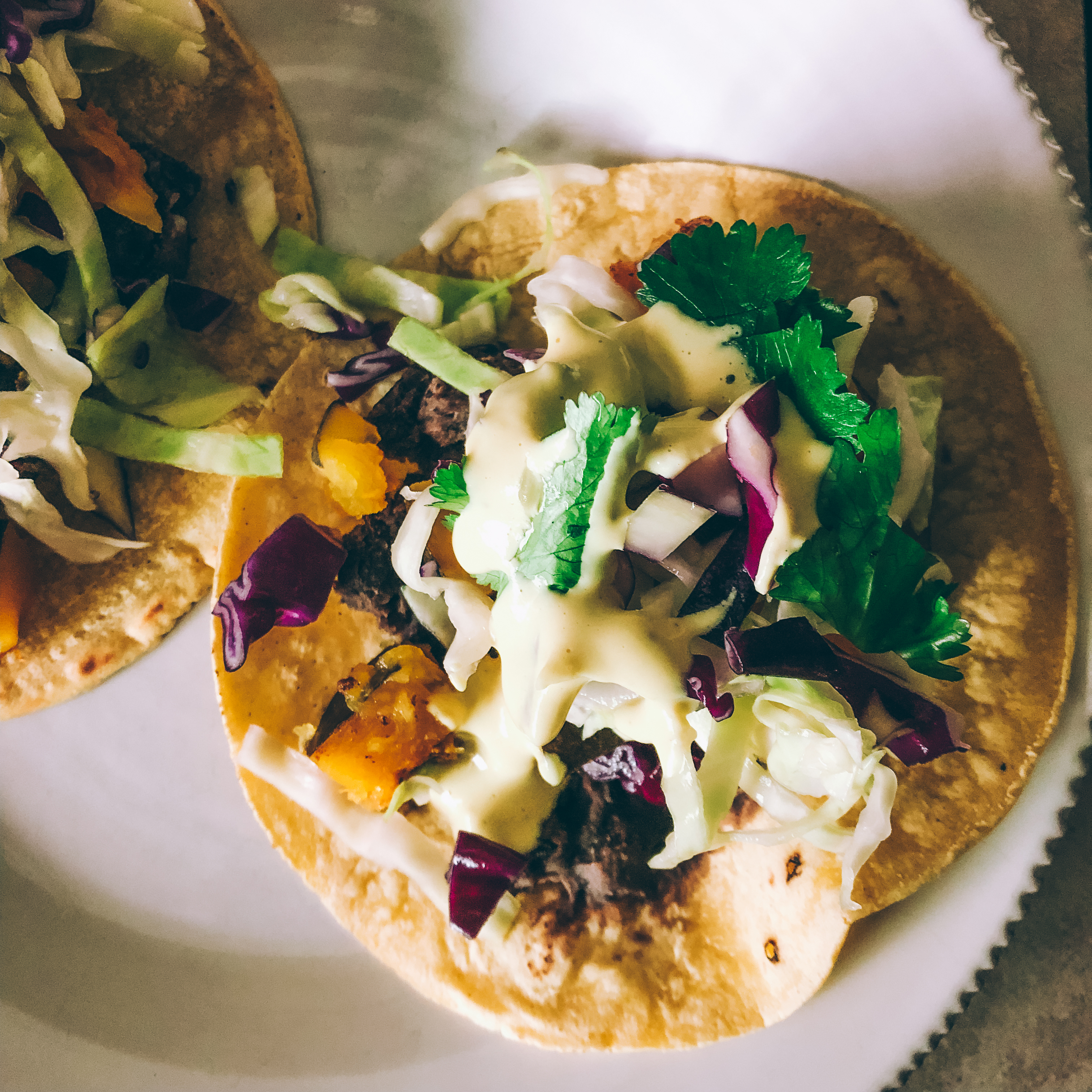
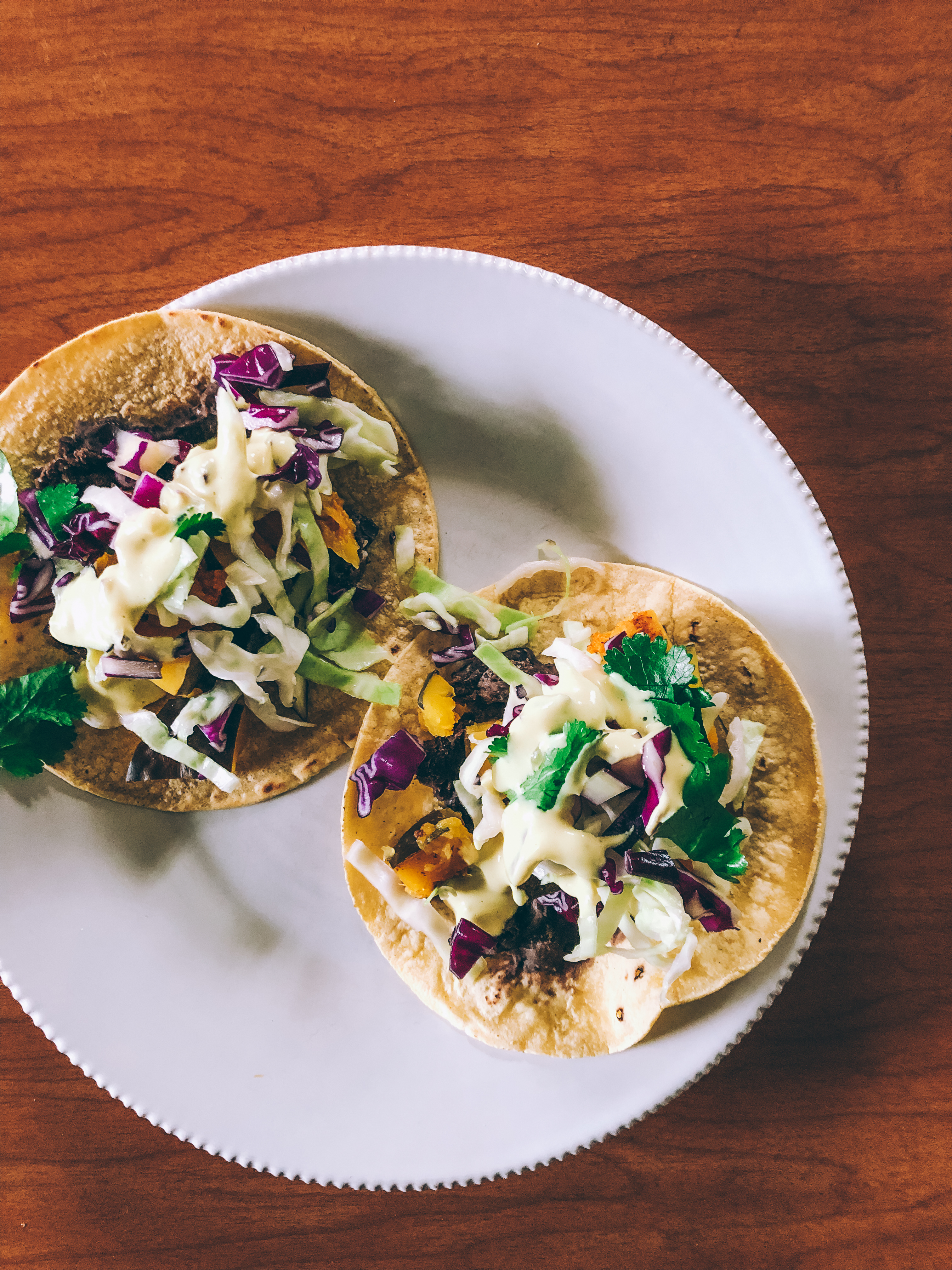
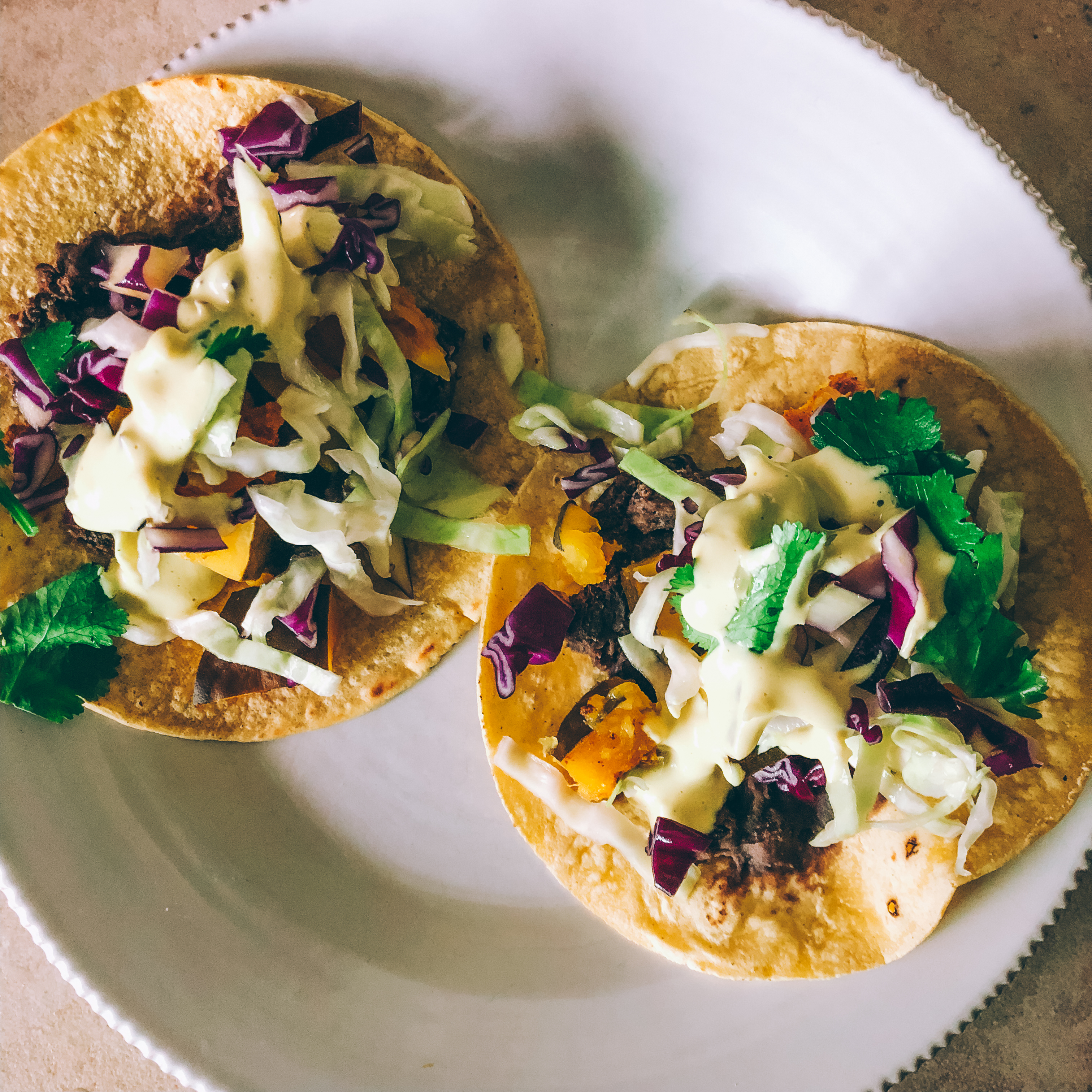
This recipe for creamy black bean tacos with lightly baked and seasoned winter squash, a simple sliced cabbage and creamy sauce to drizzle over the top, is one of those many-years-in-progress, mind and body are all connected recipes. It’s truly delicious for your fall and winter taco nights.

But I also wouldn’t have been eating it a couple months ago, when my gut health had temporarily returned to a compromised phase – I had to do a bit more healing and re-balancing first to return to eating a “more complicated meal.” That’s all to say, if you’re still in an iffy-digestion state, save this one for a little later. And let’s see about getting your system working optimally first.

And if you’re like me and tend toward too-fast, scattered thoughts, I encourage you to keep up the practice of breathing and returning to presence. I’ll be right there with you.

A true fall and winter favorite, these tacos have all the elements of a balanced meal with the six tastes, and are prepared in a way that makes them easier on digestion. The black beans are next level flavorful when cooked from scratch into a creamy, easier to digest consistency.
Any type of full-flavored winter squash works for this recipe. That includes basically all varieties of winter squash commonly used for eating except spaghetti squash and delicata. See what you have available from your local farmers and try a couple new varieties! I used a super tasty variety called Burgess Buttercup.
Nearly all components of this can be prepped ahead and gently reheated if you want to turn this into a weeknight meal. Additionally, I’ve shortened the preparation time with the way I slice and bake the squash.

Prep:  overnight   | Cook: 3-4 hours (for beans); 45  minutes to finish  | Serves: about 4

1 medium buttercup squash, or similar variety (butternut or any hubbard variety of squash)
Pinch of mineral salt
½ tsp. smoked paprika and/or taco seasoning (without preservatives/fillers added)

3-4 cups of red and/or green cabbage, thinly sliced
⅛ tsp. mineral salt
1-2 Tbs. lime juice

Cooked black beans, see below
Cashew crema, see below
12 small corn tortillas (6”)
Cilantro, minced

Black Beans
½ pound /  1 cup black beans, soaked overnight
¾ tsp. salt
1 ½ tsp. ground cumin
1 tsp. ground coriander
¼ tsp. ground black pepper
1 bay leaf
Water to cover by 3-4 inches

Cashew Crema
1/2 cup cashews, soaked for 4-8 hours or overnight
¼ tsp. garlic salt
1-2 tsp. freshly squeezed lime juice, to taste
a pinch of ground turmeric and dash pepper
a pinch of ground cayenne, optional
1 Tbs. nutritional yeast, optional
½ cup water or more

  1. For the Black Beans: A few hours before or in the morning, cook soaked black beans in a medium pot in the spices and water until very soft and flavorful and creamy, almost to a refried bean consistency.
    This is best done for at least 3-4 hours, adding water as needed.
  2. For the Baked Squash: Preheat the oven to 400 degrees F.
    Slice your squash in half, and remove the seeds and pith. Then rub the salt and smoked paprika and/or taco seasoning onto the flesh of the squash.
    Then place the two squash halves in a large, rimmed baking pan (like 13×9-inch), with cut side down/skin facing up. Add water to about ⅓ of the way up the side of the squash and bake until completely soft when pierced with a fork. This will take about 30-4o minutes.
    Remove from the oven and allow to cool before slicing. The water should all be absorbed and the spices infused into the flesh.
  3. For the Cashew Crema: Drain and rinse the cashews.Put all the crema ingredients, except the water, in a high-speed blender or food processor and blend, adding water a little at a time until the desired consistency is reached.
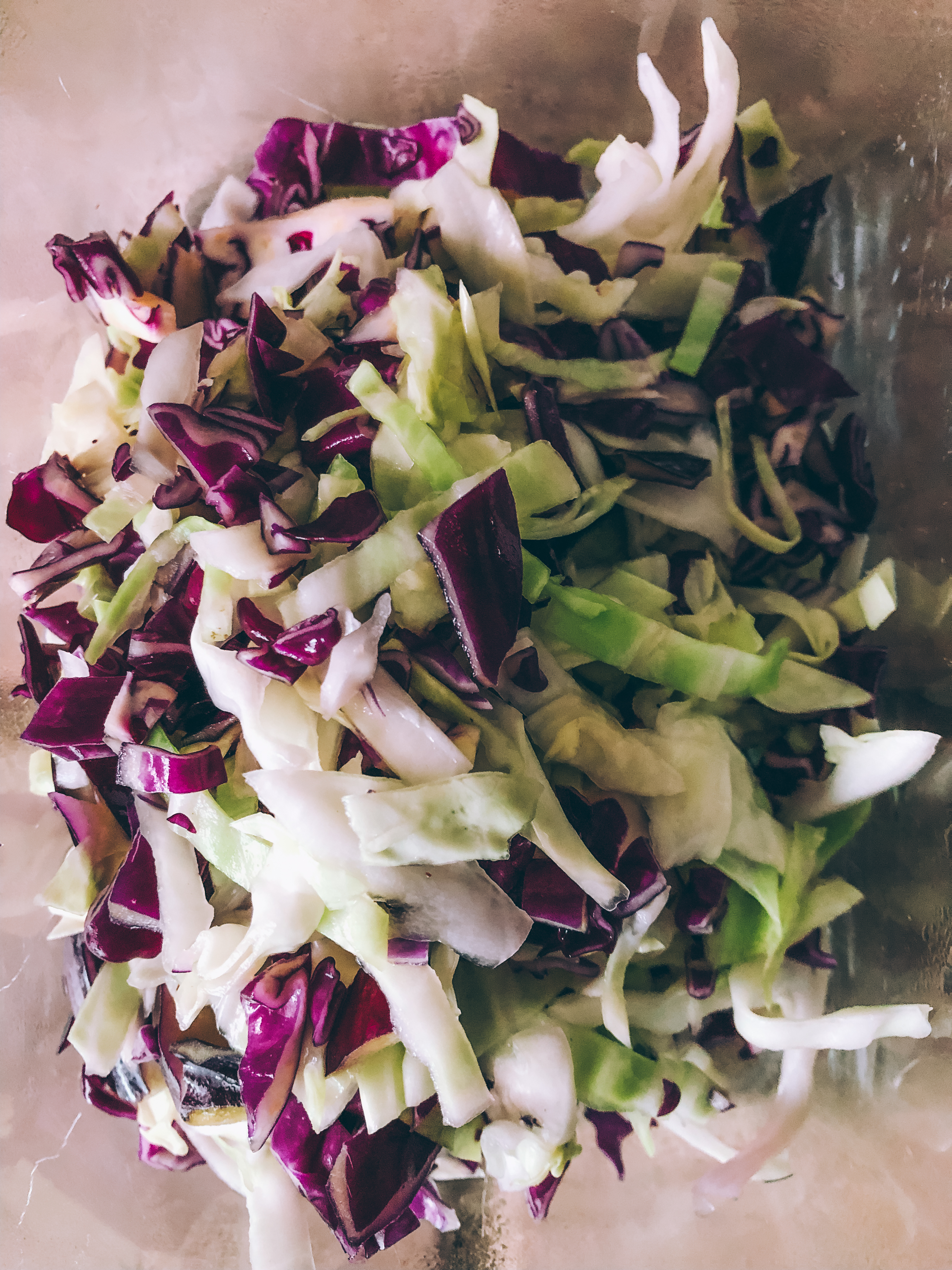
  4. While the squash is baking, prepare the sliced cabbage. If your digestion is strong, you can thinly slice and dice the cabbage, stir in the salt and lime juice, and allow to sit at room temperature for 20-30 minutes to soften.
    If digestion is compromised, gently steam the cabbage instead, just until lightly soft. Then remove to a bowl or dish, add the salt, and lime juice.
  5. Heat the tortillas over high heat, in a clean cast iron skillet.Do this by working in batches, two tortillas at a time and heat for 30-60 seconds per side of each tortilla.
  6. To serve, spoon the black beans into each taco, followed by sliced squash pieces, cabbage, a pinch of minced cilantro, and then a drizzle of crema. Enjoy!

Much of my nutrition practice is focused on individuals and athletes with digestive health issues such as leaky gut, food allergies and intolerances, chronic GI distress, malabsorption of foods and nutrients, and inflammation. If you’re tired, stressed, and not really sure what to eat to help or hurt anymore, I invite you to reach out to me for more personalized support.