Answers to the Big Questions and a Hearty Runner’s Brunch Hash

Lately, I’ve returned to reading two books. First the Purgatorio, the second in Dante’s Divine Comedy. My former English professor and deacon at my church in Corvallis has been leading a weekly class lately guiding us through the Purgatorio and the timing feels just about right since the class began the Wednesday of Holy Week and is leading us through this continued period of staying at home and distancing. Purgatory—the place between two more known-of places—seems the perfect description for where we all are now.

If there’s anything I can pick up from Dante’s 14th century poem, it’s that it gets easier as we keep going.

The other book I’ve begun again is Sajah Popham’s Evolutionary Herbalism: Science, Spirituality, and Medicine from the Heart of Nature—a reading I encourage everyone, yes everyone to read. For it guides you back to a perspective I think we all had as children and lost along the way.
I’ve been considering a lot these last few weeks. About this space, this encouraging journal and recipe guide of sorts, my role as a nutritionist and in the community, health and true wellness, and of course, nature.

On that note, I wrote in two questions for a couple of favorite podcasts a few months ago and surprising to me, both questions were answered by the respective individuals this past week. Unsurprisingly –if you know me—my questions were on the topics of sustainability and having a lower ‘footprint’ as a company, and on navigating faith and spirituality amongst busy seasons and family traditions that don’t partake in that faith. I know. I know. I like to ask the tough questions.

So why am I bringing all that up here? This past week my big questions semi-paralleled with those of Brett Farrell, the founder of Territory Run Co., for which I am a content ambassador and contribute seasonal articles. Brett spoke about his own big questions, the clothing industry’s own climate footprint, challenges with community, and more. Check out those here and here. As well as recent contributions on the Territory Run Journal – there are several excellent and thoughtful articles there lately.

What I was really reminded of however, was that in a conversation with Brett about a year ago, I spoke about the draw of trail running, the joy and peace and healing it has brought me personally, and about getting to the know the medicine around me—literally coming to know the plants I spend time with on the trails. Though I’ve only written or spoken about it in pieces, I came to an interest in herbs and herbalism like a lot of individuals. I was really sick, in a way that modern medicine wasn’t going to cure or even temporarily fix. And after a while of taking various herbs and formulas which my doctor gave me, and around the same period spending more of my running hours in the forest, the plants reached out to me and pulled me in, sometimes sharing themselves in profound ways –like being pulled to a stop suddenly alongside a trail, staring captivatedly at one, and (internally) asking, who are you? Crazily enough at times, I’d find I had my answer when the plant’s name simply came to the edge of my tongue, when if you’d asked on any other day, I wouldn’t have known it.  In fact, it happened again today.

And then Brett asked me another ‘big question’ about what it is I really want people to know in regards to nutrition and health. My answer is one I still will give and one I’ll likely give for the rest of time. What I really want you to know about nutrition and health is that if you get quiet enough – go deep enough into the forest’s eternal wisdom, and your own—you’ll find you already have the answers to the questions you seek.

To explain this more since the concept can be a little esoteric, I’ll refer to a couple lines from Sajah’s first two chapters:
To begin gathering natura sophia (the intelligence of nature), we must learn to see beyond the limitations our modern world has placed upon our perception and see the living intelligence of the Earth. And this can only be done through gnosis cardiaca—the knowledge of the heart.

and

To truly enter the kingdom of nature we must suspend our rational thought, let go of our knowledge of botany and chemistry, even dispense with our systems of herbalism—for any potential interference of the mind will get in the way of our capacities to directly perceive the intelligence within the plants. To move beyond herbal knowledge and into herbal wisdom, we must tread the pathway down the mind into the inner temple located just inside our chest.
Bringing this back down to earth even a little more, the answers to these big questions don’t come easily, they don’t necessarily just appear when we ask them or when we want them to. There can be many layers to the answers of how to be a better patron of the planet, or how to balance a spiritual life in faith with the goings on of the ‘real world,’ or how to heal – truly heal the body and mind.

Over time, I’m beginning to realize my role here is to educate about true wellness, about true healing, to be more of the guide—the Virgil and/or the Beatrice (though I claim no Godlike abilities)—and no longer the lost and hurting Dante who I was for a long time. To provide encouraging words yes, and recipes to nourish the body yes, and with those working with me clinically, proven scientific strategies to heal root cause imbalances yes. But it’s also to remind you, to remind us, that we also have the answers. That we’re not victims.

In every relationship whether it’s with me your nutritionist, your coach, your chiropractor or PT, your family and friends, your life partner, or with the plants in your window box, yard, locally farmed vegetable box, or forest, there’s an opportunity for a two-way conversation, a partnership to come to the answers that are already within you waiting to be revealed.

Maybe that’s the point of this slow down period we’ve been given, for I know it’s not for many millions to suffer. Maybe it’s the time to return to our childlike ways, picking the dandelions and blowing our wishes into the big questions, letting the answers present themselves in their own time and way.
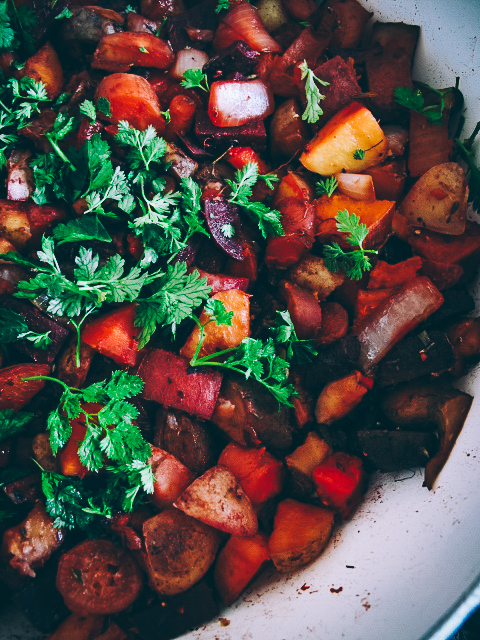
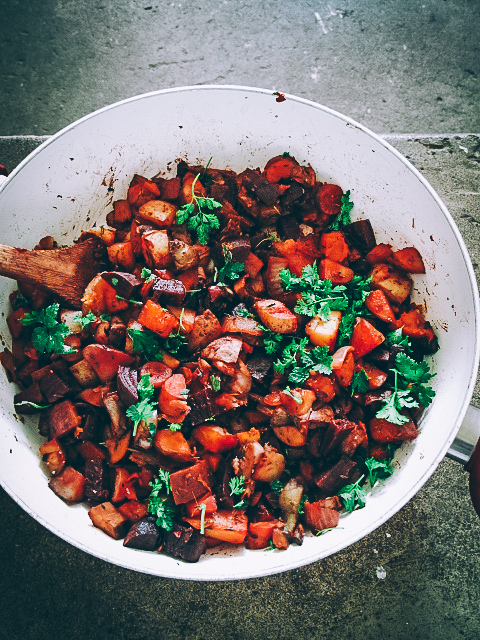
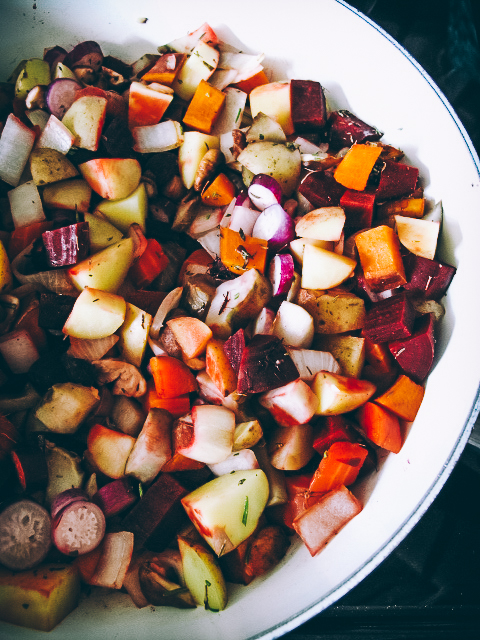
Now for this hearty brunch hash.

You’ll need a hearty, though not heavy, meal to refuel the system after your time in the forest– or wherever you go to dwell in your own big questions and their answers. I’ve shared the recipe over on the Run Journal at Territory Run Co. Get the full article and recipe here.
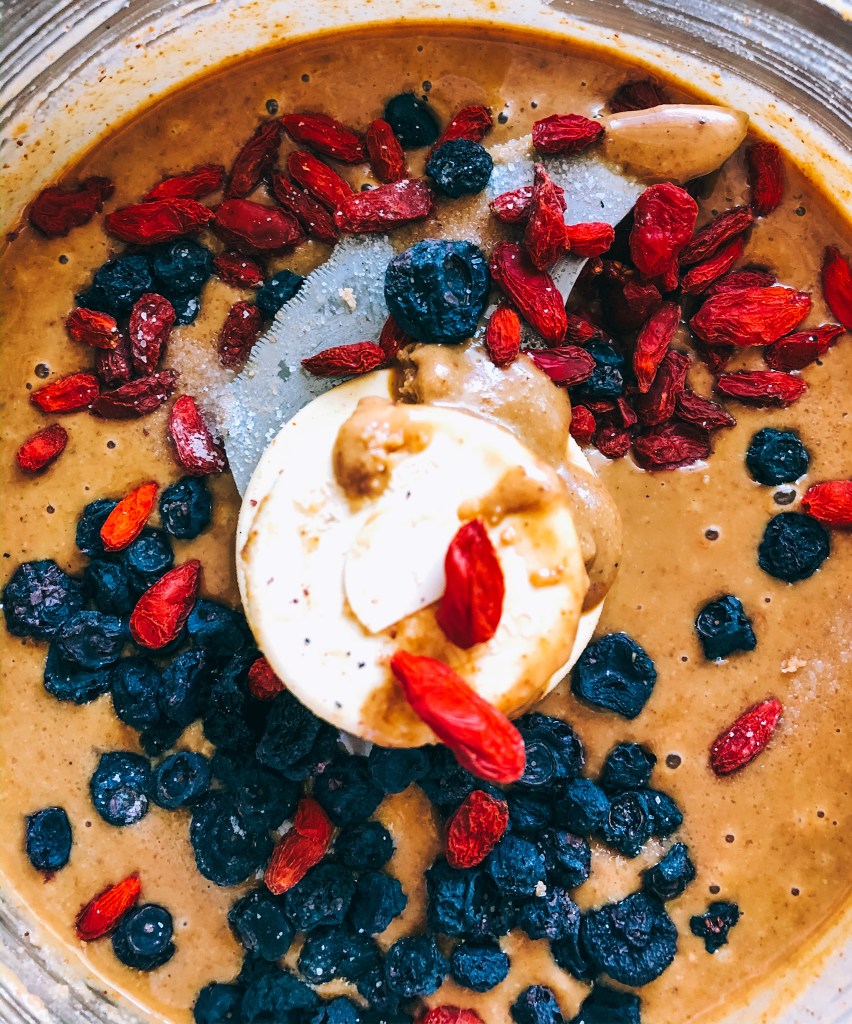
Walnut Butter with Blueberries, Goji Berries + Vanilla

I received free samples of California Walnuts mentioned in this post. By posting this recipe I am entering a recipe contest sponsored by California Walnuts and am eligible to win prizes associated with the contest. I was not compensated for my time.

There was a conversation going around the last few weeks about using up what’s in the cupboard, finding random stowed-away forgotten, stale, and outdated ingredients, and actually making a meal of them. As that went around, I truthfully had the thought of Ha, well that doesn’t apply to me.
I also remember a few years ago, a friend that first got to know me as a study abroad/international student and came to visit. He remarked at how elaborate the collection of ingredients in my pantry were. At the time, it felt like a moment of baring my soul, for what’s in your pantry and fridge tell as much or perhaps more about someone as taking a look in their medicine cabinet.

I tend to have a fairly vast collection of cooking ingredients simply because I love to experiment and create, and I like the flavors of a lot of different places. My kitchen is perhaps the [adult foodie] version of my dear grandmother’s elaborate dress-up closet that we loved as a kid.

Lately, I’ve also been making meals inspired by Heidi Swanson’s Near & Far cookbook, though I’ve particularly been drawn to the Near section, meaning Northern California cuisine. In the springtime particularly, this means I’ve been making meals with plenty of greens and herbs, and with flavors and ingredients that are pretty close to home here in Oregon’s southern Willamette Valley. In other words, as the stay-at-home recommendations went into effect, I craved even more the flavors that come from closer to home.

And…when I finally dug through the pantry and fridge to inventory what’s there, I discovered I’m not the outlier with no outdated or forgotten foods in the pantry like I’d convinced myself to be.

A jar of freeze-dried wasabi powder
An untouched jar of Rhubarb Cordial which I made during cordial-making week in Herbal Pharmacy class four years ago
A few blooming teas and flavored teas and extra-floral teas that various individuals have gifted me – love tea, kinda picky about which ones I’ll drink on the regular
A package of pizza spice mix
A jar of jalapeño jelly I made a long time ago that appears still good – the gift of high sugar content
A big pack of spring roll wrappers I’ve only needed in small amounts
A couple dried habaneros – before I realized only a smidge in a recipe will singe the hairs off, clear the mucus membranes, and help me breathe fire like the dragon I sometimes claim to be. ;)

And, not outdated at all and in constant rotation, an entire third of my fridge and a shelf on the pantry dedicated to the nut, seed, and dried fruit collection. Because I like to start from the equivalent of primary colors when making recipes, I usually purchase raw, unroasted nuts and seeds, and dried fruit with no added oils or sweeteners. This also means their amazing nutrients are retained without adding extra oils, salt, or sugar. Despite a few other ingredients that clearly need to be tossed or regifted – that cordial did not look good and went down the drain this morning – this preference for having diverse and fresh ingredients on hand came in real handy the last few weeks.

So let’s turn to this particular recipe, shall we?

One of the components of total health and overall diet that is important is the ratio of omega-3 to omega-6 polyunsaturated fatty acid types in our daily diets. Both omega-3s and omega-6s are essential, meaning we have to get them from our foods to have adequate health, but their ratio is perhaps just as important. In traditional diets, our evidence shows that peoples were likely eating a 3:1 or even 2:1 ratio of omega-6 to omega-3s, and this is still optimal. In a standard Western diet, that ratio is often skewed to a 20:1 or more ratio. Anything above a 5:1 ratio begins to be more of a pro-inflammatory state for the body.

Omega-3 fats are primarily found in fatty fish like salmon, herring, mackerel, anchovies and sardines.
But they’re also found in plant-foods including walnuts, chia, flax, and hemp seeds, as well as edible wild plants – a major source for our ancestors.

Omega-6 fats, though essential, are ones we usually don’t have to work at getting because they’re prolific in our food supply – primarily through corn, soy and other-vegetable oils, but also in most of the other nuts and seeds not mentioned above.

One important note is that no food has just one type of fatty acid profile – foods contain varying amounts of all types of fat, both monounsaturated, polyunsaturated (those omega-3s and 6s), and saturated fats. Our body thrives with a balance which is another reason it is wise to eat diversely and seasonally.

Working a little of that Near & Nearer concept into my meals and snacks lately, this recipe primarily features California walnuts, which I love because they offer a rich, sophisticated flavor, and they’re the only nut to provide an excellent source of the plant-based omega-3, ALA (2.5g/oz).

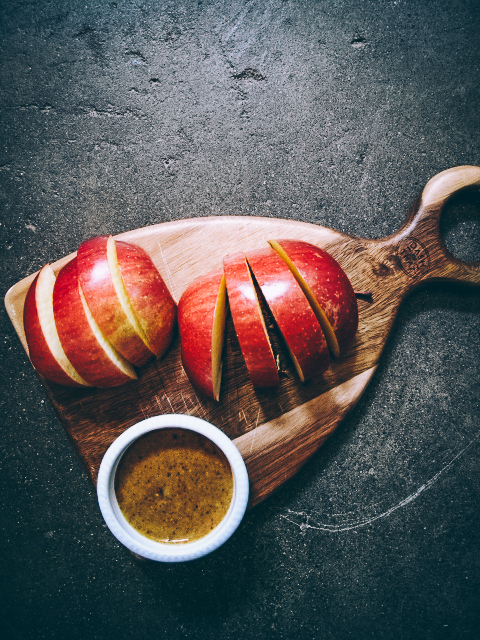
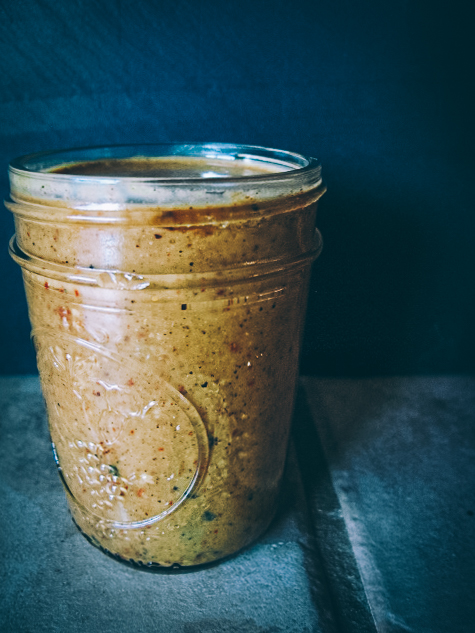
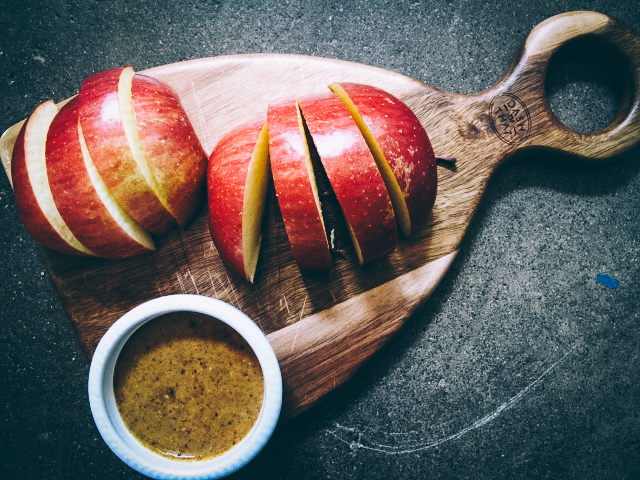
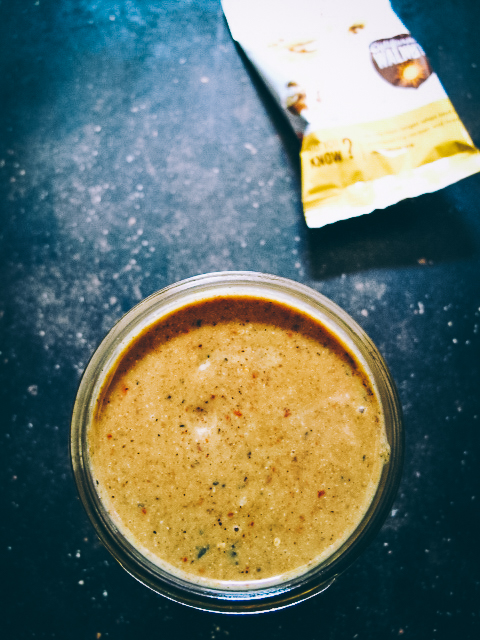
And a handful (or spoonful) of California walnuts is a versatile snack and can satisfy any taste preference, from savory to sweet.​ As far as this walnut and berry nut butter goes, it works that slightly sweet angle with blueberries that were grown by one of our local farmers, a handful of antioxidant-rich goji berries, and just enough sunflower seeds to balance out the stronger flavors that walnuts on their own in a nut butter provide. I particularly enjoy this as a snack or alongside apple slices as a little after dinner treat. And if you make it, whether you have to go source a few ingredients or work that Far angle of the Near & Far concept, I promise you will too. :)

Walnut Butter with Blueberries, Goji Berries + Vanilla, makes 240 grams (about 8 oz.)
1 ¾ cups / 175 grams California Walnuts
¼ cup / 35 grams sunflower seeds
2 Tbs. / 20 grams unsweetened dried blueberries
2 Tbs. / 10 grams dried goji berries
1/8 tsp. vanilla
a dash of salt and up to 1/8 tsp.

  1. Set the oven to 160°C / 320°F.
  2. Spread out the walnuts and sunflower seeds on a baking tray and roast for 15-18 minutes until they begin to turn a slightly darker, toasted hue.
  3. Transfer to a food processor and mix on high speed for approximately 10-15 minutes or until it starts to become smooth and perhaps a little runny (stopping and scraping down the sides every now and then). 
  4. Add in the dried berries, vanilla, and salt.
  5. Puree again until the berries are mostly incorporated but might still have some small pieces.
  6. Pour into a 8 oz. jar and store extra in the fridge.

Hot Cross Buns {gluten + dairy-free, sourdough option}

As I opened my daily planner this morning, I was reminded that I had originally been slated to be teaching a lesson today about healthy breakfasts and how to tell when one is hungry and full to several kindergarten classes I work(ed) with.

Of all the nutrition and cooking lessons I teach in public schools, that particular one is my favorite. And because the funding source leaves me tied to teaching particular curricula that I often find wanting in terms of what we should actually be teaching our children about nutrition (i.e. developing a healthy relationship to food more than focusing so much on all the food groups), this particular lesson is one I really look forward to. Hunger presents itself in numerous ways beyond just a painful, rumbly tummy, and food and nutrition is far more than just calories in/calories out, macro and micronutrients, and following the ‘right’ plan until whatever prefabricated goal is reached. If I could fill out my entire kindergarten series with this topic of developing a healthy relationship to food alone, I think my students would be far closer to having the basis of a firm foundation in healthy lifelong eating than most of us have ever gotten.


One thing I’m noticing a lot in the last couple weeks as we all go into isolation and quarantine is a few different but similar conversations about food. Panic-buying and hoarding as lack of clear leadership, lack of control over life situations, and messages about what to do change nearly daily. Bingeing or overeating on a kitchen full of food, or stress not-eating as we stay home and navigate a completely different routine. Stress-baking to put at least our hands in motion, and choosing comfort foods when nothing else is comfortable. And then stacking guilt on top of our already stressed and anxious systems as we berate ourselves for not having some willpower or not taking care of ourselves adequately, etc.

One of the questions I like to ask, not to my kindergarteners, but in clinical practice, is ‘what’s that about?’ When our minds go into worry and circular thinking about whether there’s any flour, yeast, eggs (or TP) to be found at the store. When we find ourselves needing a comfort food or snack while working from home when we’re not actually hungry. When we skip a meal or two and are ‘not hungry’ when we’ve clearly not eaten much in the last day or days. When our hands at the grocery reach for ice cream, cookies, chips and crackers, or the ingredients to make something sweet / salty. When we panic at the thought of missing a workout or being sidelined from normal training due to this situation. When we’re anxious. When we wake every night at 3am.

In any or all of these instances, ask yourself, ‘What is that about?’ What’s the underlying feeling, belief, or reason I’m doing this thing? Ask yourself without judgement, and just be okay with whatever answer comes. And if there’s no immediate clear answer, that’s okay too.

As an adult, having an awareness and lack of judgement at the reason for our actions is incredibly helpful in navigating uncertainty and beginning to form trust in yourself that you are strong and able to deal. For even when we judge our actions and ourselves incessantly, there are always fairly wise reasons for them that we are somehow protecting ourselves against.

Today as I’m writing this, it is also the beginning of Holy Week, a special solemn few days in the Christian calendar before Easter, and given the state of the world right now, the solemn state of things appears to run parallel to it. Hot Cross Buns are also a traditional specialty this time of year, at least in parts of the US, and for sure in the UK and Ireland. It you’ve never enjoyed them, they are a spiced and fruit-filled yeast bread roll, often made quite a bit richer due to extra butter/oil, added sweetener and perhaps an egg. They were traditionally eaten on Good Friday, which is also a traditional day of religious fasting. If you like to delve into the history of food traditions like me, you can learn more about hot cross buns on Good Friday in this short article and its fascinating discussion/comments.

Otherwise, may you work on asking yourself this week, ‘What’s that about?’, and if you’ve the inclination, try baking hot cross buns.


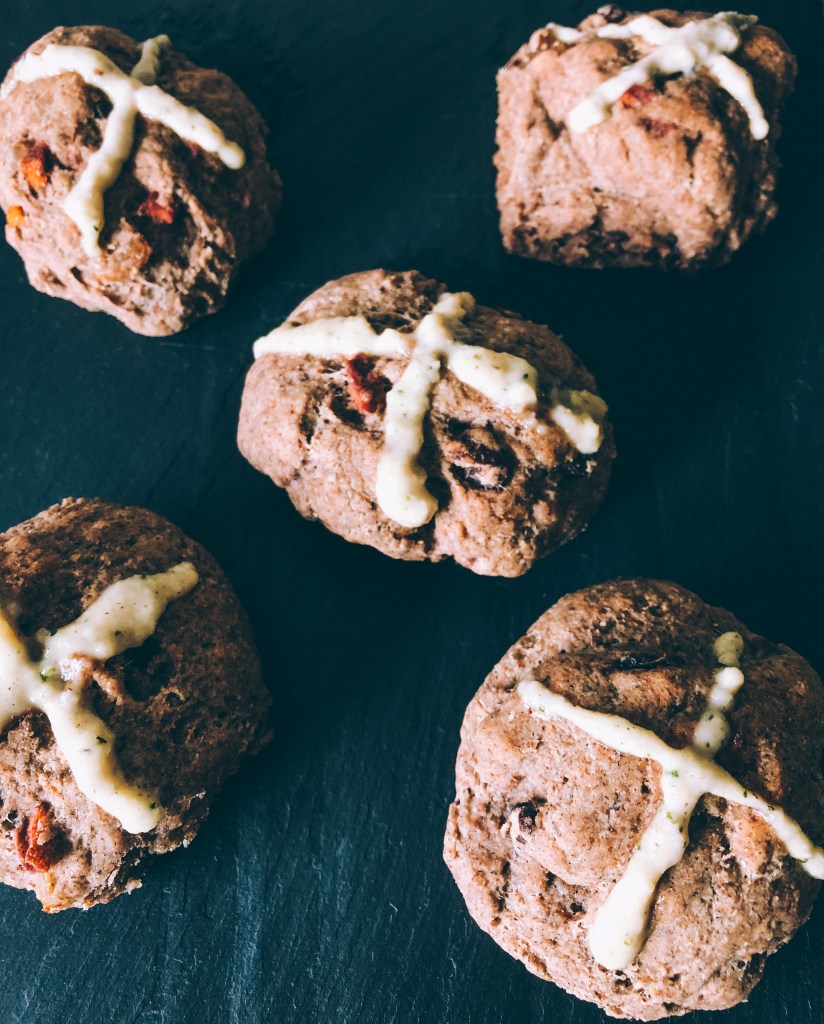
Hot Cross Buns {gluten-free and vegan, sourdough method}, makes 5
This recipe appropriately fits the needs for those avoiding all (or some) of the most common food sensitivities and allergies, and because my nutrition-brain is always on when developing recipes for this space, these are a delicious, slightly enriched and sweetened whole-grain bread option that doesn’t get too far into the super decadent category.
As you’ll note, I’ve created two options to make these, with a sourdough starter, and without. I’ve made and enjoy them both ways, and because I don’t do away with the yeast in the sourdough option or dramatically change the method, they both turn out fairly similar. Instead, I tend to use my sourdough discard for the recipe and reduce the other flours and liquid.
If you’re finding gluten-free flours difficult to source right now, substitutes work well. Sorghum flour subs in well for either brown rice or millet, oat flour made from ground up oatmeal will likely work well in part, and any of the starches (arrowroot, tapioca, potato, or corn) can be used in place of the arrowroot and tapioca combination. As always when baking and especially when using substitutions, it’s always best to measure by weight.
There are a few ways to make the cross on top, either with a bit of icing after baking, by cutting a cross in the dough before baking, or by making a flour and water paste and drizzling it on top before baking. I meant to cut my dough before baking but then forgot, and decided to use a quick couple spoonfuls of cashew, vanilla and honey ‘frosting.’ I haven’t added that in here because I think it’s too fussy and these don’t need a sweet finish. They taste great on their own!

Wet Ingredients:
6 Tbs. non-dairy milk
2 1/2 Tbs. water
1 1/8 tsp. dry active yeast
¼ cup mixed dried fruit (raisins, golden raisins / sultanas, orange peel)
2 Tbs. orange juice or tart cherry juice or water
1 Tbsp. ground flax seeds 
1 Tbsp. psyllium husk (or use ground chia seeds OR flaxseed meal)
2 Tbsp. coconut oil, melted
½ Tbsp. apple cider vinegar
1 Tbsp. honey or maple syrup

Dry ingredients:
130 grams / ~1 cup gluten-free all purpose flour
(or 13 g buckwheat flour, 19 g tapioca flour, 20 g arrowroot flour, 26 g each sorghum, brown rice, and millet flours)
100 grams / ~ 1 cup gluten-free sourdough starter (equal parts flour and water)
1.5 tsp mixed spice  (1/2 tsp. cinnamon, ¼ tsp. allspice, ¼ tsp. nutmeg, 1/8 tsp. cloves, 1/8 ginger, 1/8 tsp. coriander, 1/8 tsp. cardamom)
¾ tsp. baking powder
¼ tsp. baking soda
¼ tsp. sea salt

  1. Warm up the non-dairy milk and water together until lukewarm or at about 100 degrees F / 38 degrees C. Whisk in the yeast and allow to froth up for about 10 minutes.
  2. While waiting combine the dried fruit and juice or water. Warm for a few seconds in the microwave and set aside to let the liquid soak in and soften up the fruit. I use about 1 Tbs. finely diced orange peel in this mix to make these extra festive and more traditional.
  3. Add the ground flax, psyllium, oil, vinegar, and honey to the frothy yeast liquid. Whisk together and set aside so it can thicken a little.
  4. In a large bowl, stir together the dry ingredients. Dump the wet ingredients and fruit into the middle of the flour mix and stir. Your dough will begin to look scrappy. Keep stirring with your spoon or hands until the ball of dough becomes somewhat smooth.
  5. Put a cloth over your bowl and let rest / rise for one hour.
  6. Next stir the dough well again, and then divide into 5 equal balls. Lay parchment in a small baking pan and then roll or shape each of the dough balls into rolls. Place them on the dish, cover with cloth again, and rise again for 1 hour in a warm, non-drafty space in your kitchen. These should rise enough to be touching each other in the pan, but will not double in size.
  7. Preheat your oven to 375 degrees F / 190 C. Before baking, make a little flour/water paste and pipe onto the top of the buns in crosses. Then bake for 2025 minutes or until the edges have firmed up. Place the pan on a wire rack to briefly cool down. You can also make your own frosting /sugar glaze and pipe atop when they are finished baking instead of the more traditional flour/water paste.

EXTRA NOTES

1. Tastes best when eaten warm and straight out of the oven.
2. Store in an airtight container and keep for about 3 days.
3. The dough can be made ahead of time. Simply place in the fridge during the second rise time and allow to sit overnight. Baking time might need to be longer.

Hot Cross Buns {gluten-free and vegan, regular non-sourdough method}, makes 5

Wet Ingredients:
6 Tbs. non-dairy milk
6 Tbs. water
1 1/8 tsp. dry active yeast
¼ cup mixed dried fruit (raisins, golden raisins/sultanas, orange peel, etc.)
2 Tbs. orange juice or tart cherry juice or water
1 Tbs. ground flax seeds 
1 Tbs. psyllium husk (or use ground chia seeds OR flaxseed meal)
28 grams / 2 Tbs. coconut oil, melted
½ Tbs. apple cider vinegar
1 Tbs. honey or maple syrup

Dry ingredients:
180 grams / 1 ½ cups gluten-free all-purpose flour
(or 18 g buckwheat flour, 27 g tapioca flour, 27 g arrowroot flour, 36 g each sorghum, brown rice, and millet flours)
1 1/2 tsp. mixed spice
(1/2 tsp. cinnamon, ¼ tsp. allspice, ¼ tsp. nutmeg, 1/8 tsp. cloves, 1/8 ginger, 1/8 tsp. coriander, 1/8 tsp. cardamom)
¾ tsp. baking powder
¼ tsp. baking soda
¼ tsp. sea salt

  1. Warm up the non-dairy milk and water together until lukewarm or at about 100 degrees F / 38 degrees C. Whisk in the yeast and allow to froth up for about 10 minutes.
  2. While waiting combine the dried fruit and juice or water. Warm for a few seconds in the microwave and set aside to let the liquid soak in and soften up the fruit. I use about 1 Tbs. finely diced orange peel in this mix to make these extra festive and more traditional.
  3. Add the ground flax, psyllium, oil, vinegar, and honey to the frothy yeast liquid. Whisk together and set aside so it can thicken a little.
  4. In a large bowl, whisk together the dry ingredients. Dump the wet ingredients into the middle of the flour mix and stir. Your dough will begin to look scrappy. Keep stirring with your spoon or hands until the ball of dough becomes somewhat smooth.
  5. Put a cloth over your bowl and let rest / rise for one hour.
  6. Next stir the dough well again, and then divide into 5 equal balls. Lay parchment in a small baking pan and then roll or shape each of the dough balls into rolls. Place them on the dish equally apart, cover with cloth again, and rise again for 1 hour in a warm, non-drafty space in your kitchen. These should rise enough to be touching each other in the pan, but will not double in size.
  7. Preheat your oven to 375 degrees F / 190 C. Bake for 2025 minutes or until the edges have firmed up. Place the pan on a wire rack to briefly cool down.

EXTRA NOTES

1. Tastes best when eaten warm and straight out of the oven.
2. Store in an airtight container and keep for about 3 days.
3. The dough can be made ahead of time. Simply place in the fridge during the second rise time and allow to sit overnight. Baking time might need to be longer.