Black Bean + Corn Chilaquiles

IMG_7810

I grew up in a town where purchasing tamales from a random kid selling them out of the family car in the Walmart parking lot was a completely normal and legit means of acquiring them. Growing up, there were more Mexican restaurants than I could count, at least two full-size Hispanic grocery stores, multiple panaderías, a carnicería, and many other specialty stores. Suffice it to say, I grew up eating a lot of amazing Mexican food and it’s this type of food that I associate with home.

My favorite place to eat when back for a visit is at the taco wagon. There are actually several, but there is one that everyone knows about when a trip to the taco-wagon is mentioned. It is a slightly sketchy-looking truck that sells the exact same thing at the same price as what I began purchasing 10+ years ago in high school. It’s a place where there’s always a wait, and all the locals can be found, from the hispanics to the farmers to the visitors back in town for a couple days to the locals that never left.
IMG_7783

Tacos are our ultimate fall-back food for busy days and we eat them in all sorts of variations. I won’t even attempt to make a taco that tries to compete with a taco-wagon taco, however, and all the thrown together versions we eat are hardly worthy of a recipe. So when The Recipe Redux challenged us to take a good look into the freezer, cupboards, and pantry and find an ingredient or two that had been forgotten for this month’s challenge, I took a good look at all the ingredients that needed to be used, naturally skipped over the fish sauce and wasabi, and gravitated right towards the makings for Mexican-food.
IMG_7782

William bought me a giant bag of tortilla chips last summer when I was running a lot and craving salt. They’ve been hanging around the back of the pantry since then because I forgot about them when the weather turned last fall and I never got back to them. They’ve since turned slightly stale.

They were perfectly in need for being made into a dish I’ve been meaning to make for months, Chilaquiles. Oddly enough, I did not grow up eating Chilaquiles. It wasn’t until a couple years ago that I had even heard of them. Basically, they are a way to use up stale corn tortillas and are cooked in a sauce with meats or vegetables, or scrambled with eggs. Most variations contain eggs, cheese, and/or chicken. I decided to forego all of those ingredients because I wanted a super tasty meal that can be made with only a few pantry staples, quickly.
IMG_7773

This variation fits the bill because it contains several ingredients already on hand: frozen corn, diced tomatoes, tortilla chips, black beans, and a dried poblano pepper.
IMG_7809

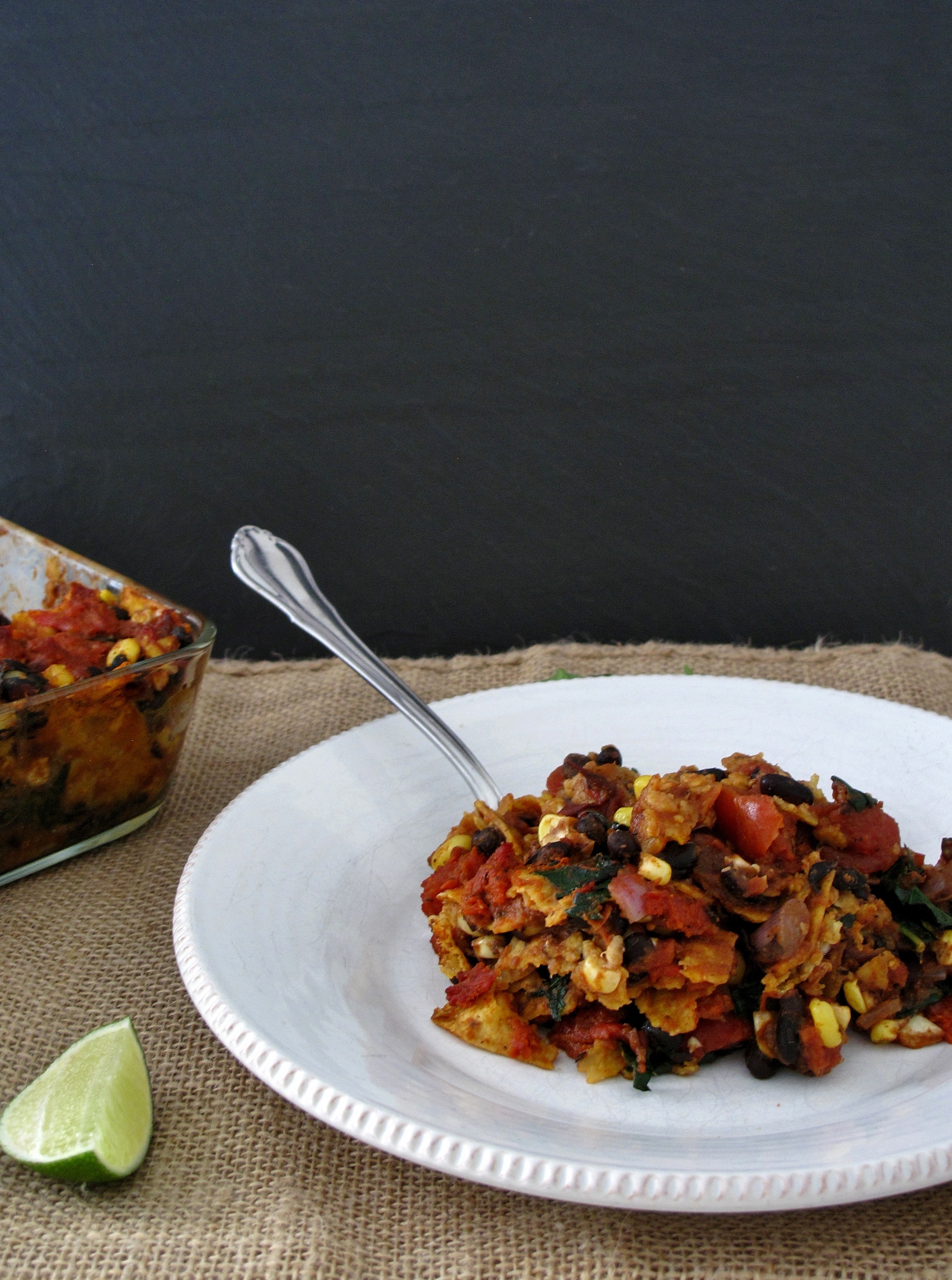
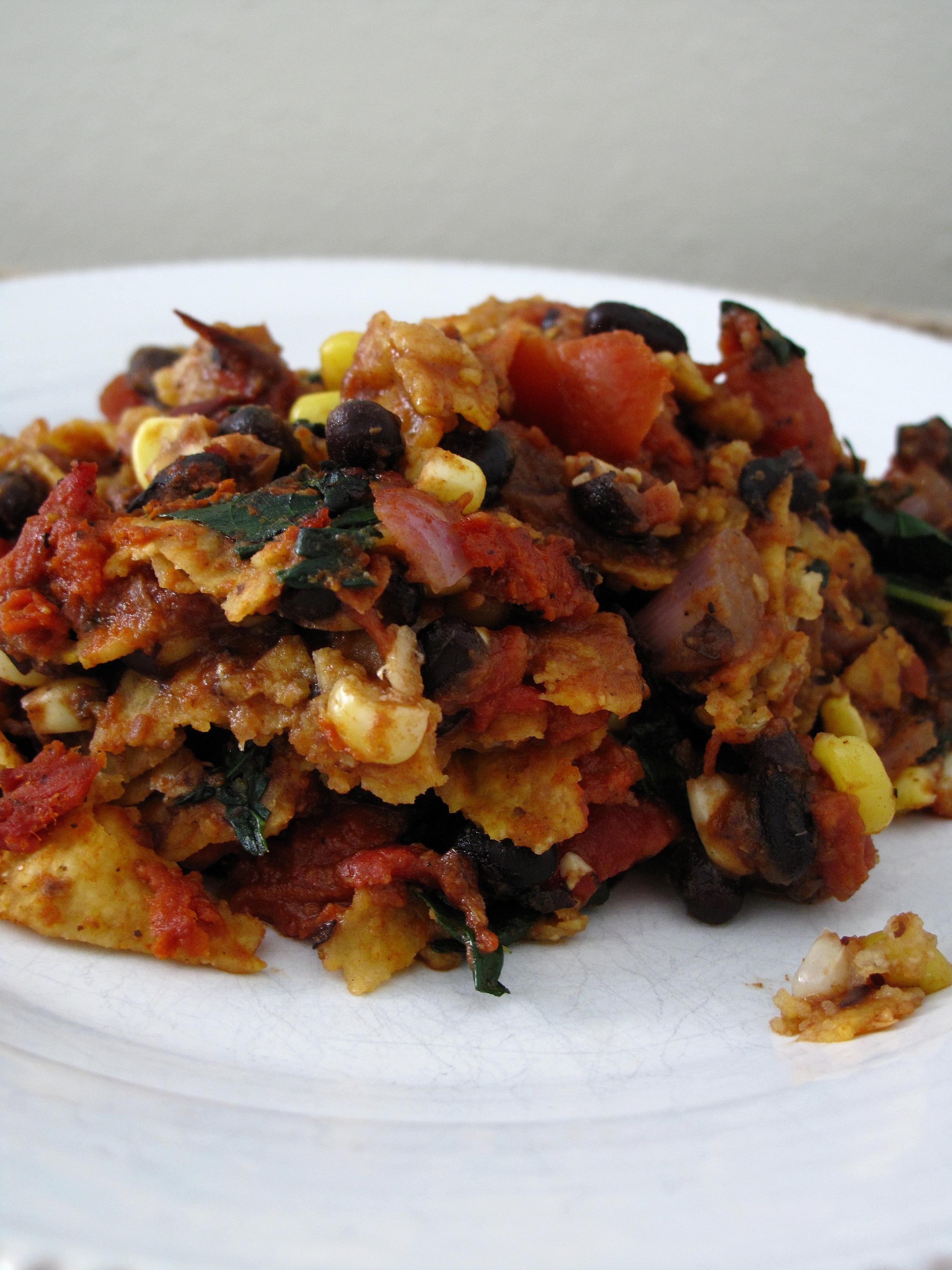
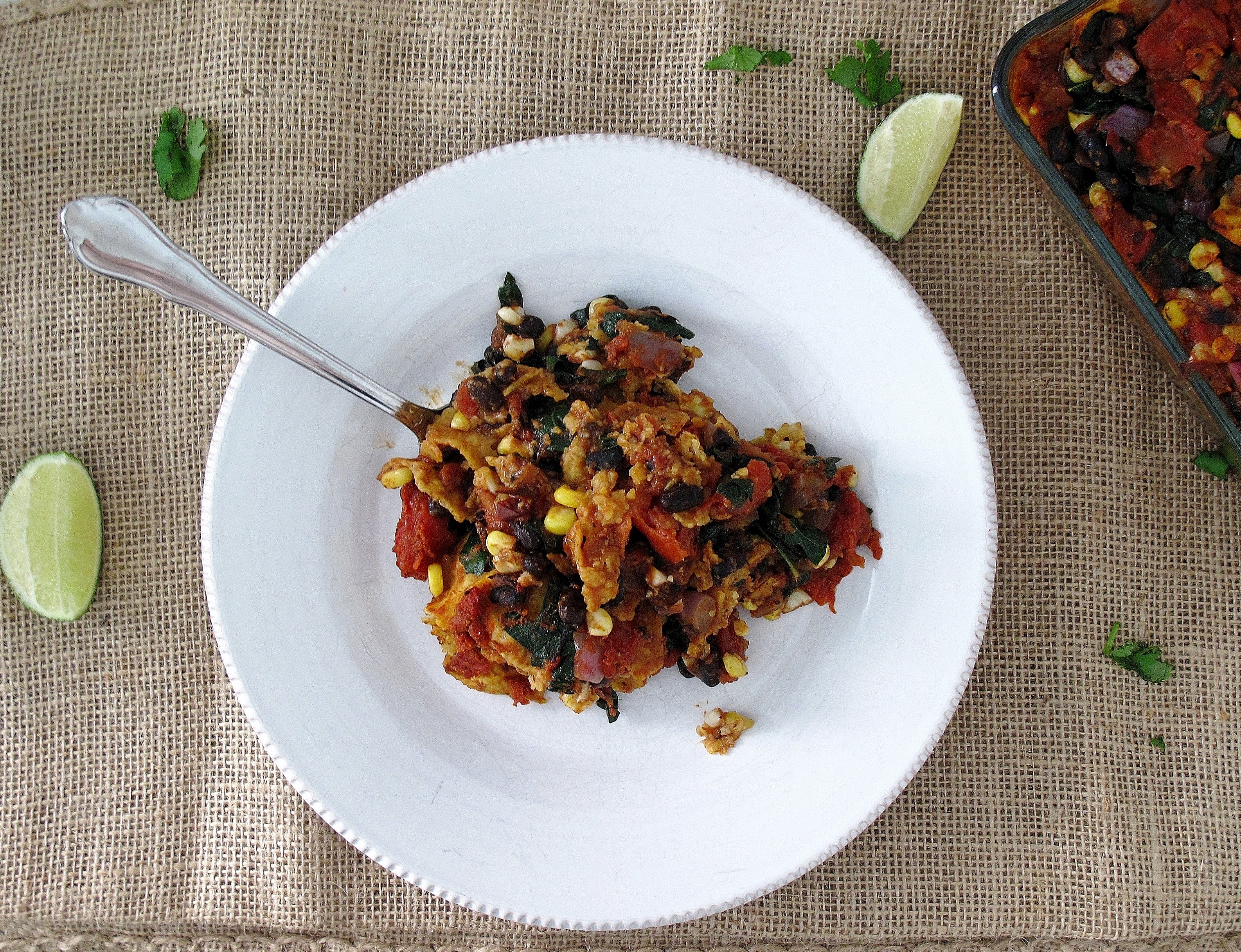
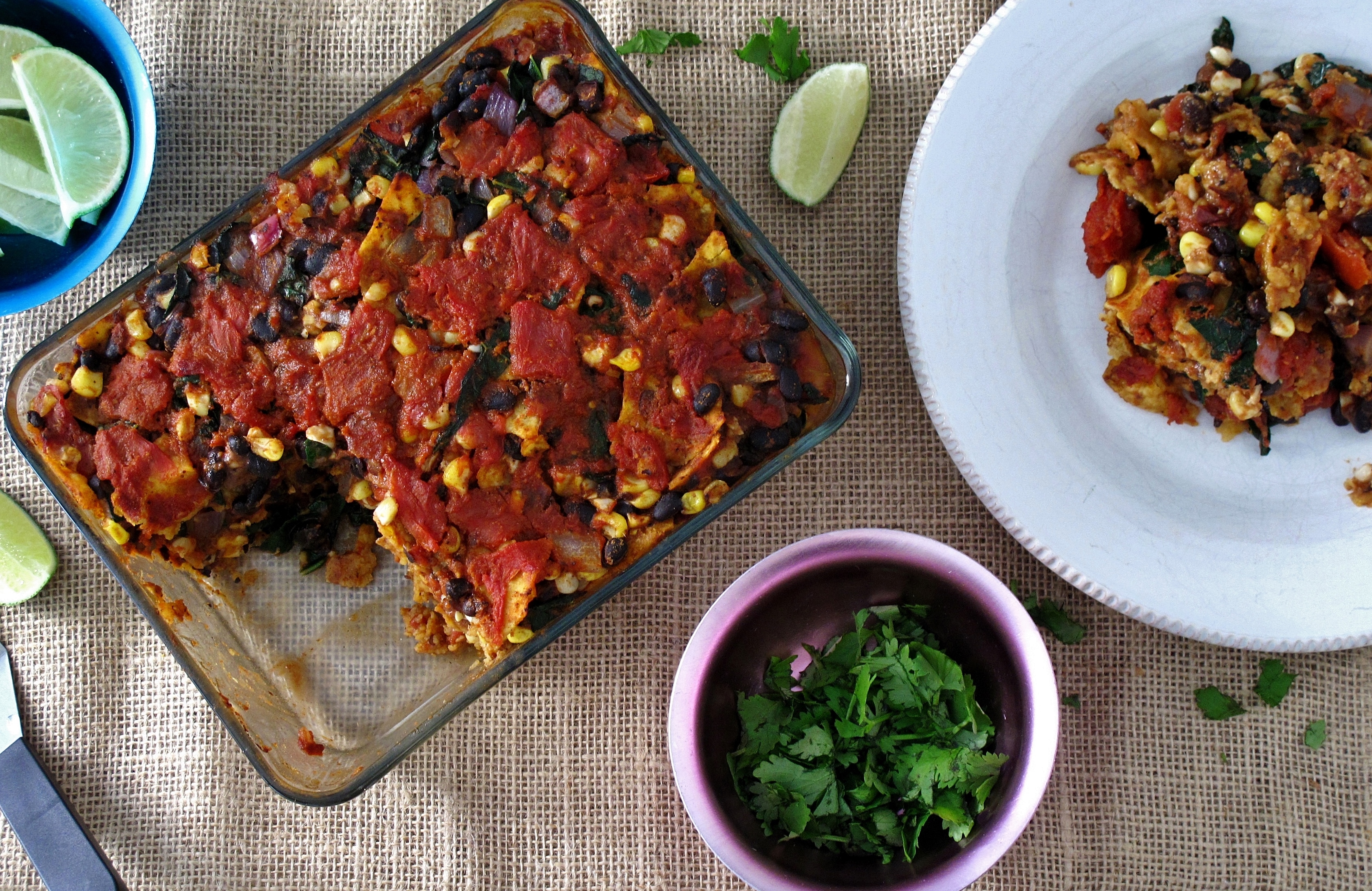
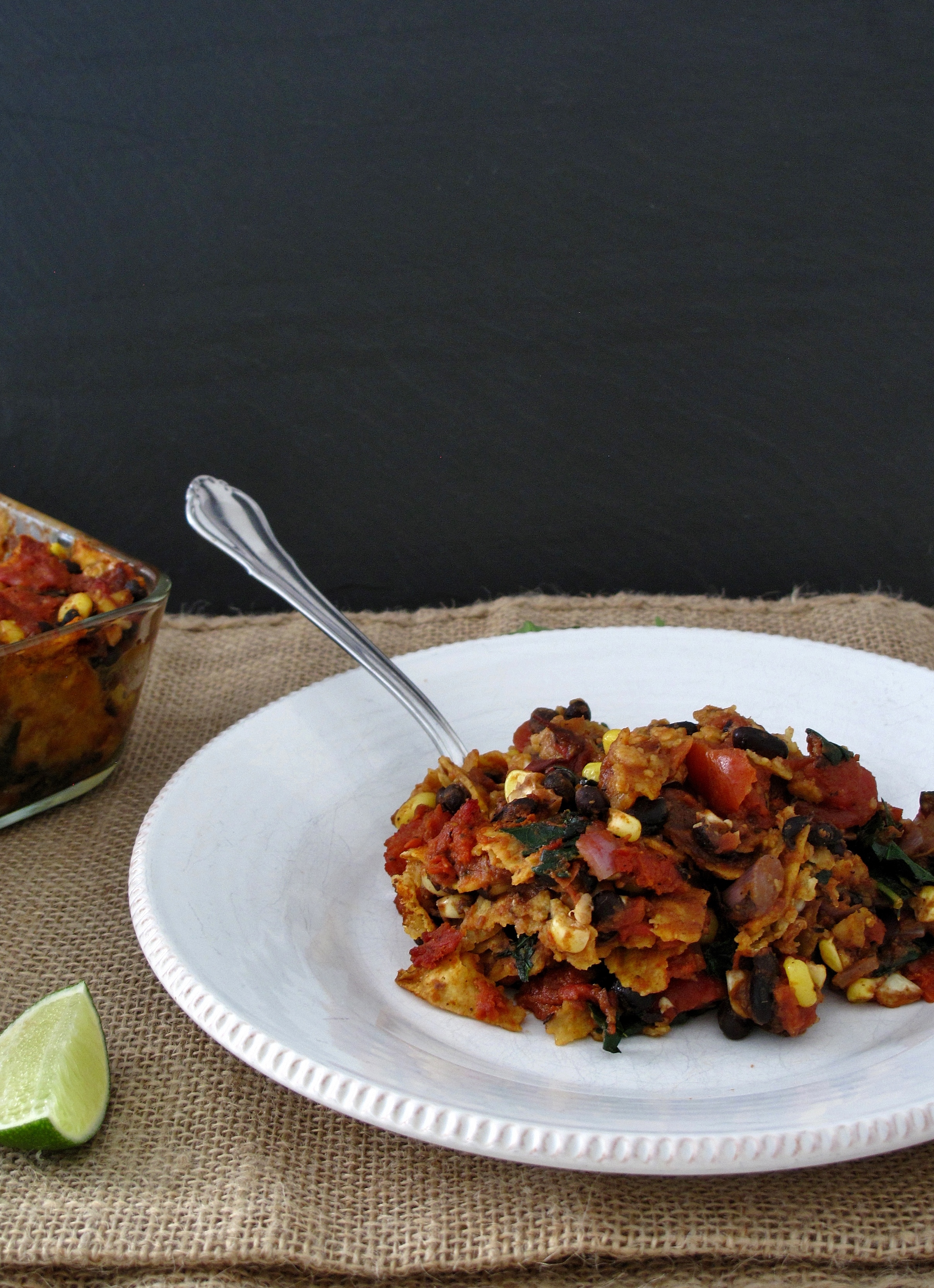
Black Bean + Corn Chilaquiles, serves 4-5

These can be made even easier by using canned black beans and enchilada sauce, but you will compromise flavor. I tend to make big batches of black beans using this simple recipe. I tossed the poblano pepper into the pot, adding even more rich undertones, and slow-cooked it for the better part of a day. It sounds slightly time-consuming but we eat them for multiple meals quite often because they’re super good! 

1 medium onion, diced

1 bunch of kale, stems removed and chopped

2+ cups tortilla chips

2 cups cooked black beans

2 cups frozen corn

1 batch of spicy tomato sauce, below

cilantro, to serve

lime wedges, to serve

salsa, to serve

  • Preheat oven to 375 degrees F.
  • In a medium sauté pan, cook onion until slightly soft, about 5-8 minutes. Toss in the kale and cook just until it wilts. Remove from heat.
  • In a large mixing bowl, toss together the chips, beans, corn, sauce, and cooked onion and kale. Use your hands and mix gently so as not to break the chips too much.
  • Turn the whole lot into a medium-sized baking dish.
  • Bake for 20-25 minutes, until the mixture is heated through and simmering.
  • Remove from the oven and serve with cilantro, lime wedges, and salsa.

Spicy Tomato Sauce

1 28-oz. can diced tomatoes

2 Tbs. extra virgin olive oil

3 cloves garlic, minced

1 Tbs. chili powder

1 tsp. garlic salt

1/4 tsp. onion powder

1/4 tsp. red pepper flakes

1/4 tsp. dried oregano

1/4 tsp. dried coriander

1/2 tsp. paprika

1 1/2 tsp. ground cumin

1 tsp. black pepper

  • In a medium saucepan, heat olive oil and garlic over medium-high heat. Saute garlic until just beginning to brown, about 30 seconds.
  • Stir in the tomatoes and spices.
  • Bring to a boil and then turn down to medium-low. Simmer for about 45 minutes to thicken a bit and have flavors develop. Remove from heat and allow to cool slightly. At this point, the sauce can be pureed if you’d like a smooth sauce, but I opted to leave it slightly chunky.

Miso Quinoa Polenta

IMG_7741


The other day, a girl in my high school group asked what I was like when I was her age. She asked what I did when upset, my teenage equivalent to eating a tub of ice cream in front of a sad movie. I thought a moment and suddenly remembered sitting on the floor in my room with the green carpet and sea foam walls, back pressed up against the bed, journal out and angry music turned up loud. I’d write poetry.


I wrote a lot of terrible poetry. I also wrote some poems that were quite good, words that I still have and to this day, can bring chills in their ability to convey a feeling, to put me back in the exact moment of their writing.


IMG_7756


My AP English teacher singled out a particular poem one day during my senior year. Standing at his podium, he read it aloud to the class. I still recall the moment because I was incredibly embarrassed. I mostly reserved my poetry-releases to funny bits in birthday cards, never sharing the serious ones. Though he didn’t say my name, I sat there petrified, afraid I’d be called out. I don’t know why I’d chosen that particular poem to submit for a class assignment; perhaps because it was powerful, those words having been torn from somewhere I didn’t know existed. Having them on paper was a vulnerability and the very act of sharing with my teacher was scary enough; having them read aloud to a room full of peers was unnerving. If only those words were safer, lighter-hearted, less mature, I would have been more fine in sharing.


Mr. Colley having done reciting, he and the others praised those words, commending their particular arrangement. As I listened, I allowed myself to momentarily separate, treating the words as if they were the work of another. In some ways their ownership wasn’t mine as in the throes of writing, I never really had a choice in putting them down.


IMG_7731


I share this memory because it’s exactly what I felt in writing and sharing my last post.


I cannot begin to express what it is like to sort through all the words, thoughts, and feelings inside and pull them out, one by one, getting them down on a page exactly as they were meant to be, and then having them composed, opening a window and flinging them out to the world haphazardly, not knowing why or what will become of them, knowing only they need to be flung.


I’m only just recovering from the result.


I am overwhelmed by the response; by the amount and depth of public and private messages received. The summary, if I can summarize, is that it is important to be real, to be vulnerable, to share the highs and the lows and to help each other out in our improving.


IMG_7748


My dear friend Kari shared a mantra on her blog that she spent a year striving to live by. I was so inspired by Kari’s mantra that I wrote it down and plastered it to the back of my phone. When it wore off, I tucked it away in my purse. On the days I am furthest from living by them, I seem to randomly pull that wisp of paper out and gain an instant paradigm shift.


Kari’s words:  Be brave. Be kind. Be true.


I don’t have preconceived notions that anything I say here is particularly important in the grand scheme of things or even inspiring to others, but I do know that Kari’s words stuck with me. I’ve been pondering them, applying them, being brave with them. In passing them along, I hope Kari’s mantra can serve as a guide for you, just as it has guided me. In whatever ways that apply, I hope you can be brave. I hope you can remember to be kind. And when life brings little nudges, I hope you can be true.


IMG_7713


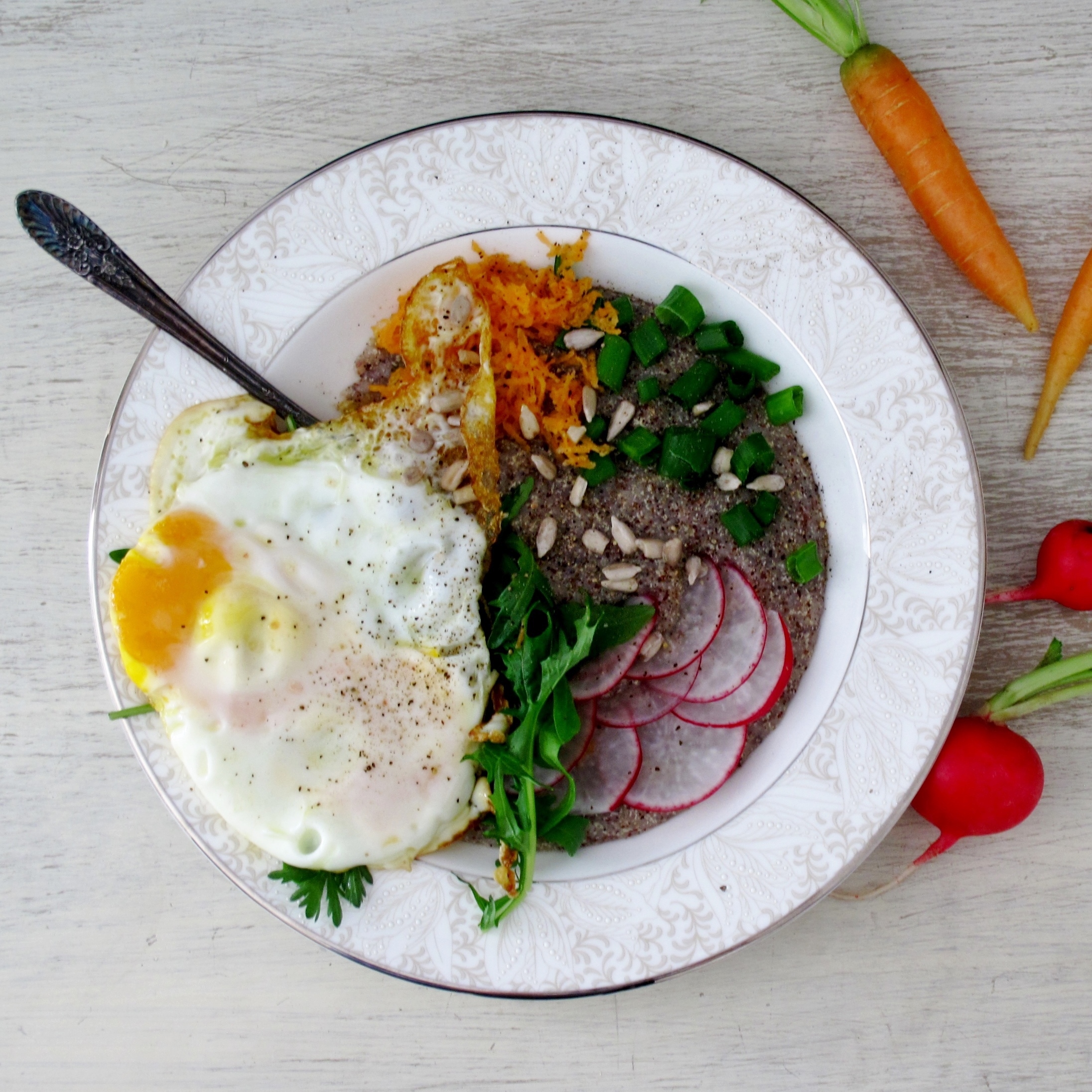
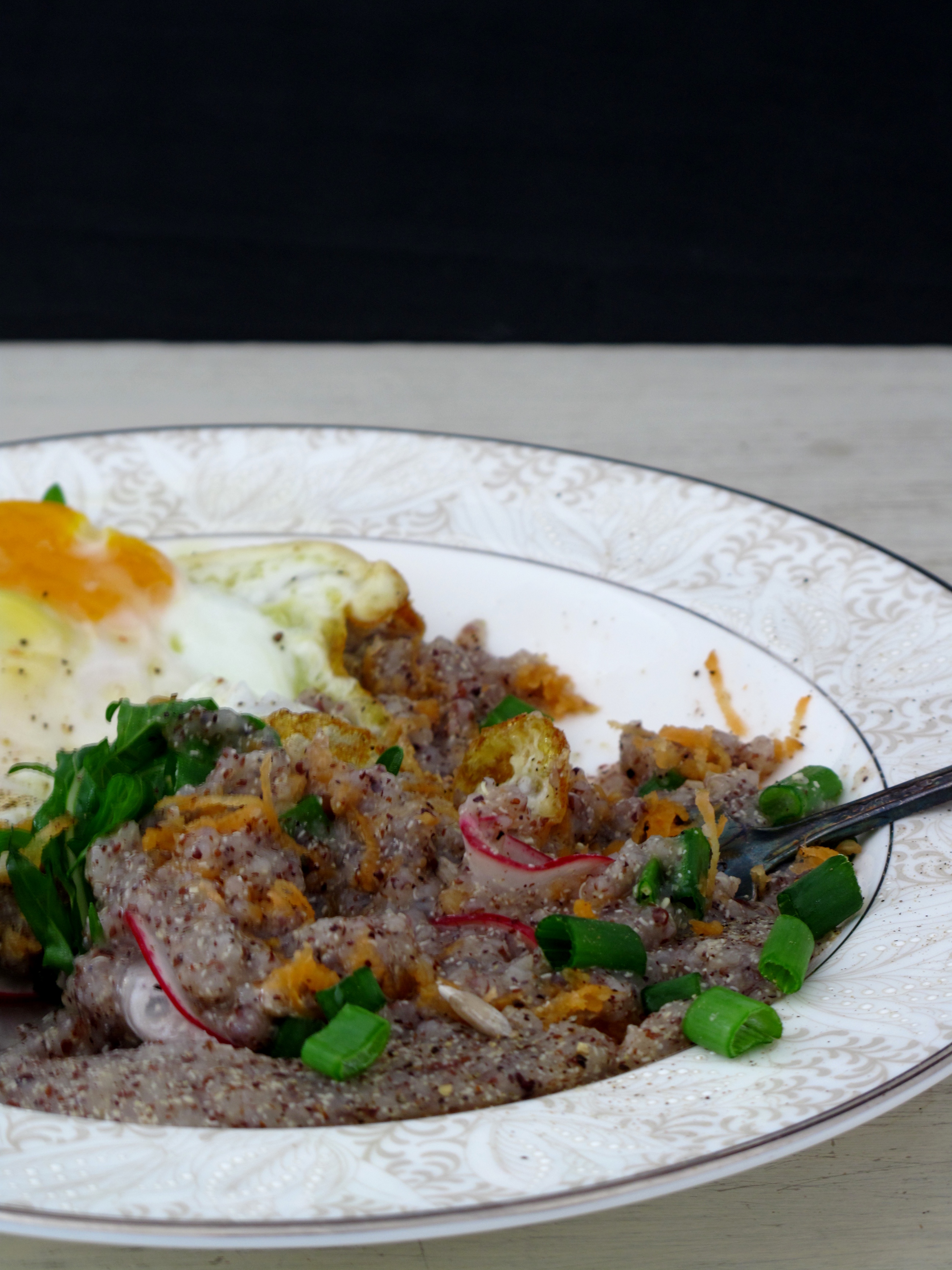
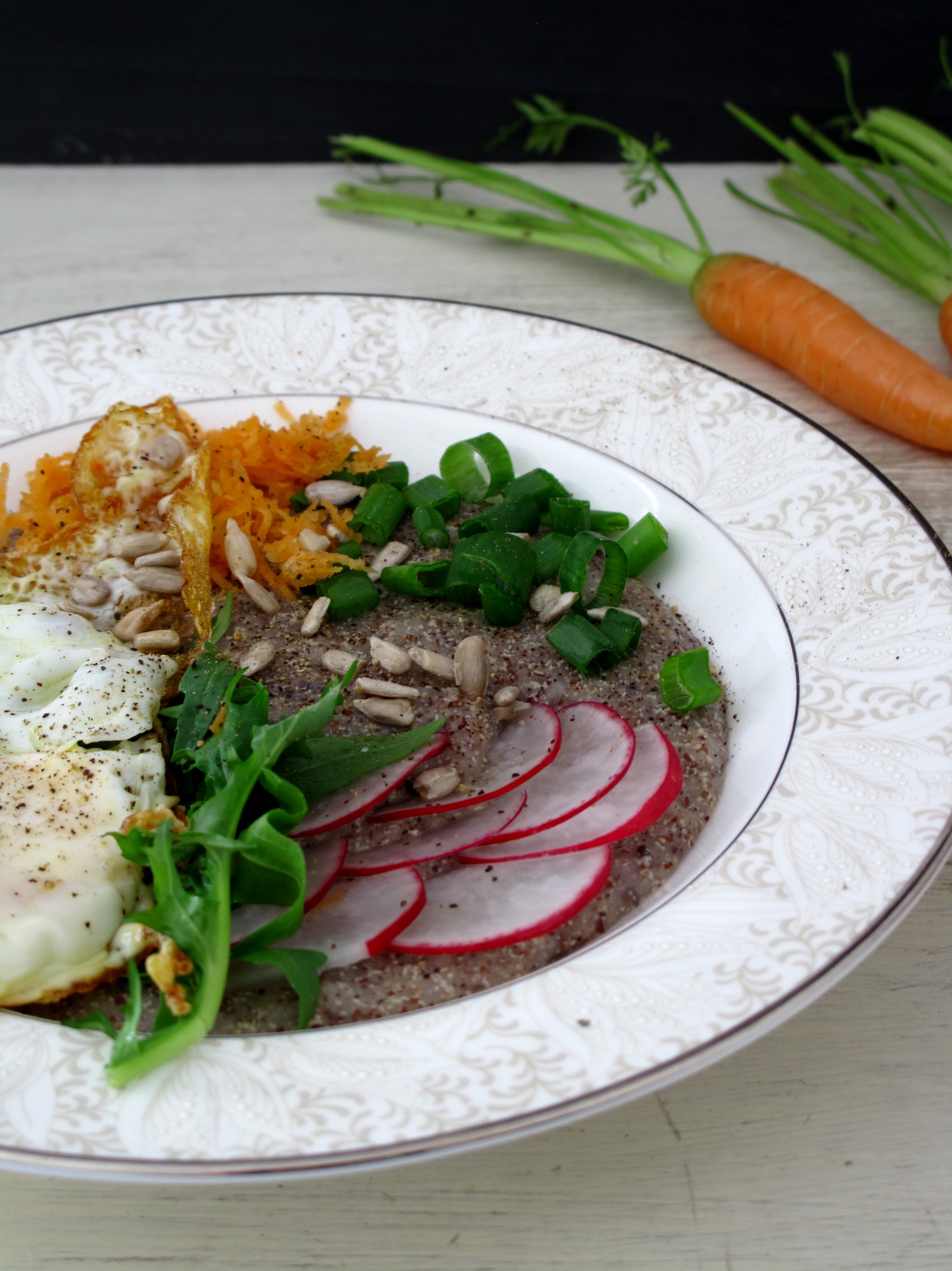
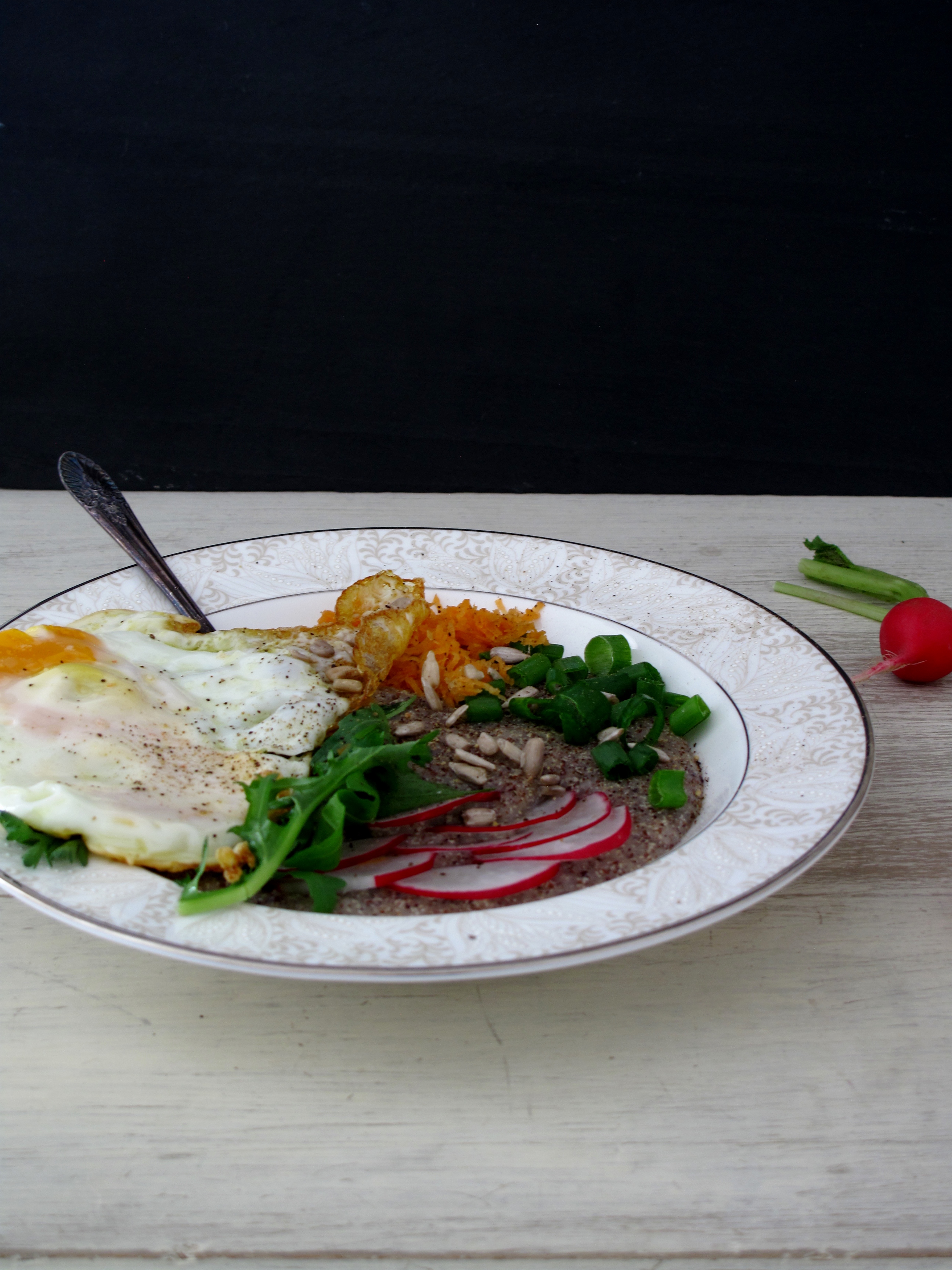
Miso Quinoa Polenta, serves 3-4

I’ve been making a mess of polenta this spring and one day, realizing I was short on cornmeal/polenta, I grabbed the quinoa and my coffee grinder and inspiration was born. The result is a nice change from both quinoa and polenta, and combines the best of both. I used a tri-colored quinoa, so the result is a touch gray, but any type will do. Grind it down to a fine meal in batches. As for the miso, I have only tried this with a soy-free chickpea miso that I purchase from a big bulk container at the co-op. I think it is this kind, but I’m not entirely sure. Regardless of what you choose, I recommend a lighter type. 

1 cup quinoa

2 + cups broth of choice or water

1 Tbs. light miso

1 bunch radishes, thinly sliced

3-4 spring carrots, finely grated

a big handful of salad greens

spring onion greens, sliced

4 eggs, fried, or protein of choice

sunflower seeds for garnish

salt and pepper to taste

  • In a medium pot, bring water or broth to a boil. Slowly, whisk in the quinoa polenta, making sure no clumps form, and turn down to medium-low. Cook until it is as thick as you desire, about 15 minutes, stirring frequently. Add more liquid as needed. Turn off the heat and stir in miso and salt and pepper to taste.
  • While polenta is cooking, prep the vegetables and fry the eggs.
  • Spoon the polenta into plates or bowls, toss on the vegetables, sunflower seeds, and eggs. Enjoy!

Lenten Fears and a Recovery Reflection


Nine years ago at the beginning of lent, I gave up eating after dinner. I did it for reasons that made absolute sense at the time. I found, late in the evening each night, around the time I should have been going to bed, I’d get a case of the munchies, and I’d indulge in what to me then was ‘too much’. It felt like something that was completely unnecessary, a temptation I needed to be able to give up.

So I gave it up.

I can see now, because of my personality, it was easy to forego eating. For something that was supposed to be a challenge, it just wasn’t. It felt like I finally had a safety. I had decided to do it, asked God for help, and then I did. It felt easier to lean on him when tempted, than the thought of not having control over my own actions.

And so it began.

What started as what I thought was a lifestyle decision to begin exercising a healthier habit (eating mindfully), became a ‘control every morsel of food’ obsession. I’d wake up in the middle of the night with my stomach growling and feel righteous that I had mastered my own will power. I’d wake up early on weekends and dutifully wait hours to eat until brunch began. I was running and working out several days a week, having found a new love in athletic activities. I compared my eating to my girl friends who were less active, who had slower metabolisms, and I was fooled into thinking I needed to eat just like them. Then I stopped eating calorically dense foods altogether. It got worse from there.

At one point, a moment in time I remember vividly, I sat on my bed writing in my journal about this thing, this beast inside of me that was my mind slipping into an obsession that I could no longer stop. I recognized then in that moment of clarity that I was powerless and I couldn’t climb out alone. I ignored that voice, tucked away my journal, and put my feet back down on the floor in the same spot. I didn’t listen, and from then on, I couldn’t. I was over the edge into denial and there was no problem. Life was glorious. I was skinny and getting compliments on both my appearance and my ability to be so fastidious. I was making meals smaller and smaller, more fervently tracking everything, and I felt superhuman. For the first time in what was a tumultuous life period, I was in control of something that most everyone struggles with–I had mastered control of self. (Except in all actuality, I had completely lost control; isn’t it ironic how we can convince ourselves?)


For my whole life up to then, I had always had a sort of fear/loathing/uncomfortability with my body and for the first time, at that point when my physical size actually was healthy, when I was active every day, when I had close connections with friends, was activity involved in my community and my faith life, I felt beautiful. I recognized my body, loved it, and felt at home in it.

Fast forward a few months.

I came home from class on a particularly windy, snowy late fall day and was so incredibly cold that I immediately shed all my clothes and jumped in the shower. I stood under the hot water longer than I can remember ever standing in a shower and finally, finally I was warm. As I got out, I glanced at the mirror, and I saw something horrifying. I saw a bony skeleton that I no longer recognized. This body wasn’t beautiful anymore. My pelvis jutted out where months before I had flesh. As I truly looked at what I saw in the mirror, a Jekyll and Hyde mind battled over the realization that this wasn’t okay, while a mwah hahha cackle echoed behind it, you’ve got it!; shrinking to nothingness is the ultimate victory.


My fears this lent, the ones that are underlying and what I thought I had ‘mastered control over’ these past few years, are that my body will betray me again. If my mind doesn’t consistently show it who is boss, it will slink back into that terrible thing it was before ‘all of that’, into the body I didn’t feel comfortable in.

Because the truth is, I am comfortable. Running and working out has made me realize how much I LOVE and ADMIRE my body. Not only what it looks like, but what it can DO for me. How awesome it’s abilities to accomplish and heal.


And so, all these years later, we’re again near the end of the season when I think the most about what happened and where I am now. We’re at the end of a season in which I have decided to release something in order to grow. As lent began, I had been thinking, I don’t know if I can handle 40 more days in the desert. I don’t know if I can handle the unknowns. I just want to be on the other side, whatever that looks like, as long as it’s not here, down in the trenches, working at something that is so individual, so solitary, so invisible that I can’t explain to anyone who asks. Years ago, I promised myself I’d never give up food again for lent. That, more generally as a lifestyle, I wouldn’t set rules for food. And so, aside from the foods I don’t eat for medical reasons, there are no parameters. I eat what I enjoy, what my body craves, and try very hard to let go of that voice that often wants to negative self-talk. As I ended 2014 and began 2015, I recognize now I was slipping. My skinny jeans were getting looser. I needed to eat a damn cookie without justifying it with activity. I needed to take a good, hard look at the situation and not disillusion myself into thinking I was alright. I know there is a very fine line for me between eating enough and convincing myself I’m eating enough, and I can easily deceive myself.


I also still have a fear of the idea of being hungry, of being isolated again, of the obsessive, only-self-interested thinking that I had to fight like hell to climb out of.

Like most eating disorders, this whole thing is less about food. It’s less about body image. It is about control. I don’t get to have control over this life. I can’t determine what will happen tomorrow. I don’t know if my body will be the same body tomorrow evening as it is this evening. I don’t know if it will accomplish all the dreams I have for it.


I do know I want to find out. The beauty of this life is that we don’t get to go back. We move forward.


And so I ask myself a question today that I likely will need to ask myself every day: Am I giving my body what it needs so it can do all that I want it to? Am I setting it up for health in the long haul, or am I punishing it because today I’m afraid of letting go?