Herbal Allies // Turmeric Lassi

Herbal Allies // Turmeric Lassi

IMG_5324


I finished my fourth term in nutrition grad school last Friday. I haven’t shared much about it here but this last winter has been intense. It was the best yet in terms of how much I’ve enjoyed the content and knowledge I’m acquiring. It has been a long haul though and because it coincided with tax season (for William) and spring marathon training for me, life has mostly consisted of attempting to completely fill up my brain with tough biochemical and physiological concepts and then subsequently trying to turn it all off, unplug as much as possible, and just run.

Motivation for any sort of inspired eating kind of went by the wayside. And I never realized how much being able to share just one meal a day with my favorite human is helpful for me to maintain a healthy relationship to food until he worked the craziest hours. Turns out, I’m equally good at doing the same when he wasn’t around to stop me.

It is time for a short stint of rest and focusing on other projects now, for the both of us.

Did I tell you I (of course) chose the longest concentration option of my nutrition program? I am focusing on herbal medicine as a component of clinical nutrition. Back in early 2016, I spoke to why I hadn’t enrolled in the nutrition program at my nearest university and really searched around for one that fit, that merged my interest in herbal medicine, ancient healing modalities such as Traditional Chinese Medicine and Ayurveda, and had the rigorous scientific component I was craving. The program I ended up with fits me so well. I’ve pretty much loved every class, even as the content has gotten much more technical. The herbal classes, while still plenty intensive, have been welcome to continue engaging in creativity with the content I’m learning during this time.

One of the practicing herbalists in my program taught me early on that specific herbs will speak to us, we will develop an affinity for them, and we should trust that. Cinnamon, ginger, and turmeric are my little trinity that ‘speak to me’ the most and I find myself adding them to meals and drinks on a fairly daily basis. I’ve shared about them more than once before in Turmeric Ginger Seed + Nut Bars, Tahini, Date + Turmeric Bars, and my Good Energy Maca Latte.

Now that the weather has warmed a bit too, I’m more inclined to incorporate cooler, smoothie-type snacks and mini-meals into my routine. This Turmeric Lassi is my longtime go-to smoothie when I feel like I need a refresh/mix up in my eating patterns, and I often reach for it during an interchange of seasons. With this stint between school trimesters and welcoming William back to regular dinners at home, it’s definitely a new season for us.


IMG_4541


So what is so great about the common herbs/spices in this recipe?

Cinnamon // While most of us know cinnamon as the comforting and feel-good spice for baked goods, there’s actually a fair bit of evidence to suggest cinnamon can be used in higher, medicinal doses to improve blood sugar imbalance in type 2 diabetics. That isn’t why I enjoy it, however. I like it because it is warming, stimulating, and improves circulation. Plus, it simply tastes and smells delicious.

Ginger // Common fresh or dried ginger is exceptionally beneficial in controlling inflammation and muscular pain, increases circulation, and also aids in digestion. Like cinnamon, it is a warming and pungent spice, and I particularly enjoy it both through the winter and on chilly spring days.

Turmeric //  One of the current “superfoods,” turmeric has been used for centuries in Ayurvedic medicine. Much of the recent research points to it as a highly beneficial nearly catch-all herb, but it is most often associated with controlling inflammation and therefore improving joint and muscular health. The thing about turmeric that is not often shared, however, is that the beneficial curcumin compound it contains is exceptionally difficult to become bio-available in the body. Taking it with a small amount of ground black pepper and with another ingredient that contains fat helps turmeric work its magic in our systems.

Rosehips // The berries from wild dog roses are among nature’s richest and most-potent sources of Vitamin C, the vitamin we all associate with improving the immune system and warding off illness. It is a good herb to add in any time physical or mental stress is high.


Turmeric Lassi, makes 1
The spices here are in a higher, more medicinal dose than might be used in a standard smoothie recipe. I enjoy them but if you’re a little wary, begin with less and add more as desired. Though I make this with either applesauce or a banana, (and sometimes both instead of yogurt), I enjoy this more with applesauce. Using a banana will result in a sweeter smoothie if that’s more your interest. The photo above has a teaspoon of elderberry syrup swirled in for even more immune-enhancing effects. Elderberry is a tasty option for including if you feel a seasonal cold coming on. 

3/4 cup unsweetenened applesauce or 1 frozen banana
3/4 cup unsweetened plain coconut yogurt
1/2 – 3/4 tsp. ground ginger
1 – 1/2 tsp. ground turmeric
1/4 tsp. ground cinnamon
dash of ground black pepper
1 tsp. rosehips powder
1 tsp. vanilla extract
1 tsp. chia seeds
1 oz. fresh lemon juice (about 1/4 of a large lemon)
sweetener to taste, if needed (honey, maple syrup, powdered stevia leaves, etc.)
1 tsp. elderberry syrup, optional

  • Add all the ingredients to a food processor and puree until smooth. Serve immediately or chill in the fridge for 30 minutes to an hour to allow the chia seeds to thicken it up a bit for a smoothie bowl.
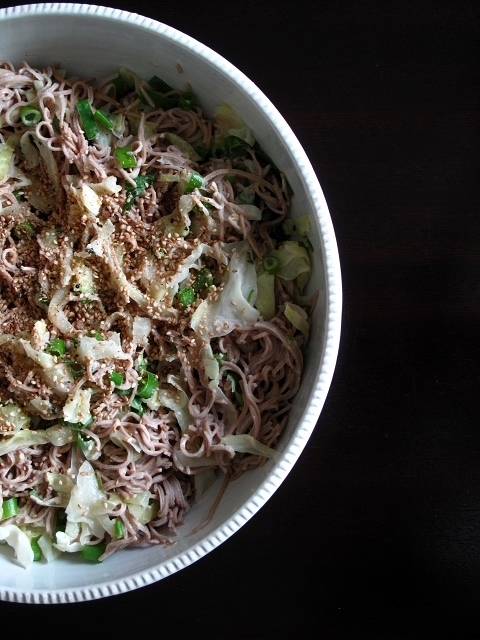
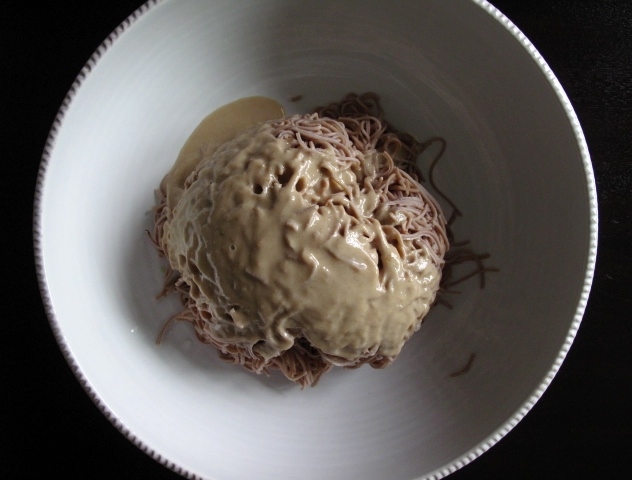
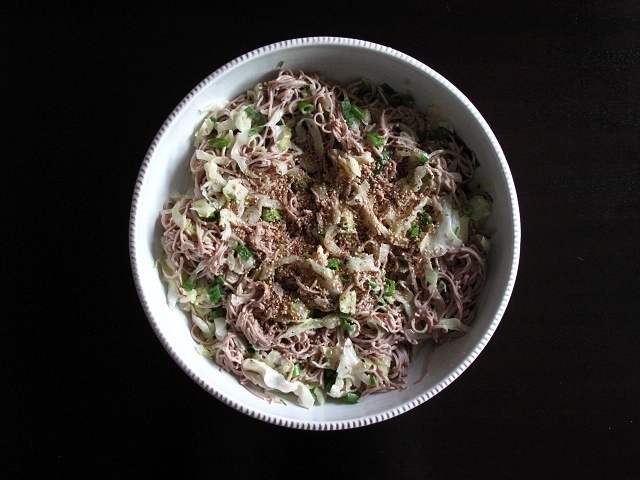
Soba Bowl with Braised Cabbage + Tahini Dressing from Eat This Poem

Soba Bowl with Braised Cabbage + Tahini Dressing from Eat This Poem

IMG_1377


Both the cook and the poet are makers.
One holds a knife, the other a pen.
– Nicole Gulotta from Eat This Poem


IMG_1391


Years ago, I began this blog as a recent college graduate with an abundance of quiet determination and no real idea what to do with it. I had a degree in agriculture and a minor in English, it was 2009 and the jobs for recent graduates with very generalized degrees were particularly non-existent. I was headed towards a teaching program in the fall, mostly because I had said I was going to years before, and every time I brought up my doubt, mentors and loved ones said try it and then decide. 

Words, whether mine or another’s, have always been a big part of my life, hence the reason I opted to keep pursuing literature courses long after deciding I did not want to specialize in the subject. So too has food, and the ability to create and celebrate a community about it, been particularly important. This space took its beginnings with that idea, of merging these two interests of words and meals because I didn’t know then of another way to combine the two. And so that first post back in June 2009 was about picking cherries high in a tree in a dress on the curb outside my last college house. And then making pie afterwards, a gift for my dad.

Since then, it’s fair to say I’ve often questioned whether I want to continue here, what the content should be, and whether anyone other than me cares for the words (or meals) that are shared.


IMG_1392IMG_1403


Though there are so many blogs now, I am still drawn to the ones that do as I started to all those years ago, capturing an otherwise forgotten moment or memory with the meal that accompanied it, in a way that is not often practiced in writing online. That is, with a real voice. Nicole Gulotta’s Eat This Poem, is one of those sites. And Nicole just wrote a whole cookbook merging the two! I’m so glad I get to share about it here.

Eat This Poem is at once a poetry anthology and a cookbook, as Nicole believes food and poetry are two of life’s essential ingredients. In the same way salt seasons ingredients to bring out their flavor, poetry seasons our lives; when celebrated together, our everyday moments and meals are richer and more meaningful. Each of the twenty-five inspiring poems—from such poets as Marge Piercy, Louise Glück, Mark Strand, Mary Oliver, Billy Collins, Jane Hirshfield—are accompanied by seventy-five recipes that bring the richness of words to life in our kitchen, on our plate, and through our palate. Eat This Poem opens us up to fresh ways of accessing poetry and lends new meaning to the foods we cook.

With poems simple and complex and recipes that mirror them, Eat This Poem nudges us to be thoughtful, to slow down, to pause and consider, and to cook and eat in the same way. I chose to make and share this particular recipe because it did exactly that, and after pausing and reflecting, I wanted to literally eat the poem, letting the meaning of the words fill me completely.


4.26 Stephen Dobyns


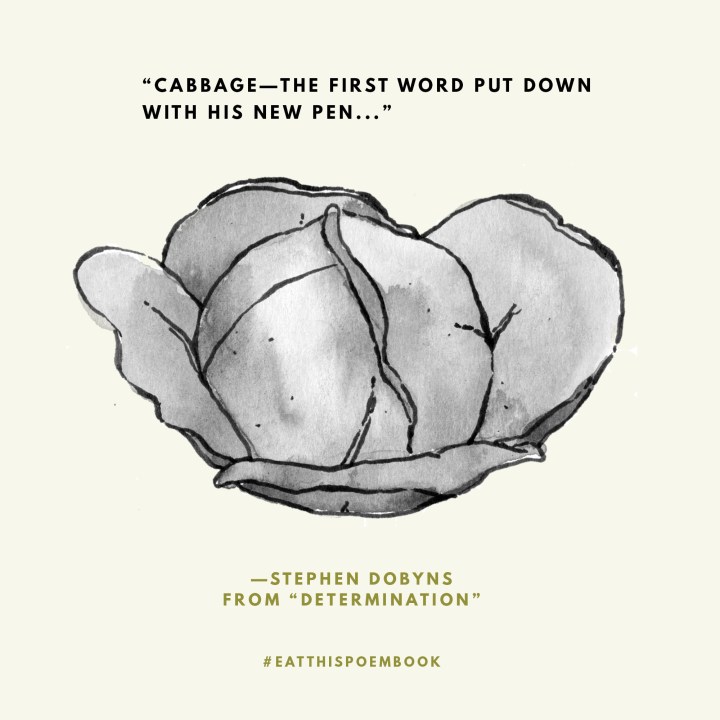
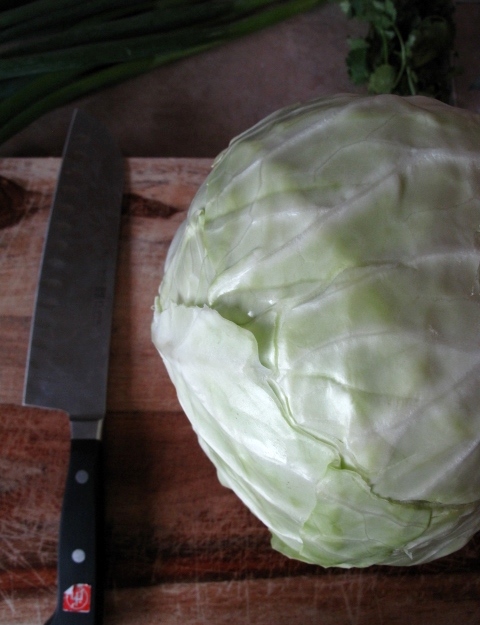
After a life spent doing other people’s taxes, this writer has purchased a new pen; dusted off an old desk; and written a single, fresh word on his blank piece of paper. Cabbage. That wrinkled, heavy, winter globe of a vegetable can be intimidating, but with a few slices of a knife and a bit of heat under its leaves, cabbage transforms into something tender and approachable. 

For writers, the blank page can be just as intimidating. Fearing rejection, they talk themselves out of doing the very thing they must do, burying their work in drawers for years. One day, they buy a new pen in hopes that it will fuel inspiration. They press on. Let this poem be a reminder to keep putting one foot in front of the other, to raise our heads, to do the difficult work, whatever it may be. Whatever struggle a writer endures, it is fuel for the page. The good news, always, is that what challenges us also changes us, usually for the better if we recognize its potential. 

What I love above all are Nicole’s reflections on each poem, like this one above about writing the word cabbage, in Determination. What I love too, is that poetry has the power to mean so many things, far beyond perhaps its literal meaning. So when I read Determination, it hits me where I’m at in life for reasons completely beyond the “simple” task of putting words to a page. And those words were more impactful when I ate them, mindfully and with intention, in this beautiful and tasty Soba Bowl with Braised Cabbage + Tahini Dressing which they were presented with.

I hope you pick up a copy of Eat This Poem when you get a chance, for it is filled with many more beautiful and moving poems from prominent and less known authors, along with recipes that fill us, in the way that only well spoken or written words and lovingly prepared meals can.


IMG_1402

Soba Bowl with Braised Cabbage + Tahini Dressing, serves 4

2 Tbs. toasted sesame oil
2 Tbs. extra-virgin olive oil
One 1-inch knob of ginger, finely grated
2 garlic cloves, finely minced
1 medium head cabbage, halved, core removed and thinly sliced (6-8 cups)
¾ cup water
Salt
8 ounces soba noodles (gluten-free if necessary or try adzuki spaghetti noodles)
1 bunch green onions, green parts only, thinly sliced
½ cup lightly packed cilantro, minced
1 red chile pepper, optional
2 Tbs. sesame seeds

For the Dressing:
1/3 cup tahini
¼ cup water
2 tsp. toasted sesame oil
1 tsp. rice wine vinegar
½ tsp. salt
2 tsp. honey
1 small garlic clove, peeled

  1. Set a large sauté pan over low heat and add the sesame and olive oils. Add in the ginger and garlic; cook for 1 minute or until they begin to dissolve and become fragrant. Add the cabbage and water, then season with 1 teaspoon salt. Increase the heat to medium, cover and cook for 15 to 20 minutes, or until the cabbage is tender. Check on it halfway through and toss the cabbage.
  2. Bring a large pot of water to a boil. While you’re waiting, make the dressing. Combine all the ingredients in a blender and pulse to combine. If you make the dressing in advance, put it in the refrigerator until this point. Take it out and thin with a bit of water if needed; it will have thickened when chilled.
  3. Cook the soba or other noodles according to package directions, roughly 3 to 4 minutes. Remove from the heat, drain, and rinse with cool water to stop the cooking, then pour into a large bowl. Pour the dressing over the top and work it together with tongs or a large spoon. It may need an additional sprinkle of salt. Mix in the cabbage along with the green onions, cilantro, minced chile pepper (if using), and sesame seeds; toss. Serve with additional sesame seeds sprinkled on top.

NOTE: For this dressing, you want just a whisper of garlic. A good clove would be one pulled from the interior of the bulb.


Adapted from Eat This Poem A Literary Feast of Recipes Inspired by Poetry by Nicole Gulotta, © 2017 by Nicole Gulotta. Reprinted by arrangement with Roost Books, an imprint of Shambhala Publications, Inc. Boulder, CO. www.roostbooks.com


Red Lentil Falafel with Millet, Lemon Ginger Dressing + Quick-Pickled Onions

Red Lentil Falafel with Millet, Lemon Ginger Dressing + Quick-Pickled Onions

IMG_1447

I’m reading this novel right now, Sweetbitter. It is a coming-of-age about a young  girl who lands her first post-college job as a back waiter in a prestigious New York City restaurant. Broken up by seasons in her first year, I’ve just reached the point of early spring and the first thing she does is mention the Hungry Gap, the short phase in the year when even the hyper-local restaurants scramble for produce and need to source from afar, the season where we’re sick of winter but warmer days are fickle and food is just sort of ho-hum.

I’ve definitely been feeling the hungry gap season and have reached the point, which inevitably happens every year, where the only meal that sounds good is plain, steamed vegetables (mostly cabbage), a plain grain and protein, and if I’m feeling particularly adventurous, a leftover dressing or some random seeds sprinkled on top. William is extra lucky he’s working long days because of tax season and his office often feeds him. Mutiny would come quickly if he had to endure more than one or two nights of my “plain steamed veg” for meals.

Thanks in part to The Recipe Redux for the march theme of making due with what’s on hand, i.e. spring cleaning the cupboards, I decided to use my creativity an extra bit and make the first day of our new season include more than steamed carrots, turnips, and cabbage.

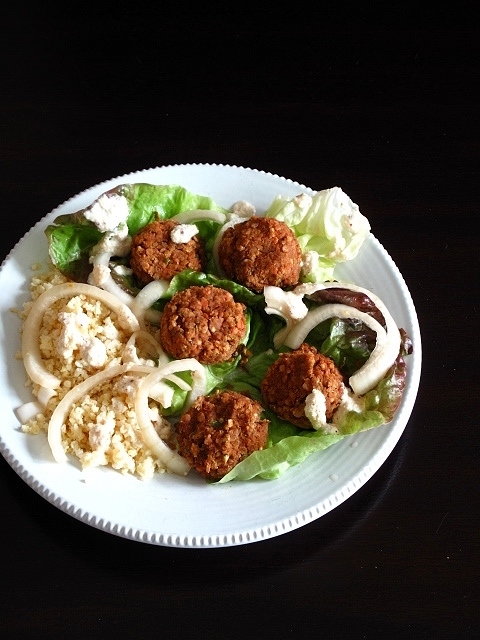
So here we have red lentil falafel, an extra delicious lemon ginger cashew-based dressing, and pickled onions. This just might be the meal that gets me back into eating a little more adventurously. And maybe you too?

IMG_1423

Red Lentil Falafel with Millet + Lemon Ginger Dressing, serves 4
I love falafel, especially baked falafel with lots of accompaniments like pickled onions, but the lemon ginger dressing is the real star of this dish, in my opinion. After enjoying a lemon ginger dressing at a super hipster Portland restaurant a while back, I’ve been trying to get a homemade rendition right all winter. It may have taken all season, but this version might just be better than its inspiration. Make sure to be liberal with both lemon zest and ginger!

Red Lentil Falafel:
1 cup red lentils, soaked
3 garlic cloves, peeled + roughly chopped
1 bunch green onions, chopped
2 tsp. ground cumin
1/2 tsp. ground coriander
1 Tbs. apple cider vinegar
3/4 tsp. sea salt + more to taste
freshly ground black pepper pepper
1 tsp. baking soda
1 cup cooked millet

  • In a large saucepan over medium-high heat, bring the soaked lentils and 2 cups water to a boil. Turn down, and simmer for 20 minutes. They do not have to be completely soft all the way through. Drain and turn into a food processor.
  • Then, preheat the oven to 375 degrees F and line a baking sheet with parchment.
  • In the food processor with the red lentils, combine the garlic, spring onions, spices, apple cider vinegar and baking soda. Pulse the mixture until it comes to a chunky paste but is not completely a puree. It should be fairly wet so add a little liquid if it’s not. Then turn it into a large mixing bowl along with the one cup of cooked millet. Combine the grain and lentil mixture well.
  • Next form about 20 falafels with your hands or with a medium cookie scoop and place them on the parchment lined baking pan. Bake for 20-25 minutes, until they are lightly browned and a little firm to the touch.
  • Serve the falafels with extra millet or flatbread, the sauce, lettuce, and pickled onions if desired.

Lemon Ginger Dressing, makes about 1 cup
1/2 cup cashews, soaked + drained
zest of one lemon
1/4 cup lemon juice
1/4 cup water + more if needed
2 Tbs. freshly grated ginger root
1 tsp. Dijon mustard
1  tsp. maple syrup (optional)
1 Tbs. light miso

  • In a food processor or blender, combine the soaked and drained cashews, lemon zest, and remaining ingredients and blend until it comes to a consistency that is spoon-able but not runny. Add more water as necessary to reach this consistency.

To Serve:
Quick-Pickled Onions
lettuce
additional cooked millet or flat bread, if desired

recipe-redux-linky-logo