Are you eating enough for your activity level?

Today’s topic is one that’s been on my mind a whole lot lately. A nutrition question that is frequently asked is:  Should I be eating intuitively when I’m hungry or tracking what I eat and going off the numbers?

Before I tell you my answer, I’d like you to think about this question for a moment. No really, take a moment and think about what you’d say if someone asked you. (Humor me please, this is the educator in me.)
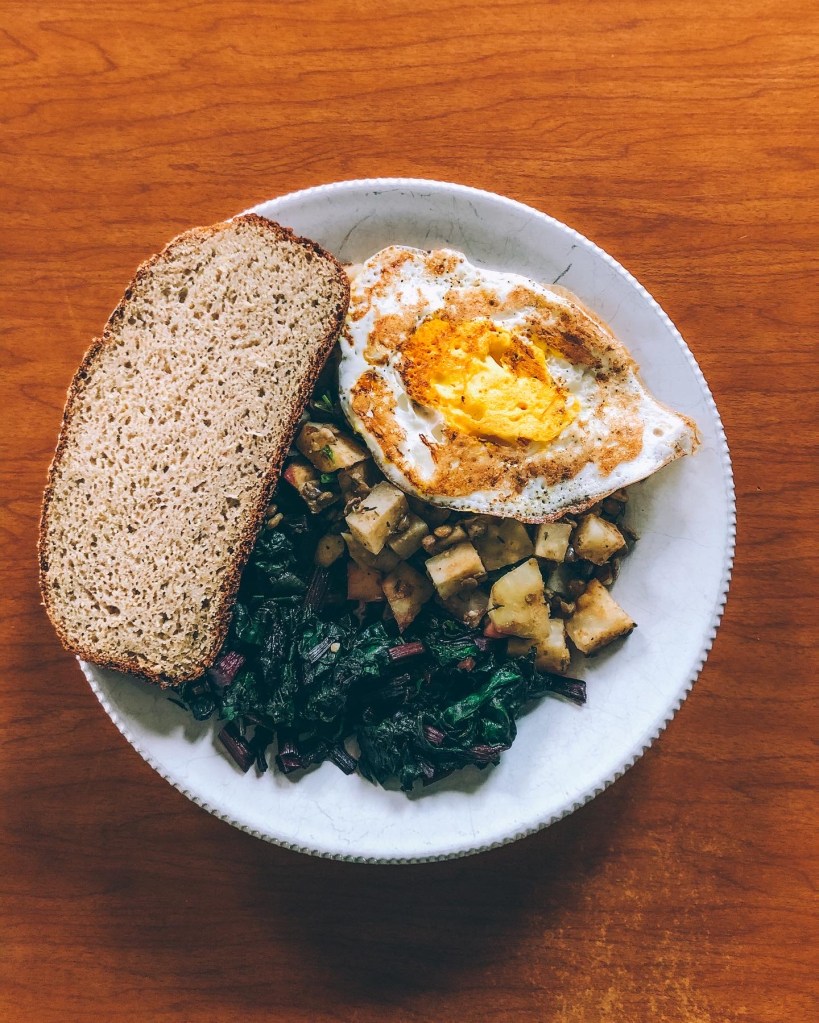
From my instagram a couple weeks ago: as mileage and/or time on feet goes up, eating becomes almost another part-time job. the last few days I felt like I wasn’t quite eating enough, and not surprisingly, today’s long run felt a little extra challenging.
low energy availability is extremely common in athletes, and long term, it can cause widespread physiological and psychological imbalances.
so the short story is if you’re moving a lot, you need to be eating a lot.

Now, my answer:  YES, eat intuitively!! Tracking numbers often leads to becoming reliant on the numbers rather than recognizing your own body’s needs. Your body is incredibly wise and those tracking websites and apps are all using estimates. They’re estimating your energy needs and using nutrition data done in a lab on a random sample item of the food tested. And that’s not to mention that your estimates of portion size, etc. are usually not entirely accurate either.
So random sample food that may not reflect the actual nutrition of the food you ate, formula estimating your energy needs, and, unless you’re a super type-A person that weighs every morsel ingested to the nearest gram (also please don’t do this), inaccurate food measurement. Yes, they can give you an idea if you might be in the ballpark with your nutrition needs, but as above, it can vary so much. And yes, some individuals can go into a lab and get their metabolic rate measured to determine a more accurate picture of energy needs, but most of us don’t have access to or need that data.

AND also my answer: It depends. Many active individuals are actually not eating enough for their on-the-move lifestyles – and the body, because it is wise, makes decisions about where it is going to prioritize its precious calories. So if you’re going to go for a trail run in the forest for the day followed by an evening bike ride or weight session, and then follow with something similar tomorrow and the next day, and throw in a weekend long couple workouts, AND you’re routinely not eating enough to meet your caloric needs, the body is going to choose where to spend those nutrients because when this precious energy is used for one function, it is not available for another one. Essentially, you are putting your system into survival mode.

And it plays out along these lines as your body says,  “Well, if you’re going to make me go do these workouts, I’ll put my energy here, though maybe with a little less pep, energy, and high-end ability, but I’ve got to rob Peter to pay Paul, so I’ll compromise over here with bone metabolism, or over here with female reproductive hormones or thyroid health, or immune function, or over here with the GI system and the ability to break down nutrients in food (because digestive enzymes are made of proteins which may be lacking in the diet), or muscle and tissue repair or”…. and the list goes on.

Why am I bringing all this up? Because it’s actually common for active individuals to be eating to hunger levels and still not be eating enough.

While intuitive eating means we should honor our hunger, many athletes have a suppressed appetite after long or intense workouts, and we still need to replace nutrients quickly after exercise, and learn to recognize that symptoms of hunger go beyond simply an empty stomach.

While intuitive eating means we should respect our fullness, if you get to the point of overeating by having excessively large meals, it is often because of low energy intake throughout the day or because you did some seriously strenuous exercise. With more even or adequate energy intake before and during a long workout, you can avoid that ravenous feeling of needing to eat quickly and impulsively, which means you’re paying more attention to fullness.

A SELF-ASSESSMENT TO HELP YOU NAVIGATE YOUR ENERGY NEEDS

So what to do if tracking all your meals isn’t very accurate (and not to mention time-consuming and takes the joy out of eating and deciding what to eat), and eating intuitively might be a little faulty, especially at the beginning?

My suggestion is to start with a self-assessment. Ask yourself these questions:
– Am I sick more than I should be?
– Do I struggle with fatigue more than I think I should?
– Am I improving in my performance?
– Have I had a lot of injuries?
– How’s my overall health?
Basic bloodwork results holds a plethora of data on how the body is ‘performing’ internally.
– How is my menstrual cycle and/or sex drive? Women have a little advantage here in that any menstrual symptoms or irregularities* are symptoms telling you to heed warning because there’s a larger health story.
– Do I have a lot of gut upset / discomfort?
– Am I more irritable, depressed, anxious, or have decreased concentration?
– Am I sleeping well?
– and if you have teammates or friends/family that you work out with regularly: Do I eat less than my teammates but have a higher body fat? This is subjective of course because every body is different, but yep, higher body fat and eating less is also a tell-tale sign, since lower metabolic rate occurs with lower energy availability, meaning you might be eating less but weighing more or having more cushion than previously.
– and one more because it can become prevalent with long term low energy availability: Am I thinking about food ALL THE TIME? We know from eating disorder and starvation studies that chronically deprived individuals become obsessed with food, far beyond just being interested in food.

So where to go from here?
Above all, food and exercise should make you feel good. The goal is to be aware and in tune with yourself and your body’s ability to show you signs that something may not feel right or as great as it should.

And you may benefit from professional guidance. If you’re confused or concerned about your needs, or would like a professional opinion, I invite you to reach out to me for more personalized support.

*Women on hormonal birth control will not have the same ability to use their menstrual cycle to gauge abnormalities, since it is designed to eliminate ovulation and the normal hormonal fluctuation that occurs. If symptoms or irregularities occur without birth control, that is vital sign that your body has an imbalance somewhere.
This information does not intend to treat, diagnose, cure, or prevent any disease. 

References:
2018 UPDATE: Relative Energy Deficiency in Sport (RED-S)
Bronwen, L., Rowe, G., and Girdlestone, C. (2020). Low Energy Availability – an imbalance that impacts more than performance. CompeatCon Nutrition Conference.
Fahrenholtz, IL., Sjodin, A., Benardot, D., Tornberg, AB., Skouby, S.,…and Melin, AK. (2018). Within-day energy deficiency and reproductive function in female endurance athletes.
Torstveit, MK., Fahrenholtz, IL., stenqvist, TB., Svlta, O., Melin, A. (2018). Within-day energy deficiency and metabolic perturbation in male endurance athletes.
Tribole, E. and Resch, E. (2003). Intuitive Eating: A revolutionary program that works. (2nd ed.). St. Martin’s Griffin.

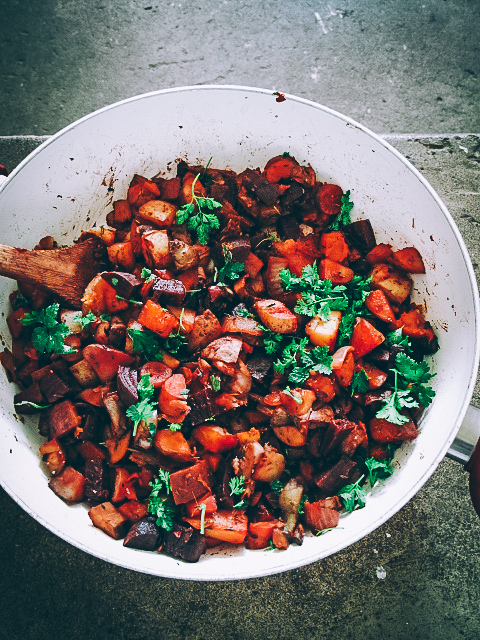
Answers to the Big Questions and a Hearty Runner’s Brunch Hash

Lately, I’ve returned to reading two books. First the Purgatorio, the second in Dante’s Divine Comedy. My former English professor and deacon at my church in Corvallis has been leading a weekly class lately guiding us through the Purgatorio and the timing feels just about right since the class began the Wednesday of Holy Week and is leading us through this continued period of staying at home and distancing. Purgatory—the place between two more known-of places—seems the perfect description for where we all are now.

If there’s anything I can pick up from Dante’s 14th century poem, it’s that it gets easier as we keep going.

The other book I’ve begun again is Sajah Popham’s Evolutionary Herbalism: Science, Spirituality, and Medicine from the Heart of Nature—a reading I encourage everyone, yes everyone to read. For it guides you back to a perspective I think we all had as children and lost along the way.

I’ve been considering a lot these last few weeks. About this space, this encouraging journal and recipe guide of sorts, my role as a nutritionist and in the community, health and true wellness, and of course, nature.

On that note, I wrote in two questions for a couple of favorite podcasts a few months ago and surprising to me, both questions were answered by the respective individuals this past week. Unsurprisingly –if you know me—my questions were on the topics of sustainability and having a lower ‘footprint’ as a company, and on navigating faith and spirituality amongst busy seasons and family traditions that don’t partake in that faith. I know. I know. I like to ask the tough questions.

So why am I bringing all that up here? This past week my big questions semi-paralleled with those of Brett Farrell, the founder of Territory Run Co., for which I am a content ambassador and contribute seasonal articles. Brett spoke about his own big questions, the clothing industry’s own climate footprint, challenges with community, and more. Check out those here and here. As well as recent contributions on the Territory Run Journal – there are several excellent and thoughtful articles there lately.

What I was really reminded of however, was that in a conversation with Brett about a year ago, I spoke about the draw of trail running, the joy and peace and healing it has brought me personally, and about getting to the know the medicine around me—literally coming to know the plants I spend time with on the trails. Though I’ve only written or spoken about it in pieces, I came to an interest in herbs and herbalism like a lot of individuals. I was really sick, in a way that modern medicine wasn’t going to cure or even temporarily fix. And after a while of taking various herbs and formulas which my doctor gave me, and around the same period spending more of my running hours in the forest, the plants reached out to me and pulled me in, sometimes sharing themselves in profound ways –like being pulled to a stop suddenly alongside a trail, staring captivatedly at one, and (internally) asking, who are you? Crazily enough at times, I’d find I had my answer when the plant’s name simply came to the edge of my tongue, when if you’d asked on any other day, I wouldn’t have known it.  In fact, it happened again today.

And then Brett asked me another ‘big question’ about what it is I really want people to know in regards to nutrition and health. My answer is one I still will give and one I’ll likely give for the rest of time. What I really want you to know about nutrition and health is that if you get quiet enough – go deep enough into the forest’s eternal wisdom, and your own—you’ll find you already have the answers to the questions you seek.

To explain this more since the concept can be a little esoteric, I’ll refer to a couple lines from Sajah’s first two chapters:
To begin gathering natura sophia (the intelligence of nature), we must learn to see beyond the limitations our modern world has placed upon our perception and see the living intelligence of the Earth. And this can only be done through gnosis cardiaca—the knowledge of the heart.

and

To truly enter the kingdom of nature we must suspend our rational thought, let go of our knowledge of botany and chemistry, even dispense with our systems of herbalism—for any potential interference of the mind will get in the way of our capacities to directly perceive the intelligence within the plants. To move beyond herbal knowledge and into herbal wisdom, we must tread the pathway down the mind into the inner temple located just inside our chest.

Bringing this back down to earth even a little more, the answers to these big questions don’t come easily, they don’t necessarily just appear when we ask them or when we want them to. There can be many layers to the answers of how to be a better patron of the planet, or how to balance a spiritual life in faith with the goings on of the ‘real world,’ or how to heal – truly heal the body and mind.

Over time, I’m beginning to realize my role here is to educate about true wellness, about true healing, to be more of the guide—the Virgil and/or the Beatrice (though I claim no Godlike abilities)—and no longer the lost and hurting Dante who I was for a long time. To provide encouraging words yes, and recipes to nourish the body yes, and with those working with me clinically, proven scientific strategies to heal root cause imbalances yes. But it’s also to remind you, to remind us, that we also have the answers. That we’re not victims.

In every relationship whether it’s with me your nutritionist, your coach, your chiropractor or PT, your family and friends, your life partner, or with the plants in your window box, yard, locally farmed vegetable box, or forest, there’s an opportunity for a two-way conversation, a partnership to come to the answers that are already within you waiting to be revealed.

Maybe that’s the point of this slow down period we’ve been given, for I know it’s not for many millions to suffer. Maybe it’s the time to return to our childlike ways, picking the dandelions and blowing our wishes into the big questions, letting the answers present themselves in their own time and way.

Now for this hearty brunch hash.

You’ll need a hearty, though not heavy, meal to refuel the system after your time in the forest– or wherever you go to dwell in your own big questions and their answers. I’ve shared the recipe over on the Run Journal at Territory Run Co. Get the full article and recipe here.

Spring Roasted Carrots and choosing resiliency

I fell down on my trail run today. It happened as it does, a little trip over a big rock and then skidding in slow motion as I attempted to catch myself before I hit the ground. Hard. I’ve relegated my trail runs lately to the hill and trail behind my house, which happens to be a little sketchy in sections with giant, difficult to navigate old-access-road gravel. Just the section I fell on as I headed down the hill near the end of the whole pursuit. I got up quickly, didn’t even brush myself off, and began on my way again before a neighbor in the distance stopped to make sure I was okay. I’m fine. Haven’t fallen in a while so I guess I was due. Well, just your pride’s bruised then anyway, he said. Haha, well no. I fall down every once in a while. It happens. I’m fine, I assured him.

A few minutes later and closer to my house, I looked down and realized I’d shredded the entire palm of one of my gloves on the rocks. And my other palm, the one that had taken more of the brunt of the fall, was throbbing. Scrapes and bruises already appearing along the length of my hip and shin as I got back home.

I guess I really have threaded deep roots into the just get back in the saddle lessons and it’s a long way from your hearts that my dad had on repeat throughout my youth.

Chin up. Shake it off. Get back in the [actual] saddle. Keep going.

Before I go any further I’ll clarify that I’m certainly very human. I fall down and fail a lot. I run in mental circles of doubt or fear or avoid big things I don’t want to think about. And I tend to be quite susceptible or tuned into other’s energy states — so the past few weeks have affected me quite a bit. But the big moments in life where I learned the most about myself and what is important to focus on was when I tuned out the noise and energy around me and tapped into what I felt, what I knew to be true, and found peace and trust amidst the chaos and unknowing. That peace and trust has been more or less my status quo emotion / mindset the last several days.

It’s in times like these, with everything around us up in the air, that I recall moments of actually getting back in the saddle from my youth. When my horse bucked me off during our moment in the spotlight during the championship class at spring junior show all those years ago. When she did the same (which kind of was her habit — we made a good pair of two strong / determined personalities) at a routine lesson with my dressage coach. Both times landing me on my back with a sudden whiplash after that slow motion almost staying upright fall. And getting up just as soon as I hit the ground, launching more determinedly back to the task at hand. Fairly exactly like in trail running.

Anyways, I share all this because I think it’s in times when we’re knocked out of the norm of our comfort level, when we’re literally shockwaved into a new reality, that our ability to deal with more than we considered we could and our determination to do so, becomes clear.

One example of this that’s crystal clear to me is in my local food producers and restaurant industry. From two weeks ago being mostly shut down to already having several local partnerships that have pivoted into creating local food hubs for online ordering and distribution. Farmers and food producers rallying to support their community and their livelihoods in record time. From the extreme cautions that our local grocery stores are going to, inserting protecting barriers for their clerks on the front lines, to wiping down every cart and every surface after each customer, and on. And on.

I wrote a couple weeks ago about focusing on the good things instead of what isn’t going well. So I’ll share one of the good lately. Our farmers market is considered a grocery store – so still open with a few precautionary changes, thus allowing our local farmers to keep going. I encourage you to support yours however you can because good food and resilient local food systems are essential in these times. And thanks to marrying into a partnership that had strong visions of growing our own as much as possible, these spring carrots I’ll encourage you to seek out and roast up are a product of our back yard, a deserted and ugly dog run when we began with it. Planted and tended by one last fall (that’s William), and pulled from their dirty soil home, scrubbed clean, sliced, seasoned and roasted by the other (that’s me.) It never ceases to amaze me what can grow from essentially nothing.

So if you find yourself needing some assurance through this (whatever this is to you in your current situation), let me remind you:

Chin up. Shake it off. Get back in the saddle. Put your hands in the dirt or nutritious food around you. Keep going. You have everything you need to know in this moment. You’ve been given no more than you can handle.

Spring Roasted Carrots, makes about 3-4 side-dish servings
Spring carrots, if you have access to them, are more tender and generally a lot more tasty than the giant fibrous ones shipped from California and the like. For access to all their carroty nutritious goodness, I strongly recommend finding the locally grown ones, since many nutrients break down and are lost after months or weeks in cold storage. Because they’re more tender, I also think they’re best when you roast them so they still have a little bite to them, like al dente pasta, which is less-cooked than I enjoy carrots in the fall or winter.

1 large bunch or 1 pound tender young carrots, sliced in half and perhaps quarters.
1-3 tsp. coconut oil
thyme, minced rosemary or sage (you choose one or all)
salt and pepper, to taste

  • Preheat the oven to 400 degrees F while washing and slicing the carrots. Toss them together on a baking tray with the seasonings and and a little oil.
  • Roast until just al dente, about 20-25 minutes, depending on their size.


If you enjoyed this, I’ve been sharing a few practical resources and video posts over on my E+O Facebook page about how to navigate these times with resiliency and less anxiety / fear, and am currently taking new nutrition clients. Be well.