Polenta with Lemon-Garlic Raab + Chickpeas

Polenta with Lemon-Garlic Raab + Chickpeas

IMG_9373


In our marriage counseling, William and I learned about family of origin and the long-held beliefs, values, and challenges we bring into our relationship. Like many relationships, the arguments we often have are about money. I have a vivid memory of a late-night ‘discussion’ my parents had when I was quite young, which I wasn’t supposed to overhear. It was about money, of there not being enough to make it to the end of the month, and I laid in bed that night unable to sleep, as if the panic and fear in their voices transitioned directly into my pysche and lodged there permanently.

To this day, I hate thinking about money. I’ve grown to avoid the responsibility of it in our marriage because in doing so, maybe its stresses will go away (logical, I know). I fought hard with William for years about having a credit card because despite his logic that it’s wise to build credit, I couldn’t get over the memories of watching my parents painstakingly climb out of debt from this system, of the shame of growing up eating free hot lunch at school, of wearing shoes that cost $10 from the local budget store when all my friends were wearing the trendy $100 ones.

It is interesting to me now how I never went hungry growing up (quite the opposite with a large garden and ranch) and I never lacked anything I needed. But as soon as I was able to compare myself to others, I decided that I lacked some of the trendy material things my peers had. I feel nothing but deep admiration for my parents for climbing out of a tough place and gratitude for their teachings about wise spending and saving. And I wouldn’t choose to go back and change those early circumstances even if I could. Perhaps because of my parents’ teachings, and probably more out of fear, I operate largely as if I don’t have money and jump to panicky reactions when talking about spending. It tends to create tension and resentment.

I also feel guilty and ashamed of spending on things my parents are frugal about.


Like food. I prioritize spending on food.

I volunteer for a local food action team whose mission is near and dear to my heart, to promote eating food that is grown or processed locally within a six-county region. The group’s reasons for striving for a more locavore diet are many, and I’m sure every member would answer differently as to why eating local food is important: for the local economy, for the environment, for health, etc. I like all of these reasons and more, but the one that is most important to me is the connection to a place and to a people, to feel as if I am a part of something meaningful, rather than consuming the mass-produced commodity of our time.


For most people, the largest barrier to purchasing foods grown locally is usually cost. I’ve heard it across the board from individuals I know are well-off to those that surely are not. Like the choice of what we eat, how we spend our money is highly individual and emotional. And though I choose to support people, businesses, and values I believe in, I really strive to eat frugally too. Our action team goal for the past couple years has been to promote eating ‘local on a budget,’ and I have been very interested in this topic.

I often feel like a fraud though, when I even talk about eating frugally or consuming local foods. As I’ve mentioned before, I’m not overly rigid about sourcing or labels. We still have olives in our fridge from Greece, tea from China by way of Ireland, and staples in our pantry from all across the globe. A lot of my food choices have more to do with my tendency to explore one or two ingredients in a variety of ways for weeks at a time–and it often leaves less consideration for a budget and a place. William I and have been eating loads of broccoli this last month, for example, and not one of those tasty florets has come from a local farmer. Likewise, my weird current craving for coconut yogurt is not a frugal indulgence. So to help me walk the talk of eating local on a budget, I plan to share a little more of the meals in this space that help me engage in what I believe in. I hope you’ll be inspired to think about the seasonality of ingredients and recall there are persons behind our foods that worked hard to provide that nourishment–and perhaps even explore more of the local offerings in your area.

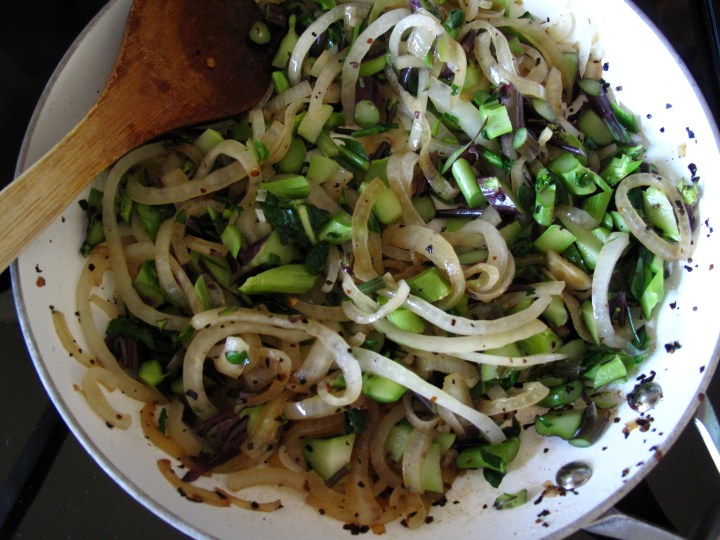


This polenta dish features raab, which can also be called rabe and rapini. If you google it, you might read that it is a unique variety related to broccoli; this is not necessarily the case to the farmers and gardeners I know. At this time in the season, all of last year’s brassica crops that have overwintered are finally telling us their time has come, the weather and light are changing, and instead of continuing to produce nice big leaves, they’re putting their energy into flowering and eventually setting seeds. So all the local farmers are selling the last of what these plants are offering as kale, sprouting broccoli, arugula, and mustard raabs. They are tasty, nutritious, and have cute little broccoli-like florets. We are currently in the three-four week window where these plants are available and they’re likely to be found from a farmer or perhaps a grocery store which sources directly from farmers.

Secondly, I used Abenaki corn polenta in this recipe, which comes from a local farmer specializing in grains and legumes. Abenaki is a heritage corn and is quite beautiful when ground, with its speckling of red and gold pieces.

Due to some dedicated farmers, this meal came almost entirely from the two counties I live and work in, and given our food action team parameters of an $8 meal for a family of four, can be counted as ‘local on a budget’ as well. Lastly, it is a meal I’ve made more times than I can count during the late-winter/early-spring months, and it is one I’d gladly make for all my friends.


IMG_9377


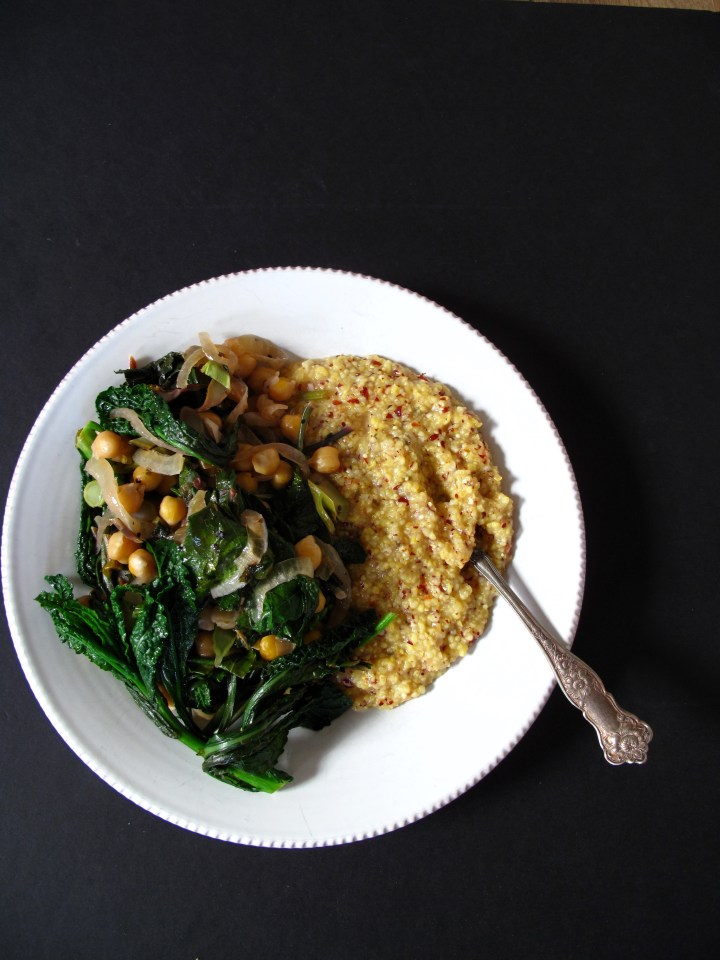
Polenta with Lemon-Garlic Raab + Chickpeas, serves 4

1 tablespoon olive oil

1 clove of garlic, minced

3 cups vegetable stock or water

1 tsp salt

1 cup polenta


1 teaspoon red pepper flakes

1 tablespoons olive oil

½ a medium onion, or 2 large leeks, minced/sliced

1 clove garlic, minced

2 medium bunches of raab (kale, sprouting broccoli, mustard, arugula, etc.)

2 cups cooked garbanzos

juice from ½ a lemon

pinch of salt


Directions:

  • Heat oil in a medium-sized saucepan with the minced garlic. As the garlic starts to sizzle, add stock or water, and salt. Bring to a boil. Gradually whisk in the polenta. Reduce the heat and simmer gently, stirring frequently to prevent sticking until the mixture is very thick, about 30 minutes. Add additional salt to taste.
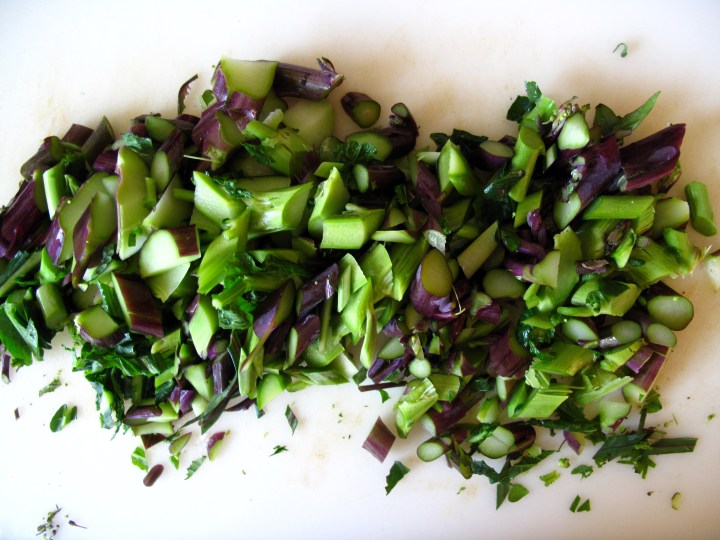
  • Meanwhile, remove the longer stems from the raab and chop into 1-2-inch pieces. Slice the leaves and florets into longer 3-4 inch pieces and set aside.
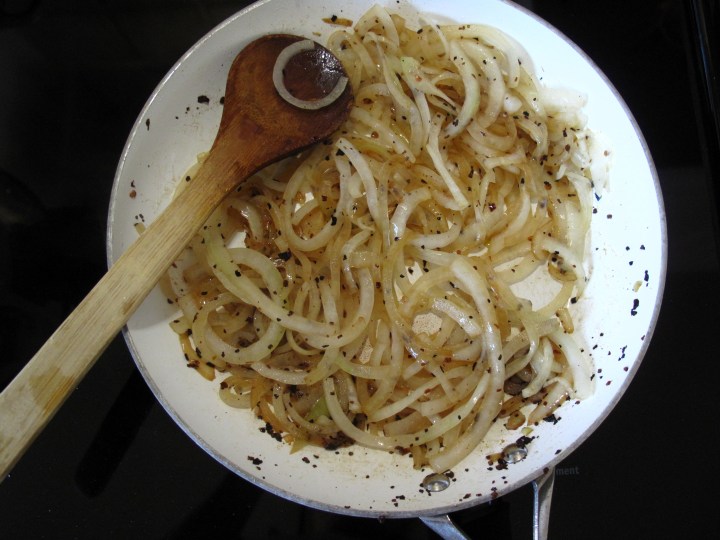
  • In a medium-sized pan, toast the red pepper flakes for 30 seconds or so over medium heat. Add the olive oil and onions and cook over slightly lower heat until they begin to caramelize. Add the raab stem pieces and garlic and cook for 3-5 minutes more. Then add the raab leaves and florets and let wilt, untouched for a couple minutes before stirring together. Add the garbanzos, lemon juice, and salt to taste. Stir and remove from heat.
  • Serve in a bowl, all together.


big enough to live in

IMG_3449


Lately, I’ve been exploring a concept that was pointed out to me several years ago, that I push people away, that I hold others at a distance, that my bubble is big and I take a lot of careful measures to keep others out of it, including the individuals closest to me. Vulnerability is particularly challenging and the more personal the share, the more anxious and uncomfortable I become. I have a number of friends that I’ve had for years, and I still feel like they barely know me because I can’t seem to share the things that really matter with them. I carefully keep conversations at the surface-level even though I hate surface-level conversations. And I often feel very much alone, starving for a meaningful interaction that doesn’t leave me feeling partially empty for what it could have been, even though I am often the one responsible for the conversations’ missing components.


Ultimately, I feel alone in my experiences most of the time with no one to say yes, me too, when I share my challenges. And that makes me close up a little more, shove people a little further outside of my space, and seek solace in insulating, because rejection, even in the form of indifference, is especially painful. When William tells me he loves me, I often ask him why, because I rarely feel lovable. I’m well aware I have selfish tendencies, and I often wallow in the mindset that being alone in my experience is my lot in life. A few weeks ago, during one of those interactions, William looked me directly in the eyes, and said, you are extremely loveable. but you are very hard to love. you won’t let people in. For the first time maybe, I saw the truth in his statement.


In one of my classes this term, I’ve learned about the illness narrative, how our reality is made up of the stories we tell of ourself, how we word our world. Dianne Connelly, the university’s cofounder, asks, Is your story big enough to live in? It is a question that has been on my mind these past weeks.


During the holiday season of 2006, my sophomore year in college, I came home for the break, deeply unhappy and isolating. My parents were worried about me and my mom would have done anything to bring a smile to my face. Though I knew this, it wasn’t enough to help. I went to the gym one day and after returning, she asked me, Did you have fun? I lifted my shoulders indifferently. Truthfully, physical activity was one of the only things that brought joy at the time, but it didn’t lift the looming shadow of what I was going through, of the consequences of pushing people away, of feeling alone. She exasperately asked, What will make you happy?


Years later, William shared a conversation he’d had about me with my dad. As it turns out, most of my immediate family are like me, afraid to show and discuss vulnerable things, and I learned long ago that doing so results in complete silence, that indifference which feels a lot like rejection. Because of this, I’ve slowly stopped sharing much at all with them over the years. In the interaction with Will, my dad told him, I don’t care what she does as long as she is happy.


There it was again, that feeling which has long seemed so elusive.


Even though much of what I write about sometimes feels a little too gray, a little too dark, I can say I’ve never been depressed in the clinical sense. I rarely feel low for more than a couple hours at a time. Realistically, I often experience happiness; when I spend time in my faith, when serving others, when teaching, when running, when deeply intrenched in good music, and when writing. Basically, I’m happy all the time when living in the present moment.


Yet I cling to another story, of being unhappy, of being alone, of being not good enough, of being unable to, of being unlovable, of being cold, of being destined for some ultimate tragic ending. And so I ask myself, Is that story big enough to live in?  


I think it’s about time I rewrite the pages.


February 21st-27th is National Eating Disorders Awareness Week (#NEDAwareness Week). It also happens to be lent, my favorite season in the Catholic liturgical year. I’m working on being less isolating this year, and reading The Sevel Levels of Intimacy by Matthew Kelly. I’ll likely be continuing to share more on the topic of my eating disorder and intimacy in the coming weeks. Much of it is challenging stuff. Other than practicing my faith and writing, I’ve done much of my really deep healing through music, and my current playlist is below. If you’ve read this far and continue reading, thank you. I truly appreciate it. 


winter meals + reading

IMG_3747


I engaged in a little spontaneous five-o’clock social hour at the co-op last Friday and realized I may never get over my fear of people judging what’s in my grocery cart. And what I mean to say is I’ve long had people comment (probably admirably so) how healthy I eat. Those comments might seem harmless but are not helpful. Regardless, it was a truly pointless fear at the co-op because when you’re chatting about getting garden produce on school lunch trays in the bulk bins, or the difference between natural food stores between C and E, there is no one around judging the contents of my cart. What’s more, it’s likely no one else at any other grocery store really cares all that much either. This was a lesson in Not That Big Of Deal Lady, and Needless Fears 101.


Second, I’m taking an introductory cooking lab for school right now. It covers the basics of cooking with whole foods and I wasn’t expecting to learn much. We started with knife skills last week and prepared the simplest side of caramelized onions with matchstick carrots and sauteed greens. There were no additional spices beyond a little salt and pepper, and I had to resist fancying it up. The results were truly fabulous as the flavor of the fresh vegetables showed through and I was reminded of the experiences that led me to eating seasonal produce and whole foods, the simplicity of those meals that called to me, and how I continually desire to go “back to basics” with food and life, and invite in more minimalism.


And then we had dinner last night at some slighty-new-to-me friends who served a truly exceptional fancy-restaurant quality meal. I already knew what to expect as one of them is William’s coworker and he stayed at their house and was treated to those meals weekly last year. The meal was the exact opposite of what I described above and as I sipped the winter squash soup, I thought to myself, I’ve got to get on board with fancier cooking. This is way more delicous that any soup I’ve made. It was super fun to chat with friends who are into good food. It was also different, because though I consider myself quite adventurous, I was the less adventurous one at the table last night. I don’t go out of my way to try new things I view as not that necessary, overly processed, or too-exotic (i.e. vegan cheese, most dairy alternatives, specialty spices, most vegetables that are not in season locally). Some of this is because I lean towards minimalism in meals, a lot of it is because I avoid foods that were produced in factories or in far away places where I imagine soil degradation and inhumane working practices (yes, my mind goes there), and some of it is because I harbor a little bit of shame about fancier cooking. Frugality was an essential component to meals growing up. I feel a little elitist sometimes in prioritizing local and organic ingredients and getting too fancy with additions most people haven’t heard about or tried before.  I’m still trying to find balance. And maybe I’ve found balance but when I start to overthink it, I get out of balance?

With that, I’ve read and enjoyed many good articles and meals since we moved, and a few of my favorites are below:


Reading:

I went to high school with Tommy. He was a little older and we didn’t really know each other, but even then I remember him as the goofy runner dude in my speech class. His share about his win at the Rock n Roll Arizona Marathon is super inspiring.

Gena Hamshaw’s 5 Tips for Balanced Eating. Gena continues to inspire me and I resonate much with what she shares.

No diet, no detox: how to relearn the art of eating. I’ve been reading a fair bit about food relationships lately. This article was a good one.

Nourishing Wisdom. This book is super great! I’m still making my way through.

My biggest vegan challenge was one I didn’t expect. This article about the challenges and disconnect of navigating meals with family and friends when following a specialized diet is a discussion worth highlighting. I still haven’t truly figured out what works for me with my own family and friends and I’ve been eating very differently than most of them for a number of years.

You already have everything you need.

Zen Habits-Let Everything Breathe


Eating:

Meal planning and prep has gotten super streamlined these last few weeks and it has revolutionized late evenings after a long day. There have been so many good meals and most of them are either old or new favorites. I keep a laundry list of meals I want to eat on my computer and many of these have been made and then go right back onto the list. William also initiated one night a week as his night to decide, plan, prep, and cook. It’s kinda sweet, but mostly he’s not so into winter squash and would like to limit how many meals I work it into. :)

Moroccan Wild Rice with Butternut Squash + Garbanzos

Garden Keepers’ Pie

Sprouted Mung Bean Salad inspired by Heidi

Millet Polenta + BBQ Lentils

Butternut Mac + Cheese, Food52Vegan

Creamy Pasta with Leeks + Broccoli, Food52 Vegan

Cumin-Lime, Quinoa + Black Bean Bowls

Shaved + Curried Cauliflower Salad

Smoked Paprika Vegetable Chowder + Orange Zest

These Black Beans. I’ve mentioned them a zillion times. They make all meals delicious.

Root Veg + Garbanzo Pot Pie, Food52 Vegan

Broccoli, Collards + Kalamata Salad 

This weekend, we’re enjoying cookies. I’ve somehow managed to avoid every sort of mainstream store in the past few weeks, so have missed all the marketing of chocolate, hearts, and balloons. I feel not one inch of regret. We first made these Jam + Sunflower Thimbles for Christmas and they’re worthy of a special occasion/sharing with friends.