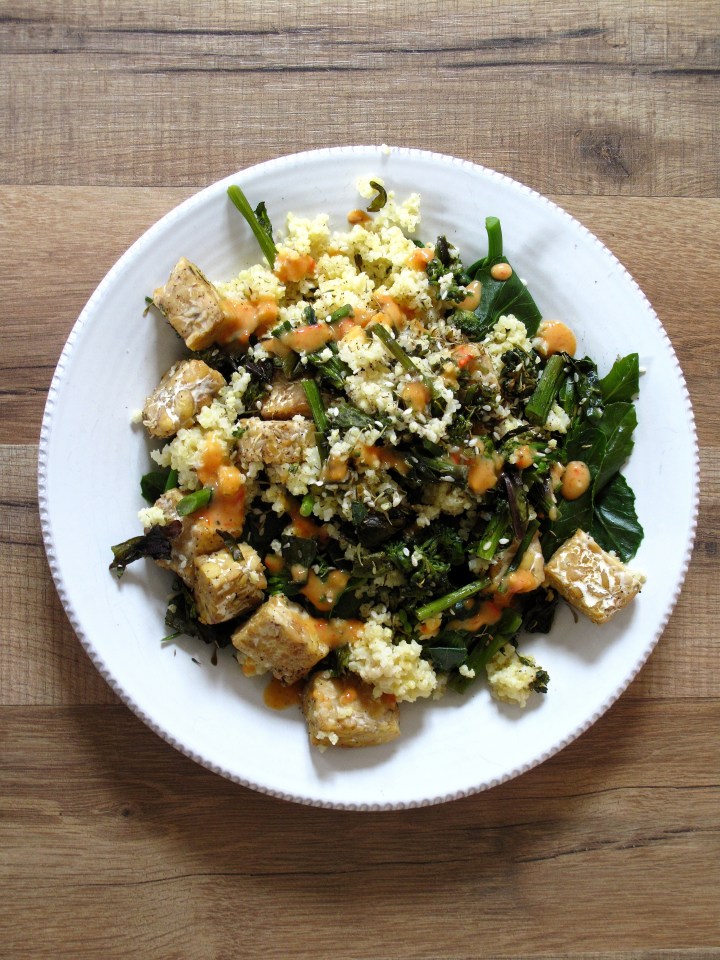
Sprouting Broccoli, Za’atar, Tempeh, + Harissa Yogurt

Sprouting Broccoli, Za’atar, Tempeh, + Harissa Yogurt

IMG_9775


Recently, I was listening to one of my favorite podcasts, and the question came up, What are you totally obsessed with right now? I love that question, and in lieu of sharing links and things, here are a couple of life updates/current obsessions:

 

IMG_9706IMG_9683IMG_9742


  • The microbiome and its potential role in virtually all aspects of health and disease. I listened in to most of the Microbiome Medicine Summit last month, and all the new information only cemented this interest.
  • Herbal remedies for stress, sleep, and anxiety: I’ve been taking an introductory class on Herbal Medicine this term and at the beginning of January, we picked one herb to study in depth. I’ve been studying American Skullcap (Scutellaria lateriflora) and I picked it for its nervine (nerve-supporting), anti-anxiety and anti-spasmodic properties. It’s been fascinating to learn about not only skullcap, but the whole host of other herbs that support sleep, stress, and anxiety, particularly because this is an area I’ve been struggling with. I’ve been carting around a review article titled Nutrients and Botanicals for Treatment of Stress: Adrenal Fatigue, Neurotransmitter Imbalance, Anxiety, and Restless Sleep and instead of reading feel good books, I’ve been re-reading it in my free time (see, obsession!). Also, I’ve been taking a series of herbal formulas which include valerian, lemon balm, chamomile, and passionflower, among others. Like skullcap, these are all sleep and stress-supporting herbs. I’ve been seeing positive results.
  • Positive self-talk and self-care: I’m almost done with my first term in nutrition grad school! It’s been an interesting few weeks, as I began with A LOT of class work, and then gradually dropped off the load and finished classes throughout the term. I have one week left of one class and then a couple weeks break. I’m already excited for next term and in particular, a foundation health and wellness class that focuses on self-care and behavior change. I consider myself somewhat good at self-care, but I’ve been obsessed lately with positive self-talk. As I work on it, I’ve noticed the negative self-talk is gradually improving. I’ve also noticed that I’m usually self-deprecating when I receive compliments, and though I’ve always thought it was just part of being humble, I’ve realized I do not have to make an excuse every time I receive a compliment. I can simply say, thank you, and leave it at that. There are huge things to be gained from building oneself (and others!) up, instead of tearing down.
  • Broccoli. I have eaten so much broccoli these last couple months in the form of broccoli raab, purple sprouting broccoli, romanesco, and just plain, straight-up broccoli. Every time I think I’m ready for a broccoli-break, it ends up in the fridge and I gobble it up. William likes broccoli too, (he’s the one that started this whole broccoli bandwagon), but tax season has him eating away from home so much that I’ve eaten the major share of our broccoli purchases. I’ve also been really into broccoli with tempeh. For forever, I avoided soy products, but something about the fermenty flavor and texture is just so delicious right now. I’ve been adding it in to meals every other week or so, and alongside roasted broccoli and harissa, it’s simply delicious. Also: if the amount of broccoli I’ve eaten parallels how many times I’ve written broccoli in this paragraph, it may be time for a mini-break!


IMG_9771IMG_9776


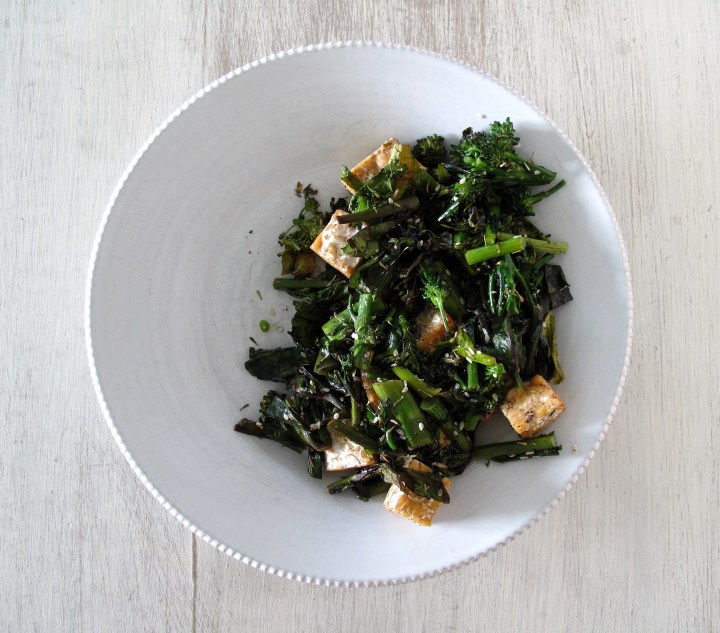
Sprouting Broccoli, Za’atar, Tempeh + Harissa Yogurt, serves 2

This is the kind of comforting bowl-food that I enjoy eating, always. Harissa, a north African hot sauce, is spicy and contributes a lot of the flavor. Add as much or as little as you prefer but keep in mind the yogurt balances the heat, as do the other ingredients. This is the sort of recipe that can easily be switched up depending. William is not so big a fan of tempeh, and I can imagine this would be just as good with any number of other protein types. Likewise, the harissa would be equally good mixed into a little thinned cashew cream for a different sort of sauce, sans yogurt. 

1-2 bunches sprouting broccoli, sliced into 2-inch pieces

coconut oil

6 oz. tempeh, cubed

1 Tbs. za’atar or more as needed

½ cup coconut yogurt

1-3 Tbs. harissa, to taste (I used Ottolenghi’s recipe, but you can also purchase)

steamed millet, to serve

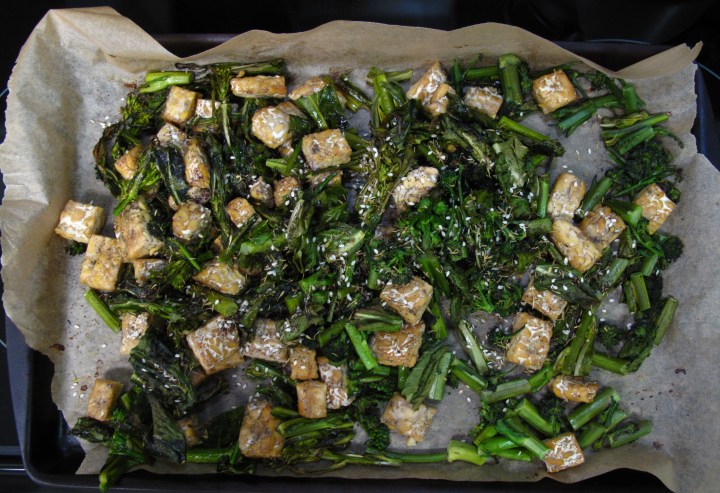
  • Preheat the oven to 375 degrees F. Line a baking tray with parchment paper and toss together broccoli pieces, tempeh, za’atar and a little coconut oil. Roast for 20-25 minutes, stirring once or twice throughout.
  • While the broccoli is roasting, stir together the yogurt and harissa. Start with a small amount of harissa and adjust according to taste.
  • Once the broccoli is done, serve with steamed millet or another grain, and top with harissa yogurt.


Reference:

Head, K.A. and Kelly, G.S. (2009). Nutrients and Botanicals for Treatment of Stress: Adrenal Fatigue, Neurotransmitter Imbalance, Anxiety, and Restless Sleep. Alternative Medicine Review, 14 (2), 114-133.
 

a powerful place: running, faith, life lessons

a powerful place: running, faith, life lessons
IMG_3916
I want to stand as close to the edge as I can without going over. Out on the edge you see all the kinds of things you can’t see from the center.  – Kurt Vonnegut


I’ve shared little snippets about my running injury over the last year or so, and even more about the upheaval to do with my eating disorder which came to the surface when I stopped running. My thinking about my body and my relationship to running was exceptionally anxious, fearful, obsessive, and controlling, and it took me a while to become aware, accept, and then work on that. At the same time, I feel less anxious and obsessive, and much more connected and active in my faith through running. This is a continuation of my processing, and I’ll share a summary at the end of this post:


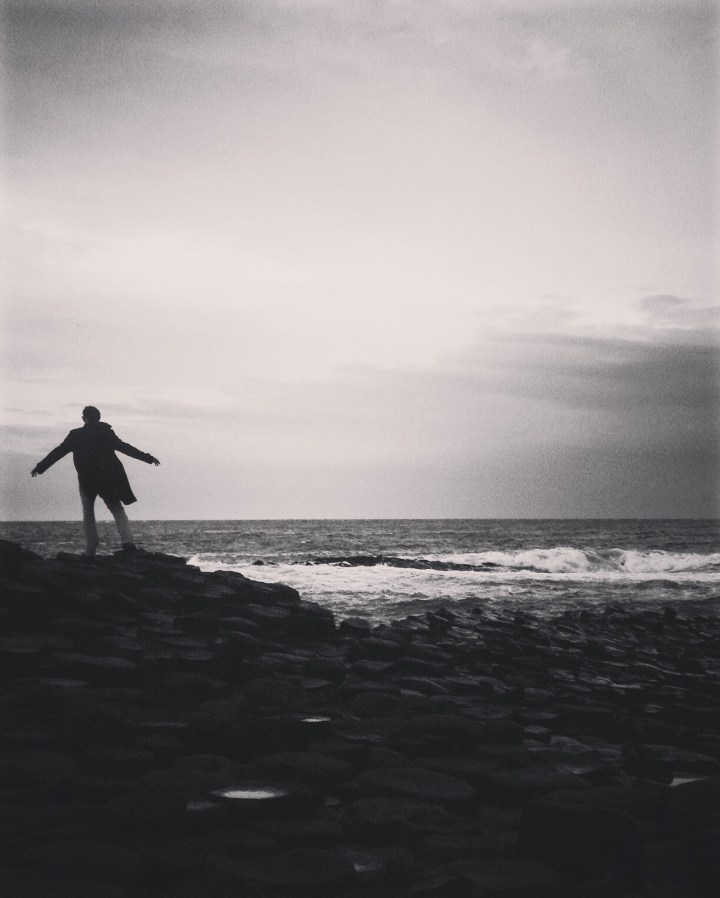
Something changed one day. Or perhaps it was a gradual transition and one day it came into awareness. I was running in Alton Baker Park. It was mid-February and I was on the outer edge of Pre’s Trail and I had this thought: What if it all just doesn’t matter? What if all these things I’ve been worrying about and building up are not big deals? What if I set them down and walk away? What if this were my last run and tomorrow I go back to riding horses instead? Immediately, the response was there. It was a very noncommittal shoulder shrug saying, Sure, that would be fine. 

The manic part of my brain fired back, You’re thinking that because you’re in the middle of a long run, in your happy place. You won’t be so happy tomorrow when you’re not experiencing this. There was fear in that thought, the fear of the what-ifs related to my body and my desire to control it. Those fears have plagued me.

But over the next several weeks, I kept circling back to that shoulder shrug, that lets not give such a fuck attitude. And I think right there I set down a little of the load, the attachment to an outcome, and there has since been a little space between where I’m at in the moment and what I wish for the future with running.

I am a little less attached to it, and certainly less anxious. On days when my feet or legs or body hurts in ways that are unexplainable, I’m often able to set down the pain and feel it only in the moment, not worrying so much about whether it will be there in the next moment, in the next day, in the way of the things I want to accomplish out there. I’ve stopped printing my weekly training plan and some days I have no idea what the next day will bring, nor do I overly care so much. I used to know every detail of what the week ahead would hold. 

I really don’t know what led to the change in my relationship with running, but because it was important, I prayed about it. I prayed for well over a year, often desperately. In January and February of last year, when I was not running, I was at a low point. William tried to console me one evening, It’s just a little injury. Give it a couple of weeks and you’ll be back to normal. You’re fine. 

It’s not, though, I responded. This is major. This is going to take a very long time. I don’t know how but sometimes I just know things. I knew the ‘little’ injury no one could explain was not so little, that it went way beyond the physical, that it was going to change me. That I had a long climb down before I could start climbing back up. In my desperate conversations with Jesus, I asked him to make it obvious if the answer was no, if I needed to set down this running hobby. I asked him to slam the door shut in my face and please, oh please God, just take away my desire to run. Help me find other hobbies. Help me find balance that is healthy. Help me not trade one obsessive, addictive tendency for another, i.e. food for running and vice versa.


IMG_3875


He did not slam the door shut in my face. There was a crack, and I cautiously, fearfully tip-toed through it, all the while expecting it to still slam closed. Even so, I’d catch glimpses of affirmation, out of nowhere, often on days that were otherwise real downers. One came sometime in the fall. I was in the middle of a run, in pain, frustrated, and a little depressed about the situation. Even so, I was like an earthworm; I could feel the light at the end of the tunnel, even if I could not see it. That little gift of His affirmation was enough to keep me trudging upwards through the mud. 

At some point, months before that February run in ABP, I stopped praying about running or physical healing without even realizing it, and my conversations with Jesus were more friend-like, not so tied to an outcome, and more in line with asking for direction with the big-picture of life, and not some non-essential hobby.

It’s often hard to say where one story ends and another begins. I don’t know when I began identifying myself as perpetually injured, or not good enough, or not worthy enough to go after goals. Or when I decided to set down that story and begin another one. It probably doesn’t matter. And I can’t really explain it, not even to myself. Why running? And why share about it? Why write and have an often too-personal blog? During the past year of prayer, several things became clear: It’s not really about me and there’s a purpose here that I don’t get to understand right now. I have some unsettled, fuzzy, too-big-to-understand running dreams that won’t go away, no matter how much I try to make them. The door keeps quietly opening, little by little, and though I’m afraid to try, I hear Him asking me to keep walking with faith, a few steps each day.

Like that day in Alton Baker Park, more recently on another run that wasn’t going all that well, I had another flash of realization. I realized I feel in a very powerful place these days, truly as if there is an energy in my physical and spiritual self not entirely of me, as this unexplainable journey I’ve been on, with all its painful, difficult, individual traumas is part of the transition upwards, out of the mindset of I can’t, I don’t get to, and I’m not good enough that I’ve been carrying around during this lifetime. In that moment, the journey itself sparkled beautifully before me, with all its ups and downs. I realized then I want to explore a concept I haven’t explored in a while: What if I can? What if I get to? What if I am good enough? What if I stop worrying about whether the door will slam in my face and instead concentrate on finding out what’s on the other side of the door? 


IMG_3989


I want to find out what I’m capable of; I want to find out what He is capable of doing in me. I want to do His work. I want to walk to the edge where He leads and see what He has for me to see. Right now, for whatever reason, running is part of that. And even though I feel in a powerful place, there are still doubts. There are days and little moments where I take a step back, look at the bigger picture of how I currently feel physically and what quiet affirmations I feel in my heart, and tell myself, lady, you’re either really fucking crazy, or on to something. I prefer to believe I’m on to something.


Reflection: I want to make clear this is my journey, and I’ve had a whole slew of professionals advise me. I do not recommend running through an injury unless under the supervision of a professional. I also have explored, in depth, my relationship between running, my eating disorder, and other behaviors that allow me to gain control. Running has always been intricately linked to my eating disorder, as I began running shortly before I began controlling food, and it likely served as a catalyst for the ensuing food and body image problems to surface. With that being said, those problems were there long before I began running regularly, and running has become one of the ways I deeply connect with my faith, with where I learn about myself, with how I finally came to love and feel comfortable in my body, and where I let go of other life problems. Two great articles I’ve enjoyed over the last few weeks include Gena’s reflection on How it Feels to Leave an Eating Disorder Behind and When Exercise Becomes an Addiction. I believe there is a place for endurance and/or competitive sports in the recovery process, and really enjoyed Julia’s podcast interview with Rich Roll on How to Take Ownership of Your Evolution, especially his thoughts on how athletic endeavors can fit into the recovery journey.


Mejadra with Swiss Chard + Tahini

Mejadra with Swiss Chard + Tahini

IMG_9494

IMG_9424


I go on stints where I cook almost exclusively from one cookbook or blog. Actually, I take recipes, apply their concept, and change almost everything. I’ve been cooking from Ottolenghi’s Jerusalem lately.

I also share recipes on Food52 sometimes and I received the kindest comment on my beet and lentils with flatbread there. It made my whole week and reaffirmed why this blog remains mainly about food. The comment made me think, too, about the decisions I’ve made that were true turning points. One of those was during my senior year in high school when I decided to go to university rather than culinary school, and then after university, deciding to find a job rather than going back to Ireland for a course at Ballymaloe.

Sometimes I feel as if I was born to cook and feed people. I’ve loved everything about cooking for as long as I can remember. I love the creativity of selecting ingredients and flavor combinations. I love both its meditative aspects and the more fast-paced balance of doing multiple tasks simulanteously. I love sitting down to a special meal with William and sometimes friends or family, turning off the phone, computer, TV, pause and say grace, and then invite in the experience of enjoying a meal.

I remember bringing a beef and mushroom stew over to a friend’s one time in college, and how her then-boyfriend took two bites and then paused, looked at me, and said, Bec, I can tell this was made with love, before proceeding. And it was.

I know a lot of my friends and family do not get the food I make. I’ve long felt sensitive about it, as I’ve been cooking creatively since the beginning. When William and I first began dating, it was summer and I was in town for a week. There was very little to eat in my college house as my roommates and I were largely absent for the summer. I invited him over for lunch, knowing there were approximately five ingredients to make a meal—and I knew they could combine to provide a pretty spectacular combination. William survived college up to then on his grandma’s spaghetti sauce, made by his family and frozen in huge quantities, tuna sandwiches, plain spaghetti, pizza, and kraft mac + cheese. Anything outside of that lineup was super adventurous, and he didn’t exactly appreciate what I thought was a fabulous summer lunch—with ingredients largely from my self-watering garden. For months after, he approached every dinner I’d make with trepidation, knowing it was going to be awful, and a breach from his standard American diet. But he’d try it anyway. Nine times out of ten, he’d end the meal telling me he was pleasantly surprised, again. The weird things I made actually tasted good. All he had to do was try.

When left to my own devices, I tend to veer strongly in the direction of cooking with middle eastern influences. I don’t know exactly when I picked this up as I didn’t try the cuisine until mid-college at least. I like the combination of savory and sweet grains and spices, the vegetable-heavy emphasis of the traditional recipes, and the infinite possibilities as even the simplest of ingredients can taste rich and flavorful and nourishing.


IMG_9476


As I reflect on the statement above, I feel as if I was born to feed people, I realize I still haven’t found exactly what this means for me. I know my place is not actually feeding people in the standard chef/culinary sense. I know it is not in producing food, as I also once contemplated. Perhaps it is in sharing recipes here or elsewhere, but more likely, it might be in feeding people something other than actual food, in the form of kindness, hope, understanding, or inspiration. Ultimately, I know for me to be able to do that with authenticity, I have to be able to provide it to myself first.

William has been working late these days, and I’ve often been feeding only me. So I’ve been cooking with more mindfulness, taking recipes and adapting them intuitively to what I need, trying to eat meals a little more slowly with less distractions. I’ve been focusing on allowing the process to fill me up in ways that stretch far beyond the meal itself, to let light shine into the dark internal corners I’m afraid of, and let self-compassion and love in, when for so long I’ve projected it only outward, onto others.

I’m at a real turning point just now, and it feels like a good one. I’m finally coming to know and appreciate me. I’ve been learning (and still often failing) how to feed myself the essential nutrients that come from genuine self-care, rather than merely “nutritious food.” This is one of the meals I’ve been enjoying lately through the process.


IMG_9507


Mejadra with Swiss Chard + Tahini

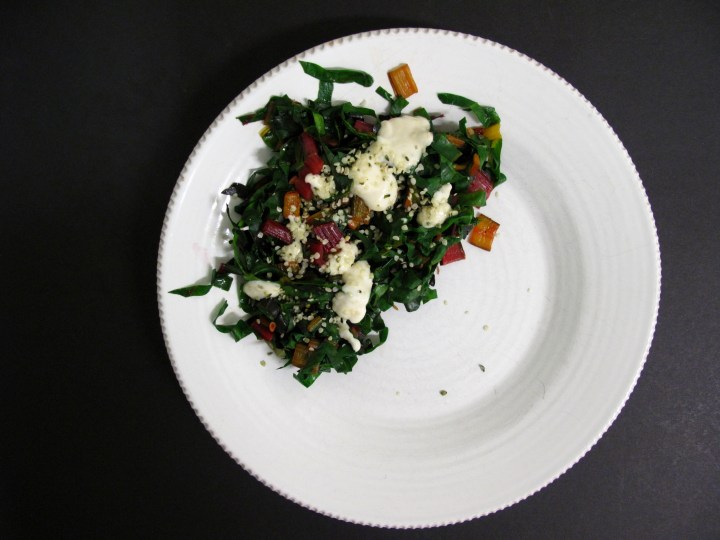
The inspiration for these two recipes are drawn from Jerusalem. Mejadra is an ancient dish in the Arab world, considered a meal for the poor but fit for kings. At its simplest, it is rice and lentils cooked together with caramelized onions. Crazily enough, those simple ingredients can taste heavenly. I’ve incorporated a few wonderful spices in keeping with Ottolenghi’s version, and for William, I’ve added raisins. He loves raisins. He added another handful for good measure as he gobbled it up.  The Swiss chard and tahini-cream will make for a nice side. I’m loving Swiss chard lately, when for so long I discarded it completely. The trick, I think, is a quick sauté. 

For the Mejadra:

1 very large onion (1 1/2 lb.), sliced thinly into rounds

2 Tbs. olive oil, divided

1 tsp. ground cumin

2 tsp. ground coriander

1/2 tsp. turmeric

1 1/2 tsp. allspice

1 1/2 tsp. cinnamon

1 tsp. pomegranate molasses

1/2 tsp. salt

pepper to taste

1 cup long-grain brown rice, soaked and rinsed

1 cup lentils

1/2 cup raisins, optional

3 1/2 cups water

  • Begin by soaking the brown rice for at least 8 hours in a large bowl of water with a little apple cider vinegar or lemon juice. This breaks down some of the phytic acids which can bind the zinc, magnesium, calcium, and other important minerals. Prior to cooking, rinse and drain the rice.
  • In a large sauté pan, add 1 Tbs. olive oil and heat to medium-high. Then, add in the sliced onions, cook and stir for 3-5 minutes, and then turn down to medium-low and cook, stirring occasionally, until they soften and caramelize, about 25-30 minutes.
  • While the onions are cooking, add the remaining 1 Tbs. olive oil, spices, rinsed rice and lentils, pomegranate molasses, raisins, and water to a medium pot, and bring to a boil. Once boiling, turn down to low, cover, and allow to cook for 40-45 minutes, or until the water is absorbed.

For the Swiss Chard:

1 tsp. olive oil

1 large clove garlic, smashed and minced

1 bunch Swiss chard, stems chopped, leaves sliced

salt and pepper to taste

  • In a medium sauté pan, heat the oil over medium-high. Add garlic and chard stems and allow to cook until beginning to soften. Add a little water as necessary to help the chard stems soften up.
  • Then add in the sliced leaves and heat just until they begin to wilt. Remove from heat and add salt and pepper to taste.

For the Tahini-Cream:

2 Tbs. tahini

1 1/2 Tbs. lemon juice

1 small clove garlic, smashed and minced

2-4 Tbs. water, as needed

salt and pepper, to taste

  • Whisk together all ingredients in a small bowl, thinning as necessary with water.
  • Spoon the tahini-cream atop the Swiss chard as a side to the mejadra.