connecting the gut and the nervous system

I had an emotional couple of days last week. If you know anything about the Enneagram personality archetyping, I’m most definitely a type 4, so deep and vast emotions are a familiarity for me. That aside, I was emotional. I cried a fair bit and felt my own little volcano of melancholy come out in periodic waves. One such wave was on a run last Thursday morning. Most long-term runners know certain runs can be incredibly therapeutic and where we work through challenging emotions. This was one of those.

When I returned to the house after finishing and began my cool down stretch, I had a familiar mild, dull pain in my abdomen set in, and it continued throughout the day. As an old familiar, I knew exactly the cause of the pain when I first noticed it. As a sensitive child, I grew up with routine anxious ‘tummy aches,’ on Sundays before a new school week began, couldn’t eat before stressful events, and generally would feel knots in my middle when emotionally distraught.

Unsurprisingly, there’s a reason for this.

For anyone that likes to show up to an athletic race early in the morning, stand in line at the porta potty, and then hope to put your best foot forward in your event of choice, or perhaps engage in a similar nervous-inducing event in another area of life like a job interview, you know that when you’re anxious, nervous, or otherwise stressed, digestion is quite a bit off. That’s because the gut and the brain are intimately connected. The nervous system has several branches and one section, the enteric nervous system (ENS), is often called ‘the second brain.’ The ENS is the section that runs through our digestive system and is connected to the actual brain through a large nerve that runs through are central body and communicates in both directions. This is called the vagus nerve.  When we have a really emotional episode, like I did, our brain can send chemical messages to the gut that change our gut bacteria, leading to low-grade gut inflammation and possibly GI distress. Similarly, if we have a particular imbalance in the gut itself—through food that doesn’t sit well or isn’t best for us, or inflammation and excessive permeability to the gut lining for another reason, we often notice behavioral changes as well. For example, persons that have chronic GI distress often also experience one or several mental health symptoms, including anxiety, depression, fatigue, confusion, brain fog, poor memory, migraines, and more.


When we have continued stress, whether in our body or in our mind, the nervous system slows down or impairs digestive function. This is why it’s best to not eat when we’re in a stressful mindset or running out the door in the morning before work or while rushing between meetings. And why one simple way to improve digestion is to single-task while we eat. That is, eat in a quiet, peaceful environment and do only that. Just eat, enjoy, and actually chew the meal. And its why major stressful life events often precede major health symptoms and then diagnoses. If you struggle with digestive conditions such as one of the Irritable Bowel Diseases (Crohn’s, Ulcerative Colitis, Diverticulitis, etc.), IBS, GERD, ulcers, chronic constipation or diarrhea, and any autoimmune disease, your condition will often respond favorably to stress-reduction techniques. For athletes with any of these conditions, we often argue that our physical activity is our source of stress reduction. That may be true—in theory—but often our activity load is contributing stress when our physical and mental systems are way out of balance.

True rest and relaxation, such as spending an hour or more per day doing absolutely nothing, deep breathing, meditation or prayer practices, spending quiet time in nature, gardening, yoga, painting, or other quiet activities without a screen are sometimes exactly what we need most to begin digestive healing – not a fancy, stressful, rigid new eating plan. (Gasp! I know; how dare I say that as someone that works with people on food!)

Otherwise, I love to work with herbs for the nervous system. In fact, nervines, the category of herbs that work on the nervous system, are by far the ones I work with and recommend the most. Lavender in this blueberry lavender smoothie bowl, and skullcap, tulsi / Holy Basil, lemon balm, and lavender in this stress-reduction tea or herbal latte are just a couple relax-inducing herbal ideas to consider.

The nervous system is one of the primary categories of digestive imbalances I look for when working with individuals clinically with impaired digestion. Often when we’re experiencing chronic GI distress, fatigue, or anxiety, there will be imbalances in several categories, and we begin working on the areas that appear most pertinent. I shared about the immune response and subsequent inflammation in part two, gut microbes and dysbiosis in part three, and a tip to support digestion and absorption in part four. I’ll explain remaining categories in future articles.

And If you’re tired of dealing with your wonky GI and would like to get back to feeling and training well, I invite you to reach out to me for more personalized support.

References:
1: Lipski, L. (2012). Digestive Wellness (4th ed.). New York, NY: McGraw Hill.

Answers to the Big Questions and a Hearty Runner’s Brunch Hash

Lately, I’ve returned to reading two books. First the Purgatorio, the second in Dante’s Divine Comedy. My former English professor and deacon at my church in Corvallis has been leading a weekly class lately guiding us through the Purgatorio and the timing feels just about right since the class began the Wednesday of Holy Week and is leading us through this continued period of staying at home and distancing. Purgatory—the place between two more known-of places—seems the perfect description for where we all are now.

If there’s anything I can pick up from Dante’s 14th century poem, it’s that it gets easier as we keep going.

The other book I’ve begun again is Sajah Popham’s Evolutionary Herbalism: Science, Spirituality, and Medicine from the Heart of Nature—a reading I encourage everyone, yes everyone to read. For it guides you back to a perspective I think we all had as children and lost along the way.

I’ve been considering a lot these last few weeks. About this space, this encouraging journal and recipe guide of sorts, my role as a nutritionist and in the community, health and true wellness, and of course, nature.

On that note, I wrote in two questions for a couple of favorite podcasts a few months ago and surprising to me, both questions were answered by the respective individuals this past week. Unsurprisingly –if you know me—my questions were on the topics of sustainability and having a lower ‘footprint’ as a company, and on navigating faith and spirituality amongst busy seasons and family traditions that don’t partake in that faith. I know. I know. I like to ask the tough questions.

So why am I bringing all that up here? This past week my big questions semi-paralleled with those of Brett Farrell, the founder of Territory Run Co., for which I am a content ambassador and contribute seasonal articles. Brett spoke about his own big questions, the clothing industry’s own climate footprint, challenges with community, and more. Check out those here and here. As well as recent contributions on the Territory Run Journal – there are several excellent and thoughtful articles there lately.

What I was really reminded of however, was that in a conversation with Brett about a year ago, I spoke about the draw of trail running, the joy and peace and healing it has brought me personally, and about getting to the know the medicine around me—literally coming to know the plants I spend time with on the trails. Though I’ve only written or spoken about it in pieces, I came to an interest in herbs and herbalism like a lot of individuals. I was really sick, in a way that modern medicine wasn’t going to cure or even temporarily fix. And after a while of taking various herbs and formulas which my doctor gave me, and around the same period spending more of my running hours in the forest, the plants reached out to me and pulled me in, sometimes sharing themselves in profound ways –like being pulled to a stop suddenly alongside a trail, staring captivatedly at one, and (internally) asking, who are you? Crazily enough at times, I’d find I had my answer when the plant’s name simply came to the edge of my tongue, when if you’d asked on any other day, I wouldn’t have known it.  In fact, it happened again today.

And then Brett asked me another ‘big question’ about what it is I really want people to know in regards to nutrition and health. My answer is one I still will give and one I’ll likely give for the rest of time. What I really want you to know about nutrition and health is that if you get quiet enough – go deep enough into the forest’s eternal wisdom, and your own—you’ll find you already have the answers to the questions you seek.

To explain this more since the concept can be a little esoteric, I’ll refer to a couple lines from Sajah’s first two chapters:
To begin gathering natura sophia (the intelligence of nature), we must learn to see beyond the limitations our modern world has placed upon our perception and see the living intelligence of the Earth. And this can only be done through gnosis cardiaca—the knowledge of the heart.

and

To truly enter the kingdom of nature we must suspend our rational thought, let go of our knowledge of botany and chemistry, even dispense with our systems of herbalism—for any potential interference of the mind will get in the way of our capacities to directly perceive the intelligence within the plants. To move beyond herbal knowledge and into herbal wisdom, we must tread the pathway down the mind into the inner temple located just inside our chest.

Bringing this back down to earth even a little more, the answers to these big questions don’t come easily, they don’t necessarily just appear when we ask them or when we want them to. There can be many layers to the answers of how to be a better patron of the planet, or how to balance a spiritual life in faith with the goings on of the ‘real world,’ or how to heal – truly heal the body and mind.

Over time, I’m beginning to realize my role here is to educate about true wellness, about true healing, to be more of the guide—the Virgil and/or the Beatrice (though I claim no Godlike abilities)—and no longer the lost and hurting Dante who I was for a long time. To provide encouraging words yes, and recipes to nourish the body yes, and with those working with me clinically, proven scientific strategies to heal root cause imbalances yes. But it’s also to remind you, to remind us, that we also have the answers. That we’re not victims.

In every relationship whether it’s with me your nutritionist, your coach, your chiropractor or PT, your family and friends, your life partner, or with the plants in your window box, yard, locally farmed vegetable box, or forest, there’s an opportunity for a two-way conversation, a partnership to come to the answers that are already within you waiting to be revealed.

Maybe that’s the point of this slow down period we’ve been given, for I know it’s not for many millions to suffer. Maybe it’s the time to return to our childlike ways, picking the dandelions and blowing our wishes into the big questions, letting the answers present themselves in their own time and way.

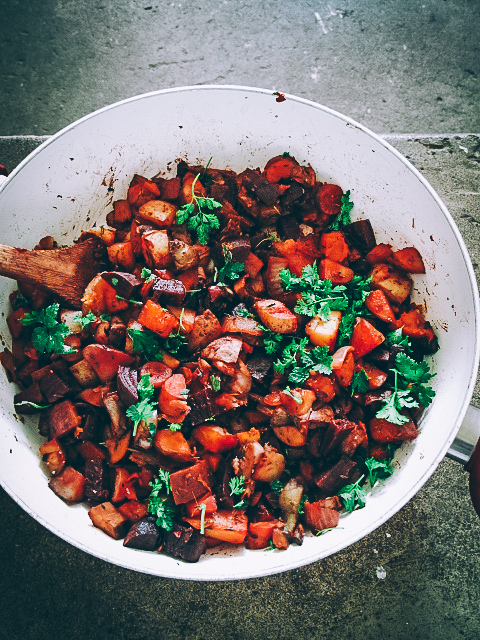
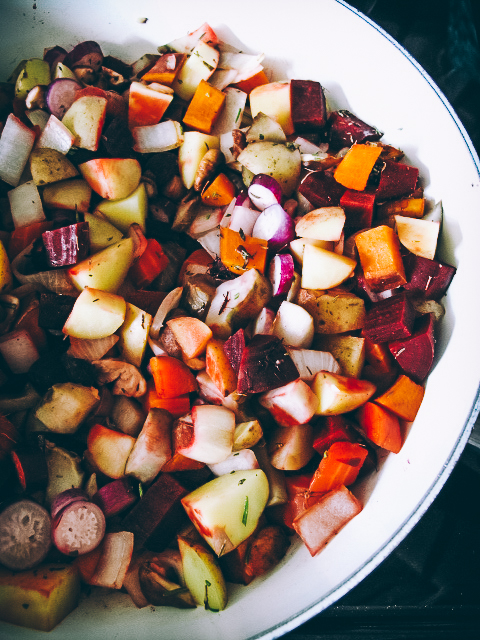
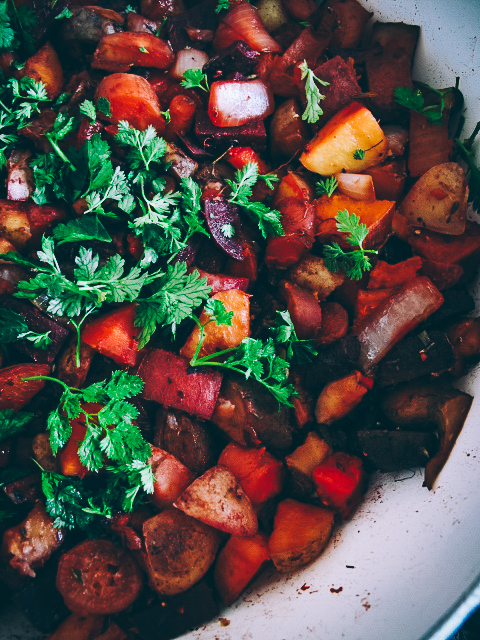
Now for this hearty brunch hash.

You’ll need a hearty, though not heavy, meal to refuel the system after your time in the forest– or wherever you go to dwell in your own big questions and their answers. I’ve shared the recipe over on the Run Journal at Territory Run Co. Get the full article and recipe here.

Falafel Loaf, and remedies for our stressful times

I had an idea of something different that I’d share here today but the past few weeks, with the news cycle, panic-stocking, and fear of a pandemic virus circulating, an entirely different reassurance presented itself to me this morning, so I’ll share it with you.

I was listening to a short meditative story on the goddesses of hearth and home, with the primary archetypes being Hestia or Vesta in Greek or Roman mythology. I was reminded that Hestia’s name means hearth, fire and alter, and that where we create warmth in our homes can also be our alters. Literally—where we create our meals can also be our sacred space.

So often when our minds run ahead or circulate around in fear or worry, it helps us to pull our energy down from that space, down from our head and into our body. This is partially why I find so much joy in athletic activity, as the meditation of physical movement is where my mind can more often turn off. And it’s partially why the kitchen is my favorite space in my home, the figurative center of the home, as it often is for those who love to cook.

For most of us, cooking and providing for ourselves and families are tasks that go on in the background of our lives, not tasks that we consider noteworthy or adventurous undertakings. But as Hestia’s name portrays, they can be powerful and sacred tasks, helping us to do what we’d otherwise avoid, drawing our minds down into our physical bodies, tuning into the senses of using our hands, noticing the smells, sounds and flavors of cooking.

As the onslaught of emails about immune health have reminded me in the past few days, combatting our daily stresses—literally not allowing the mind to run away into worries or coulds about the unknown future—is a powerful antidote to the weakening effects of that stress on our immune systems.

As the weather and temperature shifts into spring if you’re in the northern hemisphere, or fall in the southern, traditional medical wisdom tells us that now is a time when the shifting environmental patterns can invite in more physical or mental illness manifestations. I suspect this is contributing even more to the increasing anxiety and nervousness, and outright fear of our neighbors and community members that we’re currently facing.

The best remedies to combat the anxiety and fear are tuning into the body, acknowledging what it is feeling rather than running or distracting away from it, tuning into the senses, cooking nourishing meals, selecting an enjoyable kitchen playlist or podcast to invite in more relaxation, eating warming and nourishing foods, and deep breathing.

Falafel Loaf, serves about 4
Recipe updated slightly: 3/12/23

-This is great way to incorporate the flavors and ingredients that support our systems as we shift into spring: pungent vegetables like garlic and onion, spices to support moving the winter sluggishness from our liver and digestion including cumin, coriander, and cardamom, and ample herbs like cilantro for the same. If this particular herb is not your favorite, sub in parsley or mint instead.
-With all the flavors of falafel but with easier prep and the ability to put it in the oven and walk away for a while, you’ll love this loaf-version of falafel. Plus, it allows for time to focus on the side ingredients, which in a pinch are sauteed or braised cabbage, and the quick tahini sauce linked below.
– I haven’t tried making this without the egg since I’ve had limited success with egg-free veggie loaves or burgers staying together, but ground up chia or flax seeds would be my suggestion if that’s needed for you.

– You may use another high-protein whole grain flour instead of the chickpea flour, such as amaranth, quinoa, or sorghum flour.

3 garlic cloves, peeled + roughly chopped
1 large onion, roughly chopped
2 tsp. ground cumin
2 tsp. ground coriander
¼ tsp. ground cardamom
1 ¾ cup cooked chickpeas or 1 can, drained and rinsed
1 Tbs. apple cider vinegar
1/4 tsp. sea salt + more to taste
½ tsp. freshly ground black pepper
1 tsp. baking soda
1 egg
¾ cup chickpea flour
¾ cup finely chopped cilantro

Suggestions to serve with:
Tahini Garlic Sauce
Socca
Lettuce and/or sautéed greens
Seasonal braised cabbage

  1. Preheat the oven to 350 degrees F.
  2. In a food processor, pulse the garlic, onion, and spices, scraping down sides as needed, until coarsely chopped, 30-45 seconds. Then add the chickpeas and apple cider vinegar, and pulse again briefly. Transfer to a large bowl.
  3. Add the salt and pepper, baking soda, egg, chickpea flour and finely chopped cilantro. Gently stir to combine, being careful not to mash the mixture too much. Spoon the mixture into a 8 ½ x 4 in. loaf pan that has been lined with parchment paper. Smooth it down so its even, and then bake until the edges are browned and the center is completely set, about 60-70 minutes.
  4. Transfer the pan to a wire rack and let cool at least 15-20 minutes, remove from the loaf pan onto a cutting board.
  5. To serve, cut into big slices and drizzle garlic tahini sauce on top, serve with greens, socca, or other sides of choice.