Creamy Rutabaga (Swede) Mash with Mushrooms, Sage + Hazelnuts

For the past couple months, I’ve been cooking and taking a lot of inspiration from Gill Meller’s Root, Stem, Leaf, Flower cookbook. I say “cooking” but I rarely cook the recipes as written. Instead, I’ve learned my own energetics and the energetics of the season, and I adjust ingredients and amounts accordingly. Or the recipe technique doesn’t seem quite what I’m looking for and I adjust it somehow.

This is the type of cooking and eating that is the goal for all the individuals I work with in the nutrition clinic, but admittedly, it can take a long time to get there when one’s intuition is overwhelmed by inflammation, chronic pain, nutrition and food confusion, etc.

But back to the cookbook – Root, Stem, Leaf, Flower has been my favorite inspiration to cook from for the past few years. It’s hyper seasonal with produce common of the climate I live in, exceptionally British (meaning the seasonings and ingredients are very much of the region), and uses simple high quality ingredients in often novel and creative ways. The ingredient lists tend to be short and don’t require much beyond the produce and pantry staples at hand.

This creamy rutabaga mash with mushrooms is one such example of inspiration I took from Gill Meller last year. I first shared and published this recipe locally with a farming and food organization that I served on the board of for the last few years, the Willamette Farm & Food Coalition (WFFC).

Each year, WFFC publishes what is called the Locally Grown Guide, a printed and online directory of all the local food resources: farms, farm stands, CSA’s, grocery stores that stock local, and the like. This recipe first appeared in the 2023 edition of the Locally Grown Guide, but since we’re gearing up for a 2024 release (with new inspiration within the pages), I want to share the recipe here.

Plus this combo of creamy mashed rutabagas (also called Swede), mushrooms, sage and hazelnuts is incredibly tasty. It’s a true comfort dish using local–to Western Oregon as well as the UK–fall and winter ingredients. And it’s a good one for mid to late winter, when our ideas for novel and healthful (and seasonal) eating tend to wear out.

As you’ll see, this recipe is either a side-dish or a meatless “main component,” and it will need a protein on the side to balance out the meal. Even though many vegetarians tend to recommend mushrooms as an alternative to a protein source (and they do contain some protein), I don’t recommend just eating this on it’s own–most individuals will benefit from 20 to 35 grams of protein for main meals during the day–so pair it with a side of sauteed or baked tempeh, stewed and sage-ey garbanzos, or your choice of animal-based protein on the side. Another option is to pair it with a simple and delicious pot of lentils.

P.S. Lentils have been my often go-to the last few months. If you follow me on Instagram or read my newsletter, you’ll know why I’ve had them on repeat. :)
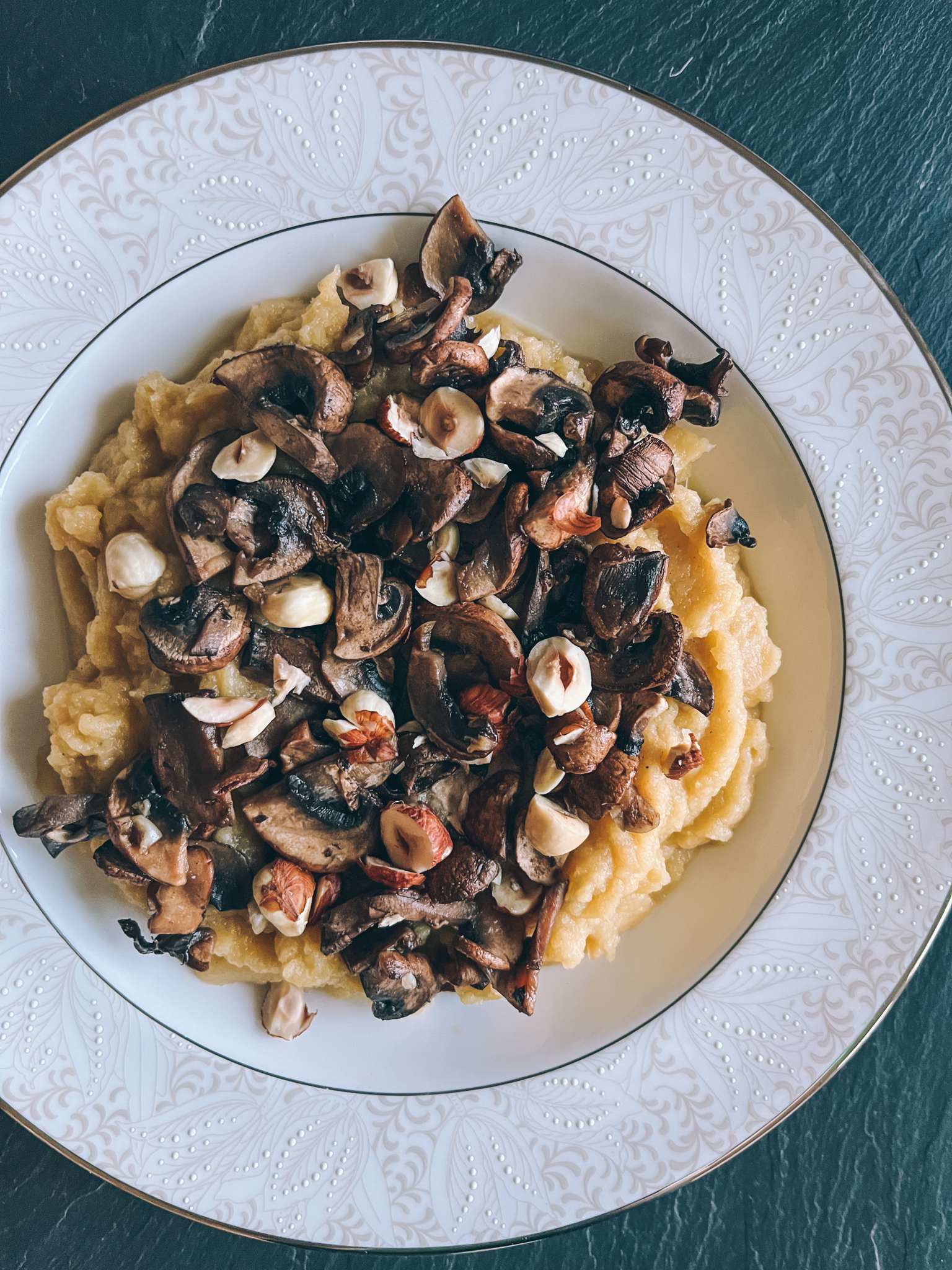
Creamy Rutabaga Mash with Mushrooms, Sage + Hazelnuts
inspired and adapted from Root Stem Leaf Flower by Gill Meller

Prep:  10-15 minutes  | Cook: 40 minutes  | Serves: 4

1 large ~ 1 ½ lb. (600 gr) rutabaga, peeled and chopped
1 Tbs. ghee or butter
8-12 fresh sage leaves
½ tsp. mineral salt, divided
⅛ tsp. ground black pepper
1 Tbs. olive oil or ghee
2 garlic cloves, minced
1 pound (450 gr) mushrooms, thickly sliced
A small handful of toasted hazelnuts, roughly chopped

  1. Place the chopped rutabaga in a medium pot and cover with water. Bring to a boil, then turn down to a simmer and cook for 25-35 minutes, until the pieces are completely soft when pierced.
  2. Drain the rutabaga with a colander, then transfer to a food processor or a blender. Add the butter or ghee, ¼ tsp. salt, about four small sage leaves, and black pepper. Puree until smooth, adding a splash of water if it is too dry. Set aside and keep warm. 
  3. Mince the remaining sage leaves. 
  4. Then heat the remaining olive oil or ghee in a large saute pan and bring to medium-high heat. Add the sliced mushrooms. remaining ¼ tsp. salt, minced sage leaves, and garlic. Cook the mushrooms for about 6-8 minutes, until they are tender, dark, and the moisture has cooked off. Then stir in the chopped hazelnuts and give it all a good stir. 
  5. To serve, spoon the rutabaga puree onto plates and top with the mushroom and hazelnut mixture. 

Notes:
– Rutabagas, which are also called swede in some countries, are truly underrated but you can swap them out for nearly any other root vegetable for a variation.
– Rutabaga belongs to the same family as broccoli and has compounds called glucosinolates, which can help with liver detoxification and can help
prevent conditions like heart disease and cancer. Hint: it looks like a large turnip but the interior flesh is more yellow.

Gluten Free Flour Tortillas or Flatbread Wraps

A few years ago, I started making various quick gluten-free flatbreads to use in meals when I wanted a grain but needed something quick, easy and different from the usual rice or quinoa or millet or buckwheat. I would often choose a slice or two of my whole grain gluten-free sourdough in that instance, but often I don’t have any bread handy either.

The flatbreads, made with just a couple flours, a pinch of salt and water, were a little lackluster, and William ate them unenthusiastically. Somewhere in the many months of making them, I happened upon the addition of psyllium seed husk. I also use psyllium husk in my sourdough recipe – it’s an essential ingredient for the stretch that gluten-free bread doughs will otherwise lack.

The psyllium addition has been a gamechanger. The flatbreads have become flour tortillas, or wraps, which I went over a decade without, and burrito size tortillas for various burritos and wraps – also a warm welcome after so long without.

The bonus is: these come together really quick! Like just as quick as the much less pliable flour/water/salt version. And if you only want enough for a meal, any leftover dough can easily be refrigerated until the next day, and rolls out super quick as you’re reheating leftovers.

Probably the only thing you’ll be wishing you had is an even larger pan to get these as absolutely large as you can possibly want them. :)

Gluten-Free Flour Tortilla or Chapati Flatbread

This is a quick and easy flatbread that can be used to make thin flour tortillas, or as chapati flatbread as a whole-grain addition to a balanced meal.

Prep:  15-25 minutes  | Cook: 20-30  minutes  | Serves: 4

12 grams / 2.5 Tbs. psyllium husk (rough husk form, not powder
240 ml / 1 cup warm water
180 grams / 1 ½ cups whole grain gf flour mix
  (or a 50:50 mix of  brown rice and sorghum flour)
¼ tsp. mineral salt

  1. In a bowl, whisk the psyllium husk and warm water. Within a few seconds, a gel will start to form. Set aside until needed. 
  2. In a separate larger bowl, stir the flour(s) and salt together, then add the liquids and mix with a wooden spoon until all the flour is mixed in.
  3. Then, give it a thorough knead by hand. Squeeze the dough through your fingers and work your way around the bowl, scraping off the sides as necessary. The final dough should come away from the sides of the bowl and be very springy to the touch. It shouldn’t be too sticky. It doesn’t have to be perfectly smooth – so long as it’s homogeneous with all the ingredients well combined and no clumps of flour or psyllium gel, you can proceed to the next step.
  4. Turn out the dough onto a lightly floured surface. Divide into 4 to 6 equal portions. If making four, this will yield burrito size tortillas or flatbreads – if you’re making them quite thin.
  5. Cover the pieces you are not currently working with with a towel to prevent them drying out.
  6. Use a rolling pin to roll out the dough into a thin tortilla, or if you’re wanting a thicker flatbread, you can also use your hands.
  7. For a tortilla, aim for very thin, about 1mm thick. This works best when your countertop is well-floured and you rotate the dough frequently to prevent it from sticking to the surface. As necessary, dust the top of the tortilla and your rolling pin with more flour.
  8. To cook: Heat a large cast-iron pan over medium-high heat. The pan is ready when a droplet of water sizzles on its surface.
  9. Place a tortilla into the hot pan and cook it for about 45 seconds. 
  10. Once you flip it, it should puff up in places with bubbles of varying size appearing. Cook on the other side for about 45 seconds to 1 minute. The tortilla is done when you begin to see large dark brown spots on the underside.
  11. Tip: If your tortillas are cooking/browning too quickly, reduce the heat. If they’re taking longer than a minute per each side to cook, increase the heat.
  12. Transfer to a clean dish towel and cover – this will help it stay soft and flexible. Continue cooking the remaining tortillas.

Notes: The tortillas are best served warm immediately after cooking, but can be stored for 1-2 days and reheated.
You can also store the uncooked dough in a covered container in the fridge for a day to quickly make 1-2 fresh tortillas as needed.

Observing the 20 Energies and How To Really Start Intuitive Eating

Every day in May is precious.

Where I live, the months of February through April are often the most challenging – January and the post-holiday, beginning of year hope always seem to fly by, but it’s in February, and March, and April that every day can feel like a grind. 

It’s not the sunshine that May can bring that necessarily turns it all around for me. I do love the sun and warmer days, but I also enjoy the rain. 

It’s the flowers and the fully leafed out trees that late winter and early spring lacks. The sheer density of foliage that has returned by early May.

A heavy blanket or extra padding of plant life that soothes my nervous system as I go out into the world, making everything hard, more bearable, and everything mundane or merely good, elevated. 

The twenty Gunas valued in Ayurvedic medicine.

One thing that is inevitably helpful from day to day, whether it’s in those more difficult late winter and early spring months, in May, or in the heat of peak summer, is tuning into and adjusting my food and lifestyle choices based on the energies around and inside me. What I’m referring to are the 20 Gunas in Ayurvedic wisdom. These are a set of 10 pairs of opposing qualities or energies that describe the different attributes inherent in all substances. 

For instance, a rock is hard. Feathers are soft. 
A rainy day is wet. A clear, sunny day in August in Oregon is dry. 
Fresh ginger is heating. Coconut milk and coconut water are cooling.  

What is so powerful about observing these qualities in your body and everyday life, and then using them to make subtle food and lifestyle adjustments, is that it’s a way to bring balance to your body, mind and health.

This daily adjusting is especially helpful as a preventative measure, but should also be used when there is clear illness or disease. Our body’s prefer to operate at homeostasis. Even with everything we do in our everyday that knocks the body out of homeostasis, its object is always to return to ‘baseline’ as quickly as possible. When there are too many blocks in its ability to do so, that’s when illness and disease, abnormal lab values, pain and aches, and injuries occur.  

The 20 Qualities are:
Heavy | Light
Cold | Hot
Soft | Hard
Oily | Dry
Smooth | Rough
Dense or Solid | Liquid
Slow or Dull | Sharp
Stable | Unstable or Mobile
Cloudy, Sticky or Slimy | Clear
Gross or Big | Subtle or Small

Observing and using the 20 qualities or gunas is a way to help the body system return to homeostasis. How you do that is for every quality that is out of balance, utilize the opposite quality instead. 

For instance, if I am currently experiencing hot, itchy skin rashes or acne, I know that adding more heating substances, foods, and heating spices will further increase the heat condition. Reducing the amount of spices in food, the type of foods that are hot in nature, and increasing cooling foods will help to clear the heat. Adding cooling, bitter vegetables like broccoli and asparagus and more cooling spices and herbs like fennel, coriander, mint and cilantro,  instead of eating a dish with garlic, onions, ginger, mustard seeds, and chili peppers will slowly (or sometimes quickly) assist in coming back to equilibrium. 

Or say I have a tendency towards being constipated and gassy, and I eat lots of dry, airy foods. Snacking on popcorn, granola, chips, crackers, yeasted bread, and raw, crunchy salads, which I eat while on the go, or eat while talking. All are dry and/or contain a lot of air.
A way towards balance is to increase the moisture — both through adding liquid into the foods consumed, and cooking foods until they’re soft, and by adding liquid fats and oils instead of dry, crunchy roasted nuts or seeds, etc.

A Daily Check-In

One way to begin to use this method is by doing a short daily check-in. Take a few minutes near the beginning of each day to journal or jot down the answers to these questions:

– What is Present today? 
– And What is Needed?

Getting more granular, it can sometimes be helpful to do a quick scan or review of different body systems, the mind and emotions, and the weather to help. Is something feeling dry? Hot? Slimy and mucousy? Slow and sluggish? Adjust your food and lifestyle choices with the opposite qualities, and see where it begins to bring more balance. 

As we weave into the summer months in the northern hemisphere, it’s often that the qualities on display in the environment become hotter, dryer (or more humid, depending on where you live), and this can be mirrored in the body more rapidly, especially when we likewise choose heating and drying foods. Here’s a recipe for summer that can give you a good example of how to balance the heat and dryness with cooling spices, coconut and gently cooked, more liquid-containing meals. 

Observing what’s occurring internally and externally and adjusting to quickly reach equilibrium is the very definition of true intuitive eating. It’s tuning into what the body needs rather than what the mind craves. 


If you’d like to know more, there is a free download in more detail to use this idea in the Resources section. I also work with clients in individual nutrition consultations, and as a Licensed Dietician / Nutritionist (LDN /LD) and Certified Nutrition Specialist (CNS), use medical nutrition therapy, integrative health measures, and a root cause approach to heal imbalanced health conditions. 

If you’d like to learn more about how you can improve your symptoms of imbalance, I’d love to speak with you in a quick phone consultation