Sourdough Pizza! {gluten + dairy-free}

img_8102.jpg

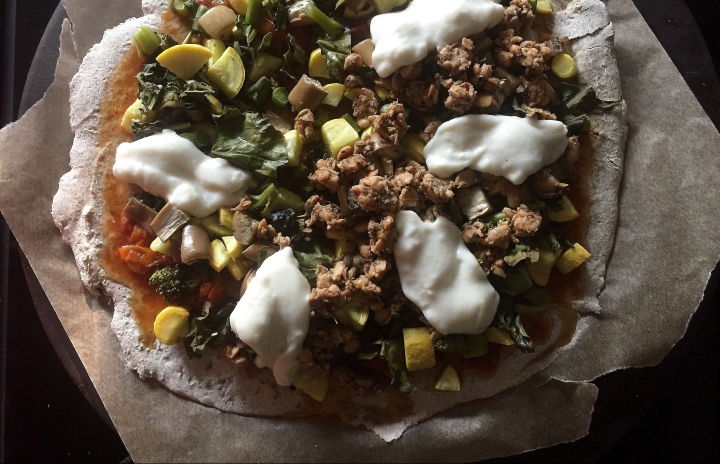
Every summer I have a meal that’s on repeat, usually as a way to use what’s coming in fast from the garden or otherwise to appease my cravings. Last summer that was kitchari and a green soup/sourdough pairing, the summer before that was zucchini noodles and pesto, and this summer it is this sourdough pizza with roasted vegetables. I’ve been making this pizza on the weekly for months and am not about to grow tired of it.
IMG_2756.JPGIMG_2759

If you’ve ever tried gluten-free pizza out on the town, you’ll likely know the experience is regularly disappointing and the ingredient list is fairly terrible. I’ve almost entirely given it up, especially too since there are very few establishments where cross-contamination is not a huge issue. (I once worked in a bakery. When working with flours, gluten is everywhere.) What I like about this recipe is that it’s super easy, takes only minimal planning ahead, is truly bready and delicious, allows me to feed my sourdough starter regularly without making way more bread than I can eat or throwing it out, and the sourdough fermentation allows for better mineral and vitamin absorption from the flours, leading to overall happier digestion and long-term health.

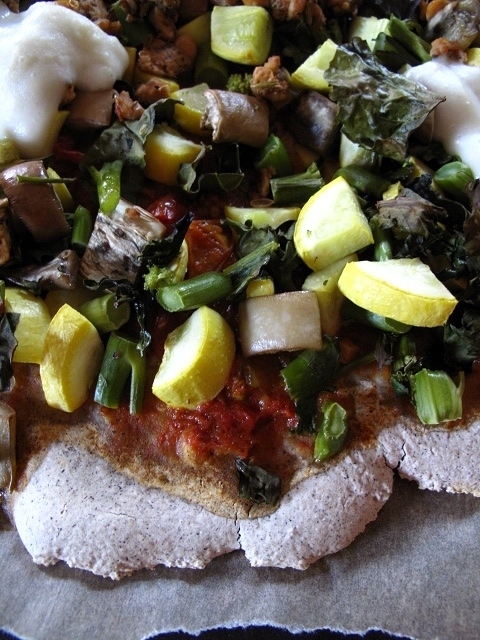
Prior to a few years ago, pizza was my long-time favorite food, and still is William’s, and this crust satisfies his discerning pizza palate enough that it actually qualifies as pizza, whereas most gluten and dairy free versions do not. Our favorite way to top this lately, in addition to the roasted vegetables and our house red sauce, is to slide a fried egg on top, but I deviated here and listed my topping ideas and recipes below.
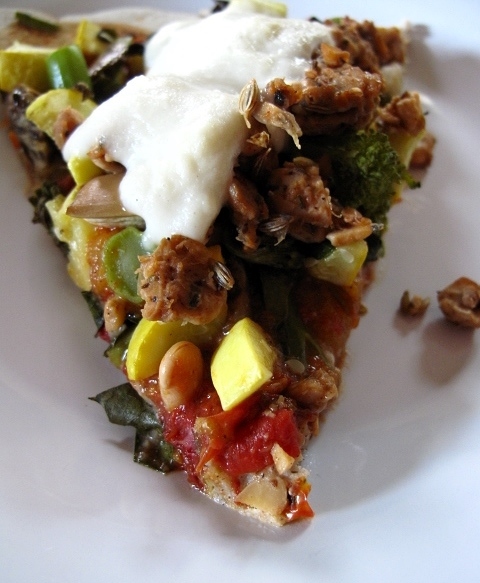
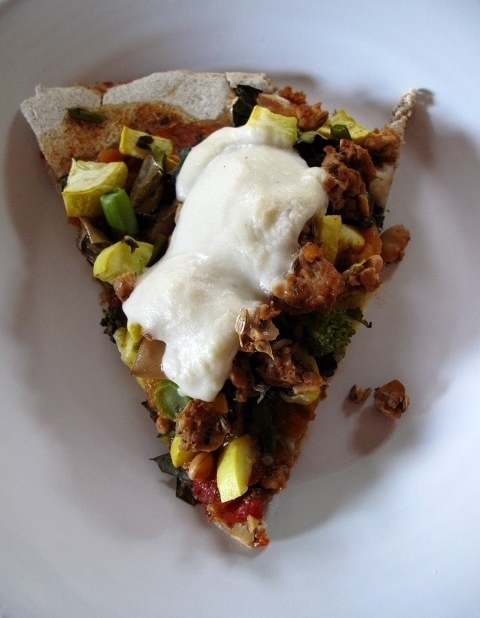
IMG_2763

IMG_2761

Sourdough Pizza Crust {gf + vegan}, makes 1 medium pizza, enough for about 3 people
This is adapted from King Arthur Flour’s sourdough recipe, which uses wheat flour. If you’re not gluten-free, the recipe should still work in the same quantities by swapping out the flour types. 

120g sourdough starter (50:50 buckwheat flour:water)
100 g hot tap water
150 g all-purpose gluten free flour
½ teaspoon sea salt
¼ tsp. yeast

  • If any liquid has collected on top of your refrigerated starter, stir it back in. Spoon 120 grams starter into a mixing bowl. Note: Then feed the remainder of your starter.
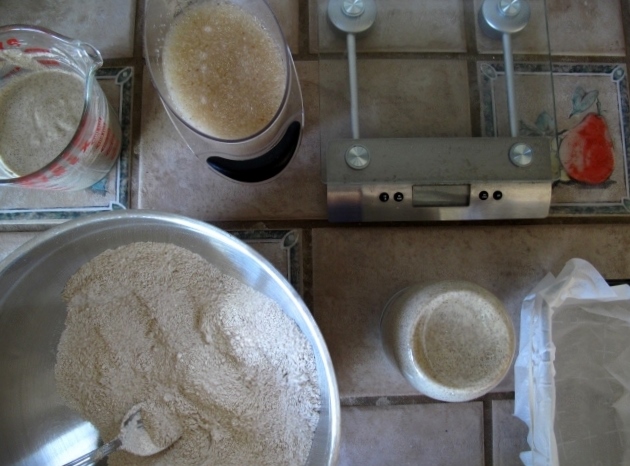
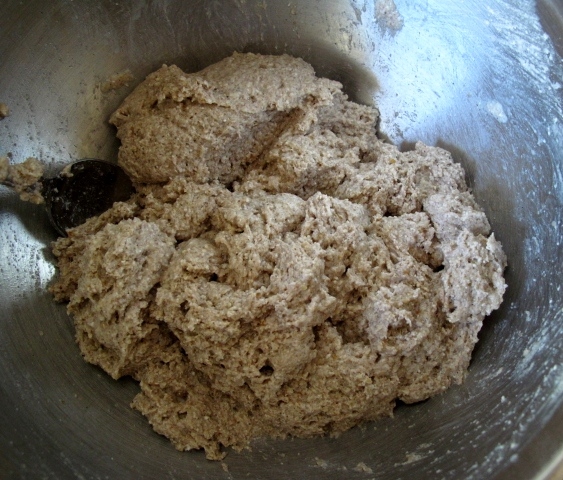
  • Add the hot water, flour, salt, and yeast. Mix to combine. It will at first be fairly wet. Cover the bowl and allow to rise until it’s just about doubled in size. This will take about 2 to 4 hours. The time it takes to rise depends on when you last fed the starter; a starter that’s been fed rather recently will react to the addition of flour and water more quickly than one that’s been neglected for a while. For a faster rise, place the dough somewhere warm (or increase the yeast). To slow it down, put it somewhere cool.
  • When the dough is risen, but still fairly wet, pour it out onto a pizza stone or pan and shape it into a flattened disk. Sprinkle the dough with a small amount of flour and then with a rolling pin that also has been lightly floured, gently roll the dough towards the edge of the pan; when it starts to shrink back, let it rest again, for about 15 minutes. Finish pressing the dough to the edges of the pan. Cover the pan, and let the dough rise until it’s as thick as you like, or, if you’re impatient, beginning topping as it is.
  • Towards the end of the rising time, preheat your oven to 450°F.
  • Turn the edges of the dough over to give it a traditional crust, or if you forget as I did above, it will still turn out just great.
  • Top with your preferred sauce and toppings, and bake for 15-16 minutes, or until the toppings are as done as you like, and the bottom is cooked through.

My current favorite toppings:
Our house pizza/tomato sauce
Sophie’s Cashew Mozzarella
Tempeh Sausage
Seasonal Roasted Vegetables
A fried egg for each serving

Whole Grain Gluten-Free Sourdough Bread

IMG_2671

This summer, myself and a group of fellow nutrition students and alums are reading Deep Nutrition for a book club we’ve started. The theme of the book is about the benefits of traditional diets, somewhat in the Weston Price tradition, for optimal health. I cannot yet comment on what I think of the book as I haven’t read enough to have a strong opinion, but the idea of eating more in the traditional style with its emphasis on whole foods as close to the source and as untouched as possible from chemicals and the like has been a major theme in my nutritional courses over the past two years. It is also a viewpoint I adopted years ago when figuring out how to truly recover from the diet culture I was immersed in and which was contributing to my eating disorder behaviors around foods. In my classes, we’ve also delved a lot into the need for promoting gut health, since a healthy, happily functioning gut can be thought of as the foundation to health in the body and mind far beyond our digestive region. This also happens to be a topic that is near and dear to me because it’s one of my main health struggles.

As I’ve mentioned before, The three major nutritional practices that promote gut health are eating more fiber, eating more fermented foods, and reducing sugar and refined carbohydrate intake.

IMG_2660

Last summer, after a particularly rocky winter and an autoimmune lab marker coming back positive, I began a very focused fine-tuning of my diet and lifestyle, in relation to improving gut health and my reaction to stress, since both strongly contribute to autoimmune conditions. As part of that process, I began a return to making sourdough.

Sourdough, as the name suggests, is a traditional fermentation process where wild yeasts ferment the flours, making them easier to digest because the yeasts create lactic acid, and which then break down anti-nutrients that plants make to protect themselves, such as phytates and lectins. These anti-nutrients block mineral absorption and the resulting sourdough can contain a lot more readily absorbable nutrients than the original unfermented flours or grains. Additionally, the process of fermentation more generally makes all the proteins in the bread easier to digest, and it is the protein that is usually causing an inflammatory reaction for those with GI issues like intestinal permeability, malabsorption, celiac disease, and other autoimmune conditions. Due to our hectic lifestyles and often very non-whole-foods diets, many, many of us have at least some of these symptoms and/or diagnoses that could be improved by adding more fermented foods, in addition to the other two gut health promoting practices of eating more fiber and reducing sugar and refined carbohydrates.

IMG_2648IMG_2651

For someone that is very sensitive to gluten like me, there’s also good news from eating gluten-free sourdough, as there are research indications that the fermentation process involved in making traditionally fermented gluten-free bread reduces the release of inflammatory compounds within the gut for someone who has recently adopted a gluten-free diet due to a celiac diagnosis, whereas consuming other types of gluten-free bread did not reduce these inflammatory responses1.

IMG_2655

Maybe it’s the tea-drinking, sweater-garbed, sourdough-baking wise grandmother in me, but I can’t help but think, of course, to that news. It simply seems that our systems recognize and respond better to the more traditionally made foods like sourdough. Whenever I have a GI flare-up these days, I definitely try to put extra focus on avoiding those refined gluten-free products and even whole grains that weren’t cooked really well, and emphasize sourdough for my grain consumption. I’m finding this helps me return to balance more quickly. For someone that doesn’t react so strongly to gluten, consuming sourdough instead of regularly-baked bread still contributes all the positive benefits I mentioned above about keeping the gut happy and increasing nutrient absorption.

So now, after more than a year of refining my gluten-free sourdough method, I have a recipe I feel good about sharing!

IMG_2673

Whole Grain Gluten Free Sourdough Bread, makes 1 sandwich/toast loaf
– Adapted from Baking MagiqueWholehearted Eats, and with tips from Bad Hunter Stories.
– I have a 100% buckwheat starter that I began using this formula. I did not add any outside culture, but simply created it from the wild yeasts in my home. This meant it took a little longer for the starter to get good and active initially.
– For the buckwheat and oats, I often start with whole grains which I grind in my coffee/spice grinder each time I bake and feed the starter.
– I only make this using a kitchen scale rather than measuring cups, and I’ve found I can interchange the flours, by weight, using this method.
– Using slightly different flours along with the the outside weather will result in needing to change the amount of water. Err on the side of having a fairly moist dough that still comes together. 

80 g brown rice flour
140 g cold buckwheat sourdough starter
110 g water
————–
350 g water at room temperature + more as necessary to reach the desired consistency
20 g psyllium husk
10 g ground flax seeds
————–
60 g of each
– sorghum flour
– oat flour
– buckwheat flour
– millet flour
– teff flour
24 g / 2 Tbs. sugar or honey
1 tsp. sea salt

  • In the evening: Mix brown rice flour, sourdough starter and water in a bowl and cover with a clean kitchen towel. Let sit overnight (about 8-12 hours) in a warm and non-drafty place.
  • In the morning: Mix water, psyllium husk and ground flaxseeds in a bowl and whisk until a thick gel forms. Set aside.
  • In a separate bowl mix all of the dry ingredients.
  • Add the sourdough starter that you made the night before to the wet ingredients and mix.
  • Add the wet mixture to the dry ingredients and stir with a wooden spoon until the flour is fully incorporated. Add a small amount of filtered water, if needed, to arrive at a moist ball of dough.
  • Line a loaf pan with parchment and dump the dough into the pan, smoothing it out into a loaf shape and leveling it into all the corners. Cover with the clean kitchen towel or plastic bag and put in a warm place away from drafts. Allow to rise for 4-6 hours. This will depend on your kitchen warmth. Mine tends to stay cool so I err on the side of 6 to even 6 1/2 hours usually.
  • Preheat the oven to 500°F/260°C. Once the oven’s hot, remove the towel or bag from the loaf, and score the top with one or two good slashes with a sharp knife.
  • Put the loaf in the oven and turn the temperature down to 450°F/230°C. Bake for 70 minutes or until the internal temperature reaches a little over 200°F/90°C.
  • Let the loaf cool on a wire rack for at least an hour, before slicing.

1. Calasso, M., Vincentini, O., Valitutti, F., Felli, C., Gobbetti, M., and Di Cagno, R. (2012). The sourdough fermentation may enhance the recovery from intestinal inflammation of coeliac patients at the early stage of the gluten-free diet. European Journal of Nutrition,51(4). 507-12. doi: 10.1007/s00394-012-0303-y.

buttercup squash soup with coconut, sage + quince

buttercup squash soup with coconut, sage + quince

IMG_2164


a few weeks ago, i discovered there’s a seemingly abandoned quince tree a couple streets over from us. instead of inquiring about picking the fruit to the nearby house or walking my ladder down the neighborhood and being for real about the situation, i instead ended my marathon-season track workouts for weeks by practicing my plyometric jumps into the lower branches, snagging one golden floral fruit each time, and smuggling it’s precious but ugly self back home to add to my for-soup collection.

i had an idea in my head about updating this soup and instead of sending the floral quince notes throughout, piling a few thin sauteed slices on top with fresh sage. the result is absolutely holiday (or just really nice self-care) worthy.


IMG_2141IMG_2142


speaking of holidays, here is what i’m making for the Thanksgiving weekend:

i. a brussels-heavy variation of this salad.

ii. apple pie. i’m planning to recreate the best gluten + dairy free pie crust i’ve made so far, adapted from Alanna’s recipe and fill it with apples + spice inspiration from Renee.

iii. if the weekend calls for more cozy time in the kitchen, i’ll be making cornbread stuffing (per William’s request), and/or pumpkin, sage + rosemary baked risotto, or perhaps just end the weekend with that cornbread alongside my favorite deep/rich vegetable-heavy chili with chocolate and walnuts.

iv. and more of this soup! the Recipe Redux challenge this month is to add some naturally colored holiday treats and trimmings to the table and this soup is definitely colorful! and, importantly, it’s also tasty. i gobbled up the first and then second batch before i took time for photos, so the third round, whipped up in the final days before we head to eastern oregon for family time, is going home to share.


IMG_2155


buttercup squash soup with coconut, sage + quince, serves about 4

Curious about quince? They’re a seriously old fruit, similar in many ways to pears, but much more floral in flavor and aroma. They require cooking too, as their heavy tannins and raw texture will dissuade even the hungriest neighborhood scavenger! Since they’re slightly precious and can be difficult to find outside of local shops and markets, a pear or apple can be substituted, or completely left out for a less sweet/interesting ending. For a little more substance, I’ve often been stirring in either cooked garbanzos or sometimes marinated/seasoned tempeh to my soup and rounding it out with some whole grain sourdough bread for a full meal deal. Also, use any squash you like. I used the last of the Buttercup from my garden. It’s a sweet, dense, slightly dry flesh variety, and any of the Kabocha, Hubbard and Butternut varieties are also good alternatives. 

2 lb. buttercup winter squash, exterior rinsed of any remaining soil
1 + tsp. coconut oil, divided
1 large onion, medium-diced
1 tsp. dried thyme
3 cups water or vegetable broth
2/3 cups full-fat coconut milk
1 1/2 Tbs. apple cider vinegar
3/4 tsp. sea salt
ground black pepper
1 quince, cored and thinly sliced
1-2 tsp. minced fresh sage

  1. Preheat oven to 375F. Slice the squash in half and turn cut-side-down on a baking dish. Add 1/2- to 1-inch water to bottom of pan and roast for about 45-60 minutes, until a fork slides easily through the skin and flesh of the squash. Let cool at least 5 minutes before handling.
  2. Set a large pot on medium heat and add coconut oil. Add the chopped onion and sauté 5-8 minutes, stirring occasionally, until it softens and becomes translucent. Then stir in the thyme and water or broth.
  3. Once the squash is done roasting and is cool enough to handle, scoop out the seeds and discard. Then scoop the flesh into the pot. You can either discard the skin or toss it in, as it is definitely edible and will add a little texture towards the end result.
  4. Add the coconut milk and apple cider vinegar.  Bring to a boil and then turn down to simmer for 5 minutes. Let cool slightly, and then using either a blender or food processor, puree in batches until you have a smooth consistency. Turn it back into the pot, and add salt and ground black pepper and taste to adjust seasoning.
  5. For the quince, heat a sauté pan over medium-high heat. Add a small amount of coconut oil, sliced quince, and minced sage. Try to spread the slices out over the pan so they are not overlapping and cook for about 2-3 minutes on each side, until they are becoming golden and crispy on the edges.
  6. Serve the soup hot with the sauteed quince scattered on top. Enjoy!


recipe-redux-linky-logo